[00:01]
Apollo Global Management's Torsten Slok, the chief economist over there, coming out this weekend. I just want to read the very first sentence of the note he "Despite massive investments in widespread hype around artificial
[00:15]
intelligence, the technology has delivered zero financial payoff to delivered zero financial payoff to corporate America outside of tech." That especially considering and you and I were talking about this this morning,
[00:29]
A lot of Torsten's research has been more on the side of business is booming. Private businesses are popping up because people are enabled by AI. Uh we see adoption rates, but there's a few good stats that um that he comes out
[00:42]
good stats that um that he comes out with. 55% of um of these companies and some of this is also coming from a a survey we got from Cloudera. 55% of companies surveyed have seen increased AI investment.
[00:55]
increased AI investment. Only 23% say value exceeds cost. 58% say value is roughly equal to cost. And only and and 19% say cost exceeds value, which is kind of the bear case here. So you're you're seeing the
[01:10]
money getting spent by the hyperscalers. going to generate huge returns for all the businesses that are going to adopt And then you see the bills that these enterprise companies are having to pay.
[01:22]
This is what Torsten's pointing out. This is what the Cloudera survey survey much, what are you getting for it? >> Yeah, I mean that Cloudera survey was interesting to that point cuz it also found um 89% of those surveyed have
[01:35]
limited or redesigned AI use cases because of rising token consumption. So there is this cost sensitivity to this. enterprises are not necessarily using the most premium models from Anthropic
[01:50]
and OpenAI. They are rather using open weight models, for example, that cost them less or they're you know, and this is something that's been discussed like sophisticated stuff you need to do, you'll spend the money, but like most
[02:03]
stuff you don't need. Or even within Anthropic and Open AI, you can use the >> Models that are a little less powerful. >> And not And not spend as much. And all of this right now seems to be going that direction. Now, I would say
[02:17]
this doesn't suppose that like it won't happen eventually. >> So, the question is like how does it shake out and when does that benefit a shake out and when does that benefit a crew to the non-tech companies?
[02:31]
>> one little wrinkle on this is that so Torsten was talking about how VC-backed more tokens whereas the other companies are not. And then it's sort of in CloudEra kind of kind of similar to this is 98%
[02:44]
failures and hallucinations. I want to bring a quick a quick anecdote. >> A friend of mine works in tech and a few months ago he was telling me that I the project-based work?" And he's like, "Dude, we are being pulled in left and
[02:57]
use AI to write code a bunch of stuff and it's broken. And we have to come in And I'm saying, "Well, why are they Why do they keep pushing the write coding?" And he's like, "It's because the board members of the company have all these
[03:11]
saying, 'You need to use AI to do these things.'" Yep. solutions they have to then hire real people to come in and fix it. So, I think that kind of speaks to the 98% of pullback because of AI deployment failures. It's
[03:27]
a sort of a circularity there with regards to the VC world, startups, and using AI for stuff, AI solutions, and it's becoming a problem. if you're in the tech industry, if you're in the Silicon Valley industry,
[03:40]
use this because you want to, because you believe in it, because you can push >> If you believe in it, sure, yeah. >> Right. And there's some good note There's some good data in Torsten's note that came out over the weekend. Revenue
[03:52]
for, you know, this kind of post-AI moment is going up in tech and staying completely flat for the rest of the economy. There is no sign of profit margins going up outside of tech when that was supposed to be one of the
[04:06]
things that AI could enable. To your point about the vibe coding, he points near the end of his note. He says that AI doesn't understand accountability, understand outlook, doesn't understand culture. All of that feeds into
[04:20]
reputational risk. And so if you're an enterprise company, how much of that are are what what are you actually going to see for it when profit margins and >> And it's funny you talk about enterprise versus regular regular companies. And
[04:33]
then there's also like how does OpenAI market itself, right? I saw a commercial like a woman and a family they run like a like a a music festival and they're out the new flyer." So open she chat, make me a new flyer. Like it the use
[04:48]
cases are so for us that's fine, but like what does it mean for Procter & like, you know, we're talking about auto makers and one thing to market I guess it's marketing. Fine, it's a commercial, but
[05:01]
flyer for me for my for my little small music festival." >> What does that do for GM's bottom line? >> And yeah, I know we're just I'm talking >> No, and it's sure, but so and it also comes back to
[05:15]
it's supposed to like it helps with this, you know, those certain use cases, but again to come back to that Cloudera survey, 43% report greater than expected productivity, great, versus 23% lower than expected. So you do have that kind
[05:31]
bring up by the way that I I just remembered was there was a new study a new a new poll, excuse me, that came out last week. It was an ABC News Washington Post Ipsos poll.
[05:44]
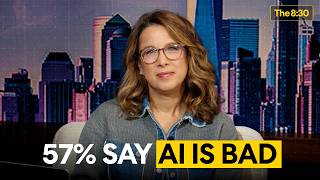
And basically a majority of Americans saying in it that artificial intelligence is a bad thing for society. 2/3 oppose the construction of new data 2/3 oppose the construction of new data centers. I think 57% said AI is bad for
[05:57]
society. So like there are so many issues within this. about recently is that you have management that is putting through AI,
[06:09]
part because they think they're going to be replaced, right? That's part of it. going to be bad for society. So, you have all these points of friction, right? You have the spend, you know, and and executives trying to figure out are
[06:23]
uptick in productivity worth what they're spending? Even if you do get an You have an a workforce that doesn't really want to do the thing the management wants them to do. And so, to me like the even if this does pay out
[06:39]
and this is something I've been saying for a while, it's not going to unfold in the way that you think it's going to. The way that probably anybody thinks >> you remember maybe year and a half two years ago ish every earnings call they
[06:53]
would the joke I count how many times AI is mentioned, right? Every company was it, they're putting in their own names for instance. I wonder if we're going to saying like, "Yeah, you know, what AI stuff.
[07:06]
Uh when when we start hearing the we're going to start measuring that deploying that differently, we're going to start being more you know, just more we're already hearing that in some cases, but but from regular companies I
[07:19]
want to see if that if you see a tide changing perhaps if the the the drumbeat gets so negative and if the forget for the drumbeat, it's the cost. Is it worth What is the ROI? This is the this is the number one thing that everyone says,
[07:32]
actually determine that as a as a positive net thing that's happening, >> Well, this is also comes back to why credit spreads are widening, why people clouds, why people are starting to question the huge spending from the
[07:46]
hyperscalers because to your point, it could very well be that the the ROI does expecting, but that it does, but this is the problem that we saw with the fiber build out in the early 2000s. The demand did eventually show up, but it took so
[08:01]
going to. And so, what do you do with that gap between you when you've spent trillions of dollars on an aggregate level of the economy and then when you level ROI. >> your point Julie about we may not know
[08:15]
>> And it may be great, right? I mean >> Yeah, it might be great. The other thing too, of course. >> That's right. >> Because if monetary you know, as Kevin Warsh has said, he expects the AI
[08:27]
productivity boom to help with inflation eventually. We know that in the short term it's not helping with inflation. So if there is a bigger gap in between and you have to wait longer for that productivity-led
[08:39]
disinflation, then that has implications for when the Fed, you know, what's going they going to be When are they going to be able to cut? Seems like it would get pretty far pushed out if it's contingent in part on that piece.
[08:53]
wonder if they would ask the additional question saying do you do you are you society? Do you use it? >> Are you using it? Yes, yes, yes. than we think, right? I mean >> I mean we use a lot of things that we
[09:05]
>> [laughter] >> so don't we?