
Is Our Universe Theory Wrong?
45sThe hook of a potential paradigm shift in cosmology is highly engaging and controversial, sparking curiosity and debate.
▶ Play Clip"The title accurately reflects the content: astronomy is in crisis, and the speaker conveys genuine excitement about potential breakthroughs."
The video explores how new astronomical observations are challenging the standard model of cosmology, potentially leading to a scientific revolution. It highlights three major cracks in our understanding: the violation of the cosmological principle, the Hubble constant tension, and the discovery of unexpectedly mature galaxies in the early universe. The speaker argues that these anomalies are exciting because they signal progress and may lead to a deeper understanding of the cosmos.
Our best theory of the universe, which explained its beginning, composition, and behavior, is showing cracks as telescopes improve. Strange mismatches between predictions and observations initially seemed like noise but have grown larger.
Discovery of impossibly large structures like a giant arc of galaxies 3 billion light-years wide, a quasar group spanning 4 billion light-years, and a wall of galaxies 10 billion light-years long. These challenge the cosmological principle that the universe is homogeneous on large scales.
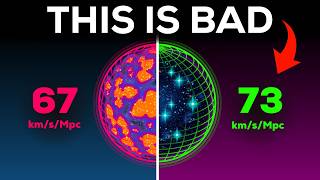
Different methods to measure the expansion rate of the universe give conflicting results: 67 vs 73 km/s/Mpc. The chance of this being a fluke is less than one in a million, indicating a fundamental problem.
James Webb Space Telescope discovered massive galaxies dating back to 280 million years after the Big Bang, far earlier than expected. These galaxies also contain heavy elements, implying multiple generations of stars formed even earlier.
Some scientists believe these cracks will refine theories, while others call for new ideas. The sense of crisis is growing, but in science, crisis means the machine is working and leads to revolutions.
The universe is showing that our current story is incomplete, and the coming years promise exciting discoveries that could revolutionize our understanding of the cosmos.
What is the cosmological principle?
The idea that the universe is homogeneous and isotropic on large scales, meaning our view is a fair sample of the whole.
03:33
What is the Hubble constant tension?
Different measurements of the universe's expansion rate give conflicting results (67 vs 73 km/s/Mpc), with less than a one in a million chance of being a fluke.
04:36
How early did the James Webb Space Telescope find massive galaxies?
Some galaxies date back to 280 million years after the Big Bang, far earlier than the expected 500 million years.
06:21
What is the 'Uranus moment' analogy used in the video?
When Uranus's orbit didn't follow gravity, a dark planet (Neptune) was predicted and discovered. This is an example of a problem solved by finding more stuff.
01:41
What is the 'Mercury moment' analogy?
Mercury's orbit didn't make sense, leading to the invention of general relativity, a completely new idea. This represents a paradigm shift.
01:58
Cracks in the Cosmic Code
Introduces the central theme that our best theory of the universe is showing significant cracks.
00:45First Crack: Violation of Cosmological Principle
Describes the discovery of impossibly large cosmic structures that challenge a fundamental assumption.
02:17Second Crack: Hubble Constant Tension
Highlights a precise measurement conflict that has less than a one in a million chance of being a fluke.
04:36Third Crack: Old Galaxies in a Baby Universe
Reveals that the James Webb Telescope found mature galaxies far earlier than theory predicts.
05:49Crisis as Progress
Reframes the crisis as a healthy sign of scientific progress leading to potential revolutions.
08:30[00:00] Now’s the perfect time to grab the 12,026 calendar – and get it in time for the holidays. Our best theory of the universe could be wrong – finally. Thanks to amazing new technology,
[00:16] our understanding of the universe is moving faster than it has in years. And if we are fortunate, we could be at the edge of the next revolution in the way we see the cosmos – a moment as exciting as when we first realized that the Earth revolves around the Sun,
[00:31] that the stars are other suns, or that our galaxy is just one tiny island in an ocean of trillions. Because for the first time in ages, the universe is misbehaving.
[00:45] Nasty Universe One that explained how the universe began, what it’s made of, and how it’s supposed to behave.
[00:57] made us feel like we’d almost deciphered the cosmic code. as our telescopes got better and our data sharper, cracks started to appear.
[01:10] Strange mismatches between what the theory predicted and what we actually saw. At first they looked like silly mistakes, noise that would go away with more data. Some cracks got larger, new ones emerged,
[01:27] and our once perfect picture of the cosmos began to look less and less … perfect. Two centuries ago, astronomers noticed that Uranus’ orbit didn’t quite follow the laws of gravity.
[01:41] they proposed that a “dark planet” was tugging on Uranus from afar. Shortly after, Neptune was discovered – exactly where the math said it would be. Its orbit also didn’t make sense, so scientists tried the same trick.
[01:58] The answer wasn’t more stuff, but a completely new idea. Gravity had to be reimagined, and we invented general relativity – opening So are we going through a Uranus moment or a Mercury one?
[02:17] The first signs that something deep could be off began piling up around 15 years ago – in the form of a few seemingly impossible cosmic monsters:
[02:29] A “giant arc” of galaxies over 3 billion light-years wide. A massive group of quasars spanning 4 billion light-years. An unfathomable wall of galaxies stretching ten billion light-years
[02:45] from end to end – a whopping 10% of the entire observable universe. There are also monstrous voids: And according to some surveys, we happen to be living deep inside
[03:03] one of them – a gargantuan “local hole” 2 billion light-years across. Well, the universe is organized in ever larger structures: galaxies, galaxy clusters, superclusters and eventually
[03:17] filaments – truly gargantuan structures separated by equally enormous voids. But our cosmic theory says that these things can’t get arbitrarily large. the filaments and voids should blur into a uniform soup.
[03:33] a basic pillar of all our attempts to make sense of the cosmos itself. Our understanding of the universe rests on one key assumption: This is the idea that, if you zoom out far enough,
[03:49] This is crucial because it means that our limited view of the cosmos is a fair sample of the whole. we can learn things about the entire universe.
[04:05] Both the cosmos itself and our place in it might be more unruly and chaotic than they should be. But if the cosmological principle turns out to be wrong, we have a huge problem. we could be like ants trying to guess the flavor of a cake while sitting on its only cherry.
[04:24] Everything we see might just be local weirdness – a cosmic quirk that doesn’t tell us the actual story of the universe. Second Crack – A Universe at Two Speeds
[04:36] It tore straight at the fabric of space – challenging how fast it grows. We know this because we have different ways to measure it
[04:48] The problem? They can’t agree on how fast. It’s like measuring the speed of a car using two devices and getting different results. You read 67 on the speedometer, but 73 on the GPS.
[05:03] But then you check them again and again and again… and both work flawlessly. The details are messy and complicated, but they don’t matter for this story.
[05:18] The important part is that, as measurements and calculations have become more and more precise, By now, the chance that this mismatch is just an accidental fluke is less than one in a million.
[05:32] The universe is literally giving us two different answers to the same question. So something fundamental must be broken – either our measurements of the universe, Third Crack – Old Galaxies in a Baby Universe
[05:49] It shattered a key part of our cosmic timeline – how and when the first galaxies formed. Light from distant galaxies takes so long to reach us
[06:03] that we don’t see them as they are now, but as they were in the past. In 2021 we launched the James Webb, the most powerful space telescope ever built. massive galaxies so distant that they belong to a time when the universe was extremely young.
[06:21] Some are so premature that they date back to 280 million years after the Big Bang – far earlier than anyone expected. Our theory says that the amorphous soup of matter that emerged from the Big Bang
[06:34] Tiny lumps of dark and normal matter gathered under gravity, building larger chunks that then fused into even bigger ones and so on. By our best estimates, the first large galaxies should
[06:50] have emerged 500 million years after the Big Bang or so, not much before. But it isn’t only that we’ve found large galaxies existing way before that. The new galaxies also seem to be too mature.
[07:03] Matter in the baby universe was made up almost entirely of hydrogen and helium. Heavy elements like carbon or nitrogen were only forged later in the cores of stars, But some of these super early galaxies contain a lot of heavy elements – meaning
[07:18] that entire generations of stars must have lived and died even before them. Either the first galaxies sprouted in fast forwards, or we are missing something huge about the infancy of the universe.
[07:33] These problems aren’t the only ones. Our theory also says that the Big Bang should have created 3 times more lithium than we see out there – a decades-old itch that astronomers just can’t scratch.
[07:47] It predicts that dark matter should pile up sharply at galaxy centers, It says that dark energy, the mysterious force pushing the universe apart, But last year, one of the biggest galaxy surveys ever
[08:02] conducted dropped the bombshell that it may have been changing over time. If true, this would overturn our current picture of the universe, its past and its future. like the interpretation of the cosmic microwave background, are suddenly up
[08:18] for debate – those early galaxies might have been bright enough to contaminate the signal. But the mere fact that such fundamental pillars are being discussed is staggering.
[08:30] So ok – what does all this mean? Some scientists argue that these aren’t real cracks, but mirages that will disappear with time, or raw gems that will end up refining our theories.
[08:45] Others are more radical and say we need completely new ideas. difficult to ignore – the sense of crisis is growing. we don’t really know what cosmology will look like when the dust settles.
[09:01] Because in science, “crisis” doesn’t mean failure. It means that the machine is healthy and working. but in cycles – periods of calm followed by sudden crises.
[09:15] When a crisis hits, experiments start giving results that don’t fit existing theories, And eventually, there is a revolution. A deeper truth emerges, and a new cycle starts over again.
[09:30] The universe is screaming that our story is incomplete. one thing is certain – the cosmos is about to get a lot more interesting.
[09:46] Science makes progress because people make a plan – and are That also goes for managing your business. a suite of business apps that cover all the needs of your activity.
[10:03] Come along, I’ll walk you through it – you know, for science! but it could be anything really. I implemented it with a few clicks and directly created a new course from there.
[10:16] But now I have this new need: I want to sell my training online. I add the eCommerce application and I’m ready for my first sales. People love the course and after a while I am ready to host my first event and meet my audience.
[10:30] I simply install the event app and create it in a few seconds! over 45 user-friendly applications such as accounting, project management,
[10:42] HR and many others – everything you could need, all centralized on one platform. You gain access to all available applications starting at $24.90 a month. This connected ecosystem saves you time and energy as all
[10:56] You can focus on what matters while Odoo improves productivity and adapts along with your needs and demands. The easiest way to change your mind and make progress – just try it out.

⚡ Saved you 0h 11m reading this? Transcribe any YouTube video for free — no signup needed.