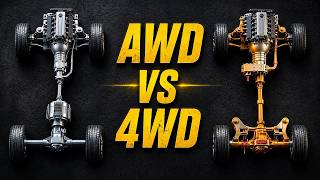

You've been using AWD and 4WD wrong!
41sChallenges a common misconception with a bold statement, sparking debate and curiosity.
▶ Play Clip"Delivers on the promise of clarifying AWD vs 4WD, but padded with sponsor plugs and hot takes."
This video clarifies the common misconception that all-wheel drive (AWD) and four-wheel drive (4WD) are interchangeable terms. It breaks down the different types of AWD systems, explains the mechanics and appropriate uses of 4WD, and provides practical advice on which system suits different driving conditions.
The video opens by stating that AWD and 4WD are not interchangeable terms, and that using them as such is incorrect.
In simplest terms, AWD sends power to all four wheels, but there are three main types: part-time, full-time, and hybrid.
Most crossovers have part-time AWD, which operates as front- or rear-wheel drive under normal conditions and only sends power to the other axle when slip is detected.
Full-time AWD, used by Subaru and some Audis, uses a center differential to constantly split power between both axles, providing better traction on slippery surfaces.
Hybrid AWD combines a gas engine for one axle and an electric motor for the other, with no driveshaft connecting them. Examples include Toyota hybrids, Acura NSX, and Corvette E-Ray.
Real 4WD is found in body-on-frame trucks and SUVs like the Ford F-150, Jeep Wrangler, and Toyota Tacoma, designed for serious off-road use.
4WD is manually engaged with modes: 2H (rear-wheel drive), 4H (four-wheel drive high range), and 4L (four-wheel drive low range for crawling).
Engaging 4WD on dry pavement causes drivetrain binding because front and rear axles rotate at the same speed, leading to damage to the transfer case and tires.
For paved, snowy, or rainy roads, AWD is recommended because it's automatic and seamless, handling everyday conditions without driver input.
For real off-road use, 4WD is preferred due to manual control and the 4L mode, which provides maximum torque multiplication for crawling.
Most 4WD truck owners in suburban areas don't actually need 4WD; they need good tires and honesty about their driving habits.
AWD helps you go but doesn't help you stop; winter tires are essential for braking, and a front-wheel-drive car with winter tires outperforms an AWD on all-seasons.
Brands use different names (4MATIC, xDrive, etc.) for essentially the same technology, and the badges cost more than the engineering difference.
Hybrid AWD systems, like Toyota's, are mechanically brilliant, offering lower weight, better fuel economy, and effective torque distribution without a driveshaft.
No technology compensates for overconfidence; a cool head and smooth hands are the most important factors in staying safe.
AWD and 4WD are distinct systems suited for different conditions: AWD for on-road confidence and 4WD for serious off-road capability. The driver's skill and appropriate tires are more critical than the drivetrain itself.
What is the simplest definition of all-wheel drive (AWD)?
AWD sends power to all four wheels.
00:45
Name the three main types of AWD systems.
Part-time, full-time, and hybrid.
00:58
How does part-time AWD operate under normal conditions?
It operates as front- or rear-wheel drive and only sends power to the other axle when slip is detected.
00:58
What is the key difference between full-time AWD and part-time AWD?
Full-time AWD uses a center differential to constantly split power between both axles, while part-time only engages when needed.
01:38
How does hybrid AWD work?
It uses a gas engine for one axle and an electric motor for the other, with no driveshaft connecting them.
02:04
What are the three modes of a typical 4WD system?
2H (rear-wheel drive), 4H (four-wheel drive high range), and 4L (four-wheel drive low range).
03:12
Why should you not engage 4WD on dry pavement?
It causes drivetrain binding because front and rear axles rotate at the same speed, leading to damage.
03:39
What is drivetrain binding?
It occurs when front and rear axles are forced to rotate at the same speed during turns, causing stress on the transfer case and tires.
04:04
Which system is recommended for on-road conditions like snow and rain?
AWD, because it's automatic and seamless.
04:53
What is the advantage of 4WD's 4L mode?
It provides maximum torque multiplication for crawling at low speeds.
05:46
Does AWD help with braking?
No, AWD helps with acceleration but not braking; tires are what stop the car.
06:52
What is a common misconception about AWD and winter tires?
AWD is not a substitute for winter tires; a front-wheel-drive car with winter tires outperforms an AWD on all-seasons.
06:52
Why is hybrid AWD considered underrated?
It offers lower weight, better fuel economy, and effective torque distribution without a driveshaft.
07:46
AWD vs 4WD: Not interchangeable
Sets the premise that these terms are often misused, which is the core of the video.
00:04Subaru's full-time AWD
Explains why Subaru owners are passionate about their cars due to the physics of full-time AWD.
01:38Drivetrain binding danger
Highlights a critical mechanical issue that can cause expensive damage if 4WD is misused.
03:39AWD doesn't help braking
Debunks a common safety misconception, emphasizing the importance of winter tires.
06:52Hybrid AWD brilliance
Praises an underappreciated technology that offers efficiency and performance benefits.
07:46[00:04] comments, yes, you've been using these terms wrong your whole life. And I'm not even a little bit sorry to tell you that. All-wheel drive, four-wheel drive are not the same thing. They are not interchangeable. They are not basically
[00:18] the same deal like Lamborghini isn't a Porsche and Porsche is, well, kind of a Lamborghini. And if your uncle has been telling you otherwise at every family barbecue for the last 15 years, your uncle is totally wrong. And it's time
[00:31] video. Let's fix your brain. Like, subscribe so we can hit 2 million subs by the end of the year. And let's go. Okay, let's start with AWD, all-wheel drive. In its simplest possible terms, all-wheel drive sends power to all four
[00:45] of your wheels. Revolutionary concept, I know. You can stop typing, "Well, actually." right now. But, here's where it gets spicy because not all all-wheel drive is the same. There are three main flavors and you need to know the
[00:58] difference. Flavor one, part-time all-wheel drive or what I like to call some of the time all-wheel drive. This is what most of you actually have if you bought a crossover in the last 10 years. Under normal conditions, your car is
[01:10] rear-wheel drive pretending to be sophisticated. Clever little clutch pack only shuffles torque to the other axle when it detects slip. Your car is basically an introvert, functioning perfect well alone, but capable of
[01:25] teamwork under pressure. Your fancy Audi Q5 is like 90% front-wheel drive on the highway. I mean, just let that sink in. Then you have flavor two, full-time Subaru and certain Audis do this. A
[01:38] center differential constantly splits power between both axles all the time, no exceptions. This is why Subaru owners have a personality about their cars. It's not a stereotype, it's just the physics. Four-wheel all-wheel drive
[01:51] genuinely is more capable on sketchy surfaces, but it does have more of a confidence, buddy, which might leave less money for a vape. And then, there's flavor-free, the hybrid all-wheel drive. This one's clever. Toyota does it
[02:04] infamously. Front wheels get a gas engine, rear wheels get an electric motor. Two totally separate systems working together. No drive shaft connecting front to rear. The second gen Acura NSX and the Corvette E-Ray flip
[02:17] it. Big gas motors in the back, electric motors up front. It's engineering sorcery dressed up as a car, and I love it. So, when you see a 4MATIC on a Mercedes or xDrive on a BMW or e-four on a Toyota, that's all all-wheel drive.
[02:32] Different branding, same concept, wildly different price tags. All right, now we go to four-wheel drive. And this is where a certain type of person, you know the type, lifted truck, never been off a paved road, calls it a rig, gets very
[02:45] emotional. Real four-wheel drive is for body-on-frame trucks and SUVs. Your Ford F-150, your Jeep Wrangler, your Toyota Tacoma, your Land Rover De- fender. These are the vehicles built for actual off-road use, not I took the scenic
[02:59] route once off-road, but Moab level. Where is the road off-road? And here's the key difference. Four-wheel drive is manually engaged. You pick up a knob, flip a lever, or push a button, and you decide when four-wheel drive is active.
[03:12] And you've got three modes to choose from. Two high, just regular old rear-wheel drive for normal roads. Four high, four-wheel drive for high range, for slippery or loose surfaces at normal speeds. Then you have four low,
[03:25] four-wheel drive low range for serious crawling, steep terrain, and getting you absolutely knew you were getting into. The magic, and also the danger, of four-wheel drive is that 4H or 4L. The
[03:39] front and rear drive shafts are locked together. They rotate at exactly the same speed, always. No differentiating, no clever computers deciding what gets power, just brute mechanical [music] force going to all four corners
[03:52] simultaneously. And this is why, and I cannot stress this enough, you do not engage four-wheel drive on dry pavement. Not on regular streets, not because I said so, because physics said so. When your front and rear axles are forced to
[04:04] rotate at the same speed, but you're trying to turn, and your front and rear wheels are actually traveling different distances through a corner, something has to give. And that something is your transfer case, your tires, and
[04:16] eventually your wallet. This is called drivetrain binding, and will ruin your day in ways that are deeply expensive and completely avoidable. All-wheel drive handles all that automatically with differentials. Four-wheel drive
[04:28] Okay, now, real quick, you want to do this. I promise. Yes, you are, because there's over a hundred thousand dollars in cars and cash sitting right here. A turbocharged Supra or a high-revving GT350. Make sure you click the pinned
[04:41] comment and get your hundred free entries while they're still alive. Good skill. Okay, decision time. And I'm going to be honest with you even if it hurts. If you drive on roads, paved roads, snowy roads, rainy roads, that
[04:53] one gravel road to your cabin, you want all-wheel drive. Full stop. It's automatic. It's seamless. You don't have to think about it, and it handles the actually throws at you. Your daily commute is not Moab, so stop pretending
[05:07] it is. Here's a real scenario that made me laugh out loud. An all-wheel drive in front-wheel drive mode in light snow is still less likely to lose control than a four-wheel drive pickup in rear drive two high. Because the crossover's
[05:20] lower, lighter, and more balanced. Your massive lifted F-250 in two high mode in a light snowfall is not the fortress or safety that you think it is. It is a large rear-heavy sled, so be humble. Now, if you go off-road, real off-road,
[05:34] intentional off-road, the kind where there is genuine mud and rocks and terrain that would make a civil engineer cry, you want four-wheel drive. The manual control matters. I mean, four low specifically is a tool that all-wheel
[05:46] drive simply cannot replicate. Crawling down a steep descent at 1.5 miles per with maximum torque multiplication, that four low does something all wheel drive just doesn't do. The Jeep Wrangler exists for this exact reason. And here's
[05:59] a simple table in your head. Close your eyes. All wheel drive, snow, rain, confidence on a Tuesday. Four wheel drive, trails, mud, rock crawling, actually using your truck the way commercials imply you use your truck.
[06:12] didn't ask for because that's why you're here. And like subscribe so we can hit two mil by the end of the year. Hot take number one. Most four wheel drive truck owners do not need four wheel drive. Yep, I said it. If you live in a suburb,
[06:25] drive to an office, and go off-road once every three years when you go camping, which means parking at a campsite accessible by a two-lane paved road, you do not need a transfer case. You need a good tire and some honesty about your
[06:37] life. Your four wheel drive has been in two high for 47,000 miles, and it knows. drive is not a substitute for winter tires. This one gets people so defensive, and I love it. Every winter millions of all wheel drive crossover
[06:52] owners feel invincible and drive like it, and then they just don't stop because all wheel drive helps you go. It doesn't help for braking. Your tires stop your car, not your drivetrain. A front wheel drive with proper winter
[07:05] out survive an all wheel drive car on all seasons every single time. Essentially, a front wheel drive with winter beats an all wheel drive on all [music] Get your winters, people. They're not
[07:19] optional, just an excuse. Okay, hot take number three. The marketing around all wheel drive is genuinely absurd. Mercedes calls it 4MATIC. BMW calls it xDrive. Subaru calls it symmetrical all wheel drive like it's a personality
[07:32] trait. Lamborghini calls it a Haldex based all wheel drive. Honda calls it like they're differentiating it from fake-time all wheel drive. Huh. They're all moving torque between two axles. The badges cost more than the engineering
[07:46] difference. And hot take number four, hybrid all-wheel drive is the most underrated system on the market. The Toyota hybrid setup, gas motor up front, electric motor in the rear, is mechanically brilliant. No drive shaft
[07:58] at all, lower weight, and send torque to the rear in slippery conditions, better fuel economy than a traditional all-wheel drive system. It's not glamorous and it doesn't make a good Instagram caption, but it is genuinely
[08:10] clever. The fact that Toyota doesn't brag about it more is insane to me. wrap up. All-wheel drive and four-wheel drive are both tools. Neither one make you a better driver, neither one makes your car invincible. The most important
[08:24] asset in navigating snow, a dirt road, or simply staying safe on your commute is a cool head and smooth hands behind the wheel. No technology compensates for overconfidence. The people who end up in ditches and snowstorms almost always
[08:36] have all-wheel drive. You know why? Because they thought they didn't need to slow down. Physics doesn't care about your badge. Know what your car has, know what it's for, use it correctly, [music] and for the love of everything, don't
[08:49] because it feels more secure. It doesn't. It's destroying your transfer case. Stop it. Now, if you learned something today, hit the like button. If you knew this all already, well, hit the like button three times. Just smash it.
[09:02] And clearly, you have excellent taste in YouTube channels. Drop in the comments, four-wheel drive? Do you like Haldex or do you like whatever Porsche's cooking up. I want to know. And if you have all-wheel drive or four-wheel drive,
[09:15] what do you drive? And uh what do you use it for? I know so many F-150 drivers out in Florida that defend their purchase, but uh yeah, four-wheel drive ain't doing you much on a flat state like that. Also, subscribe if you're
[09:27] new, and remember to go to win this ideal car because we are giving away two different cars. Yes, either this Shelby GT350 or the Mark V Supra plus $100,000 GT350 or the Mark V Supra plus $100,000 cash, 100 free entries down below. Okay,
[09:41] guys, I'm Brad Danger. This is Ideal and promise me one thing, keep living the ideal lifestyle. >> [music]
⚡ Saved you 0h 09m reading this? Transcribe any YouTube video for free — no signup needed.