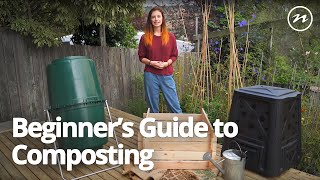

What is compost? The ultimate soil booster!
47sQuickly explains the core concept and benefits, hooking viewers with a promise of a better garden.
▶ Play Clip"Delivers exactly what the title promises — a straightforward beginner's guide with no fluff or misleading claims."
This video is a beginner's guide to composting, explaining how to turn kitchen and garden waste into nutrient-rich fertilizer. It covers the essential ingredients (browns and greens), the steps to build and maintain a compost pile, and the timeline for finished compost.
Compost is decomposed food and plant waste, used as a fertilizer and soil improver for gardens.
Compost requires equal amounts of 'browns' (carbon-rich: leaves, paper, cardboard, straw, twigs) and 'greens' (nitrogen-rich: kitchen scraps, lawn clippings, green garden waste), plus air and water.
Avoid composting meat, dairy, bread, chemicals, or plants treated with pesticides, as these can attract pests or contaminate the compost.
The smaller the material is cut or shredded, the faster it will break down.
Choose a shady, accessible spot with ground contact. Start with a layer of the biggest browns (twigs, hedge trimmings) for airflow, then layer greens and browns equally, keeping materials damp but not soaked.
Turn the compost every 1-2 weeks to aerate it, and check moisture—it should be as damp as a wrung-out sponge. Add new kitchen scraps at the center during turning, balancing with browns.
Compost takes 8-12 weeks to develop from the last time material is added, resulting in beautiful fertilizer for the garden.
Composting is a simple process of balancing browns and greens, maintaining moisture and aeration, and waiting 8-12 weeks for finished compost. It's an easy way to fertilize your garden sustainably.
What is compost?
Compost is decomposed food and plant waste used as a fertilizer and soil improver.
00:05
What are the two main types of materials needed for compost?
Browns (carbon-rich) and greens (nitrogen-rich) in equal amounts.
00:34
Name three examples of 'browns' for composting.
Fallen leaves, paper, cardboard, straw, sawdust, twigs, or dried prunings.
00:34
Name three examples of 'greens' for composting.
Kitchen scraps, lawn clippings, and green garden waste.
00:50
What items should NOT be composted?
Meat, dairy, bread, chemicals, and plants treated with pesticides.
00:50
How does the size of material affect composting speed?
Smaller pieces break down faster.
01:05
What is the ideal moisture level for a compost pile?
As damp as a wrung-out sponge.
02:14
How often should you turn the compost?
Every 1-2 weeks.
02:02
How long does compost take to develop?
8-12 weeks from the last time material is added.
02:48
The 50/50 Rule
The core principle of composting—equal browns and greens—is clearly stated, making it easy for beginners to remember.
00:34Size Speeds Decomposition
A practical tip that directly impacts efficiency, showing that smaller pieces break down faster.
01:058-12 Week Timeline
Provides a concrete expectation for when compost is ready, helping beginners plan their gardening.
02:48[00:05] hi I'm kelcie and today I'm going to show you how to turn your kitchen and garden waste into compost today I'm going to show you how to build a simple outdoor compost system so what is compost compost is simply food and plant
[00:20] compost compost is simply food and plant waste that is decomposed it is also a fantastic fertilizer in soil and prefer for your garden all you need to make compost is an equal amount of browns and greens as well as plenty of air and
[00:34] water Browns are carbon rich materials such as fallen leaves paper and cardboard straw sawdust in even twigs and dried prunings greens are nitrogen rich which organic matter such as kitchen scraps lawn clippings and green
[00:50] kitchen scraps lawn clippings and green garden waste do not compost meat dairy garden waste do not compost meat dairy or breed as these can attract pests also do not add chemicals or plants treated with pesticides to your compost remember
[01:05] that the smaller your material is cut or shredded to begin with the faster it shredded to begin with the faster it will break down there are many sizes and styles of compost bins available to buy from your local garden center or you can
[01:18] always make your own choose a shady and accessible place in your garden for your compost bin that has contact to the ground first start with a layer of your biggest brown materials such as twigs and hedge trimmings as this will allow
[01:31] air into the bottom layer then add your materials and layers making sure you have an equal amount of greens and browns shrewd and cut up your waste as small as you have time for the smaller the pieces of material the faster the
[01:47] compost will decompose after you have layered all of your materials with the heat down to ensure that all of the materials are damp but not soaked cover your heat with either your container lid a tarp or here some
[02:02] your container lid a tarp or here some sack turn your compost every one to two sack turn your compost every one to two weeks to get air into the heap at the same time check that the pile is moist all the way through and add water if
[02:14] needed it should be as damp as a wrung out sponge if you want to add more kitchen scraps add at the time that you turn the compost and add to the center to maintain the ratio of browns and greens it helps to keep a pile of brown
[02:30] waste next to your compost to add an equal amounts to your scraps it is important to remember that your compost will take 8 to 12 weeks to develop from will take 8 to 12 weeks to develop from the last time you add scraps or material
[02:48] percent brown and 50 percent green materials wet and cover turn every one to two weeks and in 8 to 12 weeks you will have beautiful compost to fertilize your garden with it's easy as that happy composting
[03:02] happy composting [Music]
⚡ Saved you 0h 03m reading this? Transcribe any YouTube video for free — no signup needed.