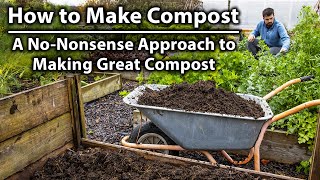

What is Lazy Composting?
60sDefines a simple, no-nonsense approach that appeals to beginners and those tired of complex composting rules.
▶ Play Clip"Delivers exactly what the title promises — a simple, no-nonsense guide to lazy composting, though it could be shorter."
This video presents a simple, low-effort approach to composting, which the creator has used for 15 years. It emphasizes using a large compost bin, adding a diverse mix of green and brown materials in small amounts, and avoiding strict ratios. The method focuses on patience and minimal intervention, resulting in rich, high-quality compost.
Composting is the breakdown of organic material into rich humus containing organic matter.
Compost bin sides should be at least 1 meter (3.3ft) long. Smaller or tall narrow bins (like 'dalek' ones) don't warm up as well, which is less effective for decomposition.
Green materials are high in nitrogen; brown materials have lower moisture content. Both are needed for effective composting.
Do not add thick layers of ingredients as they can create a sludgy, smelly mess. Apply thin layers of about an inch (2.5-3 cm).
Forget about the recommended ratios (e.g., 2 parts brown to 1 part green). Just add whatever is available as you clean up the garden, in small amounts.
The one key rule is to add diversity to the compost bin. Adding only 2-3 ingredients won't work well; use as many different materials as possible to ensure a range of nutrients and micronutrients.
Step on or jump on the compost to compress it. This allows you to fit more in and helps the pile heat up more.
Cover the compost with cardboard or newspaper to shed rainfall and prevent oversaturation. If building a bin in dry weather, add some water to the pile.
Lazy composting takes longer, often 6-12 months, compared to a few months with active methods. The compost is ready when it looks like rich soil and smells fresh and earthy.
Rats are attracted to cooked food, dairy, and bread. Avoid adding these. If you do, place the bin far from the house. Rats are more likely to be in the compost bin than in your house.
Aim for three compost bins if you have space: one ready to use, one full, and one to fill. This ensures a continuous supply of compost.
Lazy composting is a simple, effective method that requires minimal effort and patience. By focusing on diversity, proper bin size, and simple maintenance, anyone can produce high-quality compost for their garden.
What is the minimum side length for an effective compost bin?
At least 1 meter (3.3ft) long.
01:22
What is the key rule for lazy composting?
Add diversity to the compost bin.
03:46
Why should you avoid thick layers in a compost bin?
They can create a sludgy, smelly mess.
02:39
What is the recommended ratio of brown to green materials in traditional composting?
Two parts brown to one part green.
03:06
How long does lazy composting typically take?
6-12 months.
06:30
What materials should be avoided in compost to prevent rat issues?
Cooked food, dairy, and bread.
07:42
What is the purpose of covering the compost bin?
To shed rainfall and prevent oversaturation.
05:45
Diversity is Key
This is the core principle of the lazy composting method, replacing complex ratios with a simple rule.
03:46Compression Technique
A simple, often overlooked step that improves compost density and heat generation.
05:17Patience Pays Off
Highlights the trade-off between effort and time, a key consideration for gardeners.
06:30Rat Prevention
Addresses a common concern with practical, actionable advice.
07:30[00:00] (soft music)
[00:39] - Hello, and a very warm welcome back to the garden. but for me, I try and keep things as simple as possible. that are also effective, then you'll enjoy this video
[00:55] that explains the lazy, no-nonsense way of composting that we've been using for around 15 years. Well put simply, it is the breakdown of organic material
[01:08] into this beautiful rich humus that contains organic matter, The great thing about lazy composting that you need to follow in order for it to be effective.
[01:22] that the sides are at least a meter (3.3ft) long. is when you have smaller ones like this, especially the dalek ones, that tall narrow ones,
[01:36] which means it's not as likely to warm up. from bigger compost bins help promote the decomposition
[01:48] that help break down that organic matter. to add into a compost bin. These are high in nitrogen, and tend to have
[02:04] The next, your brown materials. a lower moisture content.
[02:23] of green and brown ingredients to add to your compost bin And just quickly, I just wanna draw your attention you can use them absolutely.
[02:39] not thick layers in your compost bin because these can make a sludgy, smelly mess. apply them in fairly thin layers of around an inch
[02:53] or two and a half, three centimeters, and it should be fine. Now usually when you're just starting off making compost, that are recommended to follow.
[03:06] And I usually go for the two parts brown to one part green. But with lazy composting, we don't worry about that at all. We just simply whatever is available,
[03:18] on the compost bin. as I'm cleaning up the garden, and we just put it on as and when.
[03:32] If you have some veg scraps, the odd bag of used coffee grounds from your local cafe, There was really no need to worry about ratios,
[03:46] as long as you follow one key rule. That one rule for lazy gardening is simply that you have to add diversity into your compost bin.
[03:59] It doesn't work if you just add two or three ingredients and materials on that list as possible. you're gonna get a lot of green materials, but that's fine,
[04:15] use whatever you have in your house, newspaper, You just want to add loads in smaller quantities And the reason why is because by using diversity,
[04:31] you gonna have that natural or gonna be a lot more as well as the nutrients are going to be available or three different ingredients,
[04:46] you might be lacking some micronutrients. of diversity when adding to your compost bin, in terms of greens and browns anyway,
[05:01] For over 15 years, we've just been applying that principle in a kind of little and often manner, It is that simple to do lazy compost.
[05:17] there's one more thing that I like to do. And that is to jump on it, or even just step on it,
[05:32] And the reason why is you can suddenly fit in it will help heat up a little bit more.
[05:45] the last thing that I like to do, is to put a covering over it. from a building project,
[05:58] but we usually use things like cardboard and newspaper. It helps to shed some of the rainfall it can sometimes get a little oversaturated in there.
[06:13] And If you've just built a bin during dry whether do add some watering cans full of water over that just to put a little covering over the top.
[06:30] Well, the compromise of being lazy is that it often takes which can take a month or two months. Now it sounds like a long time,
[06:45] And when you have a little look, it should look almost like soil, really nice and rich, Now, you may have some kind of sticks left over,
[06:59] Now, for me, the ideal way of testing if it really is ready, And if it smells like a vibrant, fresh,
[07:13] that it's ready to use. So I'm gonna now use this compost to help put some of the raised beds to sleep over winter.
[07:30] A very common concern that people have about composting and whether it encourages rats so you get rat issues.
[07:42] serious rat issues with your compost bins and things like dairy and bread. on the ingredient list.
[07:54] for the rats to eat, they're not going to be interested. but the thing is rats are going to be And surely you'd rather them be at the compost bin
[08:08] just try and put your compost bin as far away as possible. and things like bread and dairy, you're gonna be fine.
[08:24] Now something you should try and aim for if you have the space is for around three compost bins.
[08:36] The reason why is one compost bin is going to be ready, and the other compost bin is already full there's always a bin to fill up,
[08:50] And if you wanna find out the best way to use your homemade compost at this time of year, of preparing raised beds for winter.
[09:05] and ethical clothing, So thank you for watching, (soft music)
⚡ Saved you 0h 09m reading this? Transcribe any YouTube video for free — no signup needed.