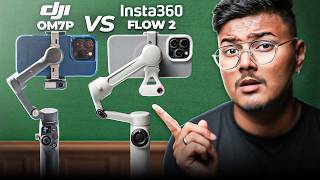

Gimbal Showdown: DJI vs Insta360
43sDirect comparison of two popular gimbals with a clear winner, sparking debate among creators.
▶ Play Clip"Delivers a thorough comparison as promised, but the '2026' in the title is speculative and the video includes some filler."
This video provides a detailed comparison between two popular smartphone gimbals: the DJI Osmo Mobile 7P and the Insta360 Flow 2. The creator evaluates them across design, tracking, stabilization, and extra features, concluding that the Insta360 Flow 2 offers superior tracking and value for solo creators.
Flow 2 folds to 98x178mm and extends to 282mm with selfie stick; OM7P is 190x95mm folded and 288mm extended. Flow 2 weighs 378g, OM7P 368g. OM7P has a longer selfie stick (20.5mm vs 27mm? likely a typo, but as stated). Both have 1/4 thread for tripod.
Flow 2's AI tracker tracks subjects up to 10 meters, supports multiple subjects, and has active zoom tracking up to 15x. OM7P only tracks human faces and has a shorter range. Flow 2 also has a Pro Framing Grid for auto-composition.
Flow 2 keeps everyone in frame during group vlogs, while OM7P focuses on one person. Gesture control range is 10m on Flow 2 vs 3-5m on OM7P.
Real-world walking and running tests show both gimbals are stable, but the creator notes the Flow 2 appears slightly better in stabilization.
Both have integrated lights with adjustable brightness and color temperature. Flow 2 supports Mic Air with camera control, while OM7P is compatible with DJI mics but only audio input. Flow 2 offers Apple Watch remote control and Teleporter script feature.
The creator gives Flow 2 points for tracking and extra features, concluding it offers more value for solo creators at a lower price, while OM7P is reliable but less feature-rich.
The Insta360 Flow 2 is the better choice for solo content creators due to its superior tracking, extra features, and value, while the DJI OM7P remains a reliable but less versatile option.
What is the weight of the Insta360 Flow 2 including clamp and AI tracker?
378 grams
01:14
What is the maximum tracking distance for the Insta360 Flow 2's AI tracker?
Up to 10 meters
03:45
Which gimbal supports active zoom tracking up to 15x?
Insta360 Flow 2
04:01
What is the gesture control range for the DJI OM7P?
3 to 5 meters
05:40
Which gimbal has a built-in Pro Framing Grid?
Insta360 Flow 2
05:40
Which gimbal allows remote control via Apple Watch?
Insta360 Flow 2
08:02
What is the Teleporter feature in the Insta360 app?
It shows the script on the screen for scripted content.
08:45
Flow 2's Superior Tracking Range
The 10-meter tracking range is a significant advantage for solo creators, allowing more freedom in framing.
03:45Multi-Person Tracking
Flow 2's ability to keep everyone in frame is a key differentiator for group vlogs.
05:13Mic Air Camera Control
The ability to control the camera via the mic is a unique feature that simplifies solo shooting.
07:47Apple Watch Remote Control
This feature enhances convenience for tripod-based shooting, a practical advantage for creators.
08:02[00:02] is a huge struggle. Sometimes the frame gets messed up , sometimes the camera is crooked and even if the shot is taken in the end, the issue of stabilization mostly remains. Then we think let's get a smartphone gimbal. But as soon as I search, the name DJI OM7P comes up everywhere
[00:15] and I have personally used this gimbal a lot. I have made a video on this. It is a very good gimbal. But the Insta 360 Flow 2 honestly stands out. I felt that in some ways it felt better for less money. Let's do a real
[00:30] less money. Let's do a real world comparison then. DJIM7p vs Insta 360 Flow 2. Which gimbal is best for you and which one could be a waste of your money. So, first of all, when we go to buy a smartphone gimbal, it
[00:43] is important to look at two things first. How quick the setup is and how practical the design is. Talking about the size of the folded design of Floor Two, it is 98 mm by 178 mm and when fully unfolded, with the built-in selfie stick, it becomes 282 mm. If I
[00:59] talk about OM7, it is a bit longer, around 190 mm by 95 mm in folded state and if you do it fully extended, it goes up to 288 mm. If I talk about weight, then Flow 2 with gimbal plus clamp plus AI tracker together weighs a total of 378 grams. The
[01:14] OM7 is also slightly lighter at around 368 grams including clamp and tracking mode. And selfie stick. The selfie cord is slightly longer in the Om7p
[01:26] selfie cord is slightly longer in the Om7p at 20.5 mm versus the Flow 2 at 27 mm, rest of the setup process is almost the same for both. Stick the magnetic clamp. Unfold the gimbun. Just plug in the AI tracker and connect to the app easily.
[01:41] What are you talking about? And with Insta 360 you also get the option of magnetic phone mode. Like if your phone supports wireless charging then it will attach to the back of your phone and then you can easily attach it to the gimbal and this has to be
[01:53] bought separately. But I personally found the first setup of the To Be Honest Floor 2 a little better compared to the To Be Honest Floor 2 because it very easy for first time users. Both are quite good and quite close in overall design and portability.
[02:08] Both gimbals are compact. Fits easily in your bag or pocket. And yes, inside both the gimbals we also get a 1/4 thread at the bottom for mounting a tripod. Whether you use a big tripod or a small one is your choice.
[02:21] Apart from this, yes, there is also a special throwpad from Insta 360 which is very compact and very light. It is of tripod type only. If you push it down like this , it opens like this. Its length is 3.6 feet. Like this you
[02:35] can stretch the length from above. And with this total gimbal and theropod, it will easily reach your eye level. Based on the specifications, the Flow 2 is a bit compact and better in connection.
[02:49] While the OM7 is slightly lighter and comes with a longer selfie radial. So for setup and dis both get equal points one and one. And by the way, in today's time the work of gimbal is not limited to just stabilization. The real game now is tracking.
[03:04] Because when you are shooting alone , at such a place or travelling, making a tutorial video or making a reel, framing, focus, everything has to be managed alone. And this is where the real comparison between the Flow Two and the OM7 begins.
[03:18] However, there is a slight difference in the design of the tracking modules of both. The OM7P that sticks directly to the bit of a plug and play style. Whereas in Floor Two you get Type C port
[03:31] I personally found the M7P's attachment design to be a bit better, both in appearance and overall use. The rest of the Flow Two system is more versatile because the tracker connects directly to the gimbal and tracking works even without using a magnetic clamp.
[03:45] And when it comes to tracking performance, Flow Two's A tracker is next level. It not only tracks human faces but distance subjects up to 10 meters easily, claims the company.
[04:01] Talking about OM7P, its tracking range is a bit only human face is tracked. Can't track the rest. And speaking of Flow To, active zoom tracking works up to 15x zoom. Meaning you are
[04:16] zooming too much. It will also track up to 15x. Will in which adjusts the zoom according to the distance. This feature is missing in OM7. That's where the 8X's tracking supports you and then
[04:31] goes a bit haywire. So right now I have tracking on. In both of them, don't pay any attention to both of them, don't pay any attention to your Flow 2 on the right side and DJJM 7p on the left side picture quality. Do
[04:44] And the tracking module is installed in both of them. Ok? So till here it is working fine. If I turn back like this and go back,
[05:01] brother, this is the best thing. This is far away I am far away from the camera right now. And if someone is doing even one thing then better than the other. The rest of the multiperson tracking is also a strong point of Floor Two.
[05:13] If you're making a vlog or video with friends, it it keeps everyone in equal framing. DJ and OM7P focus on that person and the rest of the people can be out of this frame. And another feature that comes
[05:26] in both is gesture control. Both are found in gibbons. You can turn tracking on or off by just showing your hand. By showing your hand like this you can start or stop the photo or video. But in Floor Two, these gestures are detected up to 10 meters. And whereas
[05:40] in OM7 its range is only 3 to 5 meters. And another bonus feature comes inside Floor Two that it has a built-in Pro Framing Grid which auto-composes the shot according to the Golden Ratio. That is not available in OM7P. There
[05:54] you have to manually adjust the framing with the joystick at the time of tracking. So mainly, in terms of tracking, Flow2 clearly leads. Better range, more subject support as you can track multiple objects and better framing
[06:08] with this option. So in this round, Floor 2 gets one point and Om7p gets zero. After setup and tracking comes the real question. Are the shots smooth? Or real question. Are the shots smooth? Or
[06:23] better? Instead of specs, do a real life test and you decide for yourself. I have both the tracking module installed and just now the walking test. You see how stable both of them are. However, there will be some stabilization of the phone
[06:36] here. On the left side is my iPhone and on the right side is my Samsung S23. I have stabilization on both. There was no solution to it. But still test is done. Now let's go running once and see who is more stable.
[06:49] and see who is more stable. I am running very fast right now. is better in stabilization. In walking shots as well as running shots. So till
[07:03] now we have seen setup, tracking, stabilization etc. But for a serious creator, there are some other things that are equivalent to extra features. First of all let's talk about light, mic and power which are integrated. Both the Flow 2 and OM7P
[07:18] have an AI tracking module with integrated lights that can be adjusted in both brightness and color temperature. And you can easily change this thing with the button on your gimbal or module. Its
[07:32] talk about the mic, Flow Two supports Mic Air. And the OM7PTP is compatible with DJi mics. But with Floor To's Mic Air, can also control the camera directly while recording. Like start and stop which
[07:47] is not possible in DJ setup. There is only audio input. No control. And another option of reverse charging. Meaning, if the phone's battery gets down while you are making a video, then your phone can also be charged with the gimbal and it
[08:02] is available in both. Now let us talk about remote control. Flow Two has another solid advantage. You can remote control your gimbal through Apple Watch. Mounted the tripod on the gimbal. Move away and that control can be done with the watch. Like
[08:15] can do all these things without touching the phone. And apart from Apple Watch, you can also live preview and shooting. Meaning, if you are in a group then this is a perfect thing and it is also a perfect thing for outdoor shooting. Especially when
[08:29] your gimbal and your phone are mounted separately on a tripod. Now next let's talk about the app features that matter. Floor Two has the Insta 360 app and DG has the DG Meo app. Insta 360 you get the Teleporter feature which is very important
[08:45] for many people. If you shoot scripted content then you have to forget the lines. All these things will not happen to you. You get to see the script on the screen. So easily you guys can read it and deliver it. Apart from this, this feature is missing in Apna DJ 7p. So,
[08:58] both the gimbals give you good modern features. You give you good modern features. You like control from Apple Watch, teleporter feature and camera control from mic
[09:13] which will be very useful for any solo creator. So in this round I am personally more towards Floor 2 and will give it one point and zero to OM7P because the rest of the things are same in both. You just get some extra features in it
[09:27] within 360. So now it is a simple thing that both the gimbals are strong in their own way. The both the gimbals are strong in their own way. The DJI M7P is quite reliable. It offers smooth stabilization and is a trusted brand for many, but the
[09:40] Insta 360 Floor 2 genuinely surprised me with its tracking AI features, compact design, and some smart touches that will be of
[09:52] immense help to any solo content creator, making a difference. When you can get more done for less money, it's worth considering. Rest, Rest,
[10:08] tell me in the comment section below whose side you are on, Team DJI or Team Insta 360, please comment below. And if you are serious about creating content and want to start with your phone, then I made this video explaining how to
[10:22] vlog with your phone. Everything from setup to framing, lighting and everything else has been explained in detail. Do check this video. See you again check this video. See you again in the next video. Bye.


⚡ Saved you 0h 10m reading this? Transcribe any YouTube video for free — no signup needed.