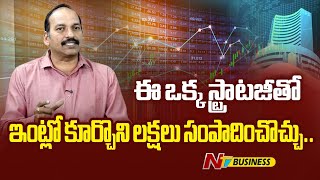

Why 90% Lose in Intraday Trading
44sHigh emotional impact as it addresses the painful reality of losing money, which resonates with many traders.
▶ Play Clip"The title accurately promises strategies and mistakes, and the video delivers actionable rules and patterns."
In this interview, stock market expert Ramachandramurthy explains the common mistakes intraday traders make and shares proven strategies for success. He emphasizes discipline, risk management, and understanding market patterns to achieve consistent profits.
Intraday trading is risky and should only be done by skilled professionals. Semi-professionals and unprofessionals often lose money due to lack of timing, accuracy, and discipline.
Traders often try to catch market momentum but go in the wrong direction. The key is to go along with the market movement, not against it.
Between 9:15 and 9:30, observe the 15-minute candle. If the opening rate at 9:30 is the same as the previous day's close, there is an 80-90% chance of a positive trend. Buy with a stop loss below the low rate.
If the opening rate is high, short sell; if low, buy. This gives a 70% success rate. Start with small quantities (20 shares) and increase gradually.
From 10:10 onwards, use 10 and 20-day moving averages. When the red line crosses above the green line, the trend is positive. Buy if the current rate is above the average rate.
Intraday patterns include V-shape (down then up), A-shape (up then down), and M-shape (multiple peaks). Understanding these helps in timing trades.
Focus on quality over quantity. Make a maximum of three trades per day. Do not carry losses to the next day.
Success comes from following the correct process. Observe the market, follow news, and maintain discipline. Aim for 1-2% profit per day.
Risk a maximum of 2% per trade and aim for a reward of 4%. Never average losses; cut losses quickly.
Do not overtrade or average losses. If you don't understand the market, stay out. Close all positions by end of day.
Successful intraday trading requires strict discipline, a focus on process over profit, and adherence to proven strategies like the 9:15-9:30 candle rule and moving average crossovers. Risk management and avoiding emotional decisions are crucial for long-term success.
What is the success rate of the open high/open low strategy?
70%
04:54
What is the ideal time frame for candlestick charts in intraday trading?
15 minutes
10:18
What is the maximum number of trades recommended per day?
Three trades
09:09
What is the recommended risk per trade as a percentage?
2%
13:27
What is the recommended reward-to-risk ratio?
2:1 (4% reward for 2% risk)
13:27
What are the three common intraday market patterns?
V-shape, A-shape, and M-shape
07:30
What should you do if the opening rate at 9:30 is the same as the previous day's close?
Buy with a stop loss below the low rate
02:21
What is the significance of 12:30 PM in intraday trading?
European markets open, which can impact the trend
08:55
What is the main mistake traders make when they try to recover losses?
Averaging losses, which can lead to heavy losses
14:50
What should you do if you don't understand the market on a particular day?
Stay out of the market
16:03
Brain Catches Momentum Incorrectly
Explains the psychological trap that causes traders to lose money.
01:129:15-9:30 Candle Rule
A proven, actionable strategy with high success probability.
02:21Open High/Open Low Rule
Simple rule with 70% success rate, easy to implement.
04:54Maximum Three Trades
Emphasizes quality over quantity, a key discipline.
09:09Focus on Process, Not Money
Core principle for long-term success in trading.
12:32[00:02] you, many people are losing money in the stock markets . Most of the people who do intraday trading and options trading are the ones who keep losing. Sometimes it even exceeds a thousand lakhs . What are the
[00:16] mistakes that are happening intraday? How to earn money ? What are intraday secrets? Let's ask and find out all these things today. With us is stock market expert Ramachandramurthy. Hello . Hello, Andi. Many people also
[00:29] . Hello, Andi. Many people also . It is said that the most people lose money even though they are intraday traders. So is there really that much risk? There will be intraday risk. This is completely a
[00:43] work that should be done by a skilled person, meaning semi-professionals or unprofessionals, but if they touch intraday, they will lose a lot. Only professionals who think they have time to complete a trade today and be fully fulfilled should do it
[00:58] intraday. So what happens in intraday is that you can make money in this too, depending on your skills, but then timing, accuracy, discipline, all of these things have to be perfect . So today,
[01:12] how can we actually succeed in intraday trading? What rules can we follow to succeed? Sir, we think that we have lost everything now, right? We lost once and then I thought that what if I
[01:27] reverse this now I will make a profit yes now if I reverse what I lost then I will make a profit why I couldn't reverse I will make a profit why I couldn't reverse sir because I don't have this for 10 reasons
[01:39] think it's correct I mean what happens there my brain catches the momentum of the market I think it's ready I don't think anyone should lose money so we
[01:54] expect it correctly this will be okay we see that there is a chance. But what happens there is that the result is wrong, which means that our brain is trying to catch the market's momentum, and as a result, we are going in the wrong direction
[02:07] . So now we need to catch the market, which means whether we do intraday trading or investing or trading, whatever we do, if we keep up with the market, we will make money. Yes, the main point is to first understand the market movement.
[02:21] Yes, the main point is to first understand the market movement. If we go along with the market movement, we now if we take intraday first, what would a day look like, i.e. when
[02:35] the markets open at 9:15 in the morning, the . So, there will be either a gap up or a gap down, either in the morning Asian markets
[02:47] or in the US markets . So there is a small rule between 9:15 and 9:30 in the morning during intraday . So, if a company opens at 9:15, leave a 15- minute candle, and if
[03:02] minute candle, and if you see it at 9:30, the opening rate is exactly the same. This is a very proven fact that the opening rate of any company is the same. The easy way is to call at 9:30, and when the 15- minute candle is over,
[03:18] minute candle is over, observe the watch between 9:30 and 9:35. Okay, the rate on the day before, the rate on the present day, the rate on that day, the rate at that time, the market opens at 9:15 in the morning . Also, a candle will form at 9:30
[03:33] . So if the opening rate at 9:30 is the same, it will be 90% to 80% positive. But how can we expect the same low rate for that day? They keep
[03:46] changing every time they open high. Yes, so if you observe, the opening rate, high rate, low rate, closing rate, closing rate, will be the same as yesterday. That's what they say, the closing rate is the same as yesterday's, the opening rate is the same as yesterday's. The low rate
[03:59] means the rate at this time. The low rate is between 9:15 and 9:30 today. Whatever the low rate is, check that low rate. If those two numbers are exactly the same, then if you see one at the opening, the trend is positive, so you can buy it. So,
[04:15] place a stop loss below the low rate, you can buy it first, it can buy it first, it works within 10 hours. If you look between 9:30 and 10, you can buy stocks that are open. If you
[04:27] look at the top 200 companies, you'll find the second three easily. Similarly, easily. Similarly, if the opening rate and high rate are the same at the same time, the week is in a downtrend. Sell. It's okay to sell, short sell, so
[04:41] first this is it, now this is it, we're following the rules. We like what we do, because these are already proven, so if we follow the rules, we will make money. Now, if we do as we please, we
[04:54] will lose more intraday, and if we trade emotionally based on those rates, we will lose. Now, I'll tell you rule number one. Listen carefully. If the opening rate is high, the rate is one. If the downtrend is short, the opening rate is low. If the rate is one, you can buy. You can buy the
[05:07] downtrend is short, the opening rate is low. If the rate is one, you can buy. You can buy the You have a 70% minimum in this. But what you have to try is, first try 20 shares, then 30 shares. Once you become confident,
[05:21] increase the quantity. So if we put a stop loss below the low rate, the risk is low and the reward is high. Yes, so watch this first, from 9 to 10 o'clock . This rule can be said to work out with this strategy. This strategy is
[05:34] between 9:30 and 10. Now suppose you saw the market at 10:30. Now it's over. From there, what does it mean from 10:10 onwards? You see a 15-minute short. If you see a 15-minute short,
[05:50] what do you do with it? Put a moving average. Okay, if you put the moving average, 11 Okay, if you put the moving average, 11 days, 10 days, 20 days, 20, 10 20, put two moving averages and whichever moving average crosses over, it crosses over.
[06:04] When the red line is above the green line, the trend is red line is above the green line, the trend is positive. So when it crosses over, the trend is positive. That means you and I can't
[06:17] even put the moving average, so you have the average rate in between you have the average rate in between . The average rate is the high, low, and then the opening close . So observe the average rate . Okay, that time was 10:15 to 10:30, from
[06:32] 10 to 12 . Okay, so if you look at the average rate, if the current rate is higher than the average rate, buy. So now the present rate is suppose to be 2 but the average is 2200 which means the average is
[06:47] less than the present rate. So if it is high, you should buy. If it is low, if this average is crossing, okay. Okay, now it has crossed. There should be no more gap of 2200. Okay, if you have a 10-point cross above five points, it means that it is more or
[07:01] cross above five points, it means that it is more or less. Try the top 50 companies because the index or because it is more than 1000, but the rate should be higher. Suppose we buy 500 shares or 400 shares during the intraday,
[07:15] it will not be a big moment. Intraday, we need a 50, 60, 100 point moment. Then we will have a fast moment. So we'll look at the average rate in a second. So, if it is moving above the average, you can buy, and if it is
[07:30] moving below the average, you can sell because the momentum is broadly intraday, which is in a V-shape. This means that the first opening rate would decrease after the opening and then rise again, reaching support. Okay, this is a way, let's
[07:45] call it a V shape. What are some other sudden moments? What is the problem? If there are any special occasions like that, how is it in general? First it goes down and then goes up. After the
[07:57] first and then goes up and then goes down from 12 o'clock and then goes down from 12 o'clock and then comes down. We call this the A shape. So after the V shape, there is the M shape, which means it goes up and then comes down again and then goes up and then
[08:13] comes down again. There is something in this mood. So now, if we regularly watch what happens to the maximum, we can catch it intraday. If you selectively invest in some indices, or if you don't, Nifty Bank Nifty or Reliance, if
[08:26] you observe one of the top 10 companies closely, you will know what shape V is . So open high morning, you can do whatever you find. Now, if you think of a V-shape as going down and going up above the average, what I'm saying now will work out
[08:41] . Okay, that means now if it goes down like this and then shape will it take? When it goes up and comes down, you should short sell. It will go down. Okay, so now from 12 o'clock, now from 10 o'clock,
[08:55] if you look at it from 12:30, it should be closed at 12:30. Because European markets will open again at 12:30. Yes, that would also start the impact again . It will start. So you have a chance to trade 12 hours a day. What
[09:09] you need to remember is that intraday trading doesn't mean making 10 or 20 trades a day. A maximum of three trades should be made. That's the first discipline to start with. The maximum discipline is three, so if there are no more than three, then you
[09:23] shouldn't make more than a maximum of four trades. What this means is that the focus here is on quality trades rather than the number of trades. What this means is that the focus here is on quality trades rather than the number of trades. So understand the pattern we are making and
[09:36] increase the accuracy of quality trades. Hum, so what happens now? We profit should be closed today. Because today's intraday moment may or may not exist tomorrow . Yes, so the major mistake that many of you make is that you say you carry a
[09:50] loss to the next day because you made it intraday . Yes, so it's not like that. You should be clear beforehand. I'm intraday today. If you follow these rules, you will be successful over the period . Slowly, I got used to discipline and became
[10:02] focused. Now, there are three types of market momentum: A shape, V shape, and M shape. So, if you are really trying to understand the trend, you should look at a chart rather than the rates. Look at the chart and see the
[10:18] actual candlestick chart. No matter if you look at the candlestick formation, 15 minutes is the ideal time frame for a 15-minute chart. So, if you look at it in that time frame, you will understand these shapes. So, the strategy will work out until 12:30.
[10:35] After that, we will see how the European markets are doing . Suppose the European markets have reversed, so what should we do then? The market will also reverse. Now, if market will also reverse. Now, if
[10:49] we look at the situation that the market has been in until 12:30, now when it becomes a V-shape, it will go up and then trend can change anytime from afternoon to evening. Any trading from morning to night will reverse, so if you take a 20-day trade and take 22 days, you will have a 10-day
[11:06] closing positive and a 10-day closing negative. So, this means that either the A shape or the V shape are more common. So what comes in a five-day M shape will come in four or five days like this. So, in general, let's say that the European markets
[11:19] are positive. The word "V" means that the European markets are positive and it goes from bottom to top. Okay, so then we are negative and the morning gap opens up, it will go down and down . So there
[11:33] again, short selling means you need to have a trade done between 12:30 and 1:00, and One between 10:30 and 12:30. Now look at the maximum last trade at 1:00, 1:30.
[11:46] Okay. What happens during the closing time is unprofessional, so don't trade at 230 or 245. We also need to close. The position should be closed and a major third trade can be attempted in the middle of the 130th period
[12:01] should be closed and a major third trade can be attempted in the middle of the 130th period trades should not be made. That was a major mistake, actually a trade loss, let it go. Until that trade comes positive, I
[12:17] not like that. What you need to focus on here is not money, but reducing losses. Increase consistency. That is, how much trade success you are getting, how much you are observing the market, your focus is not on making money.
[12:32] If the process is correct, the result will come. Right, so instead of focusing on the result, focus on the process . Observing correctly means that there should be more observation during the intraday period. What
[12:44] news is being facilitated, what news is being affected, so in the same way, in market news, we should follow not only our own market but also international markets . If we follow all of this correctly, we will
[13:00] how much can you earn per day? You can take a percentage. Now, take a percentage. Now, 1% or 2% intraday is good. Okay, if you invest 1 lakh, it will be 1000 rupees. It depends on the capital. What
[13:14] you want to do here is how to see the stock market. How much is the risk and how much is the reward? how to see the stock market. How much is the risk and how much is the reward? My risk is 2%, the reward is double 2%, which is 4%. So now, it is not important how much amount we have. How much
[13:27] get. So, here we have a reward depending on the risk . So, in general, the minimum risk in any trade is 2%, the maximum risk is 2%, so you shouldn't lose more than 2% . But it has to be cut. Now
[13:44] suppose I have an amount of 1 lakh. So if I want to do daily intraday, how much profit can I expect as a major? Every day is the same risk reward. This risk reward depends on us. Now I risk 2000 and get 4000 reward. I
[13:59] mean, depending on our mentality, I trade accurately. That trade risk reward is every trade. Now you have a four-part intraday trade. Suppose you have made 25000, 25000, 25000, four trades are eligible. Each 25,000 has a
[14:16] 2% risk, which means overall there will be 2000 risk and 4000 profit. So now we can see how many days we have in the 20 days . Now there is no limit on how much you can earn in the stock market intraday. There is no
[14:32] minimum or maximum . You can take 10 times more risk when you expect a 10% . Must be taken. This means that it changes from trade to trade, meaning that every trade is the same for the morning trade.
[14:50] cutting losses and cutting profits. Hmm, so follow that discipline, which means averaging out the losses. The follow that discipline, which means averaging out the losses. The . Averaging and averaging can lead to heavy losses. This should not be done. In fact, you
[15:05] should never average. Trade trade entry target stop loss should not be more than 2%, maximum loss should not be more than that. So whenever we take calculated risk, Now, you can cover a loss of 2000, but you can't cover a loss of 20,000
[15:20] . Also, do not overtrade. Do not take in large quantities. I have 1,000 million in capital and I need to divide it up . So, on a total of 1 lock, the . So, on a total of 1 lock, the risk is 2% per day, which means a maximum
[15:33] loss of 2000. So, how many trades do you need to make to lose your entire amount? That is, you need to make 20 to 50 trades. So if you lose 20 trades continuously, even if it's not 50, you'll lose 40,000 50s. So which is not possible? Yes, no matter how blindly you try, you
[15:48] will fail 20 out of 20 tries. So if you follow a few rules, the Success is correct, as you said, and if you do not overtrade and take all the strategies, another most important point is that if you do
[16:03] not understand trading, do not do it. If not today, it will be tomorrow. When will the market be? We should be in the market. We should be in the flow of the market. Now you do n't understand one day. Leave the market. So what they left is not my business. What will happen
[16:18] now? The profit won't come. Okay, but don't mess around by entering without understanding. And don't carry the mistake, that is, today is an intraday, that is, today is an intraday, close it today, close it, so if you
[16:34] follow all these rules, you will be very successful. Okay, thank you so much, will be very successful. Okay, thank you so much, same thing for all those who do intraday trading. Anyone who trades intraday
[16:50] should take calculated risks. Intraday traders will only be successful when they think about how much they are putting in and what they should do, and work out strategies like these, and only when they do it with that discipline with that discipline
[17:02] . So remember. This is NTV today. Let's meet again.
⚡ Saved you 0h 17m reading this? Transcribe any YouTube video for free — no signup needed.