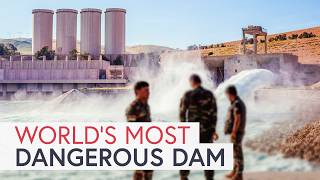

This Dam Leaks 200 Gallons EVERY SECOND
42sImmediate shock value with a massive seepage rate and the dam's 'most dangerous' label hooks viewers instantly.
▶ Play Clip"The title 'Fixing the Most Dangerous Dam in the World' is accurate, as the video details the massive, multi-billion-dollar rehabilitation effort that largely addressed the dam's critical foundation issues, though it remains an ongoing maintenance challenge."
Mosul Dam, one of the tallest dams in the Middle East, has been plagued by a critical design flaw since its construction in the 1980s: it was built on a foundation of gypsum, a rock that dissolves in water. This has led to continuous seepage and the formation of subsurface voids, necessitating a constant, multi-decade grouting effort to prevent catastrophic failure. The video by Practical Engineering details the engineering, political, and conflict-driven challenges of maintaining this 'most dangerous dam in the world.'
Mosul Dam is an earthen embankment dam built on gypsum rock, which is 200 times more soluble in water than limestone. This causes the foundation to dissolve, leading to continuous seepage and sinkholes.
Soon after the reservoir filled, water began seeping through the foundation at a rate of 800 liters per second (about 200 gallons per second), enough to fill an Olympic-sized swimming pool every hour.
In 2006, the US Army Corps of Engineers called Mosul Dam “the most dangerous dam in the world” due to the high risk of catastrophic failure, which could submerge cities along the Tigris River, including parts of Baghdad.
The dam's foundation is composed largely of gypsum, a sedimentary rock that dissolves in water. Experts agree that locating such a major dam on this rock was 'fundamentally flawed,' as dissolution creates a positive feedback loop of more voids and more seepage.
The designers originally planned a grout curtain to seal the foundation. A concrete gallery tunnel allows crews to drill and inject grout (a mixture of sand, cement, bentonite, and water) into the rock to fill voids, but this must be done continuously because the gypsum keeps dissolving.
A second dam, Badush Dam, was started in the 1980s to capture the flood wave if Mosul Dam failed, but construction was halted by geopolitical issues and remains unfinished.
After the 2003 invasion, the US Army Corps of Engineers assessed the dam, confirmed the extreme risk, and moved coalition assets out of the potential flood zone. Initial US-funded grouting contracts were plagued by errors (e.g., wrong equipment delivered).
In 2014, ISIS seized the dam, disrupting grouting operations. The dam was recaptured 8 days later, but the damage (looted equipment, missing cement shipments) compounded the risk. The US Embassy warned of 'unprecedented risk of catastrophic failure' endangering 0.5-1.5 million people.
Iraq contracted an Italian company to rehabilitate the dam. Over 3 years, crews drilled 5,000 boreholes (250 miles of drilling) and injected 50,000 cubic yards of grout. A sophisticated computer system tracked every borehole, improving foundation permeability significantly. The project cost over $500 million.
The rehabilitation was a massive but temporary fix. The Iraqi government continues maintenance grouting. Permanent solutions (finishing Badush Dam or building a deep cutoff wall) cost billions and remain uncertain. The dam is safer but still requires constant vigilance.
Mosul Dam's story is a cautionary tale about engineering choices that force a never-ending, resource-intensive battle against a flawed foundation. While the massive 2019 rehabilitation project significantly reduced the risk of catastrophic failure, the dam remains a permanent obligation requiring continuous grouting and billions in potential future investment for a permanent fix.
Why is the foundation of Mosul Dam particularly problematic?
It is built on gypsum rock, which is about 200 times more soluble in water than limestone, causing it to dissolve and create voids.
3:24
What was the initial seepage rate from Mosul Dam after filling?
800 liters (about 200 gallons) per second, enough to fill an Olympic-sized swimming pool every hour.
0:29
What agency called Mosul Dam 'the most dangerous dam in the world' and when?
The US Army Corps of Engineers in 2006.
1:27
What is the primary method used to repair Mosul Dam's dissolving foundation?
Continuous grouting — injecting a mixture of sand, cement, bentonite, and water into drilled boreholes to fill voids.
4:49
What was the purpose of Badush Dam, and why was it not completed?
It was intended to capture the flood wave if Mosul Dam failed. Construction was halted due to geopolitical instability in Iraq.
7:10
In what year did ISIS briefly seize control of Mosul Dam?
2014.
10:31
What was the approximate cost and duration of the major rehabilitation project (2016-2019)?
Over $500 million, spanning 3 years.
17:34
What is a Lugeon unit?
The loss of water of one liter per minute per meter of borehole length at an overpressure of 1 megapascal (about 145 psi).
17:05
What percentage of permeability tests after the 2019 rehabilitation showed values below 3 Lugeons?
98 percent.
17:26
Name two potential permanent fixes for Mosul Dam mentioned in the video.
Finishing the Badush Dam project or building a deep foundation cutoff wall.
18:46
Gypsum is 200 times more soluble than limestone
This stark chemical difference explains why the dam's foundation erodes at human timescales rather than geological timescales, making the problem immediate and continuous.
3:24Never-ending race between logistics and chemistry
The quote summarizes the fundamental challenge: grouting is a temporary fix against ongoing dissolution, requiring constant effort.
6:59Risk analysis of Mosul Dam
Using the Minister of Water Resources's own probability estimate (1 in 1,000 annual failure) and the Corps' fatality estimate, the dam falls deep into the 'unacceptable' red zone on the F-N chart.
14:01Half-a-billion-dollar bandaid
Despite the massive scale and success of the 2019 rehabilitation, the solution remains temporary, highlighting the extreme long-term cost of building on a flawed foundation.
18:20Estimated cost for permanent cutoff wall: $3-5 billion
This eye-opening cost underscores the economic dilemma: whether a functioning dam is worth a multi-billion-dollar retrofit.
19:06[00:01] Mosul Dam rises 370 feet or 113 meters above
[00:09] the tallest dams in the Middle East. The dam was
[00:16] never really stopped. That’s because ever since
[00:22] has literally been dissolving, nonstop, below
[00:29] water started flowing through the foundation of
[00:35] a year later, the volume of seepage was measured
[00:42] I usually hate to use the olympic-sized
[00:46] it makes sense because it was enough
[00:52] And the issue is that, once a process like this
[00:58] for the past 40 years or so, the problem at
[01:04] some of the most preeminent engineers across the
[01:09] and, of course, armed conflict. Failure of a
[01:15] towns along the Tigris River would be fully wiped
[01:20] wave would be so massive that even major parts of
[01:27] submerged. In 2006, the US Army Corps of Engineers
[01:34] in the world.” That was 20 years ago, and Mosul
[01:40] And the story of how it got there is fascinating.
[01:55] Mosul Dam is an earthen embankment dam
[02:00] built to generate hydropower and store water
[02:05] is on the west side of the dam with four turbine
[02:11] sticking up from the plant that absorb changes in
[02:16] The dam has an outlet structure through the
[02:21] radial gates here. And an auxiliary spillway with
[02:27] spillway gates and fuse plugs if you want to learn
[02:32] The dam itself is impressive, but the rock that
[02:38] and in many ways, far from ideal. The geology
[02:45] a sedimentary rock that is widely used
[02:49] and drywall. What it’s not widely used
[02:55] the consensus of experts involved on Mosul
[02:59] all around, a terrible idea. One
[03:04] “the decision to locate such a major and important
[03:10] the Mosul Dam site was fundamentally flawed.”
[03:15] That’s because of a critical property of gypsum,
[03:18] one that it doesn’t share with many other types
[03:24] You might be familiar with limestone caves and
[03:30] subsurface. Some of these can be quite dramatic
[03:36] Cave in Kentucky. They’re formed because the
[03:42] as long as it’s a bit acidic, which rainwater
[03:48] years, that water kind of carves away the earth
[03:54] is roughly 200 times more soluble in water than
[04:00] sugar or salt that dissolves almost instantly, but
[04:07] are accelerated to human timescales in gypsum.
[04:13] because dissolution isn’t a linear process.
[04:19] which means more dissolving and so
[04:23] Many dam failures have resulted from internal
[04:28] rock carries away particles, leaving voids. This
[04:34] which I covered in an earlier video. But
[04:39] by designing filtration systems that
[04:44] escape the subsurface, you can’t easily
[04:49] The designers of the dam knew the
[04:53] and they had a few ideas to address it. One was
[04:58] the bottom of part of the reservoir. This would
[05:03] at least in the dam’s immediate vicinity,
[05:08] the total volume of the flow. However, the volume
[05:14] layer would be fairly fragile to damage from
[05:19] was to use a cutoff wall, basically a continuous
[05:26] The problem was that there were no machines that
[05:31] of the gypsum. The idea they landed on was
[05:37] Mosul Dam’s design included a continuous concrete
[05:43] It had one purpose: to provide access to the
[05:48] pumps. Political and schedule pressures
[05:53] before the grouting was complete, but
[05:56] to the gallery tunnel to continue that process
[06:02] they underestimated how serious and complex a
[06:08] As soon as the reservoir filled up, the problem
[06:13] pools of seepage in the intro, but it wasn’t
[06:19] the dam as caverns formed in the geology below
[06:25] those sinkholes started appearing closer
[06:30] the solution cavities were migrating in the
[06:36] operators have maintained a continuous grouting
[06:42] bentonite, and water into the rock below
[06:47] the voids. It’s basically a nonstop
[06:53] because grout doesn’t fare well in flowing water
[06:59] Recognizing the hazard they had created
[07:04] with a backup solution. Since it was clear that
[07:10] they would just build another dam downstream
[07:16] when) Mosul Dam failed. Badush Dam
[07:22] It would have a hydropower plant and store water
[07:28] storage pool to protect downstream cities from
[07:35] halfway finished before the geopolitical
[07:43] In 2003, a US-led coalition invaded Iraq as
[07:50] to the September 11th attacks. As a major piece
[07:56] the coalition worried. Some early reports hinted
[08:02] as an act of sabotage. But it didn’t take long to
[08:09] They started coordinating with the US Army
[08:14] whose report concluded that the risk
[08:18] the “most dangerous dam in the world” quote
[08:23] The truth is that the “danger” of a dam is
[08:28] and it’s not a statistic that’s widely tracked,
[08:33] a government agency was willing to say it means a
[08:39] the situation seriously and started working with
[08:45] the dam. That panel largely came to the same
[08:52] Coalition forces had bases and equipment
[08:57] concerning enough that they decided to
[09:01] inundation area if the dam were to breach. At
[09:07] was helping the new Iraqi government
[09:11] including improving the grouting program at
[09:16] considered a temporary solution, the consensus
[09:22] to address the foundation problems beyond
[09:27] Initial efforts by the US government to help at
[09:33] A few notable examples: The winning contractor
[09:39] grout) mixing plant design, and somehow
[09:44] despite it being printed on the front page of
[09:48] the concrete plants had already been delivered,
[09:53] to try and convert them into grout mixing
[09:59] with no ladders or braces. Some weren’t even
[10:05] for the hoppers had no retaining walls,
[10:10] and pumping equipment couldn’t even fit into
[10:15] dam operations staff meant to run all this
[10:20] a few weeks of training. The oversight
[10:25] Millions of dollars had been spent on 21
[10:31] Coalition forces continued efforts to improve
[10:37] the US was withdrawing troops from the country
[10:43] back to the Iraqi government. Unfortunately, that
[10:49] continued to plague the region. In mid-2014,
[10:56] and Daesh) took over several cities in Northern
[11:03] Mosul Dam, which was still relying on nearly
[11:09] safe. That August, ISIS seized control of Mosul
[11:16] collapse. For more than a week, the dam was out of
[11:22] what the militants might do (or what they might
[11:28] Even short-term neglect presented a serious
[11:34] by Kurdish and Iraqi forces, with the help of US
[11:40] Iraqi hands, but the surrounding areas weren’t.
[11:47] the disruption of the workforce at the dam, and
[11:52] operation wasn’t being maintained. Equipment
[11:58] used. Voids were going untreated, and concerns
[12:04] Realizing that the Iraqi government was too
[12:09] the US decided to stay involved as
[12:15] the Army Corps of Engineers led a task
[12:19] and the results were alarming. The US Embassy
[12:25] saying that the dam had an “unprecedented risk
[12:30] half-a-million and 1.5 million people along the
[12:37] crisis unlike almost anything in modern history.
[12:43] ongoing occupation by the Islamic State, making
[12:49] able to evacuate to safer areas. Electrical
[12:55] and poor communication would make things
[13:00] The Iraqi government tried to downplay the alarm a
[13:06] Resources said, quote, “The looming danger to
[13:12] is present in all the world’s dams.” I don’t
[13:17] actually supported by some kind of analysis, but
[13:23] hilarious if it weren’t such a serious situation.
[13:29] what we normally use, and multiplying it by the
[13:34] of Engineers, you get an expected annual fatality
[13:43] would anybody consider that acceptable. This is a
[13:49] large dam projects. This green area generally
[13:55] making a structure safer. Yellow, you have to be
[14:01] the minister’s estimate of probability, and the
[14:07] Mosul Dam would plot somewhere around here on
[14:13] moniker doesn’t seem like hyperbole when you
[14:18] Sean MacFarland, “If this dam were in the United
[14:24] The urgency finally spurred action in 2016.
[14:29] Iraq awarded a contract to an Italian company
[14:32] to rehabilitate the structure, including a
[14:38] grouting program. It was one of the most
[14:43] with participation from the Iraqi government,
[14:48] Italian military, and a number of international
[14:54] engineers involved on the project, and
[14:58] In the early days of the project, they were
[15:03] to support the Iraqis who were operating
[15:08] let them monitor the situation remotely while
[15:14] The entire project had to happen near the front
[15:20] continued to unfold in Iraq. Security forces
[15:25] the dam and supply routes for materials and
[15:31] but eventually, the project team was able
[15:35] Over the next few years, all the grouting
[15:40] piping, electrical systems and drill
[15:45] Crews drilled more than 5,000 boreholes with
[15:51] kilometers or 250 miles. 41,000 cubic meters
[15:59] into the foundation along the entire length of the
[16:05] inflate a rubber device called a packer using air
[16:11] borehole and injection pipe. Or you just grout
[16:17] Then you can pump grout at very high pressure
[16:23] fissures. You just keep pumping until you reach
[16:29] that you hold until the grout stops flowing. And
[16:35] All this work was done using a sophisticated
[16:41] depth, mix design, flow rate, and quantity of
[16:46] track progress, identify issues, and visualize
[16:53] delivery to batching to drilling and injection,
[16:59] I love unique measurement units, and this project
[17:05] the contractor would try to inject water into the
[17:11] is the loss of water of one liter per minute
[17:18] of 1 megapascal or about 145 psi. For all the
[17:26] 98 percent had values below 3 Lugeons, a massive
[17:34] The project finished in 2019. It was a 3-year
[17:40] but Mosul Dam lost its most dangerous
[17:45] the dam is in a much less precarious position.
[17:51] Foundations Institute in 2022, highlighting
[17:57] But this wasn’t like a typical construction
[18:02] goal was to get the Iraqi government set up to
[18:08] The rock below Mosul Dam may have a lot more grout
[18:15] and there’s still a massive reservoir constantly
[18:20] the rehabilitation project was training Iraqi
[18:27] despite its magnitude, the project was sort of a
[18:33] never been considered a permanent solution, and
[18:39] improvement in the long-term prospects of the
[18:46] Iraq is still planning for a more permanent
[18:51] Badush Dam on the map, downstream from
[18:56] the table if anyone can figure out how to come
[19:00] Another option is that deep foundation cutoff
[19:06] would provide a continuous barrier for seepage
[19:11] These are used on a lot of dams across the
[19:16] and depth as would be required at Mosul. In 2018,
[19:23] 5 billion dollars, an almost unimaginable
[19:29] and functions today. Whether the electricity and
[19:36] capital is something that will probably
[19:41] the government will keep pumping grout and Dinars
[19:47] a flawed foundation, but now with much more
[19:54] One of the trickiest parts of Mosul Dam is that you can’t just see what the subsurface looks like. The Army Corps
[20:01] of Engineers did a really detailed investigation,
[20:06] on very limited observations from individual
[20:12] a challenge for all kinds of engineering projects
[20:19] My friend Brian at the Real Engineering
[20:24] “The Anatomy of.” He’s putting everyday
[20:29] so we can literally see inside. This is
[20:35] up our favorite gadgets, and if you want to
[20:40] You probably know about Nebula now, even if
[20:44] built by and for independent creators. No studio
[20:51] advertisements driving the content into a single
[20:57] they’re excited about with as few barriers and
[21:03] My videos go live on Nebula before they come
[21:08] was specifically produced for Nebula viewers who
[21:14] I know there are a lot of streaming platforms
[21:18] monthly cost to keep track of, but I also know
[21:23] there is a ton of other stuff on Nebula that
[21:28] it dead simple: click the link below and you’ll
[21:35] 30 dollars, for an entire year’s access
[21:42] if you have subscription fatigue, but
[21:45] you can get a lifetime membership. Pay once
[21:50] last. If you’re with me that independent
[21:55] I hope you’ll consider subscribing. Thank you
⚡ Saved you 0h 22m reading this? Transcribe any YouTube video for free — no signup needed.