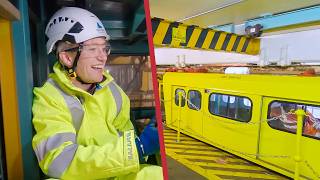

Hidden Monorail Under a Massive Bridge
45sReveals a secret engineering marvel beneath a famous bridge, sparking curiosity and awe.
▶ Play Clip"Title is honest and intriguing; the breakdown adds unexpected value, delivering on the promise of a unique engineering tour."
Tom Scott visits the Second Severn Crossing in Gloucestershire to explore the hidden suspended monorail (RAT) used for bridge maintenance. The video captures the journey on the monorail, its unexpected breakdown, and a subsequent walk through the bridge's internal structure, offering a unique engineering perspective.
Tom Scott is at the River Severn in Gloucestershire, noting the Severn Estuary's high tidal range and the two bridges crossing it: the Severn Bridge (1960s) and the Second Severn Crossing (1996), which carries most traffic.
After negotiations with National Highways, Tom gains access to the suspended monorail (RAT) tucked under the bridge. National Highways requested to check the video but had no editorial control.
The RAT (Rapid Access Train) is a rare suspended monorail used for bridge inspections. It runs on two blue rails and is currently being decommissioned and replaced.
Tom rides the RAT, noting the tight clearances and the view of the tidal mudflats. The RAT has two drivers for safety, each facing the direction of travel.
Multiple safety levels: two drivers at all times, an auxiliary drive if the diesel generator fails, and a backup electric generator. The RAT has a history of cracks and was repaired in the early 2000s.
The RAT stops at stations for access. Inside the bridge's hollow viaducts, there is a five-kilometre walkway allowing workers to walk to the Gwent abutment.
Expansion joints allow the bridge to expand and contract with temperature changes. The concrete approaches expand with seasons, while the steel bridge expands daily.
The RAT breaks down during the ride, forcing the team to switch to auxiliary power. The breakdown leads to an unexpected walk through the bridge's interior.
Tom and the team walk through the hollow viaducts, seeing internal post-tensioning cables and expansion joints up close. The structure is five kilometres long with 48 piers plus abutments.
Workers navigate the bridge using markings on the walls, indicating pier numbers and segments. The numbering starts from Wales to England.
Segments were precast and glued together, with Macalloy bars (50mm diameter steel) used to bolt segments together during construction.
A bridging plate, solid steel about 100mm deep wrapped in rubber, covers a movement joint. Car tyres sit on top of the plate.
Tom walks on metal catwalks under the cable-stayed bridge, high above the Severn Estuary, with a 50-metre drop to the mud below.
At the M2 pylon, the RAT would park for access. Tom takes a rack-and-pinion lift (from construction) down to the pylon base, then up to the top.
At the top of the pylon, about 150-155 metres above the seabed, Tom gets a spectacular view of the bridge and the estuary, noting the cables and the scale.
A van behind the maintenance vehicle serves as a crash buffer, protecting workers from errant motorway traffic.
The video offers a rare behind-the-scenes look at the engineering and maintenance of a major bridge, highlighting the hidden monorail and the resilience of the team when it breaks down. It underscores the complexity and safety measures involved in maintaining such infrastructure.
What does RAT stand for?
Rapid Access Train
02:21
How many drivers are required on the RAT at all times?
Two drivers, each facing the direction of travel.
04:35
What is the length of the walkway inside the bridge's viaducts?
Five kilometres.
05:54
What is the purpose of expansion joints in the bridge?
To allow the bridge to expand and contract with temperature changes.
06:39
What is a Macalloy bar?
A 50mm diameter steel bar used to bolt segments together during construction.
18:43
How high is the top of the pylon above the seabed?
About 150-155 metres.
24:34
What is the bridging plate made of?
Solid steel about 100mm deep, wrapped in rubber, with car tyres on top.
20:37
Access to the monorail
Reveals the hidden infrastructure and the negotiation process with National Highways.
01:10RAT breakdown
Unexpected event that leads to a unique walking tour inside the bridge.
08:59Walking inside the bridge
Provides a rare view of the internal post-tensioning and expansion joints.
15:15View from the pylon top
Spectacular engineering perspective, showing the scale of the structure.
24:34[00:00] My road trip brought me to Gloucestershire, and to the River Severn. The Severn Estuary has one of the highest tidal ranges in the world, staggering amounts of water flowing in and out every day.
[00:16] Crossing it are two bridges: the Severn Bridge, from the 1960s, and the Second Severn Crossing, completed in 1996 That’s the bridge that, these days, takes most of the traffic
[00:30] And it is a masterpiece, are held up on concrete piers 100 metres apart, But the inner part of the bridge needs to be wide enough
[00:46] so, that is a metal cable-stayed bridge a kilometre long. the bridge deck is held up by the cables
[00:58] the two big towers. After a lot of negotiation between my producers and National Highways,
[01:10] I was there to see the suspended monorail that’s tucked away underneath it. Full disclosure: National Highways did ask to check this video before it went out. But they’ve had no editorial control beyond my offer to blur stuff if needed.
[01:25] at the maintenance depot at what’s called the Avon Abutment It’s beautiful, yeah, you’ve picked a very good day. working on the bridge since its construction.
[01:40] who’s from the National Highways media team. And who had no idea quite what he was getting himself into that day. Because the plan was: take the monorail out to the English pylon.
[01:52] That’s not exactly what happened. Currently being decommissioned and replaced. That’s how they get people to inspect the outside of the bridge.
[02:04] on the two blue rails that you can see. We’re looking at replacing this... (engine starts) ...starting up. We’re about to go out onto the rail in the centre,
[02:21] And RAT stands for Rapid Access Train. -Yeah. See the rail just there, and the square holes in the bridge? -Okay, so we’ll make our way up? -Yeah, lead the way.
[02:37] Just to be clear to the audience, there has been a long safety briefing And every single piece of equipment in the hand is being safely tethered on.
[02:49] The RAT is a very rare thing: a suspended monorail. And almost none of the tens of thousands of people
[03:03] have any idea that it exists. Yeah. I was sitting on a chair
[03:16] And of course, what I have to remember is: There’s...there’s very little headroom and there’s very little legroom. -Okay, Steve, thank you. -Where are you going, Dan?
[03:29] That was the view that Steve the driver gets. that’s probably not a massive problem. and it’s the first of four carriages.
[03:41] our other driver was sat in the third, for safety. And the fourth was a metal cage for any equipment that we’d need to bring across. This is very tight clearances here.
[03:55] And just down there is the tidal mudflats of the Severn. Such a tight clearance. -It is. So, if it’s, for whatever reason, really howling winds,
[04:10] Now it is quite protected here, so, the winds have to be really bad. We do, you’ve always got one driver in each cabin
[04:22] and the driver is always facing the direction of travel. There’s...I mean, I know this ’cos I had the long safety briefing, but there are so many levels of safety here.
[04:35] -Two drivers at all times. -Yeah. if we lost power with the diesel generator... an auxiliary drive that kicks in.
[04:50] And I’m 50. I’m 50! So, yeah, I’ve worked here... I worked in construction.
[05:02] However, all through construction, which was 1992 to 1996, was the stitch beams back on the Avon Abutment. So, it wasn’t until I come onto the maintenance
[05:16] that I was lucky enough to see the structure from all sides. when you get off at a station, where are you going? Because surely there’s nowhere to walk to underneath the bridge?
[05:30] I haven’t even established that yet. Getting labour, plant, materiel out onto the bridge.
[05:42] If you ever come back, Tom, I’ll take you for a walk through the bridge. -These viaducts are hollow. -Oh!
[05:54] Inside is a walkway, and you can walk. It’s five kilometres. and you can walk all the way out to the Gwent abutment. ’cos it’s important:
[06:10] You’re either taking the RAT, or that big gantry, or you’re walking on the inside of the bridge, in the hollow parts, I really wanted a closer look at that,
[06:25] that I was missing half the story here. And there were expansion joints. that’ll expand and contract day-to-day,
[06:39] But the big concrete approaches, where we were then, so, they’ll expand and contract with the seasons. that means there have to be gaps that it can expand into.
[06:55] I was going to say, we’ve slowed down a lot here. that allow the bridge to expand and contract. That’s...
[07:13] So, we’re coming up to another station, it looks like? So, the RAT could stop, and people could get out onto the station according to where they’re walking.
[07:28] Why not use the road? and the internals of the bridge. We have got a maintenance strip, and we do use it for access.
[07:44] By maintenance strip, Dan means just the side of the road, with high-speed motorway traffic going past inches away. Items do come off vehicles. -Oh. Yeah.
[08:01] So, we try and not use the maintenance strip. -Right. -It’s not a public right of way. (laughs)
[08:16] So, as I said, this RAT has just undergone 18 months of totally being stripped down. As I said to you, I’m really excited. The RAT actually had a bit of a troubled history:
[08:31] shortly after the bridge opened, engineers found cracks in the monorail, before everything was repaired and resurrected in the early 2000s, Long-time viewers of this channel will know that I have
[08:45] I actually think they’re terrible in almost all circumstances, but in this case: it seems like it’s a good option. But alas, that day, luck was not with the newly refurbished RAT.
[08:59] And the next few moments seemed terrible at the time, Other than, of course, getting it sponsored. I really do use NordVPN all the time.
[09:12] They asked me to talk about their next-gen antivirus, I asked them. scam detection models, fake-shop detection models,
[09:25] Scams, calls, dark web, banking checks, etc. before they reach your device, leaked or stolen credentials that match yours.
[09:41] I talked to them for a long time about technical stuff and privacy, It’s always designed around that: We don’t know name, addr-- we don’t know nothing!
[09:54] And the VPN’s still there! When I’m travelling, it stops websites sending me to local translated versions, I’ve saved hundreds of dollars on car rentals
[10:07] to make it look like I’m back in the UK. NordVPN works across Windows, Mac, Linux, iOS and Android, and there’s a 30-day money-back guarantee
[10:21] Go to nordvpn.com/tomscott and you’ll get the best deal they’re currently offering. As I was saying: the RAT was... not having a good day.
[10:35] (engine stops) we were talking about rescue procedures. So, there would be a backup electric generator.
[10:48] that these guys can basically turn the diesel generator off. And move using the...it’s a battery, but we call it the auxiliary drive.
[11:00] Right. So, all you would do is get to the nearest RAT station
[11:12] (beeping) -Just the radio. -Just the radio, okay. There is another way of getting people out using RA1,
[11:25] -We don’t like doing it. -No. Yeah, 100%. (to radio) Neptune Kilo, Kilo Neptune India.
[11:39] (bleeping) Yeah, you take over. So, what they’re doing now, you don’t really appreciate here, but the bridge is on an angle.
[11:53] So, the reason we’re gonna go back that way, and that’s why there’s two drivers, Breakdowns happen. but they can deal with this. Plan A...
[12:07] well, actually Plan B, I guess, we were already on Plan B, Back in the day when this first came out and had one cabin, there was a little wheel under the seat and a pole
[12:25] -Right. -It worked. but it took forever. We got rid of that.
[12:37] The generator still kept causing trouble, and while the drivers kept trying, Which did work, which is great, we very slowly moved on, that we didn’t end up using Plan D.
[12:53] A lot of our inspectors, not all of them, This is folks who can abseil? and folks that, if need be...
[13:05] we’ve only ever done it once, can climb out...to the RAT, So, they’d send a rescue boat out and we’d have to abseil down?
[13:21] We would. (engine stops, beeping) Oh, so we’re actually on the auxiliary now. Well, sorry to have a technical problem when we’re filming.
[13:34] The electrical team will have to walk out from the station. I think we are probably better off, and it could take an hour to diagnose.
[13:50] but is very interesting, and walk to the cable-stay. Like, thank you. -Yeah. That’s a whole section I didn’t expect to get in this video, so, thank you.
[14:04] and all of a sudden, that’s become a lot more. who again is from the media team, and kept smiling despite, I assume,
[14:16] and that the RAT wasn’t behaving. What you won’t be privy to is all the cussing back there. Which pier are we on? We started at N48.
[14:30] No, luckily, we’re about halfway out. Yeah. So, what do they say in the media world?
[14:44] So, technically, well, this is a RAT, rapid access train, so there you are. -Sorry about that. -No problem. I’ll tell you what wasn’t on the schedule.
[15:01] Good heavens! Let me get my GoPro back out of there and I guess we’re going for a walk. -We’re going for a walk. -Right.
[15:15] I’m glad someone’s made a padded surface here, that’s nice. Oh, wow. The structure’s five kilometres long,
[15:30] and we’ve got 48 piers plus the abutments, so, 50. -We walk that way, yep. -For quite a while. And what you’ve got to remember to do is...
[15:44] Let’s go. Let’s walk inside a bridge. The cables you can see are internal post-tensioning:
[15:56] in each hundred-metre section of the bridge, anchored into the structure at both ends. that pull puts the entire concrete structure
[16:10] And concrete is strong in compression, but weak in tension, to hold everything together and keep it strong. It’s one of the movement joints, yeah.
[16:25] So, that huge gap that we saw earlier that I pointed out from the RAT, Okay, down is the River Severn.
[16:37] thanks to Liam who’s holding the camera there... (loud trundling) And that is the expansion joint.
[16:50] Yep. I didn’t expect to see that close up. Thank you very much.
[17:02] This is really good actually, because normally, you know, and everyone wants to see the cable-stayed bridge This is what our guys have to walk, day in day out, most of the time.
[17:17] but the repetitive concrete structure here, with... I’ve worked here, like I say, my whole life.
[17:33] If you were to bring me in one of these viaducts, the only real way I’d know if I was heading to England or to Wales, the cable-stayed bridge, is the markings on the wall.
[17:48] So, this tells me, remember I said everything numbered from Wales to England? So, this just lets me know I’m in the North Viaduct.
[18:00] I am closer to Pier 35 than I am to Pier 36. And 05, I’m the fifth segment from Pier 36.
[18:15] Oh, so when you say segment, that’s...’cos this is 04 over here. If you look from a drone shot on the outside, The same ones that we’re seeing from the inside as we walk over them.
[18:31] So, these were precast either on the English side or the Welsh side. Primarily most of it was done on the English side, although not all of it. This just there. -This would be, yeah.
[18:43] This would be brought out, dropped into place, literally glued, something called a Macalloy bar that, obviously, you can’t see now, but it’s a steel bar, like 50mm diameter, and it would be bolted, four segments,
[19:00] and that would support it until X amount of segments were in, So, it’s just build it out, build it out, get to the next pier, And I haven’t yet figured out a pattern, if that makes sense.
[19:16] Every single time we go to a new section, When you get to 29, it’s the transition. And then we go on the cable-stayed bridge.
[19:29] -Yep. -Which is a kilometre of steelwork, then. That’s just a deep black hole. -Yeah.
[19:42] This should be pitch black. We are completely encased. -Alright. Onwards. -Okay. You can just see light at the end of the tunnel.
[19:56] Okay, so this is the transition... So again, watch your head. -Mind my head. Yep. Yeah.
[20:10] I personally don’t think anyone over 5′7″ It’s too much of a safety risk. -(laughs) Now, it was out over the channel in the middle,
[20:24] There was another movement joint to let the two parts expand and contract, -Above your head there... -Yep. ...the reason it’s so loud, that is called a bridging plate.
[20:37] -Right. -It is solid steel, about 100mm deep, wrapped in rubber, and some car tyres are on top of that plate.
[20:50] Ten centimetres of rubber-wrapped steel between us and the car tyres. we headed out on the metal catwalks under the cable-stayed bridge.
[21:02] So, we are literally just above the Severn Estuary here. I hope the camera is getting the scale of this. So, the RAT would pass through the big ol’ hole next to where we were.
[21:17] -The walkway, yeah. -And just head out under there. So, I casually walked out on the catwalk, with just the metal grating and about 50 metres of air between me and the Severn Estuary.
[21:29] so, it was just mud and rocks down there. I know for a huge number of people this is their job. This is just where they have to come out day after day after day
[21:45] in wind and cold and sleet and snow. (laughs) ...thank you so much to everyone.
[21:58] There’s a very weird effect here where, if I look down, my brain refuses to accept how far away that is.
[22:10] We are so high up and that is so massive that it’s not the size of structure that the brain’s designed to deal with.
[22:23] This is M2 pylon, yeah. So, the RAT would... well, we’re under the RAT rail. we would not be allowed to be here. -No, these chains would be across.
[22:37] And when the RAT parks here, this is where you embark, get to the bottom and the top of the pylon. Bag coming down.
[22:51] We set down most of our bags in the welfare, And if you need a cup of tea, you can make a cup of tea. so, I switched to my 360 camera, and we headed to the elevator.
[23:06] Oh, that is a long way down. So, we’re going down first? and work our way up. So, these are quite rickety lifts. They’re called rack-and-pinion lifts.
[23:19] And they are the lifts from construction. So, they’re very basic. You’ll be pleased to know on this occasion, Liam, if these break down,
[23:32] it’s purely gravity-fed to the next lift. -(laughter) And there is ladders, landings, from top to bottom. but this view, from an engineering perspective, for me, is The View.
[23:49] ’cos no one really wants to see this as much as the top. So, just get your bearings a moment. We are on...
[24:07] That one is the Welsh, that’s M1. Yeah. Above our heads there is the walkway that we walked in on. You can also see the other gantry there, hanging underneath the road deck.
[24:21] this was the most impressive view, So, how high up will we be? Above the seabed, about 150 metres, 155 metres.
[24:34] I never let my colleagues forget on the Severn Bridge It’s very minimal but... Alright, if you just wait there a minute, guys,
[24:46] I will get us some light on the subject. (clanking, creaking)
[25:00] Okay, if you want to, you can use that there. It won’t come down, okay? -Okay.
[25:13] (motorbike roaring) Okay, so get your bearings. England.
[25:27] Sometimes it’s really difficult to keep my profanity PG-rated... Yeah. I can honestly say it never gets boring.
[25:41] -Yeah. -And the whole structure... And the cables come in, well, we can see them over that side, can’t we? you can see them there. -Oh.
[25:55] That’s the first time I’ve had a moment where I’m afraid of heights up here. And Liam, thank you. I’m just glad we had a media guy here, ’cos I would have been,
[26:12] Thank you to both of you. That is incredible. Well, thank you for persevering with it. Many wouldn’t have. Let’s see what I can do.
[26:27] Neptune Alpha, Neptune Alpha, National Highways, over. But you’ll notice there’s another van behind it, and that’s because, if someone loses control on the motorway,
[26:45] at the back of that van first, before they hit us. And I feel like that point wouldn’t have been made nearly as well, if the RAT had just taken us out and back.
[27:03] Next time, or right now on Nebula, I’m joined by astrophysicist, Dr Becky, for something far more down to earth, as two nerds pile up some rocks.

⚡ Saved you 0h 27m reading this? Transcribe any YouTube video for free — no signup needed.