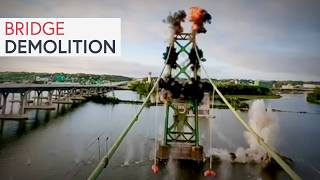

Demolition: Harder Than Building a Bridge
47sChallenges the common assumption that demolition is easy, revealing it's often more complex than construction.
▶ Play Clip"The title is honest—the video thoroughly explains the engineering challenges of bridge demolition, making it anything but simple."
This video explores the complex engineering behind demolishing the old I-74 bridges over the Mississippi River. It details the challenges of removing the structures safely without harming the environment or disrupting navigation, culminating in a controlled and spectacular explosion.
The original I-74 bridges were built in 1935 and 1959, with narrow lanes and no shoulders, making them unsafe for modern interstate traffic.
Demolition engineering is often more complex than designing a new structure, especially due to water, shipping traffic, and environmental sensitivity.
Concrete deck was sawcut into panels, and engineers had to calculate if the panels could support the weight of demolition equipment without collapsing.
Deck removal on suspension spans had to be symmetrical (staggered) to prevent towers from deflecting undesirably.
To avoid disturbing endangered mussels, demolition team floated temporary supports on a barge instead of placing them on the riverbed.
A structural computer model was critical; it accounted for historical construction methods (like rivet order) to understand stress distribution.
Shaped charges were used to cut cables and towers, but they are designed to make clean cuts rather than pulverize the structure.
Before blasting, workers precut cables and towers so that the explosives only had to sever the remaining connections, ensuring controlled fall.
What interstate highway did the old I-74 bridges carry over the Mississippi River?
The Iowa-Illinois Memorial Bridges carry Interstate 74 over the Mississippi River between Moline, Illinois, and Bettendorf, Iowa.
0:08
Why were the old I-74 bridges considered unsafe and in need of replacement?
The bridges were in poor condition, had narrow lanes and no shoulders, and were considered one of the worst bridges in America by a transportation secretary.
1:34
Why is bridge demolition engineering more complicated than designing a new structure?
Demolishing a bridge requires careful structural analysis, environmental considerations (like endangered mussels), avoiding debris in navigation channels, and symmetrical removal to prevent collapse.
1:12
What type of explosive device did the demolition team use to sever bridge members?
Shaped charges are explosives designed to cut structural members in a controlled location, rather than pulverize the entire structure.
11:48
Why did engineers add steel bumpers and bearing restraints to the bridge during demolition?
To keep the structure stable during demolition and ensure the remaining supports could withstand wind loads.
9:59
How did engineers determine the stress distribution in the trusses before cutting?
They used a structural computer model that accounted for the original construction sequence, including the fact that top chord rivets weren't installed until after the concrete deck was poured.
7:46
Demolition engineering is harder than design
Shows that taking down a structure requires its own set of complex calculations and planning.
1:12Asymmetric loading on suspension spans
Demonstrates the need for symmetrical removal to avoid dangerous deflections or collapse.
5:36Stability of crane on a barge
Highlights the engineering challenges of lifting heavy loads from a floating, unstable platform.
8:44Shaped charges for controlled cuts
Explains that explosives in demolition are precision tools, not brute force weapons.
11:05Pier becomes mussel habitat
Illustrates how environmental considerations can lead to unintended positive outcomes.
14:09[00:01] In 2022, the world got a very cool new bridge.
[00:08] Bridges carries Interstate Highway 74 over the
[00:14] Bettendorf, Iowa in the “Quad Cities” area. It’s a
[00:21] arches carrying each deck over the main span of
[00:27] DOT had a problem. The two old bridges were still
[00:34] And even though they were kind of cool looking,
[00:39] in poor condition, and without extensive ongoing
[00:45] posing a danger to the public, affecting
[00:49] and even disrupting this critical shipping
[00:55] Demolition, on its face, seems kind of easy.
[01:00] the demo part feels almost like housekeeping.
[01:06] then just pick up the pieces. No engineering
[01:12] Demolition engineering, in many ways, is even
[01:17] and the I-74 bridge is the
[01:21] And don’t worry, there are explosions at the end.
[01:34] The original I-74 bridges, with just two lanes
[01:41] This is actually a problem they faced and managed
[01:47] Despite looking like twins, the original pair
[01:53] first span was completed in the mid 1930s, but car
[01:59] Engineers decided that the best way
[02:03] nearly identical bridge right next to
[02:09] Neither bridge was ever intended to meet
[02:13] interstate system altogether. And yet, they found
[02:19] way beyond what the designers in the 1950s,
[02:25] had considered. The lanes were narrow, there were
[02:30] which bottlenecked traffic on I-74.
[02:36] were also just physically wearing out. Like an
[02:41] cost of replacing the bridges was outweighed by
[02:48] In 2012, Transportation Secretary
[02:52] reporting back that it was, quote, “one of
[02:58] You would think that already being close to
[03:03] it comes to demolition, but it’s quite
[03:07] were big bridges with 3 types of structural
[03:13] truss units over the old non-navigable part
[03:18] kind of act as connectors. And then you
[03:23] I’m sure you want to see the explosion, and I
[03:28] last step. Of course, there are lots of cases
[03:33] down right away. You end up with a pile of rubble
[03:39] equipment. It can be much quicker, easier, and
[03:45] but it’s rarely true for bridges. Of course
[03:50] Removing debris from below
[03:54] Long reach excavators can sometimes handle
[03:59] to rig the big stuff to be lifted out by
[04:04] You also have shipping traffic to consider. This
[04:09] inland waterway system, and closing it to clean
[04:15] The other thing making it tricky, in this case,
[04:20] living in the non-navigable channel below the
[04:26] couldn’t use blasting or even temporary supports
[04:31] to dismantle the bridges more carefully and
[04:37] The strategy here was to sawcut all the concrete
[04:43] equipment. An excavator with a slab crab
[04:48] steel structure, swing around, and pass to a wheel
[04:54] but it had to be done pretty carefully. Cutting
[04:58] the reinforcement is cut too. And this is
[05:04] using calculations and analysis not to design
[05:10] like, “Can these concrete panels support
[05:16] The answer was more complicated
[05:20] engineers imposed pretty strict positional
[05:25] in most cases making sure that the tracks of
[05:30] stringers instead of relying on the concrete deck
[05:36] Another challenge on the suspension span was
[05:42] to dismantle the bridge, systematically working
[05:48] if you take all the weight off one section of the
[05:54] the trusses are going to bow, the towers are
[05:59] the bridge prematurely. It’s just like re-racking
[06:04] you take everything off one side of
[06:09] So, on the suspension bridges alone, the
[06:15] Some slabs were removed with
[06:17] Others were popped up and left in place as
[06:23] It’s a lot more work with a crane
[06:26] way to get the deck off in a symmetrical way
[06:32] Once the concrete deck was off, the contractor
[06:37] and stringers that make up the bridge structures.
[06:42] go cutting up a bridge willy nilly. This is
[06:48] and that requires some structural engineering.
[06:53] team wasn’t allowed to install temporary
[06:58] So instead, they floated in the support on
[07:02] the trusses into pieces small enough for the
[07:07] The suspension spans were even more complicated.
[07:13] piece of steel that’s under significant
[07:18] it could cause sudden movements and
[07:23] Those cuts have to be carefully sequenced. When
[07:28] changes the stresses, shifting them around and
[07:34] to check each step before you do it to make sure
[07:40] or the environment. And there’s no way to know how
[07:46] Instead, they had to create a structural computer
[07:51] bridge in 3D. The order also matters.
[07:56] One cool example of this:
[07:59] the top chords of each truss weren’t installed
[08:05] most of the load was being carried in the bottom
[08:11] the whole truss responded by going into
[08:16] The top chords were in tension and the bottom
[08:21] what you would expect. That’s something that
[08:25] having gone through the exercise of modeling the
[08:31] modified, and retrofitted over the years. It was
[08:38] The engineer even used old magazine articles to
[08:44] Here’s another tricky part. To lift the
[08:49] they had to put a crane on a barge. Anyone
[08:54] not the most stable platforms for high-stakes,
[09:00] add in huge loads and the need for precision.
[09:05] these bridges, but that doesn’t mean it’s easy.
[09:11] loads from lifting and swinging. Barges often
[09:16] but there’s still a lot of engineering that goes
[09:21] variety of loading conditions. Those calculations
[09:28] limitations on pick weights and movements, et
[09:33] And just like the concrete deck, these
[09:37] staggered manner to keep the towers from
[09:42] Interestingly, sometimes to demolish a structure,
[09:48] load system had to be removed because of
[09:53] but the engineers didn’t want people working on
[09:59] So they had to design and build these steel
[10:04] the superstructure during the demolition process.
[10:09] restraints on the trusses of the continuous
[10:14] time those trusses were partially demolished. And
[10:20] stiffening truss, made from pieces of the bridge
[10:25] truss could be lifted and removed as a single
[10:31] on the shore where it could be cut down using this
[10:37] At this point, basically all that was left of
[10:43] Since those cables are essentially one long
[10:47] safely cut them loose. Imagine getting snapped by
[10:54] up energy there, and you don’t want any humans
[10:59] explosives come in. And like every other part
[11:05] Explosives used for demolition aren’t
[11:10] You’re not trying to use them to
[11:15] On buildings, you get a lot of breakup anyway
[11:20] But really, the explosives are just strategically
[11:26] falling process in a more controlled way.
[11:32] pieces that can easily be removed from the
[11:37] very exciting saws that can cut
[11:43] Demolition contractors use shaped
[11:48] in a relatively controlled manner, and
[11:53] It matters a lot what these pieces look like
[11:57] to be lifted and transported out of the water. And
[12:03] they’re accessible without blocking the navigation
[12:09] there’s an entire process of precutting. The goal
[12:15] be placed down to flat plates or smaller sections
[12:22] A worst case scenario is an incomplete
[12:27] bring the structure down. When that happens,
[12:33] and difficult because you have to finish
[12:38] it’s not entirely clear where the
[12:43] On the I-74 bridges, workers cut the outer
[12:49] the 37 strands holding. This was done in four
[12:55] manageable pieces. The towers were also cut in
[13:01] to sever completely and control which direction
[13:07] this leaves the bridge extremely vulnerable.
[13:12] stability so that the explosives can kind of carry
[13:18] down. But it means the clock is ticking. You’re
[13:23] don’t want a storm bringing the bridge down before
[13:34] I’ve mentioned a lot of pros and cons of explosive
[13:39] than anything else: the spectacle.
[13:42] You just can’t get around how
[13:46] They got perfect shots for both bridges, bringing
[13:52] quickly to pick up the pieces. The road and
[13:58] a short period of time. Here’s a good look at how
[14:03] cables. And actually, they used explosives to demo
[14:09] The piers in the more sensitive areas were taken out using conventional jackhammers as the final step. These sheet
[14:15] pile containment structures kept the debris from
[14:20] a scan to make sure all the debris was picked up.
[14:26] habitat for those endangered mussels, so you can
[14:32] But other than that, there’s almost no sign
[14:36] I don’t just love bridges; I’m actually a
[14:41] every year I have to take a certain number
[14:45] And that’s how I first heard of this job.
[14:49] put the story together in a
[14:52] So huge thanks to them for sharing so
[14:57] And another thanks to Iowa DOT who answered
[15:03] I am so impressed with this bridge demolition. No
[15:09] think taking the old ones down was the coolest
[15:15] demolition is specialized, challenging work
[15:21] Hats off to the entire team on this project
[15:27] You know, I was super interested in that
[15:29] sonar scan they did of the Mississippi River to
[15:34] And really, I love any situation where you get
[15:39] otherwise be hidden from view. My friend Brian
[15:45] to a new level with his series, “The Anatomy
[15:51] into a CT scanner, so we can literally see
[15:57] of what makes up our favorite gadgets, like
[16:03] RF shielding in the Nokia 3310. And if you want
[16:09] You probably know about Nebula now, even if
[16:14] built by and for independent creators. No studio
[16:20] advertisements driving the content into a single
[16:26] they’re excited about with as few barriers and
[16:31] My videos go live on Nebula before they come out
[16:36] I followed a large construction project from start
[16:42] produced for Nebula viewers who want to see deeper
[16:48] of streaming platforms out there right now, and no
[16:53] but I also know that if you’re watching a show
[16:58] on Nebula that you’re going to enjoy as well. So
[17:03] you’ll get 50% off an annual plan. Pay just one
[17:10] go.nebula.tv/practical-engineering. Or if you have
[17:17] what I’m doing, you can get a lifetime membership.
[17:23] Nebula last. If you’re with me that independent
[17:28] I hope you’ll consider subscribing. Thank you

⚡ Saved you 0h 17m reading this? Transcribe any YouTube video for free — no signup needed.