
How Runway Safety Systems Saved Lives
44sThe dramatic opening about three runway overruns in one month immediately grabs attention and highlights a hidden safety system.
▶ Play Clip"Delivers exactly what the title promises: a thorough, engaging look at runway engineering with real incidents and technical depth."
This video explores the hidden engineering behind airport runways, from length and orientation to pavement layers and safety systems. It explains how runways are designed to handle extreme loads, weather conditions, and emergencies, often with life-saving features like EMAS.
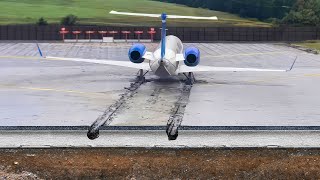
Three runway overrun incidents in September 2025, including an Embraer 145 at Roanoke and two others on the same day, were mitigated by Engineered Materials Arresting Systems (EMAS), preventing fatalities.
Runways must support aircraft weighing over 500 tonnes at speeds up to 180 mph, far exceeding highway vehicles. Design decisions like length, width, shape, and materials are critical for safety.
Length is a fundamental decision based on the critical aircraft, accounting for factors like temperature, elevation, slope, and wind. The FAA provides a 40-page guidance document on length alone.
Runways are oriented to face prevailing winds for optimal performance. Crosswind limits vary by aircraft, and FAA expects 95% wind coverage. Perpendicular runways are common where winds vary.
Water on runways can cause hydroplaning, reducing friction. Grooves, cross-slope, and surface maintenance (e.g., shot blasting) help maintain friction. The 2019 Miami Air incident highlighted the danger of ungrooved runways.
Takeoffs govern runway length and strength due to higher weight (fuel). Landings are less damaging; pavement design focuses on takeoff loads.
Runway pavement is a layered system: subgrade, drainage layer, subbase, base course, and surface. Rigid (concrete) and flexible (asphalt) pavements have different behaviors and trade-offs.
Displaced thresholds allow landing further down the runway to avoid obstacles. Obstruction surfaces are imaginary zones that must remain clear for safe approaches and departures.
Blast pads protect against jet blast erosion. Runway Safety Areas (RSAs) provide clear space beyond the runway. EMAS (crushable material) stops overrunning aircraft when space is limited.
Runway engineering involves a complex balance of cost, safety, and performance, with many hidden features like EMAS and layered pavements that ensure safe operations. The goal is smooth, boring operations that require immense behind-the-scenes work.
What is the maximum takeoff weight of an Airbus A380?
Over 550 metric tonnes.
07:50
What does EMAS stand for?
Engineered Materials Arresting Systems.
15:22
What is the purpose of a blast pad?
To protect the land behind the runway from jet blast erosion.
13:45
What is the FAA's pavement design software called?
FAARFIELD (FAA Rigid and Flexible Iterative Elastic Layered Design).
08:46
What percentage increase in landing distance does each percent of downhill slope cause?
10%.
03:56
What is the typical crosswind coverage target for runway orientation?
95%.
05:05
What is the difference between rigid and flexible pavement?
Rigid pavement uses concrete and is stronger/stiffer; flexible pavement uses asphalt and is cheaper.
08:59
What is the function of the base course in pavement?
To distribute wheel loads into lower layers, reducing stress and cracking.
11:05
What is a displaced threshold?
A touchdown point moved further down the runway to avoid obstacles, while takeoffs can use the full length.
12:21
What is the purpose of runway grooves?
To provide an escape path for water under tires, reducing hydroplaning.
06:46
EMAS Saves Lives
Demonstrates real-world effectiveness of EMAS in preventing fatalities during runway overruns.
00:01FAA's 40-Page Length Guidance
Highlights the complexity of determining runway length, a critical safety and cost factor.
02:52Hydroplaning Danger
Links a specific accident to the lack of runway grooves, illustrating the importance of surface design.
05:31Layer Cake of Pavement
Reveals the hidden, highly engineered structure beneath runways that most people never see.
08:31EMAS as Runway Truck Ramp
Compares EMAS to runaway truck ramps, making the concept intuitive and memorable.
15:22[00:01] September 2025 was an unusually bad month for runway overruns in the US. On the night of September 24th, an Embraer 145 with 53 people on board landed long at the Roanoke-Blacksburg
[00:16] Regional Airport in Virginia, overshooting the end of the runway. Just weeks earlier, on September 3rd, TWO similar incidents occurred on the SAME DAY, one a Gulfstream at Chicago Executive Airport and another a Bombardier at Boca Raton. In all
[00:32] three cases, the surface at the very end of the runway crushed under the weight of the planes’ tires. You look at the photos, and it looks like a mess, but these systems worked exactly
[00:44] as they were intended, preventing fatalities and serious injuries in all three cases. We’ve all seen a runway before. At first glance, there’s not much to it: a strip of concrete or tarmac planted on the landscape with some extra markings and lights.
[00:59] It basically looks like a short section of highway. But if you look under the surface, there is a tremendous amount of engineering that makes these facilities entirely unique from anything else we build. I want to peel back the layers and show you what
[01:14] really goes into building a runway. I’m Grady, and this is Practical Engineering.
[01:27] A fully loaded semi truck usually weighs on the order of 80,000 pounds (or 36 metric tonnes) and, depending on what state you’re in, legally maxes out at 60 to 80 miles per hour. Our highways are
[01:41] carefully engineered for vehicles in that weight and speed regime. Compare that to modern heavy jets that can weigh more than 500 tonnes or a million pounds, with takeoff and landing speeds around 180 miles per hour. Just like highways, the design decisions for runways - from length,
[01:59] to width, to shape, to materials and beyond - all have major implications on public safety. There is a long list of crashes and incidents that could have been avoided by better designs,
[02:11] and actually, a lot of the reasons we do things the way we do is because of lessons learned through previous tragedies. Maybe better than any other industry, the aviation world strives for continuous improvement through the understanding of past failures, and you can
[02:27] see evidence of that just about everywhere you look, including resources like SKYbrary. The thing is, building a runway is an extremely costly endeavor.
[02:39] to the amount of money you can spend making one incrementally safer. So there’s always a balancing act between cost and capability. One of the most fundamental decisions that affects both sides is
[02:52] length. A longer runway can accommodate larger aircraft, but it can dramatically increase costs by requiring more land and more infrastructure. It can even affect the siting decisions,
[03:04] pushing an airport farther outside a city. It’s a pretty important choice. So important that FAA has a 40-page guidance document on length alone. Based on what you want to accomplish - whether
[03:16] it’s basic general aviation at a municipal field, air cargo, medevac, or serving as a backup to the Space Shuttle program - you first have to pick a critical aircraft: the one that requires the
[03:29] longest runway. But it’s more complicated than that, since takeoff and landing performance depends on a lot of factors. High temperatures and elevation reduce the density of the air, requiring more speed for the same amount of lift, which results in longer takeoff distances
[03:44] and landing rollouts. Slopes affect both takeoff and landing as well. Uphill takeoffs are harder because the engines have to fight gravity; downhill landings require stronger braking.
[03:56] The FAA says that for each percent of downhill slope, landing distance is increased by 10%. Manufacturers of aircraft can tell you the runway requirements for a specific make and model, or FAA
[04:09] has developed curves that can help you take these factors into account to decide a runway length. When you’re driving on the highway, direction isn’t that important. Obviously, you have to get to where you’re going, but other than that, there aren’t many engineering requirements that change
[04:24] with the direction of the roadway. With runways, that’s not true. Whether taking off or landing, airplanes work best when facing directly into the wind. And in fact,
[04:36] they might not be able to land or take off at all under certain crosswind conditions. So the direction of a runway is a consequential decision. Prevailing winds vary a lot by location. In fact,
[04:48] one of my favorite types of diagrams, the wind rose, is specifically designed to show this at a glance. And if you look at enough wind roses, you’ll notice that, in some places, there’s not a prevailing wind direction at all. That’s why most large airports have perpendicular runways. Again,
[05:05] this is aircraft-dependent. Every airplane has its own crosswind limits. FAA generally expects runway orientation to provide about 95% wind coverage for the airport’s design aircraft, so in places
[05:19] without a strong prevailing wind direction, it takes a second runway to meet that target. Length and direction are easy to notice, but there’s more to the geometry of a runway. In 2019,
[05:31] a Miami Air International Boeing 737 touched down in Jacksonville during heavy rain. The aircraft skidded off the runway and came to a stop in the St Johns River. 21 people were injured,
[05:44] but thankfully, nobody was killed. When the NTSB investigated the accident, one of the main contributors was that the runway was ungrooved. The water instead building pressure in the contact patch between the tire and runway. It’s hydroplaning:
[06:03] the tires ride on the water instead of the ground, wiping out friction and directional control. Just like in a car, planes need friction to stop. Larger jets have the benefit of aerobraking,
[06:16] using devices that reverse the thrust of the engines, but regular-old wheel brakes still do most of the work. And just like for cars, water makes that much more challenging,
[06:28] so there are a lot of engineering decisions that go into maintaining good friction on the runway surface. Like highways, most runways have a gentle crown at the centerline that drops off to the sides. This cross-slope helps shed rain and stops water from pooling on the surface. Larger airports
[06:46] install grooves in the runway surface that give water an escape path from beneath the tires, reducing the chance of hydroplaning in bad weather. And this isn’t just a one-time decision. Airports use friction-measurement equipment to monitor operational conditions.
[07:02] If the surface gets too polished from use or built-up rubber from the countless touchdowns, they have to clean the surface or even retexture with shot blasting to roughen it up. Runways are a bit unusual because, when you think about it, they really have two
[07:17] very different jobs. Taking off and landing are pretty similar; one is essentially the reverse of the other. But in some ways, they’re entirely different. And so they drive the requirements for runway engineering in different ways. For example,
[07:32] it may feel like landing is the most dynamic moment in a flight, but it’s actually takeoff that usually governs runway length and strength. That’s mostly because of weight. A big part of the weight of a fully loaded airliner is fuel. An Airbus A380, the largest of commercial jets,
[07:50] has a max gross takeoff weight of over 550 metric tonnes. For a long-haul flight, nearly half of that weight can be in fuel. When an airplane touches down, even though the moment
[08:02] the wheels hit may feel impactful, the plane is much lighter. In fact, landings are so much less damaging to pavement than takeoffs that they usually don’t even count in load cycle tracking
[08:15] for the engineering design. It’s all about takeoffs, and to support those enormous loads, airport runways have some of the most heavily engineered pavement systems in the world. This is something that you’ll almost never be able to see, but the amount of consideration and
[08:31] engineering below the surface is incredible. The FAA even has its own engineering software package, complete with a wonderful government acronym: the FAA Rigid and Flexible Iterative Elastic
[08:46] Layered Design or FAARFIELD. Just like highways, you basically have two choices for runway pavement materials. Rigid pavements generally use concrete. Flexible pavements use hot-mix
[08:59] asphalt. Their behavior and performance are pretty different, so the engineering is different too. Asphalt has a small but significant measure of give to it, which causes the effective width of aircraft tires to spread out in a cone underneath the surface into the deeper
[09:15] layers. This contrasts with rigid pavement, where a tire's effective width is its actual width. Asphalt is a cheaper material, so it's used in the vast majority of paved airfields in the US. Concrete is stronger and stiffer, so most large-scale commercial airports use
[09:32] rigid surfaces. The tradeoff usually comes with volume. A rigid pavement has a longer design life, so the additional cost is offset by reduced maintenance and a longer interval before replacement. But in both cases, there’s a lot under the surface.
[09:48] It’s basically a layer cake of materials that all serve different functions. Everything sits on the subgrade, which is the natural soil at the site. The quality of the subgrade really decides everything else. The soil strength,
[10:02] its potential for shrinkage and swelling, the depth of the frost line, and the depth of the water table will drive the design. If it’s really soft and mushy, the subgrade can be amended with sand, lime, cement, or geosynthetic materials.
[10:16] Some pavements put a drainage layer on top of the subgrade. This is a permeable material, like gravel, that lets water get out of the system so it doesn’t soak the soils below, which might lead to softening and weakening over time. A runway is one place you don’t want a pothole.
[10:33] Above that, many pavement systems (especially flexible ones) use a subbase. This is a layer of course material (sometimes even crushed up bits of an OLD runway). Practically, the sub-base adds thickness cheaply. Stress from wheel loads drops quickly with depth,
[10:50] so a layer of material that doesn’t have tight engineering specifications can accomplish the depth without driving up the cost too much. Plus, the subbase serves as a working platform so you’re not mucking up the subgrade with heavy equipment during construction.
[11:05] Then comes the base course. This is the structural workhorse of a pavement system. It’s usually a mixture of high-quality crushed and uncrushed aggregates, specifically designed to lock together when compacted into a high-strength support. The
[11:20] goal is to distribute the point forces of wheel loads into the layers below. Lower stress mean less movement, which results in less cracking of the surface layer and a smoother ride over time.
[11:33] On top of all that is the surface course that provides the friction and texture. Concrete pavements distribute forces, so they don’t require quite as much engineering underneath. For asphalt, friction is essentially its only purpose. The
[11:47] layers below do the heavy lifting. And if the surface course degrades, you can often mill it and overlay it with new material without having to rebuild the entire system below. about finding the right balance between performance, cost, and constructability.
[12:06] You could just build a 10-foot-thick layer of concrete and be done with it, but eventually those costs flow to the airline tickets, and no one would be happy to pay for that! Since runways are essentially a connection to the sky, there are some quirks in their
[12:21] engineering to account for that too. One is the use of displaced thresholds. Sometimes, surrounding obstacles don’t allow for a gentle glide slope to the end of a runway. You don’t want airplanes diving steeply into a landing, so instead,
[12:36] we displace the touchdown point farther down the runway, while still allowing takeoffs to use the full length. Takeoff lengths are usually longer than landing lengths anyway, so this is a compromise worth making to take the best advantage of the surrounding airspace.
[12:51] You can only displace a threshold so much, though. Sometimes design choices and sacrifices are made to accommodate unavoidable restrictions caused by nearby terrain or buildings. Airports have
[13:04] to exist in the broader context of developed areas. So, airport designers and managers have to ensure that imaginary zones called “obstruction surfaces” are free of buildings, trees, towers,
[13:17] and anything else you don’t want to get hit by a plane. These imaginary surfaces extend farther than you might think into the air space, providing safe approach and departure paths with comfortable margins of safety. Airports don’t usually have land-use authority,
[13:33] though, so keeping the airspace free from obstructions is a collaborative, and occasionally contentious, process between regulators, cities, landowners, and developers.
[13:45] There are also areas of pavement at the ends of runways that aren’t intended to have planes on them at all. For example, larger runways include blast pads. This is one of my favorite elements of runway engineering.
[14:00] The powerful wakes produced by jet engines pick up grit and scour away the land behind them. If this is just loose soil or grass, the endless parade of planes will eventually dig a huge hole at the back of the runway! I’ve spent a lot of time working with
[14:17] concrete structures meant to curb erosion from flowing water, but there just aren’t that many pieces of infrastructure that are purpose-built to mitigate aerodynamic erosion. Blast pads can’t carry the weight of a jetliner, so they’re painted with yellow chevrons to tell pilots ‘stay off!’
[14:35] Even when a runway is long enough to accommodate the air traffic it sees on a regular basis, accidents happen, and sometimes airplanes overshoot the end of the runway on takeoff or landing. Runways are required to have a certain amount of space beyond the pavement on all sides,
[14:52] called runway safety areas or RSAs. Like the clear zones along highways, RSAs provide an airplane with room to safely come to a stop without obstacles. There are some instances where space is tight, though. Urban infrastructure, a body of water,
[15:09] or other stuff can get in the way, making it less feasible to maintain so much open space around a runway. Luckily, there’s another option: Engineered Materials Arresting Systems, or EMAS.
[15:22] These systems are manufactured from crushable material like lightweight concrete or foamed glass. In an emergency situation, they can dissipate a plane’s kinetic energy, quickly slowing it down so it doesn’t crash into whatever lies beyond. EMAS
[15:38] saved the day in all three major overrun incidents in September 2025. You can see just how effective it is in this footage from the September incident in Boca Raton.
[15:52] It’s like a much more sophisticated and carefully engineered runaway truck ramp for airplanes. There’s so much more going on in the engineering and design of runways than I can possibly cover
[16:04] in one video. I’ve tried to focus on the hidden stuff: construction techniques and requirements that you don’t really notice when you’re a passenger looking through the window and may not even be familiar with as a pilot. I really love knowing how much goes into that stuff that
[16:19] most of us never have to think about. It makes me feel safer as a passenger. It’s a reminder that smooth and boring is usually the goal, and it takes a lot of work to keep it that way.
[16:31] If you’re a fan of airports and runways, I’m sure you know my friend Sam’s channel, Wendover Productions, which has some of the deepest dives into topics on air travel. I love that stuff, but a lot of people
[16:44] don’t know about one of my favorite of Sam’s side projects, the Logistics of X. And honestly, it’s one of his best. My favorite is The Logistics of Search and Rescue. I had no idea that most search
[16:56] and rescue teams don’t have their own helicopters. It’s such a fascinating variety of topics, from mining to commercial fishing, and if you want to check it out, it’s only available on Nebula. You’ve heard me talk about Nebula before. It’s a streaming service built by and for independent
[17:13] creators, including a lot of my favorites like Neo, Wendover Productions, the Coding Train, and Branch Education. I don’t know about you, but independently-produced content is most of what I watch these days. I just like the authenticity and thoughtfulness of videos that haven’t been
[17:29] through a writer's room and ten levels of studio executives. Someone told me that Nebula’s like Netflix for people who love trains. And I like that comparison, not just because I love trains.
[17:41] Nebula’s totally ad-free, with tons of excellent channels and lots of original series and specials like the Logistics of X. Sign up for a free trial first and see what it’s all about. After three days, I think you’re going to feel like it's worth a subscription,
[17:55] especially because you can get 50% off the regular price if you use the link below. My videos go live on Nebula before they come out on YouTube. If you’re with me that independent creators are the future of great video, I hope you’ll consider subscribing. That’s
[18:10] go.nebula.tv/Practical-Engineering. Thank you for watching, and let me know what you think!


⚡ Saved you 0h 18m reading this? Transcribe any YouTube video for free — no signup needed.