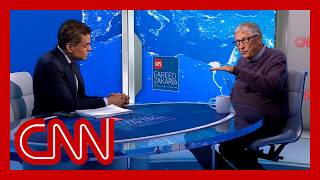

What is AGI? Bill Gates' definition
46sGates gives a clear, controversial definition of AGI by labor substitution, sparking debate on AI's impact on jobs.
▶ Play Clip"The title accurately reflects the interview content; Gates discusses navigating an AI future, including labor impacts and advice for young people. Minor exaggeration due to brevity."
Bill Gates and the interviewer discuss the rapid advancement of artificial intelligence (AI), its potential to substitute human labor in various fields (e.g., telesales, coding, legal discovery), and the challenges it poses, especially for white-collar workers. Gates emphasizes the importance of embracing AI tools while acknowledging the need for societal adjustment to avoid disruption.
The White House announced a plan to make the US a world leader in AI by scaling back regulation.
Bill Gates explains that definitions of AGI vary, often focusing on when AI can substitute human labor in jobs like telesales or support, or surpass humans in creative tasks like drug discovery.
AI can replace human work in simple coding tasks but not yet the most complex ones. Gates notes disagreement on whether this will happen in 1-2 years or 10 years.
Gates uses a 'deep research' capability daily to explore complex questions and is impressed by AI's ability to gather and summarize information.
Satya Nadella said 30% of Microsoft's code is now written by AI.
Gates predicts fewer coders, paralegals, and accountants will be needed as AI handles pattern recognition tasks, creating a more challenging job environment for college graduates.
Higher productivity is good, but rapid change could outpace society's ability to adjust, leading to dislocation—e.g., smaller class sizes or longer vacations.
Gates notes that robotic arms are not yet decent but will eventually affect larger classes of labor.
Gates works with Microsoft and OpenAI to ensure AI benefits low-income countries in health, education, and agriculture.
Gates advises: 'Be curious, read, and use the latest tools'—including AI—while acknowledging dislocation risks.
Bill Gates highlights the transformative potential of AI and its challenges, urging young people to embrace and adapt to the technology while recognizing the need for societal adjustments.
Beneficial for some, but coders may be fewer
This insight explains how AI boosts productivity while reducing need for certain roles, demonstrating a nuanced view on job displacement.
2:24[00:00] On Wednesday, the White
[00:01] House announced its plan
[00:02] to make America
[00:03] the world leader
[00:04] in artificial intelligence.
[00:06] The main way it will seek to do
[00:08] that is to
[00:09] scale back on regulation of AI.
[00:12] I recently had a chance
[00:14] to sit down with Bill
[00:15] Gates to talk about
[00:16] how he sees
[00:17] the present and future of AI.
[00:21] Bill Gates,
[00:22] pleasure to have you on.
[00:23] We've been trying
[00:24] to track on the show
[00:25] the progress of AI
[00:27] and the place we are now at
[00:29] is everybody talks about
[00:31] AGI, general intelligence.
[00:34] What's the difference between
[00:36] artificial intelligence
[00:37] and what people are now
[00:38] predicting,
[00:39] which is
[00:40] artificial general
[00:41] intelligence?
[00:43] You know,
[00:43] the people use very different
[00:47] definitions and
[00:50] you can say when is AI
[00:53] so good
[00:54] that something like
[00:55] a telesales job
[00:57] or a support job that just
[00:59] I mean, the AI do that work,
[01:01] that it's
[01:02] way cheaper and more accurate
[01:04] than humans are.
[01:06] So that's,
[01:07] you know, really
[01:07] looking at the labor
[01:08] substitution piece.
[01:10] Or you can
[01:10] look at the most creative
[01:12] things that humans do,
[01:14] like come up with a new drug,
[01:17] that,
[01:18] helps with tuberculosis.
[01:20] Us.
[01:21] and,
[01:23] you know, look at okay.
[01:25] Is I just helping humans
[01:26] get this done,
[01:27] or is it eventually
[01:29] replacing humans?
[01:30] You know, like,
[01:31] people talk about writing code.
[01:33] Simple coding tasks.
[01:34] AI today can replace human work
[01:38] the most complex coding tasks.
[01:40] It's not able to do yet.
[01:42] And people
[01:43] in the field disagree
[01:46] is that.
[01:47] And within the
[01:47] next year or two,
[01:48] or is it more like
[01:49] ten years away.
[01:51] But I
[01:52] you know,
[01:52] I it's improving at a rate
[01:56] that surprises me.
[01:57] Things like this deep
[01:58] research capability.
[02:00] You know, a few times a day
[02:01] I take some complex question
[02:03] and just for fun, I see in the,
[02:07] the AI does
[02:08] an awfully good job.
[02:11] gathering
[02:12] all the materials and
[02:13] and bringing it,
[02:16] summarizing what
[02:17] I need to know.
[02:18] Satya Nadella says
[02:20] 30% of Microsoft's code
[02:21] is now being done by AI.
[02:24] That seems inevitably
[02:25] to mean one.
[02:27] You will hire fewer coders.
[02:29] You you'll need fewer of all.
[02:30] I mean,
[02:31] what is it
[02:32] that paralegals
[02:33] do at a law firm?
[02:34] They do discovery,
[02:35] which is essentially
[02:36] pattern recognition,
[02:37] is very easy for AI to do.
[02:39] Similarly, entry level
[02:40] people at accounting for right
[02:42] all that is going to mean
[02:44] white collar work.
[02:45] College educated, graduates
[02:48] are going to have
[02:49] a more challenging
[02:50] job environment.
[02:52] Well, when you
[02:52] when you improve productivity,
[02:54] there are you can make more
[02:58] and so it
[02:59] it shouldn't mean,
[03:01] you know,
[03:02] if you get less productive,
[03:03] that's bad.
[03:03] And if you get more productive,
[03:04] that's good.
[03:05] It means you can free up
[03:06] these people
[03:07] to have smaller class size
[03:09] or have longer vacations or,
[03:14] you know, to help do more.
[03:16] So it's it's not a bad thing.
[03:19] The question is, is it
[03:20] come so fast
[03:22] that you don't have time
[03:23] to adjust to it?
[03:25] And in parallel,
[03:26] you know, the blue collar work
[03:29] when the robotic arms
[03:31] start to be decent,
[03:32] which they're not today.
[03:34] And that starts to affect
[03:36] even larger classes of labor.
[03:39] So this is a
[03:41] a profound set of changes.
[03:44] you know, I'm
[03:45] working with Microsoft, OpenAI,
[03:48] on these things.
[03:50] You know,
[03:50] my lens is
[03:51] let's make sure it gets out
[03:53] in low income countries
[03:55] to help with their health
[03:56] and education and agriculture.
[03:58] So finally,
[03:59] what advice
[04:00] would you give to
[04:02] young people
[04:03] who are thinking about
[04:04] how do you enter
[04:05] the world of AI?
[04:06] What should the skills they
[04:08] they develop be?
[04:10] You know,
[04:11] if you get to very
[04:12] profound levels,
[04:14] you almost get
[04:15] to philosophical questions
[04:17] in this transition period.
[04:19] The ability to use
[04:22] these tools
[04:23] is both fun and empowering.
[04:26] You know, I, you state,
[04:27] have an advantage
[04:28] that I have very smart people
[04:29] I can call up
[04:30] when I get confused
[04:31] about physics,
[04:32] but now I actually use
[04:34] deep research.
[04:35] And then I'll send
[04:36] that answer to my,
[04:38] you know,
[04:39] smart friends and say,
[04:40] hey, did did it get it right?
[04:41] And most time they're like,
[04:42] oh yeah, you didn't need me.
[04:45] and so you can really learn
[04:47] so much.
[04:49] and, and the idea of the tutors
[04:51] that people like Khan
[04:52] Academy are building on
[04:54] how will get that out?
[04:56] all over the world.
[04:58] And so embracing this and,
[05:02] you know, tracking
[05:03] it will be very,
[05:04] very important.
[05:06] That doesn't guarantee that
[05:08] that we're not going to have
[05:09] a lot of, dislocation.
[05:12] But I really haven't changed
[05:13] my be curious, read
[05:14] and use the latest tools,
[05:16] recommendations
[05:17] for young people.
[05:18] Be curious, read
[05:20] and use the latest tools.
[05:21] In this case, AI. Absolutely.
[05:23] Bill Gates,
[05:24] pleasure to have you on.
⚡ Saved you 0h 05m reading this? Transcribe any YouTube video for free — no signup needed.