
Top 3 Tips to Negotiate a Raise Like a Pro
33sThis segment provides actionable, expert-backed tips that viewers can immediately apply, making it highly shareable for career growth content.
▶ Play Clip"The title delivers exactly what it promises—pro-level negotiation tips for a raise, backed by a seasoned expert."
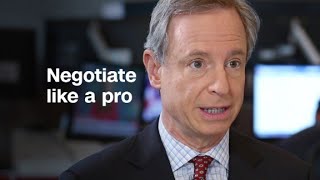
Phil DiPicciato, a top negotiator representing elite athletes like Steph Curry and Michael Phelps, shares three actionable tips for negotiating a raise or promotion. He emphasizes knowing facts from both sides, choosing an authentic negotiation style, and communicating a clear story. Key pitfalls include avoiding bluffing, impatience, and the phrase 'I want'—instead focusing on a win-win collaborative approach.
Know your facts from both sides to avoid surprises.
Any style works as long as you are authentic and comfortable.
Be clear and concise to communicate effectively what you want.
Don't bluff, put yourself in a corner, be impatient, or act disrespectful.
Avoid the phrase 'I want'; instead, lead with value to the other side.
Start by acknowledging company growth and contributions, then ask for future plans.
Secure commitment by asking if you are part of the company's future plans.
What is the first tip for a successful negotiation?
Know your facts from your side and anticipate the other side's facts to avoid surprises.
0:17
What is the second tip regarding negotiation style?
Choose a style that is authentic and comfortable for you.
0:24
What does 'get your story straight' mean in negotiation?
Be very clear and very concise so you can communicate what you want.
0:41
List four things you should definitely not do in a negotiation.
Bluffing, putting yourself in a corner, being impatient, and acting disrespectful or unprofessional.
0:50
Why does Phil recommend not using the phrase 'I want'?
Because it sounds like a demand and puts the other side on the defensive.
1:16
After acknowledging company growth, what question does Phil suggest asking?
Ask: 'Do you feel confident that we're going to continue to grow and am I part of your plans?'
2:13
Know Your Facts
Emphasizes anticipating the other side's perspective to eliminate surprises.
0:17Choose an Authentic Style
Any style works if it's genuine—a key insight for personal effectiveness.
0:24Avoid Bluffing and Impatience
Highlights critical pitfalls that can derail negotiations.
0:50Win-Win Mindset
Frames negotiation as collaborative value exchange, not confrontation.
1:05Get Commitment First
Shows how to secure a verbal agreement before discussing compensation.
2:13[00:00] If you need to learn how to negotiate, you needn't look further than Phil DiPicciato.
[00:04] Our top clients right now include Steph Curry, Michael Phelps, Jimmy Johnson, Bill Cowher, and
[00:09] many, many more. What are the top three tips you would give to someone going
[00:13] into an interview, asking for a raise or promotions, something like that? The top three
[00:17] tips are first, know your facts. And don't only know them from your side, also
[00:21] know them from the other side so that you can anticipate and there are no
[00:24] surprises. And second, choose a style. Any style works in a negotiation. One can approach
[00:30] a negotiation being nice, being aggressive, being fearful. The most important thing pieces that
[00:37] you be authentic and that you be very comfortable with the style that you choose.
[00:41] And third, get your story straight in your mind. Be very clear and very concise
[00:46] so that you can communicate what you want to communicate. Are there certain things that
[00:50] you should definitely not do? First, one shouldn't bluff. One shouldn't put oneself in a
[00:54] corner. And one shouldn't be impatient. One shouldn't act disrespectful or unprofessional. I
[01:00] would prefer in a negotiation not to use the phrase, I want. A negotiation has
[01:05] to be win-win if it's going to have a successful and long-term conclusion. I would
[01:10] always try to lead by what value you can give to the other side.
[01:16] But going in and saying I want sounds like a demand. It will put the
[01:20] other side on a more defensive posture. It's not very collaborative and it won't usually
[01:25] yield the results that you want. We've learned the skills. Now let's try this out
[01:29] for ourselves. I'm going to try to negotiate a raise for myself against 35 years
[01:35] of experience. So I've been with this company for two years. Start with the company.
[01:40] Tell me what has been happening at the company while you have been here. While
[01:45] I've been here, I have helped. Not I. What is happening at the company? I
[01:50] have seen this company grow. I am very proud of the work we are doing.
[01:56] You have put together a fantastic team. We are the pride of the industry. Positivity
[02:02] that communicates your awareness of what the other person has been doing and
[02:08] contributing to the company. I see myself growing here. I already have grown a lot.
[02:13] I see myself helping the company to grow. Put it back on them and say,
[02:17] do you feel confident that we're going to continue to grow and am I part
[02:21] of your plans? Once a company acknowledges that you are, then you've got some data
[02:26] points where you know you can say, but you said that I was good. You
[02:31] said that I'm adding value. You said you want me as part of the future.
[02:36] And that will end up becoming part of the conversation discussion.
⚡ Saved you 0h 02m reading this? Transcribe any YouTube video for free — no signup needed.