
AI Summary
This video explains the mathematics behind the blackjack insurance bet, clarifying that it is a side bet on whether the dealer has blackjack, independent of your own hand. It details when card counters should take insurance based on the true count and analyzes the special case of having a blackjack against a dealer's ace.
Chapters
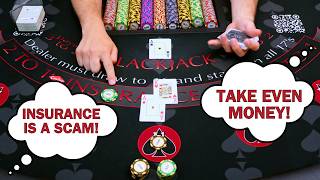
Insurance is a side bet on whether the dealer has blackjack, not related to your hand's value. It pays 2:1 and is offered when the dealer shows an ace.
With a full deck, the dealer has a 30.7% chance of having blackjack (16 ten-value cards out of 52). Insurance becomes profitable when the probability exceeds one-third (33.3%).
At a true count of +1, the probability is 32.6%; at +2, it's 34.6%. However, the recommended threshold is true +3 because aces also increase the count but don't help the insurance bet.
For shoe games (4-8 decks), take insurance at true +3. For double deck, take it at true +2.5 or higher. For single deck, the threshold is even lower.
When you have blackjack and the dealer shows an ace, all four outcomes (taking insurance or even money, with or without dealer blackjack) result in the same profit of $100 on a $100 bet.
Insurance is a mathematically driven side bet that card counters should take only when the true count is high enough. Understanding the probabilities and the special case of blackjack vs. ace ensures you never lose money on this bet.
Study Flashcards (5)
What is the insurance bet in blackjack?
easy
Click to reveal answer
What is the insurance bet in blackjack?
A side bet on whether the dealer has blackjack, paying 2:1, offered when the dealer shows an ace.
What is the probability of the dealer having blackjack with a full deck?
easy
Click to reveal answer
What is the probability of the dealer having blackjack with a full deck?
16/52 = 30.7%
03:05
At what true count should you take insurance in a shoe game?
medium
Click to reveal answer
At what true count should you take insurance in a shoe game?
True count of +3 or higher.
06:08
Why is the threshold higher than the mathematical break-even point?
hard
Click to reveal answer
Why is the threshold higher than the mathematical break-even point?
Because aces also increase the count but don't help the insurance bet, so you need extra ten-value cards to compensate.
04:42
What is the outcome when you have blackjack and the dealer shows an ace, regardless of taking insurance or even money?
medium
Click to reveal answer
What is the outcome when you have blackjack and the dealer shows an ace, regardless of taking insurance or even money?
You profit the same amount ($100 on a $100 bet) in all four scenarios.
06:59
💡 Key Takeaways
Insurance is a side bet
Clarifies a common misconception that insurance depends on your hand, when it's purely about the dealer's hole card.
Probability calculation
Provides the exact math (16/52 = 30.7%) that forms the basis for the insurance decision.
03:05Ace adjustment
Explains why the true count threshold is +3 instead of +2, due to aces inflating the count without helping insurance.
04:42Blackjack vs. ace outcome
Demonstrates that all insurance/even-money decisions yield identical profit, simplifying a common dilemma.
06:59Full Transcript
[00:00] You may have heard it said before that you should never take insurance when you're playing blackjack. Insurance is when the dealer has an ace showing and they offer you the chance to place a bet on the insurance bar, which pays out two to one.
[00:13] And most people will attribute this to their hand's value, whether or not they should insure their hand. And that could not be further from the truth. Insurance is actually a side bet whether or not the dealer has blackjacked.
[00:27] It has nothing to do with your hand. You could have a very weak hand of like a 5 or 2 and a 3. You have a 14 like I do here. You could have a 20, all right, and you can insure all those different hands,
[00:40] and it turns out that the math is the exact same at the very point that you take insurance compared to whether or not the dealer will have blackjack or not, all right? The reason is if they do have blackjack, then you no longer get to play out your hand.
[00:58] regardless of what you have. All right? A very weak hand, very strong hand, like a 20, right? Your hand is over, and you lose. But if you bet up to half of your bet, so here $50 on the insurance bar,
[01:14] then if the dealer has a blackjack, yes, you do lose your initial bet, but you get paid out 2 to 1 on the insurance bar, which here, if it's $50, I'm going to get another 50 and another 50,
[01:27] which is essentially $100 and you didn't lose any money. All right, let's talk about the math behind insurance. Then I want to talk about some nuances as to when you would take this versus when you don't want to take this.
[01:40] All right, so you can see I have a whole deck laid out for us. And I want to talk about the math behind insurance before we can get into some of the nuances of it. And if we think about kind of what's going on here, let's say we have five greens and we're taking like $50 bets or so.
[01:54] and that means that we would bet up to half or $25 on the insurance bar. And let's just see what happens if the dealer were to have three aces in a row with a high enough count and when this would become worth it to take it, right?
[02:07] So, for example, let's say we lose one, all right, the first time, and so we lose our $25. The next time we take insurance, we lose that, all right? And then the third time, let's say they do have it.
[02:19] Well, because insurance pays out two to one, we essentially get those two bets back that we bet for the insurance at those previous times.
[02:31] Now, this disregards our initial bet because, remember, this is a side bet. So we're really only focused on how much money we're losing to that insurance bet. All right. So it takes about one out of every three times for us to bet correctly and guess that the dealer has blackjack in order for that insurance bet to be worth it
[02:52] Now, the math backs this up, right? Currently, if I have a full deck of cards, here there is four 10-valued cards in each suit. So, when the dealer has an ace up, what is the likelihood of them having a 10-valued card underneath
[03:05] and actually having blackjacks? Well, there's 16 of those 10. So if I do 16 divided by 52, that is 30.7% of the time they're going to have blackjack.
[03:19] We need it to be about one-third of the time in order to make this bet worth it like you just saw here. Okay? And so because of that, that's when, if I add in a 10-valued card, and in fact, let's add in a 10 and also take out a neutral card so that we're still dividing by 52 for one deck,
[03:37] because now my true count is a true plus one. The thing with these is like the cards yet to be played, all right? And so the 10 value cards are in our favor as they're still in the shoe, all right?
[03:49] This means that all the other cards that have been played are some of the lower cards and neutrals and things, but there's one extra high value card left, and so it's in our favor now, all right?
[04:01] Because of that, the math says this is now 17 divided by 52, which is 0.326 or 32.6 percent almost 32.7 so it's still less than one-third one-third is 0.33
[04:16] repeating right so I would need at least one more 10 value card but remember this is only a true plus two now again I would take out one more neutral as now my my true count is a true plus
[04:29] two. So this would be 18 divided by 52, and that is 0.34, which is above 0.33 repeating, and therefore this is one-third. So why do we wait until a true plus three? Well, the answer
[04:42] is because it could also be an ace that's causing our counts to go up for those remaining cards in the deck. Now, for other hands, aces are really good for us to have left in the deck, but for taking the insurance bet, that ace doesn't really help us. Remember, we take insurance when the
[04:58] dealer has an ace, and this bottom card, if it's an ace, well, we don't win the insurance bet in that case. And because this could also cause our counts to go up, we're kind of banking on about every
[05:10] one out of every three of those 10 value cards that are left to be an ace. Now, it's a little bit different math than that, but kind of for the sake of this, you know, real simplistic argument here, think about one out of every three is going to be
[05:24] an ace and therefore that would bump us to a true plus three when we are confident in taking an insurance bet to win about one out of every three of those One out of every three of those will get us our money back And also remember that just
[05:38] broke us even, right? If we kind of lose one, lose one, and then win one, well, it pays two to one. And so therefore, that just breaks the deal. We want to win, right? We want to win that insurance bet more often than not. And so if it can be a little bit higher than one third, which is now at
[05:54] 19 divided by 52, which is at 36.5% of the time. That's going to be even more beneficial for us. So let's go back and check out some of the nuances of the insurance bet.
[06:08] So I showed you all kind of math behind insurance, and if you're a card counter, when you should take it, which is at a true count of plus three, if you're playing a shoe game, which is, you know, four, six, eight decks,
[06:20] or something like that that comes out of a shoe, as opposed to if you're playing double deck, you actually can take that a little bit lower at a true count of plus two and a half or higher. And we saw why, because there,
[06:32] that does bump us above one third of the time that there's going to be a 10 value card underneath. There's less aces in a double deck game, and so therefore you can take it just a little bit lower. And if you're playing single deck,
[06:44] you can even do it lower than that. So let's look at a few different situations that kind of be a little bit trickier. Let's get our $100 out there. And the trickiest is when we have a blackjack, what happens when a dealer also has an ace?
[06:59] There's four particular outcomes that could potentially happen depending on whether we take insurance or your casino might offer you what's called even money. And I'm going to show you that all four, no matter what you do, are the exact same outcome.
[07:14] All right, so let's think about this kind of like we did at the beginning. We have $100 out here. If I were to take insurance, which is betting $50, now I am sort of risking, you might say, $150.
[07:29] I still have this. This was mine at the beginning of this hand. However, let's see what happens if the dealer, in fact, has blackjack. All right. Well, it turns out that we don't lose our initial bet in this case because it is a push.
[07:47] I have blackjack and they have blackjack. But because I bet the insurance bar, I'm going to get paid out two to one. So again, all this was my money to begin with.
[07:59] And I get paid out two to one. And so how much more money do I have now? Well, those are what I initially put out there. And so you can see I ended up with $100 extra.
[08:13] All right that is kind of one case I going to take this back We going to start over Again this is all my money to begin with The other situation that could potentially happen do it like this is if I take insurance or if I bet the insurance bar right
[08:30] However, the dealer does not have a blackjack. I do end up losing the insurance bar money. but because this is blackjack I get paid out three to two okay in this case that is 100
[08:46] plus 50 okay so I guess I did lose this 50 but I gained 50 and another 100 so how much am I up
[08:58] total for this hand a total of 100 extra dollars again think of this as that insurance bet so I and I get that back, and I get $100. So again, I profited $100, same exact thing.
[09:10] Now, the next two situations are very similar, and that is even money. You might get a blackjack when the dealer has an ace showing, and instead of betting the insurance bar, the dealer might ask, even money?
[09:22] And you're saying, sure, because you know, after watching this video, that it's the exact same thing, and that is we're not going to get paid out 3-2 like blackjack normally does, but because we're risking or we're not risking the dealer having blackjack as well,
[09:39] we are just going to take even money and be done with our hand. Now, in this case, we bet $100 and we got $100. Didn't have to mess with the insurance bar, so notice that our profit is also $100.
[09:51] Now, that is true regardless of what the dealer's bottom card is. If they have blackjack or if they don't, Either way, by taking even money here, we gained $100.
[10:03] So if you were to go back and look at those four situations, the two where we got even money, we gained $100. And the two where we bet the insurance bar, when the dealer had blackjack and when they didn't have blackjack, we also were up $100 at the end of that.
[10:17] So that special situation where we have blackjack and the dealer has an ace showing, regardless of what you do with insurance or even money, you will profit the exact same amount.
[10:30] Now, that said, be very careful. You don't always want to do that. You only want to do it in those counts that are high enough. Again, it's a true count of plus three in a shoe game and a true count of plus two and a half if you're playing double deck.
[10:44] All right, guys, a little bit of a quicker video this week. Hopefully you enjoyed it, learning about insurance. If you did, please hit the thumbs-up button for me. That really helps me out. Until next time, remember, this is A1 Blackjack.