
Insurance vs Even Money: Same Thing?
45sDirectly addresses a controversial topic that sparked backlash in comments, promising to prove a surprising equivalence.
▶ Play Clip"The title promises a clear explanation and delivers exactly that, with solid math and no fluff."
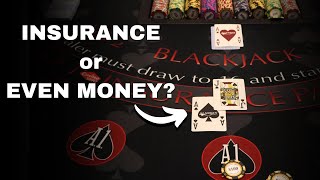
This video explains why taking insurance and taking even money in blackjack, when you have a blackjack and the dealer shows an ace, are mathematically identical outcomes. The presenter uses a deck cross-section to demonstrate that both options guarantee the same payout regardless of the dealer's hole card.
A blackjack occurs about once every 20.7 hands (4.8%). The dealer shows an ace about once every 13 hands (7.7%). The combined probability of both happening is 0.37%.
For card counters, insurance or even money is only taken when the true count is +3 or higher in a shoe game, or +2.5 or higher in a double deck game.
The four scenarios are: insurance with dealer blackjack, insurance without dealer blackjack, even money with dealer blackjack, and even money without dealer blackjack.
With a $100 bet, you bet $50 on insurance. If the dealer has blackjack, your hand pushes, but the insurance pays 2:1, netting you $100 profit.
You lose the $50 insurance bet, but your blackjack pays 3:2, giving you $150. After subtracting the lost $50, you net $100.
Taking even money pays you $100 immediately, regardless of the dealer's hand. Your hand is swept away, and you net $100.
Even if the dealer doesn't have blackjack, taking even money still pays $100, and your hand is swept away. You net $100.
Insurance is profitable when the probability of the dealer having blackjack exceeds 1/3 (33.3%). With an ace showing, there are 4 out of 13 cards (10, J, Q, K) that give blackjack, which is 30.8%. The true count threshold pushes this over 33.3%.
Taking insurance and taking even money when you have a blackjack and the dealer shows an ace are mathematically identical, both guaranteeing a $100 profit on a $100 bet. The decision to take either should be based on the true count, as insurance is only profitable when the dealer's blackjack probability exceeds 33.3%.
How often does a player get a blackjack?
About once every 20.7 hands, or 4.8% of the time.
00:41
What is the combined probability of having a blackjack and the dealer showing an ace?
0.37% of the time.
01:40
At what true count do card counters take insurance in a shoe game?
At a true count of +3 or higher.
02:07
What is the tipping point probability for taking insurance?
When the dealer's chance of having blackjack exceeds 33.3%.
07:35
How many cards in a suit give the dealer a blackjack when showing an ace?
Four: 10, Jack, Queen, and King.
07:48
Insurance with Dealer Blackjack
Demonstrates that even when the dealer has blackjack, insurance still nets a $100 profit, proving the equivalence.
03:14Insurance without Dealer Blackjack
Shows that losing the insurance bet still results in the same $100 net profit, reinforcing the mathematical identity.
04:39Insurance Tipping Point
Explains why insurance is profitable at just over 1/3 probability, not 50%, due to the 2:1 payout.
07:35[00:01] dealer's ace. What do you think is better to take insurance or to take even show you that those are the exact same. And recently, I made a YouTube short where I kind of went over the same situation and you guys absolutely hated
[00:14] little bit more time today go over some of the numbers and the math behind these hands and kind of prove that those are the exact same outcome. All right. So, to help us out, I have a cross-section of a deck here, just the spades from a
[00:28] different deck. And uh to kind of help reference back to this, remember there are 13 cards in a suit. All right? And so most of our calculations will be out of 13 as we do uh some of the math behind this. And first thing I want to
[00:41] show you is that this is a really really rare situation. In fact, it is I looked rare situation. In fact, it is I looked up uh that you get about a blackjack in about one in every 20.7 hands. So about 20 to 21 hands or so, you should get a
[00:57] blackjack on average. Now you might get two back to back and you might not get another one for next 40 hands or so and that would still yield about the same result there. But that's 4.8%. Okay. Now you also or I guess the dealer
[01:12] is also likely to have an ace showing one and 13 times which again makes sense. If I have my 13 cards here, how many of them are an ace? One, right? So about every 13 hands or so, they will have an ace showing. Now, the math gets
[01:26] a little bit less likely to happen when they have a 10valued card because we're not going to go over that math today because as long as there's an ace showing and you have blackjack, that is about if I turn these into decimals. So
[01:40] this would be 0.048. This would be 0.077. And if I multiply those things together, that gives me 0.00369 or about 0.37% of the time you will have a blackjack
[01:53] and the dealer will have an ace showing. So the potential for this to happen is really rare. And also if you're a card counter, it's even more rare because we know we don't take insurance or we don't take even money unless the true count is
[02:07] a plus three or higher. And if it's double deck, then it' be a plus two and a half or higher for the true count. And so again, even more rare that this would happen, but I do want to go over this situation because you guys were not
[02:20] happy in the comments of that YouTube short. And so we're going to see why this is the exact same thing. Now, there's four potential outcomes that could happen. Uh the first thing is that you could take insurance and the dealer
[02:34] would have blackjack and you get paid 2 to1. The second thing is you could take blackjack and you would lose the insurance bet, but you would win and this would be paid three to two. All right. The third thing that could happen
[02:46] is you take even money and the dealer doesn't have blackjack. Fourth thing is you could take even money and the dealer does have blackjack. So, I think those are our four possible outcomes. I'm going to show you that no matter what
[02:59] happens, you are likely to or you are uh guaranteed to end up with the same amount of money um in all of those different cases. Okay. So, first off, to take insurance, you bet half of your initial bets. So, if this is $100 here,
[03:14] initial bets. So, if this is $100 here, we bet 50 on the insurance bar. All right? So, let's do that first. And let's say for this first time that the dealer does have blackjack. So, what happens? Well, they're going to flip
[03:27] happens? Well, they're going to flip their blackjack over and because you also have blackjack and they have blackjack, you push your hand. Okay? You push your hand. However, you also win the insurance bet which pays two to one,
[03:43] right? Insurance is basically a side bet. We're betting that the dealer has blackjack. In this case, they did. So, because this pays two to one, you get paid if this is $50 here, you get two more sets of 50, which is $100. All
[03:58] right? So, keep that in mind. You are up $100 right now. If you take insurance with a blackjack and the dealer having ace, and they also have a blackjack. do that or not, that's a whole different issue. Okay? We're going to talk about
[04:12] So, I know some of you in the comments like, "That doesn't even happen." Okay? I I get it, right? They might not let you. That's fine. But remember, right now, you're up $100. So, I'm kind of showing that this would pay the same
[04:25] whether they let you do one thing or the other. All right. The next thing, so I'm going put this all back. The 100 came from here. And the next thing that could from here. And the next thing that could happen is that you bet the insurance bar
[04:39] and the dealer doesn't have blackjack. So, what happens this time? Let's say So, what happens this time? Let's say they have a 20. Okay. Well, first off, bet. Remember, this kind of like a side bet. Side bets get swept away before you
[04:54] taking this away. So, right now, you're down 50, but because you have blackjack, blackjack pays 3 to2. Okay. So, I'm going to get $100 and 150. Now, if you
[05:09] remember what happened there, we had 50 that we lost, but now we got 150. So 150 that we lost, but now we got 150. So 150 minus 50 is 100. So those two things are the exact same. We got $100 regardless of whether we took insurance and the
[05:24] dealer had it or we took insurance and the dealer didn't have it. All right. Again, I'm going to put those back. And this time, let's say, let's go back to having a blackjack for the dealer. This time, let's say that we want to
[05:40] take even money. Okay? Okay. So, before the dealer puts their uh card in the to see if they have blackjack or not, they can ask, "Would you like even money?" And as a card counter, if the count is high enough, so at a true count
[05:54] of plus three or higher or two and a half in a double deck game, uh we would say, "Yeah, I would like that." Right? We don't have to mess with insurance. But what am I paid if this is even money? $100. And is that the same thing?
[06:08] Yes, it is. Okay. So your hand gets swept away at that point because you are already paid. There's nothing left that you can do in your hand because that's over. Now the dealer had blackjack, but it doesn't matter because you got paid
[06:23] the even money. All right. So again, I'm going to reset this. And this last time, the last and final thing that could happen here is that you're going to take you need your cards. you're gonna take even money and the dealer isn't going to
[06:39] have blackjack. And this is very similar to the last one because again, if the count's high enough as a card counter, we're going to take even money. All right. And again, our hand gets swept away. Doesn't matter what the dealer
[06:53] has, blackjack or something else. In this case, something else. What are we paid? $100. So, is that the same thing in all four situations? Yes, it is. We got $100 every single time. And so I hope that's enough to convince you that
[07:08] that's the same thing. Now again, some of you are going to say in the comments, insurance or to take even money." And you are absolutely right. Remember what you are absolutely right. Remember what I said earlier how rare it was. It is
[07:21] 37% of the time that this would even happen. And that's before we have a high happen. And that's before we have a high enough true count as a card counter to make it worth it to take insurance. The idea behind taking insurance, by the
[07:35] way, isn't if I take my uh cards back out here, isn't that it's going to be over a 50% chance um of the dealer having blackjack, but it's actually over just onethird of the time that they would. That's the tipping point. In
[07:48] fact, if I think that right now when the dealer has an ace showing, how many cards would give them blackjack of the 13? There's only four, a 10, jack, 13? There's only four, a 10, jack, queen, and king, which four out of 13
[08:01] queen, and king, which four out of 13 cards here, that is a 30.8%. cards here, that is a 30.8%. So that's just under 1/3. 1/3 is 33.3%. But as our true count rises at a 2 and 1/2 in and double deck and a three, a
[08:14] shoe game, that is the tipping point where it goes over that 33.3%. And because we get paid 2 to one, that's why it's not 50% because we're getting
[08:26] kind of double our money, if you will. And so it only has to be at 33 and a3% uh for us to be able to take that insurance bet. Okay. So, that's might be
[08:38] but in this one, hopefully you kind of realize that taking insurance or taking even money when you have a blackjack and the dealer has an ace showing is the you, please give me a thumbs up. If it didn't, drop a comment down below and
[08:52] I'll try to help explain. [Music]
⚡ Saved you 0h 09m reading this? Transcribe any YouTube video for free — no signup needed.