
Treasury yields spike: Why stocks are selling off
60sExplains a complex market dynamic in simple terms, triggering curiosity about the impact on personal finances.
▶ Play Clip"The title overpromises 'breaking' news and historical proof, but delivers routine Fed commentary and generic election-stat hand-waving."
Snapshot 2026-10-31
Every observation TubeSum recorded, plotted as measured.
Based on 3 observations · last observed Oct 31, 2026 · straight lines connect consecutive observations — TubeSum does not measure the days between them.
Exact daily observations; gaps mean no observation was taken that day.
| Date | Views | Avg views / hour | Channel median |
|---|---|---|---|
| 2026-10-31 | 675,479 | 9,513.8 | 269,142 |
| 2026-10-30 | 606,662 | 12,907.7 | 269,142 |
| 2026-10-29 | 458,686 | 19,942.9 | 269,142 |
The video breaks down the immediate market conditions surrounding a Federal Reserve rate pause, focusing on inflation, Treasury yields, and a historically narrow stock market. It explains how a few mega-cap tech stocks are propping up the S&P 500, creating a K-shaped economy, and then explores the pressure it puts on the Fed and investors. The final part offers practical advice on positioning a portfolio amid uncertainty and highlights the sponsor SoFi.
Inflation rose to 3.7% in September, a level not seen since 2023.
Wholesale prices surged 1.3% in September, more than double expectations, and are up 6.3% over the last year.
The 20-year Treasury reached its highest level in decades, pushing investors to prefer guaranteed returns over stocks.
The top seven companies (Apple, Microsoft, Nvidia, Amazon, Alphabet, Meta, Tesla) make up over 35% of the S&P 500, and the top 10 stocks have driven 59% of all gains this year.
AI investment accounts for a third of US economic growth, while the rest of the economy shows weakness (e.g., only 29,000 jobs added in September, new home construction down 5.2%).
Historically, midterm years have averaged only 7.5% returns, with an average 17.5% drop from peak to trough. Yet, after the election, the S&P 500 has been higher 12 months later 19 out of 19 times.
The Fed paused rate hikes but signaled more work to do; chair Kevin Walsh has stopped giving forward guidance, leaving markets to guess.
The S&P 500's CAPE ratio sits at 41 (near dot-com bubble peak), yet stocks trade at an average 20 times earnings, making valuations a mixed signal.
Inflation jumps to 3.7% in September
Provides a concrete data point showing inflation resurging, key for understanding the entire video's thesis.
02:04Top 7 stocks dominate the S&P 500
Explains the index's growing concentration, which is crucial for investors' risk assessment.
04:21AI accounts for a third of US economic growth
Illustrates the AI-driven split in the economy, with non-AI sectors nearly stagnant.
05:07Midterm years average only 7.5% returns
Provides historical context for market weakness during election cycles, contradicting the current year's exception.
08:15Market prices in more hikes despite pause
Shows that the Fed's pause may be temporary, impacting rates for mortgages and loans.
12:16[00:01] ready because everything's about to go to All right, I know that joke's seriously wrong with our economy. And what worries me even more is that most investors are completely clueless with what's about to happen. After all,
[00:15] inflation is rising. Nearly 40% of the S&P 500 is already in a bare market. And the United States, we could be on the verge of something that almost nobody is to break down exactly what the Federal Reserve just said as of a few hours ago.
[00:32] The impact that this is about to have on stocks, midterm elections, and the entire economy. And then most importantly, what you could do about this starting today, because the real danger isn't what everyone's worried
[00:44] about. Instead, it's what everybody is ignoring, which we'll cover as soon as you haven't done that already. All right, I know you're sick and tired of me begging for likes. I don't like it either, pun intended, but it does help
[00:57] the channel tremendously and is a thank you for doing that. I will give a random comment $100 if you leave a comment in the next 12 hours. How about that? So, you so much. And also, big thank you to SoFi for sponsoring this video, but more
[01:11] on that later. All right, so in terms of what Kevin Worsh just said, the risks to about, and then most importantly, what you could do today to get ahead of it bonds. Look, really quick. I've said
[01:24] Treasury bonds basically make up the foundation of our entire financial system because those interest rates determine how much it costs to borrow money for everything. We're talking mortgage rates, personal loans, credit
[01:37] lines. Basically, think of this like an IOU. And in this case, the borrower is the United States government paying you back basically guaranteed interest. So, what's the problem? Well, in the last few weeks, those interest rates have
[01:50] skyrocketed with the 20-year Treasury reaching its highest level in decades. All thanks to the neverending boogeyman of inflation. When it comes to this, unfortunately, according to all of the data out there, the prices of just about
[02:04] everything is getting out of control. In fact, inflation just rose to 3.7% in September, back to a level that we haven't really seen since 2023. On top of that, this could get even worse because there's another inflation report
[02:17] that gives us a glimpse into what's coming next, and that's what's known as the producer price index. Basically, this measures what businesses pay for goods and services before they potentially pass those costs on to you.
[02:29] And in terms of those numbers, it's honestly, it's pretty bad. Like, in September alone, wholesale prices surged 1.3%, more than double what economists expected. Plus, over the last year, those prices are up a whopping 6.3%.
[02:44] four years. Or I guess to sum all of this up, these factors caused interest rates to surge to unprecedented levels over these last 3 to four weeks. And that raised a very interesting question to investors. Because if you could get
[02:59] paid more than 5 1.5% risk-free every year for 30 years, backed by the US government just for owning a Treasury bond, why hold stocks? Why buy real estate? Why take the risk for any investment when you could get a
[03:13] guaranteed return buying a US bond instead? And uh yeah, you get where I'm going with this. Over the last few days, we've seen a rather dramatic sell-off in the markets. And when investors sell their stocks because they're afraid of
[03:26] how much these companies are spending and potentially losing on AI buildouts, the safest places that they could find, which of course, you guessed it, is these Treasury bonds backed by the US government. And that is what's leading
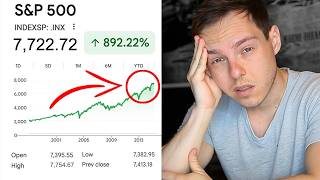
[03:39] to a market sell-off. Look, when it comes to the stock market, once you zoom out and look at the year-to-date returns, objectively, stock prices look like they've performed incredibly well. However, when you look beneath the
[03:52] surface and just exclude the top seven stocks holding up the rest of the market, as it turns out, everything else is completely fine. No joke. According to Auter's analysis, more than four to 10 stocks in the S&P 500 is down for the
[04:05] year. How? Well, remember that the S&P 500 isn't 500 equal slices. Instead, it's weighted by size. And that means the top seven companies, we're talking about Apple, Microsoft, Nvidia, Amazon, Alphabet, Meta, and Tesla, make up more
[04:21] than 35% of the entire index, which is more concentration than almost any other sector ever in history besides the railroad bubble in the 1800s. Or basically, think about it this way. When you invest $1,000 into an S&P 500 index
[04:36] you invest $1,000 into an S&P 500 index fund, $400 of that goes into just 10 companies. and then the remaining $600 is split amongst the remaining 490 companies. This means when the top seven makes a move, your entire portfolio
[04:52] makes a move right alongside with them. And funny enough, those top 10 stocks have been responsible for 59% of all gains this year. This is why we have a K-shaped economy within the stock market that is completely split in two. Plus,
[05:07] happening with stocks. It's literally throughout everything. Like Iinging says that AI investment alone accounts for a third of all US economic growth this year. Meanwhile, the rest of the economy is barely moving. Like employers added
[05:22] only 29,000 jobs in September. July was revised down to a loss and new construction for homes fell 5.2% with one economist warning that the housing market is headed for a deep freeze. This means both our economy and our stock
[05:36] market is entirely dependent on a few companies spending hundreds of billions of dollars on AI. And look, don't get me wrong, if it goes well, we're all going to make a ton of money. But if it doesn't and investors start thinking,
[05:51] wait a second, how long is this going to take to start to pay off? And what if it doesn't? That's where we run into problems. That's why in terms of what happens next, how midterms could wind up flipping everything. And then what Kevin
[06:04] Walsh just warned us about when it comes to interest rates. Here's what you came for because I have a feeling the real danger is probably not what you're that, I just want to say that while everyone's focused on the Federal
[06:16] Reserve, interest rates, and what happens next with our economy, there is another major shift happening right now in our markets, and it all has to do with cryptocurrency. When it comes to this, without exaggeration, there are so
[06:28] many new potential opportunities on the horizon. But getting started can often feel overwhelming and complicated. And with so many platforms out there, it could be hard to know where to even begin. But that's where our sponsor SoFi
[06:40] is able to help. In fact, from now until December 2nd, you'll be able to earn up to $1,000 in your choice of crypto. But more details on that very shortly. For those unaware, SoFi is the first nationally chartered bank where you
[06:52] all from one simple app. This means instead of throwing your money in a random spot and hoping for the best, SoFi gives you a federally regulated platform with all the safeguards of a bank. They even give you in-app guidance
[07:05] could better understand what you're doing before making any decisions. Not buy and sell cryptocurrency from within the same SoFi app as the rest of your manage your cryptocurrency right alongside with your SoFi checking,
[07:20] savings, and investments without jumping between platforms. Of course, crypto is sure it makes sense for your financial situation before investing. But if SoFi, a nationally chartered bank. Just head to sofi.com/gram
[07:36] description to start your crypto journey with SoFi today. Plus, like I said, new customers will be able to earn up to $1,000 in crypto in your choice of Bitcoin, Salana, or Ethereum. All the information is down below in the
[07:50] description. Thank you so much, and now, let's get back to the video. this is about to have throughout our entire economy and then most importantly
[08:02] what you could do about it, there is one more catalyst that no one's talking about that is about to happen next week. And that's what's known as the midterm curse. See, for those unaware, historically midterm election years are
[08:15] the weakest for the markets during any presidential cycle. In fact, since 1970, the stock market has averaged just 7 12% during midterm years, compared to 12.4% in every other year. And since 1950, the average drop from peak to bottom during
[08:31] a midterm year has been 17 1.5%, the deepest of any year in the cycle. In terms of why, well, the market hates uncertainty. So rather than take risks, investors are more likely to take their capital out of the markets, keep it on
[08:46] the sidelines until they could see what's probably going to happen, and right now, the election forecasts are pointing to a potential Democratic sweep, which of course could be a huge
[08:58] have. However, even though the election year itself is usually pretty weak, the good news is that after the election results are in, usually the markets tend to rally. And in terms of how much money you could make, since 1950, the S&P 500
[09:14] has been higher 12 months after every single midterm election 19 out of 19 times with an average gain of about 15%. In fact, the best was 33% in 1954, and the worst was still up 1.1% after 1986,
[09:31] which fun little tidbit there, that was even after the 1987 Black Monday crash. Although, in terms of this election year though, here's where 2026 gets very interesting. Surprisingly, this year has broken nearly every single historical
[09:46] trend ever in history. Like instead of getting the typical 17 and a.5% decline, the biggest drop has so far been just 9% and the market's already up 10% heading into the election. Which raises a very interesting question. Did we already get
[10:02] the post-election rally early before the midterm elections even happened? Well, to answer that, we got to go all the way back to 1874 because believe it or not, the stock market has gone up following 32 out of 38 midterm elections or
[10:17] roughly 84% of the time. Now, of course, those are pretty good historical odds that yes, we'll continue to go higher. Of course, it's not a guarantee, but what I did find the most interesting is that in terms of midterm elections, it
[10:30] has no consideration whatsoever in terms of market gains. Who gets seats, who loses seats, who wins, who loses, it does not matter whatsoever. Instead, the results are in and investors could plan from that point forward. So, even though
[10:46] midterm elections are soon coming to an end, which should in theory unlock some pretty cool profits, there is another hold up to the economy, and this is the entire reason I am posting this video today. And that, of course, leads us to
[10:59] the Federal Reserve. Like I mentioned earlier, as of a few hours ago, the Federal Reserve decided to pause any interest rate hikes and keep everything the same until their meeting in December, at which point, let's be real,
[11:12] anything can happen. After all, in their words, inflation is still high. They've already raised interest rates, and there's a lot more work that they need to do, which points to probably higher rates in the future. But unfortunately,
[11:24] the Fed chair Kevin Walsh refuses to give us any guidance on what's coming next. After all, in their words, inflation is high. They've already raised rates, and there's a lot more work to do. So, that points to most
[11:37] likely higher interest rates in the future. But unfortunately, the Fed chair Kevin Walsh refuses to tell us what's coming next. Like earlier in the month, he said that I don't prejudge meetings and that when it comes to giving the
[11:50] markets a heads up, he said that we're not in that business anymore, which is basically another way of saying that all of us are on our own. Like previously under Jerome Powell, the market would get a playbyplay. He would give
[12:02] indications of what they were likely to do. He would sprinkle in little hints. He would talk to journalists and really signal his intentions going forward so this time we get absolutely nothing. That's why as of now the market's
[12:16] pricing in a very high likelihood of another rate hike occurring unfortunately in December with about 50 basis points of hikes baked in for the next 6 months. So if you're waiting around for lower mortgage rates or maybe
[12:29] better personal loan rates, all I got to say is uh good luck. Anyway, best case here is that oil cools off. we reach a temporary agreement with Iran enough to smooth things over temporarily and then we get just one rate hike and that's it.
[12:44] But worst case is that oil keeps going higher. Inflation gets worse and the Fed raises interest rates during a time when we're adding fewer jobs than we have in most people are missing and then most
[12:58] here's what you came for. Overall, I'm going to be honest with you. I'm a little more cautious about stock market valuations today than I had been in the past. Not because I think there's going to be a crash coming soon, but just
[13:11] because when I look at valuations, it gets me a little cautious, a little nervous. Like, look at the S&P 500's cape ratio. This compares prices to the last 10 years of earnings, and it's now sitting around 41. For reference, the
[13:25] only time it's been higher than this is the peak of the dot bubble at 44. Now, to be fair, prices could just as easily keep going higher, and the bull case is actually pretty good, too. Like, when you look at the S&P 500's expected
[13:38] earnings, the S&P 500 is trading at roughly 20 times profits, which is average. And unlike the previous bubbles, these companies are making a boatload of money. There is so much money out there that it's pretty
[13:52] surprising. And that also makes me think that, hey, we could have a long ways to go. That's why the question today isn't whether or not stocks are overvalued. It's whether or not their earnings could justify the prices today or if earnings
[14:05] have to come down eventually to reflect reality. Or really, I guess from my perspective, this is why I just like having a bit of a buffer so that if something happens, I have some cash or some treasuries to fall back on to
[14:17] continue buying the dip. Again, not because I I think there's going to be a I'm just going to go and buy the bottom." Listen, I I don't try to time the market, but I like to make sure I'm never going to be a force seller and
[14:30] that if something falls, I have more dry powder just to keep buying in. On top of to be diversified. Make sure that you don't have all of your money in like just the S&P 500 or just tech stocks. Instead, maybe look into international
[14:44] stocks, some bonds, some treasuries, a little cash, maybe a tiny bit of cryptocurrency, maybe gold. It doesn't matter. It's just really important that if one thing falls, you have something else to fall back on. And then finally,
[14:57] just make sure you have a steady income because with hiring slowing down this matter a lot more than whatever the market does. So do whatever you can to keep your job, keep a consistent income. And then again, that way you keep buying
[15:10] in even if the market drops, even if the market goes, you're just going to be end of the day, I just believe that we should expect the best, but also prepare for the worst because I'm not going to pretend this market is cheap. But I'm
[15:22] it's going to happen either. And my entire strategy from the very beginning is just keep buying no matter what and hitting the like button and subscribing with that said, thank you so much for watching. And also, if you want bonus
[15:35] videos from me every single week, as well as early access to content that I don't post publicly, feel free to join as a channel member. you'll be able to get extra videos from me that sometimes are just too niche to post on YouTube or
[15:48] enjoy those extra videos. These are topics that I just I really enjoy talking about, but I know they wouldn't do well for a big audience. So, hope you enjoy that. Feel free to uh join that. Thank you so much and until next
⚡ Saved you 0h 16m reading this? Transcribe any YouTube video for free — no signup needed.