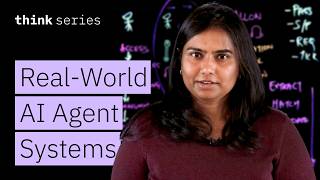

Why AI Agents Fail in Real World
46sContrasts impressive demos with real-world failures, creating curiosity and engagement.
▶ Play Clip""
[00:00] Today, there's a lot of excitement around AI agents.
[00:03] We've seen impressive demos of agents that plan, reason,
[00:13] and act across tools.
[00:16] But the real question isn't whether we can build them or not.
[00:20] The real question is what it takes to make an AI agent effective in real-world environments.
[00:26] When agents move from demo into production systems,
[00:30] many fall short, not because technology is incapable,
[00:34] but because real-world problems are complex, constrained, and interconnected.
[00:40] So instead of focusing on what AI agents are, I want to focus on how they behave in practice
[00:46] when embedded into real world systems.
[00:49] Most real world agent problems share the same core challenges.
[00:54] The first one, they span across multiple systems.
[01:00] Second one, they involve a lot of policies, approvals, and rules,
[01:06] they must fit into existing workflows,
[01:11] and the human should always be in the loop.
[01:16] Because of this, successful agents aren't standalone decision makers.
[01:21] They act like coordination layers,
[01:24] maintaining context, orchestrating actions across systems, enforcing
[01:29] rules, and determining when control needs to be transitioned to a human.
[01:35] A common pattern in real-world agent system is coordinating a sequence of
[01:40] actions across multiple systems while managing state,
[01:48] timing,
[01:51] rules, and exception.
[01:56] This pattern shows up anywhere a single event triggers a multi-step workflow with dependencies.
[02:04] One concrete example of this pattern is onboarding a new employee.
[02:11] Onboarding isn't an easy task.
[02:14] It's a workflow composed of many steps, starting with provisioning, access and entitlements,
[02:21] ordering required resources, scheduling initial activities, assigning required trainings and tracking them to completion.
[02:32] In this use case, agents don't replace people.
[02:37] It uses context-based signals such as roles, location, and start date to sequence actions across systems,
[02:47] monitor workflow state, and flag deviation from expected behavior.
[02:52] The hard part isn't reasoning.
[02:54] It's reliably orchestrating multiple systems while respecting policy and timing constraints.
[03:02] Another recurring pattern is policy-governed action execution, where risk, rules, and access control shape
[03:11] what actions a system is allowed to take.
[03:14] This pattern appears whenever a system is handling incoming requests with very level of sensitivity or impact.
[03:23] IT support is a good representation of this pattern.
[03:26] In this case, agent may process requests such as passwords, software
[03:33] or hardware resources, any requests that come through,
[03:40] ticketing, and routing of any requests.
[03:45] Some requests follow a well-defined and low-risk execution path.
[03:50] Others require validation, approval, and sometimes escalations.
[03:55] An effective agent in this case interrupts requests intent, evaluates the applicable policies,
[04:04] automatically executes some of the permitted actions, escalates any ambiguous or high-risk cases.
[04:14] This shows the explicit control boundaries.
[04:18] The system behaves predictably and humans step in precisely where the rules need them to.
[04:25] In other cases, agents operate inside a well-defined processes where exceptions are the real challenge.
[04:33] This pattern shows up in systems such as invoice processing or order management.
[04:39] In this case, an agent may,
[04:41] extract
[04:45] structural data, match it against the existing record, validate it
[04:56] against rules or concerns,
[04:58] or route approval and lastly, update the downstream systems.
[05:08] This is a happy path.
[05:11] Which is straightforward.
[05:13] The real complexity lies in handling missing data, mismatch data, or any non-standard conditions.
[05:24] Agents add value by consistently handling predictable flows and surfacing only through exception for human reviews.
[05:33] Another important pattern involves triaging and routing large volumes of incoming work.
[05:40] This pattern appears wherever the system needs to prioritize attention under load.
[05:46] A customer service is a great example for this.
[05:50] Here an agent
[05:52] must analyze
[05:58] and categorize incoming requests.
[06:02] Route
[06:05] work to the appropriate teams,
[06:07] and suggest responses based on historical data.
[06:15] Humans still resolve the issues, but agents ensure the priority, context, and routing decisions are applied consistently at scale.
[06:26] The pattern holds regardless of where the work originates.
[06:30] Across all the patterns that we saw, regardless of the domain, the same characteristics apply.
[06:38] A successful AI agents are narrowly scoped, they orchestrate across systems, apply rules, and relate its signals.
[06:56] Keep human in the loop and are designed for integration and not isolation.
[07:05] These systems don't feel like flashy AI features.
[07:09] They feel like well-designed components of a larger architecture.
[07:13] The real power of AI agents is in the autonomy.
[07:17] It's its alignment with real workflows, limits, and control structures.
[07:23] When agents are designed around coordination, rules and accountability.
[07:29] They stop being experiments and start operating as reliable components in production systems.
[07:36] That's what it takes to make AI agents work in the real world.

⚡ Saved you 0h 07m reading this? Transcribe any YouTube video for free — no signup needed.