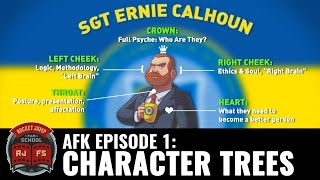

What is the Character Tree Method?
45sThe opening clearly explains a unique character development tool, hooking viewers interested in writing.
▶ Play Clip"Delivers a solid, practical breakdown of the character tree method, though it's padded with casual banter and could be more concise."
This video from RocketJump Film School explains the 'character tree' method for developing deep, nuanced characters, using the character Calvoon from their series 'BGH' as a case study. The hosts walk through each part of the tree—from surface details to deep psychology—showing how this framework helped them break through creative blocks and create more compelling stories.
The character tree is a guide for in-depth conversations about character, created by Stonecrate Hulk, used to change a character's story by breaking down their psychology.
The hosts use Calvoon from BGHS as an example because key moments in his story were only resolved by doing this kind of character work.
The seat covers obvious, tangible details: appearance, occupation, personal history, family, and background—like a Wikipedia article about the character.
Calvoon is a former BGHS alum, which explains why the school is so important to him and why he believes in the Institute.
A key scene where Calvoon mentors Brian was improved by realizing Calvoon is a father figure with a two-year-old, making his advice feel authentic.
The groin covers primal wants and desires—what gets the character out of bed. For Calvoon, it's being left alone and having things work smoothly.
Calvoon is romantic, not lustful, and represses his emotions. He can overreact and get irritated by people when things affect him.
The heart is what the character secretly needs to become a better person. For Calvoon, it's feeling like a winner again and being vulnerable with the kids.
The throat is how the character projects themselves—posture, attitude, presentation. Calvoon has a soft voice, contrasting with his tough exterior.
The left cheek is rationality (Calvoon is smart, logical, practical), and the right cheek is ethics/soul (he's not artistic but appreciates realism, and is secretly romantic).
The crown synthesizes everything into an archetype—Calvoon is a 'tough ass with a heart of gold,' but the tree adds depth beyond that cliché.
There's no single process; the character tree is a tool to think about a character across the entire diagram of a person. Other versions exist online.
The hosts encourage viewers to create a character tree for their own characters and post it on the RocketJump forums for feedback.
The character tree is a powerful framework for developing complex, nuanced characters by examining them from surface details to deep psychology. By using this method, writers can unlock new story possibilities and create characters that feel real and compelling.
The 'My Kid's a Jerk' Moment
This insight transformed Calvoon from a cliché mentor into a relatable father figure, showing how the tree can unlock authentic character moments.
02:35Heart Over Desire
Distinguishing between wants (groin) and needs (heart) is a core principle for creating characters with depth and growth potential.
04:41Soft Voice as a Character Choice
A simple vocal choice can dramatically change a character's presentation without altering dialogue, demonstrating the power of the throat.
06:23The Crown as Archetype
Synthesizing all parts reveals the character's core archetype, but the tree adds nuance beyond the cliché.
09:00[00:00] The character tree is the method we actually want to talk about today. So basically, it is a guide to having those in-depth conversations about character that you can use to change your story. This is a tool expressed by our good friend of the show, Stonecrate Hulk, who some of you might know.
[00:16] This is his method, which is to break your character's psychology down into what he calls a character tree. What we'd like to do today is walk through the character tree with you guys by talking about one of the fan favorite characters from BGHS, Calvoon.
[00:32] Yeah. We figured it would be better than just doing like Brian or Jenny or those because, you know, their own screen life and their characters are kind of pretty, you know, expressed there. But it's also important because there's some key moments with Calvoon that were only kind of broken by doing this kind of work.
[00:45] And so we did this kind of work, you know, when Calvoon was just like the gruff teacher who like, you know, hard ass with a heart of gold. who are like, kind of like Brian, but still get in a rough time. It works. There's certain moments where we're like, s***, we need some.
[00:58] There's certain moments where we're like, crap, we need more. You know, we need to really figure out who Calvin is. Brian. Brian! Brian! No!
[01:10] So we're going to start at the seat, which does not actually describe what they wear on their shoes, on their feet, but is about obvious, tangible details about a character. Yeah. This is everything from what do they look like?
[01:22] What's their occupation? Even, like, what is their personal history? Like, if you were to look up a Wikipedia article about Calhoun, what would it say when you click on the best part about his background? How did they grow up?
[01:34] What is their family like? You know, like, the very surface-level personal history details that inform a character a lot. This is something that hasn't shown up in the original season, in the two seasons we showed you, but he will show up in season 3, is that Calhoun is a former BGHS alum.
[01:49] Yeah. That he went to the school back in the day, and that sort of shooting up the tree for a second is one of the reasons why BGHS is so important to him. Yeah. He believes in the Institute. You'll find that really simple stuff like that ends up affecting this idea of a character with his life on the tree
[02:04] as a kind of a metaphor. It's Harley, so he's big and he's got a scary beard, and he's like 90 feet tall. He's a... He wasn't as iron as like his actual... Yeah, I was looking at the administrator, he's just worn down a little bit by his day-to-day.
[02:19] One big moment to see the suit is Calhoun coming to Brian. Like, we wanted Calhoun to be the father figure in that moment, which I think wasn't that surprising. Like, I, you know, I was like, I'm really happy with that. You've seen this scene a lot. The stern, patronly mentor drops the mask for a second and gives the kid some good advice.
[02:35] And we didn't want it to feel like a cliche. We wanted it to feel like really close. And we knew Brian was going to be beating himself up and feeling down and the scene didn pop until we thought about Calhoun more I think when you came over to the point where you were like you not a jerk Brian my kid a jerk And we were like oh my god that the kind of guy we were It just kind of instantly made sense
[02:53] You're not a jerk. Believe me. My kid's a jerk. Like, hardcore. He has a two-year-old. Yeah, he has a two-year-old. He's a three-year-old, and throws spaghetti at him, he's come from work, he's got to deal with a little kid. Clearly the guy's a pain-bill.
[03:06] Like, you know, has loved and lost, and like, can't stand kids. It's a very kind of real sort of administrative character. So moving on to the groin. The groin is all about wants. It covers all of the things about the character that are born out of impulse and desire.
[03:21] It's what you want on a primal level that kind of gets you out of bed in the morning. For God, I would like the simplest one would be like to be left alone. Yeah, exactly. Be quiet, you know. You just want things to work. Like the tools should be working.
[03:33] Things should be clean. Like just go to your classroom. Just do your homework. People think, people to be rational, like don't bother them with problems. Dean Calhoun, I respectfully request to be withdrawn from Fetty's class. Yeah, no.
[03:45] They don't get to do that. They don't get to withdraw from class. You have to get kicked out by the teacher. And that ain't never going to happen to ugly narc. But, okay, but that doesn't make any sense. There's got to be a loophole or something. Why don't you look for that loophole elsewhere?
[03:59] If you two don't mind, I have a school to run. How do you think Calhoun's sexuality manifests itself? I think he's, you know, I think he's a romantic guy who is not about the number of times he has sex. I think it's like, I think it's like, you know, him and his wife probably like every two weeks like have a nice dinner and he really makes it special.
[04:16] I think he puts the effort in. I don't think he sleeps around. If he's not lustful, what goes through his head and at least what is he indulgent about? What is he sort of, what about his juvenile or immature?
[04:28] He'd be very, I think, non-empathetic. Two others, I think if something's affecting him, he can overreact and get incredibly irritated by people. He's repressed. That's, I think, definitely something you talk about. And, um... And then just don't repress.
[04:41] Okay. That's one of Matt's flaws, is that right? Uh, yeah, I think you got it, actually. Moving on to heart. The heart is essentially all of the things that they secretly need in their lives to make them a better, more functional person.
[04:55] This should be less about what you think the character needs, or thinking that people like this deserve, and more about looking at where their flaws lead them to. Yeah. So, uh...
[05:07] I don't know all the degrees on the here, but, like, what I think is one of the first things is being a winner again. Like, truly feeling like he is... Because we talked about it, right? He's very proud. He's somebody who's had these great experiences back in the day. He was a hot spot at VJ.
[05:22] He says, and I think he loves his job these days, but I think it's also a job that just makes you never feel, he's never gonna feel like a champion. It a constant assault on your dignity Yeah He needs to feel like a kid again And I think that is maybe something he doesn even recognize by himself All even adults need to get drunk or goof off and play around and screw around
[05:40] with toys and stuff again and he's just someone who doesn't allow himself any of that. He has to be with those 100% of the time. 24% Yeah. Cool and then he gets back home and is a two year old. So one thing that would make him a better being is to open up more with the kids. Like to actually be
[05:53] vulnerable and have an authentic interaction with someone that isn't about different-playing them. So that is hard, and this is the really exciting part. This is where this character really starts to get under way. Like, here you've got like a shell, then with growing you've got like a cliche, and then like here's where you get into the really interesting stuff.
[06:10] Moving on to the Throat. The Throat is basically their posture, attempt, and presentation and affectation. This is how they literally project themselves through the world. Yeah, the difference between what you're born with and then how you choose to play yourself.
[06:23] This was something that wasn't in the draft, but again, Harley brought to it, which is that he has a very soft voice. Yeah, which I would love for him to be like, but not from actual times. Yeah, well, which I love that Harley doesn't reminisce the character. He brings this very soft, quiet...
[06:36] But yeah, he could have been Sergeant Finn barking out his orders in the southern drawl. Again, without changing a word of dialogue, your characterization can change massively. To me, the iconic out-of-image is just... And then the copy.
[06:48] You know what I mean? I think that he puts up a wall, because he is a wall. Yeah. He wants to be a wall. And it's a very, there's nothing joking about it. You're not loose. There's nothing fun. It's don't mess around. This is serious.
[07:00] I'm serious. Thank you, seriously. You're not getting emotions in here. I'm not protecting them. Yeah. Just go bounce off of the wall. Yeah. We're moving up the ladder now into the left cheek and right cheek,
[07:12] which is basically, it's another way of saying the left, right, and the right. Yeah. In terms of the left cheek, the left cheek deals with rationality. How smart is Talbot? I think Talbot is actually very smart. He's a classic example of a guy who's smart enough, but maybe not empathetic enough to
[07:26] know maybe not everybody can be as smart as him. So in the element of like, go fix it. Like, Brian's complaining, like, I don't have to fix it. Like, go do the mop. Do the mop. Like, get a job. It's a very simple, like, it's logical before it's emotional.
[07:40] I think he solves problems logically in as few steps as he can. This is not someone who I think is going to do a lot of talking about how people heal. Or does he not even think he's necessarily interested in coming up with a creative solution to problems?
[07:53] Is he just trying to come up with a simple solution to problems? He's very practical. He's very practical. So let's talk about his right cheek. The right cheek is their ethics and their soul, and exposes their right-brained sort of activities and abilities.
[08:06] Maybe he's not artistic, but I don't think that flows out of him naturally. Like if you were to show him two paintings and ask him which one he liked more he would pick the one that was more realistic He would be like if you go down he be like oh I like that drawing it like a really technical drawing or something It really looks like the thing that it looks like you know He wouldn go into an impressionistic painting of a butterfly it like a blur
[08:28] You know what I mean? You've got to bring him when he's an engineer. He'd be an engineer and he wouldn't be an architect. And you know, that doesn't mean he's not festive. I think he's probably, he'd cry in the whole deal. He'd cry in the whole deal.
[08:40] He would cry. But you know, he wouldn't be confused by a double life of right or something. or something, like he does not get it. He's upset because he's done done his idea, he has this romantic view of EJ Jess and the cynical side of him just keeps getting proven right. You know, every time a kid acts like a jerk, every time kids care more about like going to the pros than they do about the game, it just probably disappoints them and that kind of sums up like how it was intended to be.
[09:00] You put it all together in terms of what's called the crown or what is your whole picture of the arc? What's weird is in a weird way when you get the crown you can almost essentially say an archetype. Because essentially he's the ass, he's like the tough ass of the heart of gold.
[09:12] But it's not just that, right? Because he involves all this other stuff. But that is essentially his pathology, that is kind of the way he acts. He's a guy who acts very tough and very emotionless and very pragmatically, but he follows up underneath it.
[09:25] Yeah, that's the tip of the iceberg in here. It's like this is the part you see the hard ass of the heart of gold. There's no single process for any of this stuff. And this is, as we said, this is essentially we're using our brand's own critical, like specific version of character tree.
[09:38] If you look online, you'll find they're all essentially more or less the same thing in terms of the details of characters going into their psychology, right? And maybe certain other ones will work for you. But again, all they do is just look out the results.
[09:50] And the result of this is you thinking about your character across the entire diagram of a person. So I hope this was helpful. And for extra credit, one thing you should do is you're writing, and even if you've got emails, this is short. Like, it doesn't matter how simple you think your story is.
[10:03] If you're working on something now or you're thinking about working on something, you know, come up with a character tree and post it. And you know what the good thing would be, if somebody can look at your character tree and they're intrigued and they understand the character, you've done a good job.
[10:15] If there's no story yet and you were in a good character tree, I'm going to be like, whoa, like, I get who that guy is. Like, I want to see a story about this guy. You know, maybe people on the forums will clearly even be able to start coming up with stories. They can develop a complex, nuanced character tree that, you know, has contradictions with
[10:30] the character. You understand, like, what they'd be uncomfortable doing, what they'd be comfortable doing, what goals would be difficult for them, what goals would be easy. Yeah. If you've done that, stories will just start coming out. So, yeah, so go to rocketjump.com, slash whatever it says right here,
[10:43] and you can go to the forums and post your character tree and talk about today's episode of ASA and also check out the other episodes of Rocket Jump. Those are cool. Thanks, guys. Thank you.
[11:06] .



⚡ Saved you 0h 11m reading this? Transcribe any YouTube video for free — no signup needed.