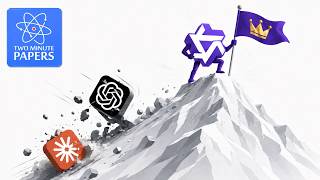

OpenAI's Worst Nightmare?
42sThe opening directly challenges OpenAI with a cheaper, faster AI model, sparking curiosity and debate.
▶ Play Clip"Delivers on the promise of a new open model challenging OpenAI, with concrete details and benchmarks."
The video discusses the release of Qwen 3.8 Max, an open-source AI model that challenges OpenAI and Anthropic's frontier models. It highlights the model's capabilities, including a 1 million token context window, multimodal features, and autonomous agentic workflows, while emphasizing its significantly lower API pricing. The video also mentions the release of smaller Qwen models, which are considered best-in-class for their size, and praises the open-source community's contributions.
Qwen 3.8 Max is an open model that competes with OpenAI and Anthropic, offering similar performance at a fraction of the cost (5-10x cheaper). It is multimodal and has a 1 million token context window.
The model is great for agentic workflows, demonstrated by its ability to work independently for extended periods, allowing users to focus on other tasks.
Qwen 3.8 Max can autonomously write, test, and repair its own code for up to 16 days, starting from an empty folder. It can reproduce and improve research papers.
The low API pricing of Qwen 3.8 Max may force other AI providers to lower their prices, benefiting consumers.
The weights for Qwen 3.8 Max will be released soon, but the model is too large for most users to run locally. However, smaller Qwen models (3.6, 27, 35 billion) are available and are considered best-in-class.
The smaller Qwen models are likened to the 'Toyota Corolla' of AI—reliable, efficient, and free to own, making them ideal for users with modest resources.
The video highlights 'Humanity's Last Exam' as a reliable benchmark. Initially, top closed models scored ~2%, but now open models exceed 50%, showing rapid progress.
The video celebrates the contributions of Qwen to open science and open-source AI, calling it a golden age with new releases every week.
The video concludes that Qwen's open-source contributions are accelerating AI progress, making advanced models accessible and affordable. It encourages viewers to explore these models and use Lambda for running AI experiments.
What is the context window size of Qwen 3.8 Max?
1 million tokens
00:33
How long can Qwen 3.8 Max work autonomously on coding?
16 days
01:04
What benchmark is mentioned as reliable for measuring AI performance?
Humanity's Last Exam
02:50
What was the initial performance of top closed AI systems on Humanity's Last Exam?
About 2%
02:50
What is the approximate performance of open models on Humanity's Last Exam now?
Over 50%
03:08
16-day autonomous coding
Demonstrates a significant leap in AI autonomy, capable of sustained independent work.
01:04Humanity's Last Exam benchmark
Provides a reliable measure of AI progress, showing open models surpassing closed ones.
02:50Golden age of open science
Highlights the rapid pace of open-source AI development, benefiting the entire community.
03:23[00:03] free AI system with Deep Seek Flash on the lower end. Super quick, super cheap. But what about the Open Frontier models? This is Quen 3.8 Max. And look, OpenAI
[00:17] and Anthropic are getting challenged there too. And not only that, but the price maybe even five to 10 times cheaper depending. It is multimodel. So it has eyes and ears 1 million token context
[00:33] window and it is great for agentic workflows. This is actually one of the key points. They demonstrated it working independently while you get out there independently while you get out there and live an active scholarly life. An
[00:47] absolutely lovely value proposition. You see, nobody has to be scared. It's not advertised by hacking into other people's systems. just productivity and tranquility, man. Sign me up for that. Especially that many other systems have
[01:04] to tap out within minutes to hours. And if you think one day of independent work if you think one day of independent work is impressive, well, try 16. Yes, it sat there thinking for 16 days, starting from an empty folder, writing, testing,
[01:20] and repairing its own code. It can reproduce research papers and even improve them meaningfully. Stunning. It can also create incredible websites and apps with ease. The value proposition is so amazing and the API
[01:37] proposition is so amazing and the API pricing comparatively so low. I think it might force the other players to adjust their prices down. That is great for us fellow scholars. And they have committed to releasing the weights soon as well.
[01:51] to releasing the weights soon as well. Oh, now since it is gigantic, not many of us will be able to run the full model at home. But here comes the best part. Dear fellow scholars, this is two minute papers with Dr. Kohaa. Now hold on to
[02:04] your papers, fellow scholars, because the best part is that there are going to be a variety of other smaller models too. The earlier smaller models Quen too. The earlier smaller models Quen 3.6, 27, and 35 billion have legend
[02:19] status. And despite being several months old by now, many of you fellow scholars still consider them the best in their categories. They are the Toyota Corolla of the AI world. And that is the real news for most of us with more modest
[02:34] resources. Yep, this might be your next daily driver that you can own for free. Wow. Oh, and I almost forgot. I'll give you a little secret. There are many benchmarks. Some of them are gamed, some of them less. So I think this is one of
[02:50] the good ones. Humanity's last exam. Devilishly difficult academic benchmark when it started out the best billion dollar closed AI systems were able to do about 2% on it. Now just a bit more than a year later an open model well over
[03:08] 50%. Keep an eye on this benchmark because it has been one of the most indicative of real life performance for most brilliant fellow scholars like you. What a time to be alive. Quen's contribution to open
[03:23] science and open source is simply incredible. We are being spoiled here with amazing new gifts every week. It is the golden age of open science and open
[03:35] the golden age of open science and open AI systems. I am incredibly grateful for this. I use Lambda to reproduce AI research papers often in minutes. It's also great to train your own models or fine-tune an existing one. Run inference
[03:50] or text to image or video. Easy peasy. Running a DeepSeek chatbot or agent. Super fast, super reliable. Lambda gives you powerful NVIDIA GPUs to run your own
[04:02] experiments. I test ideas from the papers I cover and moments later results. Love it. Seriously, try it out now at lambda.ai/papers.

⚡ Saved you 0h 04m reading this? Transcribe any YouTube video for free — no signup needed.