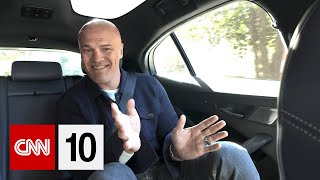

First Ride in a Self-Driving Car!
45sPersonal, first-person experience with futuristic tech creates immediate curiosity and relatability.
▶ Play Clip"The title accurately reflects the content: a special CNN 10 episode explaining self-driving cars with real-world testing at Curiosity Lab."
Host Koiwire visits Curiosity Lab in Peachtree Corners, Georgia, a nonprofit testing ground for autonomous vehicle technology on public infrastructure. The episode explores how companies like May Mobility test self-driving cars, drones, and delivery robots in a real-world environment with pedestrians and traffic. Key technologies like lidar are explained, along with the safety and accessibility benefits of autonomous vehicles.
Curiosity Lab is a nonprofit that helps companies test tech on public infrastructure like roadways, intersections, and airspace.
The lab has a closed three-mile loop inside a 500-acre ecosystem with real pedestrians, cars, and intersections for realistic testing.
May Mobility's AVs use nine cameras, five lidar sensors, and radar. Lidar fires millions of laser pulses per second to create a 3D map.
Lidar was developed in the 1960s and used on Apollo missions to map the moon. It stands for Light Detection and Ranging.
AVs learn from historical data in different weather conditions (heat, snow, etc.) to adapt to new environments.
Over 40,000 road deaths in the US last year; AVs could reduce accidents from human errors like texting, drowsiness, and intoxication.
In Minnesota, the biggest rider groups are seniors and middle school students who lack transportation options.
What does LIDAR stand for?
Light Detection and Ranging
6:50
When was lidar developed and what was its first major use?
The 1960s, originally used on Apollo space missions to map the moon's surface.
5:48
How many cameras and lidar sensors does a May Mobility AV have?
Nine cameras, five lidar sensors, and radar units.
5:24
What is the 'middle ground' testing environment at Curiosity Lab?
A closed three-mile loop inside a 500-acre ecosystem with real pedestrians, cars, and intersections.
1:55
How many road deaths occurred in the US last year according to the video?
Over 40,000 deaths in the US from road accidents in the previous year.
8:35
Which two groups are among the biggest riders of May Mobility's AVs in Minnesota?
Seniors and middle school students.
9:16
How does lidar create a 3D map of the environment?
It fires millions of laser pulses per second in every direction to create a detailed 3D picture of surroundings.
6:07
Color printer and Haze modem invented in Technology Park
Shows the historical innovation legacy of the area where Curiosity Lab is located.
0:40Middle ground testing environment
Explains the critical step between closed tracks and full urban deployment for AVs.
1:55Lidar's Apollo origins
Connects modern AV technology to historic space exploration, adding depth to the explanation.
5:4840,000 road deaths vs. AV safety potential
Provides a compelling safety argument for autonomous vehicles by citing human error statistics.
8:35AVs learn from diverse weather data
Highlights how machine learning and historical data make AVs adaptable to different climates.
7:08[00:12] What's up everybody? Koiwire here with a
[00:14] special edition of CNN 10. Today we're
[00:16] taking a deep dive into the world of
[00:18] artificial intelligence and self-driving
[00:20] cars. Today we're going to Curiosity Lab
[00:23] in Peach Tree Corners, Georgia to
[00:25] experience this tech firsthand. This is
[00:27] my first time in a Whimo. Let's go.
[00:31] You could call this one of the most
[00:32] advanced smart cities in the world.
[00:35] Tomorrow's technologies being tested and
[00:37] created today. The color printer was
[00:40] invented here in Technology Park. The
[00:42] Haze modem, too. Now, autonomous or
[00:45] self-driving vehicles are being steered
[00:48] to new frontiers. Air package delivery
[00:51] systems via drones. Mobile delivery
[00:54] robots tested and perfected. Where are
[00:57] we? What is this place? I feel like I
[00:59] stepped into the future.
[01:00] >> This is Curiosity Lab. We are a
[01:02] nonprofit just inside the city of Peach
[01:04] Tree Corners. And what we do is we help
[01:06] companies test and deploy their
[01:08] technology on public infrastructure. So
[01:10] that meant always sounds super cool, but
[01:12] it is. I mean, think about all the stuff
[01:14] that public infrastructure entails,
[01:16] right? Roadways, intersections, even
[01:18] airspace. Um, a lot of different
[01:19] technologies work on those things.
[01:21] >> And that's very important because we're
[01:22] living at a time where we're seeing more
[01:23] and more of it, hearing more and more
[01:25] about it. They might be taxi cabs that
[01:28] are flying through this city. So how
[01:31] well all do you help companies prepare
[01:33] us for that type of future?
[01:34] >> Sure. So when it comes to an environment
[01:37] like what is the ideal environment for
[01:38] testing? So you always start in a closed
[01:40] environment, right? There's there's no
[01:42] things coming in in terms of variables.
[01:43] You want to make sure the product works.
[01:45] So in the case of a vehicle on a
[01:46] roadway, that would be like a closed
[01:48] track. But we also know that from there,
[01:50] how do you get into an urban
[01:51] environment? How do you get into a real
[01:53] city? And you've got to have that middle
[01:55] ground. We have a closed three mile loop
[01:57] inside a 500 acre ecosystem so that
[02:00] cars, technology, drones, whatever it
[02:02] is, can test in a real environment where
[02:04] there's real pedestrians, real cars,
[02:06] real people, real intersections. So you
[02:08] can start to get the data and learn how
[02:10] these technologies work in real time
[02:12] with real elements so that you know,
[02:13] hey, we're ready to get into the city.
[02:15] >> I just saw a robot fly by. I don't know
[02:18] what it was, but
[02:19] >> oh my gosh, I think it might have been
[02:20] Cheetah. She's a cute little thing.
[02:22] Basically, she's a helping hand
[02:24] essentially. She is a a robot that
[02:26] follows a subject in front of it. So,
[02:27] it's not a self-driving one. It's not
[02:29] like it's doing delivery, but it's more
[02:31] like, you know, a robotic dog that
[02:32] follows you everywhere.
[02:33] >> You don't need to carry a backpack
[02:34] anymore.
[02:34] >> It's exactly what it is. It's a rolling
[02:36] robotic backpack. You open up the uh vat
[02:39] inside of it, and you know, they have
[02:40] different inserts. I mean, you can make
[02:41] it follow you like a tailgate. Um, but,
[02:43] you know, it also increases
[02:44] accessibility for things like disabled
[02:47] folk or even elderly and, you know,
[02:49] walkable communities if you're at the
[02:50] airport and you need help carrying
[02:52] stuff. Um, so it's cool. The fun fact
[02:54] there is that its design was based off
[02:57] of the droids in Star Wars. So they're
[02:59] they're quite cute, I think.
[03:01] >> Now you're speaking my language. Where's
[03:04] my lightsaber? I feel cars whizzing
[03:06] behind me. So tell me what's happening
[03:08] here. What are we seeing? What are we
[03:09] learning from what we're seeing?
[03:11] >> Yeah, absolutely. So we talk about, you
[03:13] know, the roadway. Um that is a very
[03:16] loaded thing to think about. There's so
[03:18] many things going on at all different
[03:19] times on the roadway. And as drivers,
[03:21] you know, we learn to get used to these
[03:23] things. You learn when someone's going
[03:24] to cut in front of you. You learn how to
[03:26] interact with different lights and
[03:28] different signals and different signs.
[03:29] You know, what we're doing here is we're
[03:30] using uh cameras and we're putting
[03:32] analytics over those cameras to show you
[03:34] what's happening in here. So, um this
[03:36] can be a forum of AI, right? So, it
[03:38] could be doing things like object
[03:39] detection. As you can see here, it's
[03:41] looking at vehicle vehicle. It could
[03:42] clock a, you know, a bicyclist or a
[03:45] pedestrian, which we're seeing a couple
[03:46] pedestrians come right there. So, it
[03:49] says unknown and that's a part of
[03:51] testing, right? Is that, you know, it's
[03:52] still learning. It says person now as
[03:54] it's getting closer to the camera.
[03:56] >> Um, but that's part of it, right? Is
[03:57] there are times where a truck comes
[03:58] through and it and you know, it might
[04:00] say person and you're like, well, that's
[04:01] definitely not a person. But that's why
[04:03] you need the testing environment so they
[04:04] can train their AI models to do better.
[04:06] >> Okay. So, we've spoken about the cities,
[04:08] the roadways, the intersections of
[04:10] tomorrow.
[04:12] Also, there will be the cars of tomorrow
[04:14] that work better with that. And I
[04:16] understand there's a garage where we can
[04:18] maybe check out one of these cars. Put
[04:19] me to work.
[04:20] >> All right, let's do it. Let's go.
[04:22] >> The company testing out their fleet of
[04:24] autonomous vehicles at Curiosity Lab
[04:26] during our visit is called May Mobility.
[04:29] These cars use similar technology to the
[04:31] brands we may be familiar with like
[04:33] Whimo. But this company is particularly
[04:35] interested in making AVs that are more
[04:38] accessible for passengers who use
[04:40] wheelchairs, scooters, or need other
[04:42] accommodations.
[04:43] >> In order for an autonomous vehicle to
[04:45] work, you have to have a bunch of
[04:47] different technology, right? So, you've
[04:49] got to have the hardware, and I'll walk
[04:51] through that in a minute. And you have
[04:52] to have the software, which is pretty
[04:54] much the brains of the technology. So
[04:56] the AI component, you're using
[04:58] human-like reasoning, which is basically
[05:01] the software component, and combining it
[05:03] with all the things you're gathering
[05:04] from the hardware so that the technology
[05:07] can make thousands and thousands and
[05:09] thousands of scenarios and decisions in
[05:11] real time.
[05:12] >> Mhm.
[05:13] >> So you'll see here different
[05:15] technologies. A lot of people say this
[05:16] looks like a cup holder. It is not. It's
[05:20] actually technology.
[05:22] And you'll see cameras here and LAR
[05:24] sensors. We have a total of nine cameras
[05:27] all around the vehicle. And then we have
[05:29] five LARs and radars. The other big guy
[05:32] here, the top hat, is basically um our
[05:35] largest LAR. And that is able to look
[05:38] out further away so that we can see
[05:41] what's happening in real time.
[05:43] >> While autonomous vehicles are relatively
[05:46] new, lidar has actually been around for
[05:48] quite some time. It was developed in the
[05:50] 1960s and it was actually used on the
[05:53] Apollo space missions to map out the
[05:55] surface of the moon. It uses lasers,
[05:59] shoots them out everywhere to measure
[06:00] distances and create an incredibly
[06:02] accurate picture of an environment.
[06:05] Here's how it works. The system fires
[06:07] millions of laser pulses
[06:10] every second in every direction. They
[06:12] bounce off surrounding objects to create
[06:14] a detailed 3D picture of its
[06:16] surroundings. That includes everything
[06:18] from buildings to other cars, people,
[06:20] and animals. It's similar in a way to
[06:23] echolocation, the system used by bats,
[06:25] whales, and dolphins to navigate and to
[06:27] hunt prey. But this system swaps the
[06:30] sound waves for light. You may have seen
[06:32] the rapidly spinning mechanisms on some
[06:34] of these autonomous cars. Well, that
[06:36] allows them to have a 360° field of view
[06:40] to help eliminate blind spots and safely
[06:42] navigate the world around them.
[06:45] Pop quiz hot shot. Self-driving cars
[06:48] often use lidar to scan surroundings.
[06:50] What does lidar stand for? Light
[06:51] detection and ranging. Laser
[06:53] identification and radar. Light
[06:55] identification and response. Looking
[06:57] into dangers around the route. Answer is
[07:00] light detection and ranging. Lidar is a
[07:03] remote sensing method used to examine
[07:05] the surface of the earth. So what you
[07:08] want to do is you want to use a
[07:10] combination of historical data, right,
[07:12] which it's accumulated over time based
[07:15] on different locations. So for example,
[07:18] let's say you're in Georgia, hot
[07:20] weather, right? You're in Phoenix,
[07:24] Arizona, hot but dry weather, and you're
[07:27] in Michigan where you have snow. So, you
[07:30] want to be able to take all of those
[07:32] elements and have the vehicle learn from
[07:34] all the different weather conditions so
[07:36] that when it's a location, if we happen
[07:38] to get snow in Georgia this year, the
[07:41] vehicle will know what to do.
[07:43] >> But I think about, you know, my
[07:45] daughters when they're old enough to be
[07:48] going places,
[07:50] I think that I would feel comfortable
[07:51] with them being in a vehicle all to
[07:54] themselves. The tech is only going to
[07:56] get better, right? And you would think
[07:58] as there are more and more autonomous
[08:00] vehicles on the roadways that are now
[08:03] communicating with each other, they're
[08:05] like computer brains communicating with
[08:07] other drivers. And so you would think
[08:10] that would be even safer than kind of
[08:13] guessing and wondering what a human
[08:15] might do.
[08:16] >> There's a lot of um transparency and
[08:19] visibility into a vehicle. you have
[08:21] cameras everywhere and um so you you can
[08:25] see what's happening and so for them in
[08:28] a lot of ways they're probably a lot
[08:30] safer you know in the vehicle we all
[08:32] know that you know last year I think
[08:35] there were over 40,000 deaths in the US
[08:38] from um accidents road accidents it's
[08:41] things like you know falling asleep
[08:43] texting and driving intoxication so all
[08:46] of those things can happen you know with
[08:49] with your
[08:50] right for the future. So, and I would
[08:53] argue that for the future and maybe even
[08:55] today that these vehicles are for, you
[08:57] know, safe and hopefully that's their
[08:59] future. And then you've got to think
[09:01] too, there's others as well. I mean, you
[09:03] have kids, right? But there's um people
[09:06] with disabilities, great for them. And
[09:09] then, you know, people who are elderly,
[09:11] right? They can come in and use those
[09:12] vehicles. In um Minnesota, we have um
[09:16] one of our biggest groups of riders are
[09:19] seniors and the middle school kids
[09:22] because they
[09:23] >> not seniors in high school.
[09:24] >> No, senior citizens. Yes, that's senior
[09:26] middle schoolers and middle schoolers
[09:28] because you know a lot of times they
[09:30] don't have a way to get home um you know
[09:33] after after school activities and so
[09:36] this is a way for them to do it safely.
[09:38] >> What do you think? I want you to press
[09:40] pause for a moment. Discuss with your
[09:41] friends if a self-driving car service
[09:44] was widely available in your city or
[09:45] town. Maybe they already are. Would you
[09:47] use them? Would you trust AI over
[09:49] getting your own driver's license? What
[09:51] are the risks? What are the benefits?
[09:53] Thanks for taking a ride with me today
[09:54] on this special edition of CNN 10. I
[09:56] learned a lot today. I hope you did,
[09:58] too. Be kind, stay curious, and rise up.
⚡ Saved you 0h 10m reading this? Transcribe any YouTube video for free — no signup needed.