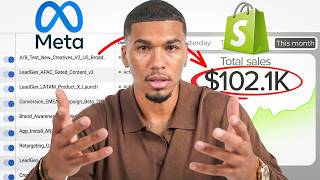

Good Ad vs Bad Ad: The $484K Difference
60sThe stark contrast between a failing ad and a $484K ad with 184K likes creates curiosity and a clear 'aha' moment for viewers.
▶ Play Clip"Delivers a solid, actionable strategy, though the title oversells the 'blow up' promise; content is genuinely useful for beginners."
This video presents a comprehensive beginner-friendly strategy for running profitable Facebook ads for dropshipping stores. The creator, AC from Supreme Ecom, details a systematic approach covering creative development, campaign structure, and performance metrics, using a real product example to illustrate the process.
The video introduces a method to take new dropshipping stores from zero to their first $1,000 day in weeks, designed to be simple and maximize profit on every ad dollar spent, regardless of budget size.
The creator contrasts a poor ad (text-heavy, no hook, unengaging) with a high-performing ad that generated over $484,000, highlighting the importance of hooks, visual storytelling, and authenticity in creative.
The 3x5 framework involves creating 15 original creatives by combining 3 ad types (problem-solution, founder VSL, social proof) with 5 ad angles (vanity, social proof, skeptic, before/after, price flip) to give the algorithm enough data to find winners quickly.
The creator emphasizes using Campaign Budget Optimization (CBO) to let Facebook allocate budget across ad sets, avoiding the learning phase reset that occurs with manual budget splitting. He recommends a single campaign with five ad sets, each targeting a different angle.
The video advises against detailed targeting, showing how narrowing an audience from 239 million to 9.4 million limits reach. It recommends keeping targeting broad and using Advantage+ placements to let Facebook's AI optimize delivery.
Instead of complex KPIs, the creator provides three rules: kill ads with CTR under 1.5% (hook test), fix the store if clicks don't convert to add-to-carts (website test), and kill ads that spend the break-even amount without a purchase (wallet test).
Two scaling methods are presented: increasing the campaign budget by 20% every 2 days, or duplicating the winning ad with a different thumbnail to reach a fresh audience without increasing budget.
The video provides a complete, actionable framework for Facebook ads, emphasizing creative variety, algorithmic trust, and simple metrics. By following the 3x5 creative framework, CBO campaign structure, and three rules for ad management, beginners can systematically find and scale profitable ads.
What is the 3x5 framework for Facebook ads?
Creating 15 original creatives by combining 3 ad types (problem-solution, founder VSL, social proof) with 5 ad angles (vanity, social proof, skeptic, before/after, price flip).
07:12
What is the minimum CTR to consider an ad's hook effective?
1.5%. If CTR is under 1.5%, the hook is not stopping the scroll and the ad should be killed.
25:06
What does CBO stand for and what is its main advantage?
Campaign Budget Optimization. It lets Facebook allocate budget across ad sets, spending more on better-performing ads, which is more efficient than manual ad set budgeting.
13:35
What is the 'wallet test' rule?
If an ad spends the break-even amount (e.g., $20) without a purchase, kill it and test a new angle. The audience has spoken; it won't turn around.
26:20
How many conversions per ad set does Facebook's algorithm need to optimize?
At least 50 conversions per ad set to complete the learning phase.
12:00
What are the two scaling options for a winning ad?
1) Increase campaign budget by 20% every 2 days. 2) Duplicate the winning ad and change the thumbnail to reach a fresh audience.
27:15
Why does the creator recommend broad targeting?
Because narrowing interests limits reach (e.g., from 239 million to 9.4 million) and Facebook's AI is smarter at finding buyers than manual guesses.
17:04
What is the 'website test' rule?
If people click the ad but don't add to cart, the ad is fine; the problem is the store. Fix product images, price, or page load time instead of turning off the ad.
25:42
Authenticity beats polish
Highlights a key principle: people trust people over faceless brands, making authentic content more effective than polished commercials.
06:43The 3x5 framework
Provides a concrete, actionable method for creating a large volume of creative variations to feed the algorithm.
07:12Learning phase requirement
Explains the technical requirement of 50 conversions per ad set, crucial for understanding why budget splitting fails.
12:00Broad targeting wins
Demonstrates with numbers how detailed targeting limits reach, advocating for algorithmic targeting over manual guesses.
17:04Three simple rules
Simplifies ad management to three actionable metrics, removing the complexity of spreadsheets and multiple KPIs.
24:25[00:01] that I use to take brand new dropshipping stores from zero to the first $1,000 day in weeks, like the store that I just started and scaled to store that I just started and scaled to over $100,000 in just 24 days using this
[00:13] massive ad budget or some [music] deep understanding of KPI metrics to follow along, you don't. This method is designed to be simple to follow, simple to manage, and built to maximize profit on every dollar that you spend. So,
[00:26] whether your ad budget is $100 or $1,000, this will get you growing just everything that you need to run profitable ads, so lock in. Now, running Facebook ads without the right creatives is like pouring premium gas into a car
[00:40] with no engine. You can throw money at it, but your car won't move. That's why resonate with your target audience and work best for your product is so crucial you a crystal clear understanding of how important this is, let's play a quick
[00:56] game of good ad versus bad ad so you can see the difference yourself. Okay, if this was an ad, I would not even know it's an ad in the first place. And scroll right past this. I'm seeing a bunch of text in this description, and
[01:11] then I've seen a bunch of text in this screen, which I can barely see because the formatting is not even good. And then the description is even more text. So, for me, it's feeling like I'm reading an entire novel. And honestly,
[01:24] grab your attention. There is no hook, there is no image that's going to make you want to see more. I mean, I do see that this is like from a doctor, which is great, but doctor type of ads don't really interest me unless I know that
[01:37] it's going to actually help my type of health. Even just looking at this and trying to compare this as a bad example to you guys, I don't even want to look at it because it's just not interesting, it's not grabbing attention, and
[01:50] honestly, it's not showing anything behind what the product can really do. Facebook to read a commercial. People are scrolling because they want to see to see pictures of things that they like, and videos that can keep them
[02:04] entertained. And looking at this does none of what I just mentioned. And the is usually when I'm doing a lot of different things at once. So, there is absolutely no way I'm going to stop my day to read, squint my eyes, and try to
[02:19] see all this different stuff inside of this one ad that really just looks like that I wouldn't read any of this and that I would ignore this ad, think of advertiser. This ad is going to show up to Facebook in terms of bad quality and
[02:34] bad engagement ranking because nobody's going to engage with this. And that's only going to make the advertiser have to spend more money to try to target more people who probably aren't going to be interested in this either. So, now
[02:47] ad so you can see the difference and compare the two. Now, this ad right here did over $484,000 just from this one ad, and I see why. this ad, look at this engagement. Over 184,000 likes, 200-plus comments. Before
[03:05] I even click onto this, I would be more interested in clicking to it because And I'mma show you exactly what a customer is going to do. Before I even comment section. And people are saying, "This is so true. Literally me, and I
[03:20] have this type of issue. Literally me again. Why you call me out like that?" So, right away I know that there's real people who are actually in a position being said in the ad. So, now that I'm interested because I see other people
[03:33] play it. >> chin looks like this and your pooch looks like this, you're not fat, babe. You just have high cortisol. Okay, the hook is amazing because they are talking to the legit person that they want to
[03:47] your chin looks like this or your body looks like this, whatever they're about to show you is going to solve that problem. So, within 3 seconds, I'm go ahead and click and see what else she's going to say. fatigue, brain fog,
[04:01] poor sleep, constant hunger cravings, but they're all classic signs of high I don't even know what high cortisol is, but I do know what those other things are. So, they first off told you if you look this type of way, this product is
[04:14] for you. And the second thing they just said is if you feel this type of way, knowing about cortisol or all these other medical terms, I know that as a customer, I probably have one or two of these things that they're mentioning.
[04:28] working in health care for almost 30 years, and something that big pharma does not want you to know. Stress dysregulation is one of the One thing I love that she just said is that big pharma doesn't want you to know this.
[04:42] insider, right? Like I'm getting information that these big brands, these billion-dollar brands in the world don't want you to know. And so, now I'm even more intrigued because she's calling out something that is a major claim. most
[04:57] Her body And she's not just talking on the screen, but there's actually visuals her claims. issues that we have. Her body runs on something called the HPA axis. This controls your stress response and your cortisol release. And magnesium
[05:12] body's stress levels. When your magnesium levels are low, your stress goes up. And all the And she's using a lot of medical terms that people might not know about, like how magnesium affects your body, but she's simplifying
[05:25] it down throughout the video to make it relatable to anybody. Saying low magnesium equals high stress. And everybody knows what high stress looks like and what it feels like as well. So, now as a customer, I'm thinking, "Wow,
[05:37] affecting me?" And you want to know something that's crazy is that I've now just sat here, watched this for over a minute and 40 seconds, and she just now product. And it doesn't even feel like she's trying to sell anything. She's
[05:51] just recommending what the solution is to all the problems that she just talked >> This combines eight different types of the magnesiums that I mentioned earlier, even feel like I'm being sold by a brand. It's not like this huge brand is
[06:04] product today. I mean, it's just a doctor recommending something that a lot of people face and deal with on a day-to-day basis. And I know that if I was scrolling and I was watching this, there would be no way I would think that
[06:17] them not even pushing the product within the first minute or two. And think about that, right? If I'm going to sit down for over two minutes of my time to watch this without even knowing about what the product is, don't you think I'd be a lot
[06:30] were the problems that I was having? This is why I always say that people buy from faceless brands that are trying to showcase the product. Because they want to feel that they can trust the person behind the camera. And trusting people
[06:43] who's just trying to sell you something. Here, it doesn't feel like I'm being right now, authenticity will beat polished commercials every single time. And this is a great example of that. So, the difference should be clear. A bad ad
[06:59] interrupts a scroll. A great ad blends into it. So, with this in mind, the next step is to identify what angles actually resonate with your target audience. Because the same creative won't speak to two people with separate problems. And
[07:12] this is where the 3 by 5 framework will give you the biggest leverage. It means choosing three ad types, multiplying it by five ad angles, and getting 15 original creatives for the algorithm to test. Now, that may sound confusing
[07:24] because I'll explain exactly how it works with a real product example. You see, Facebook it needs volume to find your buyers. And if you only upload one ad, well, the algorithm has one data point. And it's not going to know if
[07:38] your creative sucks or if it's just shown to the wrong people. But, when you upload 15 variations testing different angles and formats, Facebook can see which combination of message and style will actually stop the scroll and
[07:50] convert. And this method is how you find winning ads in 48 hours instead of And here's what it looks like on a real product, okay? So, let's say that you're selling a jade roller for face massage. Well, we already saw why running with
[08:04] "Buy this jade roller, it is great for your skin" type of ad will not get you anywhere. Instead, you need to identify three different pain points, three this product because not everyone has the same problem. Now, here's the five
[08:18] different angles I start with. Angle one is vanity. So, what this is going to do is speak to the person who wakes up every morning with a puffy, swollen face before their skin wakes up. They're not worried about anti-aging or skin care
[08:32] routines. They just want to look normal when they wake up. Angle two is social proof or the ritual identity. This is for the person who sees every skin care creator and that girl on their feed using one of these and it feels like
[08:45] They're not sure if it actually works, but everyone they follow swears by it. So, this angle sells the identity and the belonging, not the product itself. Angle three is a skeptic. This targets a person who's seen jade roller content
[08:59] before and rolled their eyes at it. They've heard the claims, but they don't buy it. Well, this angle disarms their objection before it forms by leading with doubt and then proving them wrong. Angle four is the before and after
[09:11] mechanism. This is for the person who needs proof over promises. >> They want to see a specific result tied to a specific action over a specific time frame. Now, this person, they don't want to be sold to, they want data. And
[09:23] that they can visualize themself getting. And angle five is the price assumes good skin care has to be expensive. They've been conditioned to believe that price equals quality. So, this angle flips that by showing them
[09:38] spas charge $80 for the same result that they can get with this tool for only $12. Five different problems aimed at five completely different people. And think about it, if you only made one ad, you'd only reach one of those five
[09:52] customer types. Now, if you want to maximize this strategy and reach every type of buyer who would buy your product, not just the obvious ones, you need to take each angle and run it through five different ad formats. So,
[10:04] for example, with this product, format one is going to be problem solution, 3 seconds of the ad, which is like a puffy face, tight jaw, product not absorbing. Then you show the jade roller
[10:16] solving it. No talking needed with this. Really, all you have to do is just show visual proof. Format two is founder VSL. In this type of ad, you get on camera this product or why you're selling it.
[10:29] to the brand. And we already know people trust people way more than they trust logos. And format three is social proof, like customer testimonials, before and after results, unboxing reactions. All these type of ads work because they
[10:44] remove the risk. If someone else already bought it and loved it, well, the viewer feels safer clicking add to cart. So, that's three ad formats across five different ad angles bringing you 15 total creatives. Now, what you want to
[10:57] do now is take those five angles, which are your pain points, and create three ads for each angle using the ad types that I just showed you. This is what's going to give the algorithm enough fuel to identify two things. First, who
[11:09] resonates and engages with your ads the most, a crystal clear target audience that you know is going to buy your product. Second, which ad angles and pain points convert these same people to your store the best. Now, if you couple
[11:21] these two together, you've got the formula to find your winning ads as fast as possible. And here's the best part, you could film all 15 in one single afternoon with your phone. You just need your bathroom mirror, decent lighting,
[11:34] and the willingness to talk on a camera for 30 seconds per video. And in the future, you can outsource it to a professional UGC creator as well. So, by foundation, but it is equally important to set up your campaign structure in a
[11:47] tests in the first place. And I'm going to be real, it is very easy to mess this up. And if you do, Facebook will burn through your ad budget without giving any of the necessary data back. Now, if you don't know, Facebook's algorithm
[12:00] needs at least 50 conversions per ad set to optimize. And that is not my rule, this is what's called the learning phase. And if you spread your $50 budget across five ad sets, each ad set is only getting $10 per day, where none of them
[12:16] conversions. So, Facebook never learns what's working, and you just burn your test budget on nothing. And the new Meta Andromeda update it made this even worse. If you micromanage your targeting or split test at the ad set level,
[12:31] you're resetting the learning phase over and over again. And the algorithm then to do instead is you have to feed it volume in one place so that it can optimize fast. And to help you avoid that, I'm now going to hop behind my
[12:44] computer and show you the exact setup so it is impossible for you to screw it up. ahead and click on create, and go ahead and click on sales, and then continue. the Jade Roller, so we're going to go ahead and name the campaign Jade Roller
[12:57] CBO, and then we're going to go ahead and put the day as today, which is March 23rd. And I set this like this so that I know exactly what day that the campaign was launched, so that when it is doing well, I can continue to keep optimizing
[13:09] it every couple days and know when I'm optimizing it. So, we have the campaign name set up. Now, let's scroll down and make this into a CBO. So, to do that, campaign budget or ad set budget. For it to be a CBO, we want it to be campaign
[13:22] set this for $50 a day. So, right here where it says budget, just change it from 25 to 50. And now on the campaign level, that's basically all that we need is, let me go ahead and quickly explain. Okay, there's two types of campaigns out
[13:35] there. There is a CBO and there's an CBO stands for campaign budget optimization. stands for ad set budget optimization. And the only thing you're allocating the budget and how it spends. So with the CBO, you're
[13:49] campaign level and you're letting Facebook decide how to disperse that budget across all of your different ads. Whereas some ads might spend $15, some might spend 10, some might spend 20. But what Facebook is going to do is it's
[14:02] going to spend more money into the ads that are performing the best. Now with a the difference is you're putting the budget on the ad set level. So think of ad set one, two, and three all being $10 each and they're all spinning
[14:14] everything an equal chance and you're not spending more into the better things worst things. But you have to understand that Facebook is so much more smarter than you and me. So what I always use the CBOs. Because I would rather the
[14:27] data from a multi-billion dollar company like Facebook make those decisions from the very beginning. So now that we have the campaign level set up and the CBO turned on, let's go ahead and head over here to the ad set level. Now with
[14:41] up the conditions behind our targeting. And I'm going to be real, when it comes to targeting, this is where most people over complicate it. Because they think they know their customer better than Facebook does. And at the end of the
[14:53] data that they're collecting on this platform has been backed up through years and years of research. So sometimes you'll notice that people are targeting specific interests and demographics and different types of
[15:05] occupations that people have. Where all that does is it just limits the amount love to do is I love to keep this broad and I don't really do any targeting they're going to see your ad and they're going to know who to push it to more
[15:19] the campaign name, we need to set up the ad set name. So, we're going to go ahead and name this batch one Jade roller test. And all that's just telling us is first type of ad that we're going to be rolling with. Now, we want to scroll
[15:32] we'll be running it to. For performance goal, we want to change this to maximize ahead and select our data set, which is going to be our pixel that's going to collect all of our data. And then for conversion event, we always want to go
[15:45] conversion location, go ahead and just choose website. Now, we're on the budget and set this up for the following night at midnight to give this a full day's worth of spend. Now, it's going to ask us the locations, and here we can go
[15:58] which is going to be United States, United Kingdom, Australia, Canada, and those inputted. Okay, so for targeting, we're going to start off with the locations. And here, I always like to start off with United States first. And
[16:11] States is the hardest market to tap into. And once you actually test out your ads into this market and you find a winner, then you can apply it to the other four markets that we tap into, which is United Kingdom, Australia,
[16:24] off with United States for now, find a winning ad, and then test out all the next thing you're going to see is minimum age, and I do like to go ahead and select 21 plus. Then for languages, I want to go ahead and choose English
[16:37] because I do want the people who are watching my ad to also be able to read is nothing else that you need to be doing. Now, right under age and gender, detailed targeting. And this is what I was mentioning earlier where people try
[16:51] But right now, not choosing any audiences, look at this audience size, audiences, look at this audience size, okay? 239 million to 282 million. But just as an example, let's say that I think I know an audience that's better
[17:04] recommend. So, because this product is used on your face, let's say that an audience that we'd want to target is people who wear makeup. If I come over here and type in makeup, it is now dropped that audience size from 239
[17:17] dropped that audience size from 239 million people to 9.4 million people, which means that you just limited yourself to hundreds of millions of people just because you think that you might know who to target better. This is
[17:30] why I always go broad. It's so that I can target the masses and let Facebook and the data do the work for me. So, I'm going to go and take this interest out >> [music] >> And that's basically it on the ad set
[17:42] the ad level. Okay, so right under the targeting, you're going to see this section called placements. And here, I like to do the same thing I just mentioned, which is let Facebook do the work for us. Now, what these placements
[17:55] want your ad to be placed? Do you want it to be placed on Facebook, Instagram, Facebook stories, newsletters? What type of platform and where on the platform do going to know who's going to convert more. Is it an Instagram story or a
[18:09] Facebook newsfeed? So, what I like to do and what I recommend you doing is just to keep this broad with Advantage plus placements on, which you can see if it's now you can see it's hitting Facebook, Instagram, Audience Network, Messenger,
[18:23] old advertising, you would come in and select different ones and then try to guess which one's going to work better, but there's just absolutely no point of doing that anymore. Again, Facebook's AI is way smarter than you and me. So, now
[18:38] level, let's head over here to the ad level. And this is where you're going to you're going to be running. So again, we're going to go ahead and name it, which this one is going to be batch one, select our Facebook page, select our
[18:51] need to do is just go ahead and upload our first ad. So, we're going to go video, scroll down, and then for destination, we want it the main destination to be our website, and then the website URL to be the landing page
[19:05] of the product that we're going to be selling, not the homepage. So, I'm going example in, and now scroll down and you'll see this section that says add creative, click on video ad,
[19:18] upload the ad that you're going to go ahead and run inside this campaign. So, going to go ahead and upload a random ad that we've already been running with on a different campaign. Skip and continue. Now that the ad is uploaded, just go
[19:32] and then now you're going to go ahead and upload your primary text, your you just want to keep it simple and focus on what is already working in the market. So, take your competitors' text, their ad copy headline, input it in
[19:46] ChatGPT, and ask it to keep 90% of it the same and make 10% unique to you and in example text inside the primary text, the headline, and the description. And then for the call to action, we always want to go ahead and choose shop now.
[20:01] and click on next. So, since all that is now uploaded, you can see your ad right going to see your text, you'll see what your headline looks like, as well as your video. So, now that your video's uploaded, the next step is to be able to
[20:15] able to do that, just click on edit media, edit video, and then you have the choice of choosing automatic or manual. Automatic means best performing thumbnail that they think is going to perform the best from
[20:30] the video that you uploaded, but you can also come in here and click on manual, choose a segment from the video itself, or click on upload and upload a separate this video. So, to be able to test out the other ads, what we want to do is
[20:43] click on these three dots, click duplicate, and then for number of what that's going to give us is five total assets that we're going to work with, with the first one already being the original one that we set up. Now
[20:56] much. So, go ahead and delete the first ad by clicking on remove media, add video, and now upload the second video that you're going to be running with. exact process as before. Then when you get done with the second batch, you then
[21:09] want to do the same thing to the third, the fourth, and the fifth batch that you're going to be running. So, once you get all the first five ad sets set up, You're seeing batch one through five and one ad inside each one of these ad sets.
[21:23] possible, right? And get the best data possible. So, to do that, what I love to possible. So, to do that, what I love to do is put three ads on each ad set. And these batches are angles that you're going to be testing. So, angle one will
[21:37] be batch one, angle two will be batch two, and so on and so forth. Well, since the whole entire batch one is going to be around puffy eyes, then ad one is also going to go towards the puffy eyes. But, I want to see which ad towards that
[21:49] angle is going to do the best. So, now instead of duplicating on the ad set level, we're now going to duplicate on the ad level. So, click duplicate again, click the number of copies, click two, and then now let's go ahead and change
[22:01] the name of this as well. So, now this one is going to be batch one ad two, and three. And now you're just going to come back over here to the ad level, trash the media that's inside of it, and now upload your second ad that is going
[22:15] towards that same exact angle. So, to make it as simple as possible, this is what it will look like. At the very top, you'll have one campaign. On the ad set level, you'll have five different ad sets that are going towards five
[22:27] different angles. And on the ad level, you'll have three ads inside of each ad set that is pushing towards that angle so that you can AB test and see which one is going to perform the best. So, we set the first one up to be puffiness as
[22:42] target with that. Now, the second angle is going to show a before and after type of result. So, our second angle is before and after. And as you can see, there's ad one, two, and three that are all targeting that before and after
[22:55] angle. So, now I've set up the third batch to be in towards social proof, which you're you're to see all three different types of ads inside there. The curiosity, which you're going to notice all three ads are set up there. And the
[23:08] fifth angle, which is value flip, which you'll notice all three ads are added into there as well. So, let's go ahead and recap one more time. Okay, there's your CBO, which is going to be the host of all your ad sets that you're going to
[23:20] be running. Inside of this CBO, you have five ad sets that are going towards five different angles. Here's the first, second, third, fourth, and fifth. And inside each one of these ad sets are three different ads that are pushing
[23:34] running with, which you can notice this is batch two ad three, batch two ad two, and batch two ad one that are all going towards the before and after angle. This
[23:46] is how you test volume without splitting your budget, where all 15 ads are in the same campaign, so Facebook can allocate budget to whichever one performs best. And that's basically it. Facebook is now testing all 15 creatives inside three
[23:59] it's going to show you which one is going to convert the best within 48 need to do is just click on review to publish, and then go ahead and publish a campaign to start running at midnight tonight. Now, you've probably seen gurus
[24:12] trying to teach you how to read a 40-column spreadsheet with break-even ROAS calculations, CPM benchmarks, cost per click thresholds, and a bunch of other metrics that will literally make your head spin. But, here's the truth.
[24:25] to know if your ads are making you money. So, I'm going to give you three simple rules. That is it. Three numbers to look at, and if followed, you will never waste money on a dead ad again, and you'll never turn off a winner by
[24:39] happens. People constantly make emotional decisions when money is investing, but the same goes for running ads. So, what we're going to be doing is removing emotion from this completely, and you're going to follow three strict
[24:52] exactly when to kill an ad and when to scale it. Rule number one is the hook test. Look at your CTR, which is your click-through rate. If your CTR is under 1.5%, your video hook sucks. So, just go
[25:06] ahead and turn the ad off. Because here's what CTR actually tells you. It's the percentage of people who saw your ad and actually went ahead and clicked on it. So, if 100 people saw your ad and only one person clicks, well, that is a
[25:18] 1% click-through rate, which also means that 99% of people scroll past it without caring at all. So, Facebook is going to reward high click-through rate interesting. So, if your click-through rate is under 1 and 1/2%, it means that
[25:30] your hook didn't stop the scroll and it didn't grab attention. So, the higher the better, the lower the worse. Just go ahead and kill it and test a new angle if you're under that 1 and 1/2%. Rule two is the website test. Are you getting
[25:42] cheap clicks but zero add to carts? Well, at that point your ad is fine. problem. And here's how you're going to know if that's true. If people are clicking on your ad but not adding the product to the cart, well, that means
[25:55] that the ad did its job. It got them interested. But when they landed on your product page, something scared them away. Maybe your product images are low quality. Maybe your price is way too high compared to what they expected.
[26:07] Maybe your page took 10 seconds to load and they just ended up bouncing. Here, you do not want to turn off the ad. What you need to do is just fix your store. Rule number three is the wallet test. Did the ad spend your break-even amount,
[26:20] let's say $35, and get zero purchases? Well, here you want to kill it and test a new angle. Here's the logic. If your product costs $10, shipping costs $5, and you're selling it for $35, well,
[26:33] your profit before ads is $20. So, that means that your break-even cost per purchase per sale is at that $20 mark. So, if the ad burns through $20 it's not going to magically turn around on day four. The audience has spoken.
[26:48] They don't want it. Just move on and test something else. That's it. Three simple rules and you don't need to track 15 different KPIs to make the right type of business decisions. You don't need a spreadsheet, you just need
[27:01] rate, and how much are you spending relative to your break-even point. Now, let's say that you follow those three rules and you found a winning ad. You click-through rate, people are adding it to cart, and you're buying customers for
[27:15] to cart, and you're buying customers for $25 while your profit margin is $10. So, you are profitable. Well, here's exactly how you scale it without breaking it. And do not overcomplicate this. Okay, option one. Just increase your
[27:28] campaign budget by 20% every 2 days. So, you remember how I showed you earlier how I set a date on the campaign level? Well, that way you always know what date was the last time that you adjusted the budget. So, for example, if it's doing
[27:41] well, day one will be $50, day three will be $60, and day five will be $72. And here what you want to do is you want to let Facebook stabilize between each increase. So, if you jump from 50 to $150 overnight, you will reset the
[27:55] learning phase and completely kill your performance. That's why slow, steady increases, this is what lets the algorithm adjust without freaking out. Duplicate the winning ad and change the
[28:08] ads to people based on the thumbnail. So, if you duplicate the same ad but swap the thumbnail image, well, Facebook is going to treat it as a new ad and show it to a fresh audience. That's how you scale reach without increasing the
[28:21] budget. That's it. Those are your two scaling options. Just pick one and just stick with it. You now have the exact campaign structure, the creative framework, and the metrics rule book to run profitable ads. But, here's where
[28:34] what you learn in this video, you implement it, and you move on to the next video. That's the free path. It works, but it'll just take way longer through trial and error. Or option two, if you want to speed things up and avoid
[28:48] learning solo, my one-on-one mentorship is going to be perfect for you, and you link right below. Both paths work. One just gets you there faster with less money wasted on learning expensive mistakes. Either way, your next step
[29:02] from here is to find a winning product to plug into this ad strategy. So, click top 10 winning products that you should be selling this month, and I'll see you over there in that next video. This is AC with Supreme Ecom, and I'm out.

⚡ Saved you 0h 29m reading this? Transcribe any YouTube video for free — no signup needed.