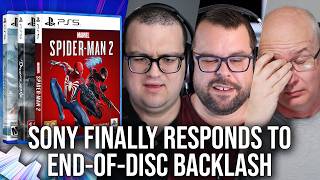

Sony's Investor Response: 'No Impact'
60sDirect quote from Sony dismissing disc backlash as having no business impact sparks outrage and debate among gamers.
▶ Play Clip"Delivers on the promise of discussing Sony's response, but spends significant time on tangential topics and sponsor reads."
In this episode of DF Direct Q&A, the panel discusses Sony's recent response to the backlash over the discontinuation of physical media on PlayStation. Sony's statement, made during an investor Q&A, downplays the impact of ending disc production, citing the growing digitization of the market. The hosts analyze the implications for consumers, the potential legal and market consequences, and the broader challenges facing the console industry, including the rise of 'forever games' and the high cost of next-generation hardware.
Sony responded to questions about ending physical media on PlayStation, but only in an investor Q&A, not directly to players. They stated they see no negative impact on their business as of now, citing that a large part of their business is already digitized.
When asked if physical discs differentiate consoles from PC, Sony said they don't feel the disc is a factor. They emphasized the stability of the game environment and the product itself as strengths, suggesting they can coexist with PC gaming.
A supporter, Osgos, criticized Sony's statement as disingenuous, arguing it recasts economic objections as mere emotional expression. They highlighted issues like resale, library permanence, delisting risk, and lack of pricing competition on the storefront.
John notes that Sony acknowledges feedback but offers no change in strategy. He believes the response is aimed at investors, not players, and shows they are not interested in addressing the issue publicly.
John suggests that consumers should show displeasure by not supporting the product. He notes that the impact won't be felt until the PlayStation 6 and its handheld are released, and that discs alone won't change anything, but a confluence of factors could.
John speculates that Sony might offer an add-on for the PS6 to allow older discs to remain compatible, which would show goodwill and keep consumers locked into the ecosystem, especially for those with large disc libraries.
Rich argues that Sony is focused on extracting value from users and may cross a line where they push customers too far. He emphasizes that entertainment companies must still produce products that please customers, not just maximize margins.
John compares Sony's approach to the Xbox One's failed strategy, where Microsoft followed telemetry and ignored user desires, leading to a disastrous launch. He warns that Sony might be making the same mistake.
The rise of AI has caused a memory crisis, threatening the existence of console gaming as we know it. The old model of affordable consoles may not continue, with examples like the Xbox Series X being sold for €800.
John suggests that Sony sees the writing on the wall and is focusing on monetizing remaining users, but if they push too far, they risk alienating them entirely. The industry is at a tumultuous point.
Oliver notes that Sony's statement uses financialized terms, indicating they haven't seen impact because they haven't implemented the changes yet. He reads between the lines that they expect non-digitized players to convert and offset losses.
Oliver suggests Sony could alleviate backlash by offering a supplemental disc drive for legacy titles, similar to what they might do for PS5 and PS4 games.
Oliver discusses the question of whether to review distribution models (physical vs digital). He backs away from it practically, noting the difficulty in evaluating digital-only releases and the lack of insight into disc versions.
Rich points out that Digital Foundry often plays pre-release code that matches what ships on disc, giving them insight. He notes that most games are in good shape at release, and day-one patches are not always necessary.
The panel criticizes Sony's communication, noting that Xbox overshares while Sony backs away from the audience. This strategy is proving unsatisfactory, especially compared to the past when Sony had personalities driving user-first policy.
John notes that even non-gamers are asking about Sony killing discs, indicating the issue has broken containment. This is unusual for gaming news and suggests a broader impact on brand perception.
Sony's latest earnings show $0.781 billion in physical sales, $6.5 billion in digital game sales, and $8.4 billion in in-game purchases. This highlights the dominance of digital and microtransactions.
A supporter suggests that if Sony prevents a marketplace for games outside its store, governments might force third-party stores. If Steam offers cross-buy to PC, Sony could lose DLC revenue, winning the battle but losing the war.
Oliver explains that under the EU's Digital Markets Act, console stores like PlayStation, Xbox, and Nintendo are excluded due to market size and the number of affected businesses. So Sony may not face immediate legal pressure.
John points out that the $8.4 billion from in-game purchases dwarfs physical and digital game sales. This money flows from 'forever games' like Roblox, which are becoming like consoles themselves, shrinking the market for traditional games.
Rich notes that Sony is pulling first-party narrative games from PC to make them exclusive to PlayStation, while Xbox is going back to console exclusives. This is a reversal from previous strategies.
Rich argues that even if the vocal minority is small, their words matter and impact brand perception. He cites Eurogamer statistics showing less than 1% of commenters, but they still had influence.
John says Sony needs to communicate its strategy clearly and reassure players that it cares about their rights. Simply announcing the end of discs without follow-up is a fatal communication flaw.
Rich shares a story about a friend in Tokyo who bought a Switch game for her niece, only to find it was a code in a box. The mother didn't want to set up an online account, so they returned it. This highlights issues with digital-only for younger audiences.
The panel discusses that younger generations are less interested in consoles, and digital-only makes it harder for kids to get games. Nintendo seems to buck the trend, but the industry is losing younger players.
A supporter asks what tech features will justify a $1,000 price point for PS6. The panel discusses machine learning, neural texture compression, and ray tracing, but notes these may not appeal to average gamers.
Oliver says there won't be any particular secret sauce that appeals broadly. Features like better RT and neural texture compression are enthusiast-focused, not mass-market. The PS5 had more obvious improvements like 60fps and fast loading.
Oliver argues that people buy consoles for games, not back-of-the-box features. Sony needs to show exclusive titles, but with a small install base, recouping $300 million development costs is tricky.
Rich worries that if next-gen consoles launch with no exclusives, there's no reason to upgrade. He suggests that path tracing should be the focus of development, but the financial case may not exist.
John says selling hardware to excite people is no longer feasible because the bottleneck is content creation, not hardware. The old model of rapid hardware evolution is gone, and the industry may need to adopt a phone-like upgrade model.
Rich notes that while hardware has potential, commercial considerations may mean it's not the focus of development, similar to how path tracing is a bolt-on feature now.
Oliver says games are so scalable that publishers will ship on multiple platforms, not just PS6. This generation fixed last gen's problems, but there are few games that couldn't run on PS4.
A supporter argues that devs find it easier to optimize for fixed-spec consoles than PCs. Rich agrees that curated experiences are a strength, and Steam could step in to offer optimized settings.
John says it's not difficult to get a good PC experience if you use medium presets or Nvidia optimizer. PCs can offer console-like performance if you're willing to accept defaults.
Oliver acknowledges that PC settings can be complex, especially on mid-range hardware. He notes that even with a high-end GPU, he still uses upscaling, and there are issues like traversal hitches that are worse on PC.
Oliver says that despite fixed specs, consoles don't have huge performance advantages over PCs. There's often only a 20% delta, and they're all x86 boxes, so it's much of a muchness.
Rich praises SteamOS for making PC gaming more accessible, but notes developers aren't interested in supporting a small pool of devices. He suggests third-party settings like Digital Foundry's could be integrated.
A supporter asks if Xbox Helix will be impacted by only supporting base PC versions of Series games. The panel notes that Series X games are in good shape, and Helix could offer PC versions with better visuals, but there are many unknowns.
Oliver hopes for dual entitlement like Play Anywhere for many games. He notes it's widespread among first-party titles, and maybe Helix could supply PC storefront versions of games.
Oliver suggests that Helix could get special patches for games to improve functionality, similar to PS5 Pro patches. Even without that, backwards compatibility would smooth out performance and resolutions.
Rich notes that Sony's PS5 Pro ensures a ton of titles have Pro patches, which will extend nicely into PS6. This avoids a mad scramble for developers at launch.
The panel concludes that Sony's response to the disc backlash is inadequate and primarily aimed at investors, not players. The industry faces significant challenges, including the high cost of next-gen hardware, the dominance of 'forever games', and the need to attract younger audiences. Sony must improve communication and consider consumer goodwill to avoid alienating its user base.
What was Sony's response to the backlash over ending physical media?
Sony said they see no negative impact on their business as of now, citing that a large part of their business is already digitized.
02:57
What did Sony say about the disc as a differentiator between console and PC?
Sony said they don't feel the disc is a factor to differentiate from PC, emphasizing the stability of the game environment and the product itself as strengths.
03:23
What were Sony's earnings figures for physical sales, digital game sales, and in-game purchases?
Physical sales: $0.781 billion, digital game sales: $6.5 billion, in-game purchases: $8.4 billion.
22:04
Why might Sony be excluded from the EU Digital Markets Act?
Because the market size and the number of affected businesses are not large enough to meet the DMA criteria, which were designed with mobile app stores in mind.
23:25
What is the 'forever games' trend mentioned in the video?
Games like Roblox that generate massive revenue from in-game purchases, dwarfing traditional game sales, and are becoming like consoles themselves.
26:45
What anecdote did Rich share about a code in a box?
A friend in Tokyo bought a Switch game for her niece, but it was a code in a box, and the mother didn't want to set up an online account, so they returned it.
32:26
What is the 'Xbox One playbook' warning?
Following telemetry and ignoring user desires, as Microsoft did with Xbox One, leading to a disastrous launch.
11:47
What did Oliver say about the potential for a disc drive attachment?
He suggested Sony could offer a supplemental disc drive for legacy titles to alleviate backlash.
15:42
What is the 'memory crisis' mentioned?
The rise of AI has caused a memory crisis, threatening the existence of console gaming as we know it.
12:31
What did John say about hardware lust?
He said hardware lust is gone because the bottleneck is content creation, not hardware, and the old model of rapid hardware evolution is over.
40:25
Sony's Investor-Focused Response
Highlights Sony's decision to address backlash only to investors, not players, showing a disconnect.
02:14Memory Crisis Threatens Console Gaming
Introduces a critical external factor (AI-driven memory crisis) that could fundamentally change the industry.
12:31In-Game Purchases Dwarf Sales
Provides concrete numbers showing the dominance of microtransactions over traditional game sales.
22:04Forever Games as Consoles
Insightful comparison of games like Roblox to consoles, explaining the shift in revenue generation.
26:45Hardware Lust is Gone
Key insight that the industry's growth is now bottlenecked by content creation, not hardware.
40:25[00:05] latest edition of the DF Direct Q&A show and I bring you happy news. Uh Sony has actually responded to the outcry surrounding the end of physical media and we're going to be talking about that um in answer to the first couple of
[00:17] discuss that and several other things. First of all, John Lenman. Hello. >> Hey Rich, it's always good to be joined by the migity mac daddy himself, which is you. >> Really? Okay. Yes.
[00:31] Hello. >> Yes. I'm not sure I quite share John's enthusiasm on this fun Monday morning, but uh, I like being on and sure it should be a good show. >> Yeah, absolutely. Okay. Um, yes. So,
[00:45] let's crack on with our first questions. But first, this video is sponsored by Greenman Gaming. August and September are jam-packed with new PC releases. And if you want to lock in your pre-orders now, Greenman
[00:59] currently have some solid discounts available right now. You can secure Beast of Reincarnation at 12% off, Metal Gear Solid Master Collection Volume 2 at 23% off, and Onushia: Way of the Sword at 18% off. You can also grab The Blood
[01:15] of Dawn Walker at 15% off and Silent Hill Townfall with a massive 25% discount. Greenman Gaming is also offering free access to their XP loyalty program. usually requiring a purchase to join. Using the link below instantly
[01:29] unlocks monthly XP packs, exclusive giveaways, and additional vouchers. Better yet, once your XP status is active, you'll unlock even deeper hidden discounts on some of these upcoming titles. Crucially, Greenman Gaming is an
[01:44] official digital games retailer. They work directly with over 1,300 publishers and developers around the world. This means you can save money on the biggest from the source. and fully supporting the creators. Check out the link in the
[01:58] video description below to find these specific deals and to claim your free XP specific deals and to claim your free XP membership. essentially that Sony has actually responded to questions about the end of
[02:14] physical media on PlayStation. Um, however, it chose to do so within a Q&A effectively they've they're making further statements because they've been forced to effectively and they're doing uh they're doing it to investors not to
[02:29] players. I think this presents a really negative um viewpoint on the whole thing. It really doesn't look good for Sony in terms of as I've described before this sort of growing divide between um Sony and its user base. Let's
[02:43] take a look at the comment that it did actually come up with um uh well up way. Well, up until 2028, well, at this point in time where we are not seeing any impact on our business as of now, this is uh in response to a question
[02:57] about whether the announcement has impacted PlayStation. Uh going forward large part is already digitized. Therefore, as a result of the discontinuation of a disc, we don't see that there will be any negative impact
[03:09] on our business. However, as I already said, the users, the players have attachments and we have to think about how to respond to those feedbacks. Hm. Um, another question was basically asking about whether physical discs were
[03:23] a differentiator between um, console and PC. I would say very much so uh, to a certain core element of the user base. Um, however, Sony disagrees. Um, we don't feel that the disc is the factor to differentiate from the PC. For PC,
[03:38] there's certain ways to play with the PC as a user. It's a long tale. Our that's one of our strengths. The game environment being stable, that's another strength. Compared to the high-end gaming PC, our product is more
[03:51] itself is a strong factor for differentiation going forward. We can differentiation going forward. We can coexist peacefully with PC games. Um, okay. So, we have Sony's words on this particular topic. Now, let's talk about
[04:07] some of the questions that um the supporters brought into the mix. Um, several opinions here. Uh we're going to uh kick off with this one from Osgos. Salutations Dfers exclamation point. Sony's this statement is disingenuous in
[04:21] a way worth naming precisely. Uh strong opinions recasts the subject the substance of an objection as mere intensity of expression and the vocabulary of feelings marks users as emotional. Both are slight of hand and
[04:34] both sidestep objections that are economic and rational. resale, library permanence, dellisting risk, and pricing power on a storefront with no competing sellers. Dressing that up as listening to the community is shameful, which
[04:47] generally. The standing principle is that you assess the game, not the the separation isn't youthful. It's why ownership sits in the one zone. No evaluative pressure could ever reaches, which is precisely the arrangement that
[05:02] decide whether there's a complete physical release. and publishers are the ones who care how a game is received. So, should distribution model be reviewable? Whether that's a score um at outlets that use them or a version
[05:16] recommendation at outlets that don't. Is quote unquote complete discre a legitimate thing to weigh or does that break something important about what a review is for? Several other comments, but there's plenty to be getting on with
[05:28] here. Um John, thoughts about all of this? I mean basically um it seems that Sony has been sort of asked to make a comment. Uh there seems to be some sort of recognition that there is quote unquote feedback but no actual change of
[05:46] strategy or anything substanti substantive that's uh likely to appease substantive that's uh likely to appease the very negative and continuing um feedback that they're getting on just about all their social media channels.
[05:59] Well, I mean, given that this was an investor's meeting, I think that's a they're actually thinking about this right now. Um, they're basically sharing their current point of view on it, which is not aligned with what I think people
[06:13] is not aligned with what I think people want and what I want for sure, but it's it shows that they're still not really interested in addressing this in a public way. They they're merely addressing this from for the investors.
[06:26] And as you would expect though, given that this is targeted towards them, uh "Yeah, we we screwed up. We got to we >> they're going to present the best possible uh picture going forward. And
[06:42] the people investing are, you know, I mean, logically speaking, I understand why they're saying what they're saying. It makes perfect sense, but uh I still don't agree with any of their thoughts on this matter.
[06:55] But it's this is such a difficult topic now. Like it's it's like realities of this. But I think we should still I don't I don't think people
[07:09] should just give up and say, "Well, that's what they're going to do." Um you know, ultimately this is still a business that's serving consumers. And if consumers are unhappy with something, they should show their displeasure by
[07:23] not supporting said product. Uh I think you can't really gauge the impact of this and on the current business just yet because one there is still discs yet because one there is still discs being made for for one thing but two you
[07:36] that people have already invested in. How much of an impact this will have is very much due is very much going to be contingent upon how the PlayStation 6 contingent upon how the PlayStation 6 and its handheld are received. Um, and I
[07:51] think discs alone wouldn't change anything for them, but I do think there's a confluence of factors going forward that could directly impact uh forward that could directly impact uh the chance of success in that space. So,
[08:06] I think they're putting on the typical brave face as a corporation for their investors. Not going to show their weakness there. Uh, and maybe things will go exactly as they say, but I think they are taking this very much like um,
[08:21] we tell the consumer what you want. You just have to come along for the ride. just have to come along for the ride. Like this is what we're doing. And we'll see what happens. If if they end up launching a $1,000 plus PS6,
[08:35] I don't know. I and that's there's just so many factors in this, it's really hard to say, but I don't think that they would reverse course on this. The only thing I could see them doing is potentially embracing an add-on for the
[08:48] system to allow older discs to remain compatible going forward. Uh, and people say, well, you can't make money on that. But I think that also shows goodwill
[09:00] towards its consumers that have supported the brand, especially if backwards compatibility is important to them. Uh, anybody that's built up a disc library and then this comes along and that's no longer a feasible option, they
[09:15] at that point. >> Yeah. >> In terms of the overall sort of uh revenues that comes into PlayStation, I makes any money. It is all about servicing the audience basically. And um
[09:29] I don't really see a negative outcome by producing a um an add-on that basically continues to lock people into your ecosystem, right? You know that, you know, because people want to bring their existing games forward into the next
[09:43] that's the one big question from my perspective that hasn't been answered yet. It's like, okay, it's fair enough saying that, oh yes, the uh physical edition of Wolverine's coming soon. you know, go out and buy it when you have no
[09:56] next generation console yet at this point. >> So, yeah. Um, it's just real I the thing I think about all this is like I feel to walk as a company creating entertainment products. Um, you can push
[10:12] your customers to a certain degree and they will follow, but I think there is a line you can cross where you've pushed them too far. And I do feel like Sony is reaching this point where they're so focused on extracting as much quote
[10:25] unquote value from their users. There's going to be a point where they where they're heading in that direction right now. When you're making a product like this, it's not just about these these returns and these margins. And yes, that
[10:39] is how you run a business, but if you're making a business that's designed to entertain people, like you have to still produce something that they want and pleases that customer. And if you fail on that, if you go too far in one
[10:53] direction, you do risk the business, I think. And you know, sometimes you have to make decisions for that business that maybe aren't the most profitable on paper, but I think that helps make a more uh I think that contributes to a
[11:07] >> uh in the long term, and I think that's what's at risk. >> Mhm. Yeah. everything can turn on a dime, especially at the um onset of a new generation and especially if there is actually going to be a a a physical,
[11:22] dare I say, a dividing point of the consoles of now and the consoles of the of your games with you certainly gives you pause. And I think there's also the you pause. And I think there's also the the whole concept of um uh the Sony that
[11:35] was and the Sony that is. Um, if you're going to be producing a next generation console that's basically based on what the figures are telling you, what the telemetry is telling you, well, basically you're following the Xbox One
[11:47] playbook. And we all know how that turned out. You know, where everything going to deliver was actually what the users wanted. You know, everyone was using their Xbox 360s to play media apps like Netflix and everyone loved Connect
[12:01] at the time they made the decision to bundle Connect with Xbox One. And you know, um, it all went horribly wrong. And obviously the the chase for revenue, um, with their DRM system that they were going to bring in for Xbox One backfired
[12:16] badly. And I think part of the problem here though is that everyone's facing a new a new reality that is very challenging for this market. >> The rise of the memory crisis, which is caused by the rise of AI directly,
[12:31] actually does threaten the existence of console gaming as a whole. like the the model that has worked for decades >> is at risk. It may not be able to continue at this rate. When you see things like five, sixy old hardware like
[12:44] the Xbox Series X now being sold for €800 uh or thereabouts, you just like who's going to buy this? Who can afford this? especially now like if things become so inaffordable unaffordable in this space
[12:59] inaffordable unaffordable in this space uh it starts to make sense why Sony and I think this may not work but that they're really focusing on quote unquote milking their users. >> They are starting to see the writing in
[13:12] the wall that maybe console gaming is is shifting in a direction that requires a new strategy. They have to find a way to monetize those users that are still remaining. But again, it comes back to the balance. If they push them too far,
[13:26] they risk completely alienating them. So, it's it is a very tumultuous time for the game industry and that front. And I do think this uh things need to
[13:38] change and um or else we could be heading for essentially the end of gaming as we know it. the end of console >> Oh, yeah. Yeah. I mean, gaming will continue, but the the models that we've
[13:53] known may be over. >> Yeah. Um, Oliver, I'm curious about your thoughts on the statement and also Osgos's question here. We'll come back it's an interesting question, but yeah, the statement, Oliver,
[14:07] >> the statement, the statement is curious. Uh certainly like when they're speaking in the these financialized terms, when they're talking about well up until 2028, we're not seeing any impact on our business as of now. I really do strongly
[14:20] indicating obviously there's no impact on our business because we've not gone through with the plans as of yet, right? Those don't have any material impact in what we're doing at the moment. Um and then when it comes to content sales, I
[14:32] mean, I think maybe you can read between the lines here that there there is a digitized. there's an expectation the players who aren't digitized will be and then there's also probably implicitly an expectation of um we're
[14:47] those users. So that should offset uh any marginal loss in uh users at least they probably have projected this out and they've determined that's the case otherwise they wouldn't be going through this whole process of discontinuing
[15:02] their audience and to a lot of enthusiasts. Um, so I don't know if that's going to be the case. I I think there probably is a good business case here to discontinue disc production for many reasons. Uh, one of the largest
[15:17] bigger cut off the digital storefront when they can cut out the middleman of the retailer and the disc producer. I mean, which in this case is Sony, but it does cost them money, you know, to produce those discs. Uh, so yeah, I
[15:30] think that I don't know what the right answer is there. I suspect we'll know in extremely divisive obviously on the biting them. I don't know. Um but there are ways they could alleviate that
[15:42] obviously um potentially uh responding to those feedbacks in their own terms and and I suspect that probably would include something like a supplemental disc drive or disc drive attachment, who knows, for uh legacy titles for
[15:55] PlayStation 5, PlayStation 4 titles. Um, with regards to uh the question from this user here, I think this is an interesting question. Um, should should we be reviewing the distribution models of games? I I would kind of uh back away
[16:11] from this on kind of a practical level and maybe not a philosophical level where I would just say it's it's kind of tricky to evaluate this kind of thing that is supplied digitally and we have very little insight into how the disk
[16:24] version is going to run, right? So even if I wanted to critique a publishers's maybe it's just a code in a box fundamentally or maybe it's, you know, maybe it's just uh no game data, no relevant game data is on the disc even.
[16:39] Um I can't really comment on that too much because I don't know. I might not know at that point in time. There are other outlets that do that though. Um like does it play? Um so I I'm not going to say that there aren't people who do
[16:51] this and I think those people should be uh doing that work. I think it's very personal perview, at least as I judge things to be commenting on that stuff when I don't I I often do not know. Right. I think actually that's an
[17:05] important point, Oliver, that we actually have more insight into this than you might realize because we do play pre-release code regularly. You disc is just going to have a day one patch, etc., etc., But usually the
[17:20] version we end up playing ends up being in most cases what ships on the disc. And by and large I think most games today are quite good in that state. I don't really have a large problem with those pre-release versions. If if that
[17:35] was the only version that was able to continue in perpetuity, continue in perpetuity, that'd be okay most of the time. codes go out without the day one patches. um presumably because the
[17:48] actually quite happy enough with the code and it's only sort of crazy people things like performance and uh in any sort of real depth. Um yeah, so you're
[18:01] quite you're quite right there is that but then again I think there is some I'm not sure whether the the digital distributed review codes are the same as what's on the disc because the discs printed like months in advance are they
[18:13] not? Uh, it's I've I've kind of kept up on this and in a lot of cases they are >> Interesting. >> That's that's largely consistent. The only time I've seen some exceptions is there's been some interesting huge lead
[18:27] version that we talked about I think God of War 2018 >> which turned out to be the game disc version was actually better but the version that came right after that but was before the first patch was that
[18:41] really broken one with the messed up frame rate cap that >> is now lost time but boy it was something. something. >> Um yeah interesting stuff. Uh
[18:55] massive issue here in terms of uh communications from um uh Sony and I direct. I won't I won't go over the the details too much but there's a sense that maybe Xbox is oversharing and Sony is just kind of like completely backing
[19:10] away from the audience and refusing to engage with them. That particular strategy is proving to be particularly uh unsatisfactory at this point. you the user base and run away and pretend it didn't happen or that it's irrelevant
[19:24] as seems to be the case here. Um, yeah, it's it's very disappointing and it's a it's it's very disappointing and it's a far cry from, you know, what happened E3 >> I agree. >> You know, that there was a definite
[19:37] sense that there were personalities at Sony that were driving policy where the Sony that were driving policy where the user experience was first and foremost um the most important thing. Right. And I think, and I've mentioned this before,
[19:49] that they may have gone too far this time really stems from the fact that the normies are aware of this, >> right? There's a lot of people that have work in game stuff, but I know a lot of
[20:04] people that don't play games like at all or barely. And they have also asked me like, "What's this about them killing discs or are they getting rid of they're getting rid of discs, stuff like that." So, like just comments from people that
[20:17] don't really keep up with this. They're finding out about this. And I feel like that's usually a sign that it's quote unquote broken containment. Uh, and it's not something you see with most gaming news. Like people that don't play this
[20:31] stuff have no idea about. They do not follow it. They don't care. >> But people do know about this more than I think people realize. And I do think I think the the dude that that buys their PlayStation and this isn't necessarily
[20:44] what Sony wants and then wants to trade it in some years later with the all the they're going to be real bummed out if they find out that wait, they can't actually get any money for any of the games that they bought, you know. So,
[20:57] >> Yeah, absolutely. Okay. Um, let's move on. We got a couple more questions concerning the um the whole Sony disc situation. And it's an issue that's just clearly not going away much as Sony would like it to. Teasing hilarity. Hi
[21:11] on ending physical media production, they seem supremely confident that the any visibility the data they're using to make their decisions and much less reasonably. But I do wonder whether the likes of us in the enthusiast community
[21:25] are really a very small part of the pie these days. Could it be that our requirements really don't feature for the vast majority of consumers who typically play PlayStation games these days? Put another way, could it be that
[21:38] for those who don't choose a digital purchase in the first place, code in a box is as good as disc in the box for the vast majority of them who just want to play the game. Thanks and best wishes for the week. Exclamation point. Well,
[21:50] certainly I suspect what Sony would like uh to believe. uh some guy person in Sony's latest earnings they doubled down on ditching the discs but there were also some very interesting numbers to prove that point 0.781 billion in
[22:04] physical sales 6.5 billion in digital game sales and a staggering 8.4 4 billion in in-game purchases. Here's the rub, though. If Sony prevents a marketplace for games outside of its own store, a lot of governments will force
[22:16] third party stores as alternative digital storefronts. If Steam comes in and promises purchases that transfer across to PC, a substantial percentage of those DLC purchases might go through Steam instead of the PlayStation store.
[22:28] Is Sony potentially winning the battle, but losing the war in the long run here? Keeping disc sales gives the illusion of a competitive marketplace, but shutting that down opens up uh opens them up for a far more costly legal fight than it
[22:41] would be just to keep the small amount of discs flowing. I'm going to come to it's sort of like it's difficult to argue with a lot a lot of these points. Um we're kind of moving into wild west frontier territory here because we kind
[22:57] when all of this rolls out. But I think that's telling in itself because I don't think Sony are prepared and I don't think the policies that are in place um for the PlayStation store are robust enough to uh withstand you know for
[23:10] enough to uh withstand you know for example third uh EU um uh policy uh scrutiny that kind of thing. >> Yeah. So I I did look into this a while ago um for an unrelated thing but I looked into this a while ago and under
[23:25] the logic of the digital markets act I think in the EU basically um there are some criteria that they sketched out and when they were sketching out those criteria they specifically excluded like it was you know they were thinking of
[23:37] drafting the criteria and the criteria ended up applying mostly to Android and iPhones obviously but they ended up excluding um the PlayStation store, Xbox store, Nintendo store. In in the particulars,
[23:52] uh the market size, I believe, is not large enough for it to fall under the digital markets act in terms of monthly active engaged EU users. And then also, discrete EU businesses that are affected, although that's more of a
[24:05] actually that many businesses involved in game publishing relative to like uh mobile app publishing, right, which is much more of a sole proprietor kind of small firm kind of thing. Um, so yeah, I I think at the moment, at least when you
[24:19] look at the cons both both the considerations that went into the DMA drafting and the specific criteria of the DMA drafting, um, consoles are not really in that bucket of concerns that the EU has. So maybe this does put it
[24:33] saying, okay, we're actually going to foreclose the physical side of things. issue. I don't know. It's entirely possible and certainly there has been some renewed scrutiny, but at the moment um I don't really think there would be
[24:49] necessarily an obvious impact or an obvious need for greatly increased scrutiny if previously they were like so below the thresholds that the EU was interested in. Maybe they changed their mind. I don't know. But at the moment,
[25:01] I'm not really worried about that. Um in terms of I mean just the overall market terms of I mean just the overall market questions here, uh yeah, I I I really motivated group of enthusiasts who are really really upset um and they probably
[25:17] business in terms of actually buying games and in terms of registering their discontinuing their business with Sony for other vendors who they feel more if it's a digital product obviously there are advantages to buying games on
[25:32] PlayStation ecosystem in terms of preservation all kinds of factors that John has discussed before um for me personally you There are some things where I like having a physical good and
[25:44] experience. For games, it's more about the experience, but I see the utility of the physical good. Um, so I think there's probably going to be a wide range of reactions among enthusiasts and a wide range of array uh of reactions in
[26:00] discontinue their use of PlayStation products as a result of this. But I and priced this in and they're going to go full steam ahead with this and maybe they will offer some accommodation to those disc users. But um I think they're
[26:14] probably not going to change their stance fundamentally uh based them. Right. But uh based on these statements it's not changed thus far. >> Right. Okay. What do you think, John? >> The more disturbing thing from those
[26:30] >> The more disturbing thing from those numbers is the $ 8.4 4 billion generated from in-game purchases. That dwarfs everything else. And when you dig down to that stuff, you kind of realize that most of that money is flowing from
[26:45] >> Yeah. >> And it's just continuing this this trend of shrinking the market down to these few successful forever games. Uh I and I
[26:58] start to think about this point where PlayStation right now is a portal to PlayStation right now is a portal to play a games designed for its platform. But at this point, something like a Roblox is pretty much the same as a game
[27:10] Roblox is pretty much the same as a game console in the modern sense, right? So console in the modern sense, right? So um let's say people that are invested in in the disc games, the types of games that that you know you and I enjoy, we
[27:23] stop investing in that platform. this none of this will change the people that are generating the most amount of money, which is these types of like players that are into the forever games. Uh, and so we we continue down that path. The
[27:38] games we like sell less, but the forever games continue to generate more and more money into making the types of games we enjoy. Um, I don't know. I just I I start to like extrapolate all this out and kind of
[27:53] worry about where we're going. And I don't really know what we can do about this. Like it just seems like that's like the the way the industry that that we fell in love with, the way I like to play games is not the way that
[28:09] the majority of people like to play games. And I would hope that some companies still would like to make $781 million million on uh us. But if they choose to not do
[28:22] on uh us. But if they choose to not do that, it's that's what we can voice our displeasure and not support it, but they still have people spending insane amounts of money on the same like three games. So
[28:34] legitimate concern for sure, John. But at the same time, you've got like uh Sony a looking to take their first party uh narrative driven games away from PC users because they think it's a core
[28:49] part of the PlayStation experience and it should be exclusive to PlayStation consoles. And at the same time, you've got the reverse ferret from um Xbox going back to console exclusives and none of them are forever games and
[29:02] produce them. >> I agree. I guess Microsoft Microsoft has um Minecraft but that's multiplatform anyway. My concern is that the a lot of people that are interested in these games are the more the type that might
[29:16] drift away from these platforms over these types of decisions, leaving the people playing the Forever games as like the the primary earnings driver, the the primary earnings driver, >> right? which they already are
[29:28] >> because I know a lot of people like again anecdotal but I I am aware of many that's obviously very biased because I'm in this kind of world here but that would purchase the Sony firstp party games on disc even though I could play
[29:43] on the work accounts I would still buy them myself I like to have the physical copy all of us will see spending money on these games all of us. I don't know if that's a big enough figure for them to care at all. Maybe not. Probably not.
[29:57] to care at all. Maybe not. Probably not. But I I feel like that could impact those types of games while they continue to make tons of money on those forever >> and and what does that do to the the market going forward? I don't know.
[30:11] about. >> Right. Interesting. Uh there is one thing I want to say about the concept that it's a small vocal minority uh that's making these points and and causing issues for Sony. Well, you know,
[30:26] that's kind of like the way it is and the power of vocal minorities can be about how the fact that physical discs going away has made its way into kind of like normie conversation, John. And um you know I was just thinking about um
[30:42] how back in the day um when we were part of Eurogamer there was a lot of criticism in the comments and actually a statistical analysis and it turned out to be like less than 1% of the audience that were uh making comments on the
[30:57] articles and I suspect it's going to be probably even less on YouTube probably even less on Twitter etc etc but the point is that you know it it makes an impact those words kind of matter. The the the
[31:13] those words kind of matter. The the the impact is kind of like um uh not really tied to the to the size of the audience making it. You know, it has a fundamental impact on the perception of brands. So I do think that Sony really
[31:27] needs to be thinking uh rethinking their whole strategy about communication here whole strategy about communication here and um and and coming up with answers here essentially. I mean, I think it's probably a fatal compliant at this time
[31:41] that, you know, PlayStation 6 games will not appear on disc, but you can't just say that and then just sort of uh not say anything else for 18 months or however long it's you've basically got to re reassure your audience that
[31:55] is the strategy going forward. We care about what you think. We care about your rights. and um it's kind of like a process that seems to have happened in on the PC side of things but has yet to sort of make its way through to um to
[32:10] >> Also, another thing I I thought about was um just an anecdotal thing. A friend of mine in Tokyo, she celebrated the birthday of her niece who fairly young. She's a little girl still and wanted to get her a Switch and a game. So even
[32:26] it's the original Switch. But so she bought all that, brought it over without reading the package carefully, realized, uhoh, it's a code in a box, but the mother of the kid did not want to sign up and have this online account with
[32:42] value in it on the system. So she ended up having to return it and getting something else that was on a cart. >> Uh, and she was able to do that >> Uh, and she was able to do that thankfully. Uh it's but um the situation
[32:55] was interesting because none of them are really super into games but she decided to to do that for her and ran into this kind of problem. And I do have to wonder we're talking about us old heads but this I feel like they already have a
[33:08] problem with getting the younger audiences into the console space and digital stuff. I feel like that just makes it even more difficult to to give kids games or for them to even have
[33:21] their own sort of ability to purchase them. Uh, and I'm wondering if there's any numbers on that on as what's that's doing to the younger generation, do have suggests that the younger generation are particularly interested
[33:35] in consoles, but Nintendo seems to buck the trend there. mean, and that was a case where the fault wasn't even Nintendo, it was And I think ultimately there's while there is some flaws in the strategy, I
[33:49] doing a good job capturing that younger audience or trying to. And I think that younger audience is very important as we see uh and this is something that I think Square Enix just in his example has acknowledged. people that grew up
[34:05] loving Final Fantasy during their childhood, they were able to experience a new Final Fantasy every like 2 or 3 years. Now it takes 10 or something, you know, not not actually, but it takes so much longer to deliver anything in that
[34:18] much longer to deliver anything in that series. So, you can have a kid that goes experiencing one of those. They never get attached to the series. And I feel like we're in this this danger zone now where they're losing the younger
[34:32] don't have as much interest in consoles what they want to do when they get older. And I think this is this is a potentially dangerous spot that the industry is in.
[34:46] Yeah. Interesting. Okay, let's move on. A question here we got from aging Whiskey. uh what might be the tech and quote unquote secret source feature sets that will be there for the PlayStation 6/Hix releases that will set them out as
[34:59] quote unquote justifying to the public at large user consumer base a potential $1,000 price point. Each generation has usually done something to distinguish whether 16 bit, 32-bit, CDROM, DVD, Blu-ray, internal drives, HDD, and now
[35:13] NVME advancing from SD to HD to 4K mostly is when thinking about the what comes next. Can't help but think machine learning influence and squeezing more from less might be the result, making it seem like a lot to ask in the current
[35:27] interesting question because there's also some comments attributed to aren't really important." I mean, that's something Nintendo would say, but we kind of discussed this a couple of weeks ago about, you know, the the I wouldn't
[35:42] call it a crisis, but certainly a um a problem that the next generation consoles face, which is that they're going to be super expensive and that they're going to be providing is kind of like encroaching on what is
[35:56] currently a high-end PC feature set. And do people actually really want that? Um, and I guess our takeaway at that point was, well, it's going to be down to Microsoft and Sony to make the case and make the uh and make the software to to
[36:10] justify it. Um, Oliver, what do you think about this? Yeah, I don't think there will be any particular secret sauce that appeals to customers broadly likely nextG feature set, which is like
[36:24] better RT, some fancy features like neural texture compression, faster CPUs, etc., probably some new version of ray regeneration technologies like that as part of the RDNA5 feature set. I'm sure we'll hit both consoles. Um, those are
[36:39] things that are like appealing to us as enthusiasts, but are they appealing to your average gamer? I feel like with PS5 you actually had a lot of different back of the envelope things just like you know Series X as well of course um where
[36:51] you were hitting 60 fps much faster load times raid tracing for the first time all these nice features that are old hat by the time we get to nextG consoles by the time we get to nextG consoles unfortunately um and I do also look at
[37:03] unfortunately um and I do also look at PC right now and think about how the context because I think what we saw last generation or I guess this generation actually was that a lot of the uh early titles looked a lot like the PC
[37:17] a year or two prior to the launch of the PS5. Um because they had, you know, higher resolutions, they had better frame rates. Um and I'm not really seeing anything in the PC side of things in the kind of general area of
[37:33] capability where PS6 would be or even higher than that potentially. um where you're actually seeing really meaningful improvements that I think would move the needle on a box beyond the enthusiast audience. Um there could be some things
[37:47] enhancements for older games, some automatic enhancements, maybe some uh smooth motion style frame generation. That could be interesting. Some like automatic AI upscaling like uh kind of similar to the enhanced image quality
[38:01] toggle for PS5 Pro. Maybe a little bit better than that. Who knows? could be interesting for like PS4 software. Um, but ultimately I don't think that people are buying new consoles for better back of the box features. I think they're
[38:16] buying them for games and I think it's up to Sony to show off some cool games in the console. In particular, exclusive titles, right? I think that'll really move the needle. But I think Sony's in a in a tough position where you want to
[38:28] make exclusive titles for PS6 as they did for PS5 and PS4 before it. But uh I mean early on in the generation, but when you're marketing a a game to an install base of singledigit millions of users, you can't hope to recoup $300
[38:43] million in development costs, right? So it's a very tricky situation for Sony and I don't envy envy them in that, but uh but I think it's yeah, it's really up best light, but I kind of feel like the only way you can do that realistically
[38:58] is to show off like a new exciting game on the system, right? Yeah. Yeah. Yeah. Yeah. That's my point exactly is that um what if these consoles are launching with no exclusives, with no games that you can't play on your existing machine?
[39:14] That's a real problem. So, what do you do if that is a given? If if there are no exclusives, well, basically the focus of current generation development has got to change. So right now even with like um uh the really cool Nvidia stuff
[39:26] we've seen with path tracing basically and we're seeing actually this uh example with 007 first light the game has shipped right and um a fancy path tracing version is coming along at some point after the game has released but
[39:41] the point is that um I think for next generation to actually present a meaningful difference the path traced version has got to be the focus it's got to be the you know the the first class citizen in development and then um the
[39:55] other versions, the last generation versions, your switch to versions, you know, your handheld versions, they've got to be the secondass citizens. And my worry is that the financial case does not exist to make that happen. I'm not
[40:09] John. >> Yeah, my the big concern right now, I guess, with this is just there. I think hardware lust is gone. Selling a heart selling a piece of hardware to excite people is it's not really feasible at
[40:25] this point because we've reached the point where every the generation and bottlenecked more by the the process of creating content actually building the games. That's the real bottleneck now, not the hardware. The console generation
[40:39] that we grew up with happened during a period when hardware was evolving rapidly and each new generation brought with it major changes to the types of capabilities developers could utilize in creating their games. Uh, and now that's
[40:54] creating their games. Uh, and now that's kind of gone. Um, and we just naturally reached that point. And there's still room to grow in terms of rendering, but I don't think it's in a way that's immediately exciting to most customers.
[41:06] still just producing the amount of content necessary to sell this stuff. So content necessary to sell this stuff. So that basically the old model has become uh impossible to maintain as a result. So, I guess their best bet is just to
[41:25] kind of go with the phone model to a degree. Just >> offer increasingly faster devices that sort of, you know, enhance your experience. I guess I just I don't know where you go from here.
[41:38] sure. >> I don't know. I think when you look at the potential of the hardware based on kind of what we know um about it, I and there is a good degree of differentiation. My question is the
[41:50] extent to which uh commercial considerations will mean that it's not the actually the focus of of the development for new games that it's like a bolt-on as you're seeing with um um path tracing at the moment for example.
[42:03] >> Yeah, that's that's my concern there. You've got to present something that's meaningfully better and a decent price point, right? And I think, you know, if I think maybe the the direction of travel before the AI memory crisis was
[42:16] basically, hey, if we can uh basically phase out the PlayStation 5 and replace more expensive but delivers these fantastic looking visuals, we're good. actually get a mainstream priced device anymore, and that's problematic.
[42:32] >> I do think on some level if you were to develop games really tightly around the probably achieve some pretty great things with enough investment, enough technology. I think you could achieve some things that are truly transformed
[42:48] above last generation consoles, but I don't know if the market case is going to be there. And then also like so many things are scalable already that the 5. >> Like the I feel like the incentives were
[43:01] not as strong this generation and were were almost non-existent uh in in the PS4 generation where you couldn't really scale a game nearly as easily. And now I just think that game is going to look so so scalable to a publisher that you're
[43:15] not going to get away with shipping just on PS6. You're going to need to ship on PS5, Xbox Series, maybe even Switch 2. You're going to be a very distributed game running across a wide variety of different specs.
[43:27] >> Exactly. Because I think this generation has turned out to essentially be the generation that fixes the problems of last generation. There are very few games I think that exist today that could not have been done in some form on
[43:39] a PS4. >> Uh the biggest problem is we have faster frame rates and loading times as a problem have largely been eliminated which are awesome. Those were kind of selling points, but I guess where do we
[43:52] of those problems. I guess you could clean up the the unreal uh temporal noise that people hate so much. I'm not sure that's going to fly at large in the
[44:04] marketplace, though, >> right? Mhm. As I said, uh you know, it's all going to come down to how they pitch it and what the software is. Okay, let's move on. Okay, so we've got this question here from IB12. Uh my good
[44:18] deFs, I do like the way that uh everybody's sort of like reverting to uh Elizabeth and English when they when they address us. Uh it would be like Gad Zuk's DF. Uh my conclusion about poor PF poor PC
[44:33] performance as opposed to more widespread 60fps adoption on current gen. More devs are finding it easier to optimize for a fixed specs fixed spec console uh PS5, Xbox Series X, Switch 2, etc. as opposed to a more open-ended uh
[44:48] spec PC that's forever changing with a zillion hardware configs to account for. As Tom pointed out in a past video, which I can't remember which it was, and I paraphrase, after a long hard day, you don't want to have to fiddle with game
[45:00] settings for hours/troubleshoot just to get your game to work. Games perform relatively well without any of the hassle. I seriously lament the amount of trouble I'd have to go through just to get PSVR2 support for F12425 on
[45:15] PC, whereas on PS5 it would just work if they'd implement it. Yeah, I think And actually going back to that investment call that uh the earnings call that Sony did, they they you know, the curated experience definitely has
[45:29] something strong going for it. the the plugand play side of things. And I actually consider this to be a pretty weak area on PC where somebody like weak area on PC where somebody like Steam uh could step in. Um obviously
[45:41] Nvidia does the sort of own optimized settings thing via the Nvidia app, but want to be able to load a game, run it, and not have to worry about um you know, gaining 20% of performance by dropping
[45:55] global illumination from ultra to high. Um, John, thoughts? >> I think this is it's going to vary from person to person and I do think there is if you can tweak performance, you must do so. Um, after we discussed the topic
[46:11] last week, I kind of realized like, yeah, it's not that difficult to get a pretty good experience on a PC, if you're willing to just sort of go with a you're willing to just sort of go with a medium tier uh, preset or use something
[46:25] like the Nvidia optimizer stuff, if you just accept that what it's doing is good, you can usually get a nice 60 fps experience. It feels like um if you're willing to match the consoles, but I think like a lot of the people in the PC
[46:40] ones that we're hearing from, and I don't blame them. I get it. Uh where you want more from your PC experience, and that's what leads you down that path. But I do think more than ever, PCs can offer a pretty good, not perfect, but
[46:55] getting close to console-like performance if you're willing to just like roll with it more so than it's been in the past anyway. So things are improving in that in that front.
[47:07] >> I do think there is something to be said uh in terms of improving accessibility uh in terms of improving accessibility on the PC side to just you know being straight off the bat and I do think that is something that is a bit missing but
[47:20] you know I guess we'd be out of business from the PC side if that was the case. Why would you have an optimized settings video? Uh what do you think Oliver? pain, especially if you have like a mid-range or lower-end kit. Trying to
[47:34] work out settings that can be rather complex. I'm lucky in that I have the luxury of an RTX 5090, so I could just whack settings up for the most part. I mean, I still engage upscaling. I'm not an animal. I don't go to native 4K or
[47:46] anything like that generally speaking uh for most titles, but you know, um that can be okay. Um, but there are all kinds of issues on PC and all kinds of problems and some of those extend past the usual kinds of settings malaise that
[48:01] we end up with on PC. Um, oftentimes obviously many issues on PC like console. Um, frame rate issues that recent example. I'm playing through that on PC at the moment. And the traversal
[48:15] hitches on PC, my god, I didn't experience them hardly at all on console, but on PC they're everywhere and they're really omnipresent and it's quite something. Um, but yeah, that can be certainly uh a set of issues on PC
[48:29] you don't want to contend with. But I would maybe take issue with the idea that devs are finding it that much easier to optimize for spec fixed spec consoles as as it's easier suggesting because I think in most games uh some
[48:43] recent outliers like Halo Campaign Evolved accepted. Um typically we're finding that PCs and consoles are much of a muchness. Maybe there's like a 20% performance delta in favor of the console sometimes with respect to what
[48:58] is generally thought to be equivalent spec PC parts. It's often not that much think they're that badly disadvantaged relative to consoles. I mean, they're relative to consoles. I mean, they're all PC AMD boxes, x86 boxes at the end
[49:11] deal of differentiation between them. I mean, on the back end, obviously, there is a lot of differentiation, but it doesn't show up in huge performance advantages for the consoles these days. It's much of a muchness as I think Rich
[49:24] might say. >> Thanks. Thanks for that. Thanks for putting words in my but um uh yeah, I mean here's what I'm thinking about this is that Steam OS has done such an amazing job of actually um
[49:39] accessible. you know, you don't have to worry about a whole ton of stuff if built your own Steam machine or you've got a Steam Deck because, you know, um you've got a nice little control panel
[49:52] there that gives you the features you'd kind of want to engage anyway. And um I interface, which is something that PC has historically lacked, but there is something missing. And I think, you know, Valves um supplied APIs to de to
[50:06] developers that say, "Hey, you know, um uh this allows you to identify the accordingly for it." But I don't think developers are that interested in um
[50:18] actually providing that level of support for a relatively small pool of devices, certainly compared to, you know, however large the Steam user base is out there. do though which is to say that you know
[50:32] maybe similar to the way for example uh it offers you the chance to download shaders to get rid of stuttering. Maybe there is also the case that um a third party perhaps digital foundry settings should go in there as well you know to
[50:46] to offer a more curated experience that I don't think developers are that interested in supplying. Just a thought. Um let's go on to the final question. And this one from Die Hard with the A being uh an at symbol. Uh hello DF
[51:00] of the next generation Xbox Helix console will be impacted in any way because it will only support the quote unquote base um PC versions of Xbox Series games? This time around they elected not to release a mid-gen upgrade
[51:13] and their games will remain uh quote unquote locked to often sub 1080p resolutions and sub subpar upscalers forever. On the other hand, the PlayStation 5 library already has over 200 games with pro enhancement, boosted
[51:26] resolution, PSSR upscaling, enhanced RT effects, ensuring that it software can be reproduced with better visuals on future hardware. Uh, it's an interesting mean, if this had happened last generation where there wasn't an Xbox
[51:39] problematic, wouldn't it? Cuz your Series X console would be running Xbox One games. this generation. I think I think there's something to be said for the comment here because it won't have those features, but at the same time,
[51:53] the gap isn't quite as big, is it? >> Yeah, I think Series X games are largely in good enough shape and this would just clean up any issues there. But I guess we still don't know the nature of what Helix will be, right? So, there could be
[52:06] this >> situation where they allow PC versions or make tweaks to whatever they're running. like there's still so many unknowns and we know what's possible with their backwards compatibility given
[52:20] could sort of pull out a wild card in this and do something different >> because again I think just doing exactly what they did before isn't going to work. So, right, uh, this feels like one area where they could innovate, I guess,
[52:36] >> and sort of combine a console experience with the benefits of the PC being that look and run better. So, we'll see. >> Yeah, that's an interesting thought. I basically all your achievements would carry over to the PC version. Uh, they
[52:53] could, you know, just basically allow you to, let's say you're playing Fortza Horizon 5, for instance. Um there's more scalability there on the PC version. So perhaps the Helix version would just down uh
[53:06] would be the PC version running on ultra or something like that. Um thoughts >> Yeah, I would hope that for many games if not most games that you would get some sort of dual entitlement like a play anywhere functionality for those
[53:19] titles. Play anywhere is pretty widespread. Um certainly among the first party stable of Xbox titles, it's very very widespread. Uh, generally speaking, you know, sometimes you'll get a play anywhere entitlement. Like I went on my
[53:32] Xbox account on Windows the other day and I saw that I had like 40 or 50 Play majority were Microsoft titles, but there are some titles in there that are Play Anywhere titles from third party vendors. And so maybe they can finagle
[53:46] something there. Maybe they could do something with licensing, uh, something of say, well, you know, if you're on the Helix device and not on a Windows PC generally, maybe we can supply you with the PC storefront version of the game,
[54:01] I don't know if they can do that legally, but perhaps I have not looked some way for them to do that. That would be interesting. Um, but beyond that, I mean, you could get Helix patches for games, right? You could be running the
[54:15] the the series version of the game on your Helix device and get a special Helix patch to improve its functionality. That could be in the in in the cards for some titles. Um but you know, I mean ultimately I I would hope
[54:28] that at the time the system launches there will be some kind of solution there. But even absent a solution, I mean, you're still going to be getting, how the backwards compatibility functionality will work, but we presume
[54:41] much better resolutions in those titles that support dynamic resolution scaling. smoothed out performance in those titles. you're going to be getting a kind of like soft remaster in some cases of those titles where all the little
[54:55] hitches hopefully are smoothed out and all the performance all the all the like getting with the RS would be smoothed out. So that should help at least to some degree. Um but it won't be as good as the PS5 Pro treatment. And I think
[55:09] Sony actually had a had a really good step here this generation by shipping PS5 Pro because it does mean that you're going to have a ton of titles. Almost all, you know, major titles on PlayStation 5 have PS5 Pro patches now.
[55:23] And those will extend really nicely into PS6. So there doesn't need to be some mad scramble from developers on day one trying to ship PS title updates for all They're all going to be in pretty good shape on PS6 already, especially if you
[55:38] have the automatic uh PSSR enhancement turned on in the system settings. I'm but presuming it's the same as PS5, just to go in the vast majority of PS5 software. Yep, good stuff. Okay. Um, so
[55:52] the end of the show. So, please do like, subscribe, share, uh, ring bells for you have supporter program though? Crucially important stuff. patreon.com/digitalfoundry. Uh high quality video downloads, ad free
[56:06] video downloads of everything we do. Um updates from the team, brilliant community. Lots of great stuff going on there. Oh, and of course uh an adfree website, digitalfoundry.net. That's all from us for now. Thanks for
[56:19] watching and supporting Digital Foundry. And I guess we'll see you in the next And I guess we'll see you in the next direct proper.
⚡ Saved you 0h 56m reading this? Transcribe any YouTube video for free — no signup needed.