
AI Summary
This video provides a countdown of the best XLR microphones under $200 for beginner voice actors, emphasizing that the right mic depends on your room and skill level, not just budget. The creator, Mike Hathcote, shares his personal recommendations based on experience and popularity, and highlights common mistakes to avoid.
Chapters
Many new voice actors buy the wrong microphone, which can hinder progress. The video focuses on XLR mics under $200 that are beginner and intermediate friendly.
The first rule is that your microphone must match your room, not just your budget. An expensive mic in an untreated space will sound terrible due to sensitivity.
Clients don't care about your mic; they want clear, clean, consistent recordings. A good mic won't fix a bad recording chain or noisy room.
A good XLR mic has low noise and is forgiving, not overly sensitive, especially for beginners who are still learning technique and may have imperfect spaces.
The number one mistake is buying a mic just because a professional uses it. Pros have years of technique; their mic may not work for you.
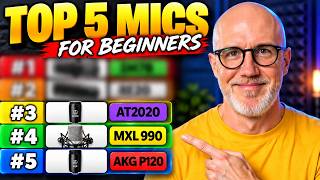
The AKG P120 costs about $130. It's a trusted brand with great build quality, best for learning basics and stepping up from USB mics.
The MXL 990 costs $120. It's popular in beginner bundles, solid for beginners, but you'll likely want to upgrade eventually.
The AT2020 costs $119. It's clean, reliable, sturdy, and used by thousands. Great for consistent recordings and a starter-to-intermediate mic.
The Rode NT1/NT1A costs about $160, includes pop filter and shock mount. Known for low noise floor, but best for quiet, well-treated spaces.
The AT2035 is the top pick, around $150. It's detailed without being harsh, sensitive but forgiving. The creator started with it and still owns it.
The AT2035 is the best all-around choice for beginners due to its balance of quality and forgiveness, but always consider your room and skill level. Avoid chasing gear and focus on technique.
Mentioned in this Video
Tutorial Checklist
💡 Key Takeaways
Match Mic to Room
Emphasizes that room acoustics matter more than mic price, a key insight for beginners.
01:08Expensive Doesn't Mean Bookable
Shifts focus from gear to client needs, a practical reality check.
02:38Avoid Copying Pros
Warns against a common trap, saving beginners from wasted money.
04:14AT2035 as Top Pick
Provides a concrete, tested recommendation with longevity.
07:08Full Transcript
[00:00] A lot of new voice actors buy the wrong microphone when they get started in voiceover and this can actually hinder your progress as you move forward. This video is about picking the right XLR
[00:13] microphone under $200 to get started in voiceover and the reason why I chose under $200 is because at that price point you're going to get something that is not just beginner friendly but is also
[00:27] intermediate friendly and can actually last you quite a while. And before we get into the actual countdown, I want to just state that this is all my personal opinion. This is based on popularity,
[00:39] microphones that I've actually used, and these are microphones that I believe are going to be your best bet to get into the voiceover industry without breaking the bank, but also without
[00:51] sacrificing on quality. And before we do get to the number one choice, I want to mention that there is one mistake that a lot of new voice actors make that will actually make even a good microphone sound bad. So I'll talk about that too. The first rule is that your microphone has to match your
[01:08] room, not just your budget, because you can take a very expensive microphone and put it in a not treated space and it's going to sound terrible because it's so sensitive. So as you watch this
[01:20] video, don't just think of the best microphone. Think of the best microphone for you and your situation. That one little mindset shift will actually end up saving you a lot of frustration and most likely a lot of money too. My name is Mike Hathcote and I'm a full-time voice actor
[01:36] and I run the VoiceOver Blueprint YouTube channel where the aim is to get you as much actionable information as I can about getting started in VoiceOver. If you want to get a deeper dive on not only microphones, but other equipment, as well as all other aspects of the
[01:51] voiceover industry, I'm hosting a live webinar coming up this Tuesday night at 6 p.m. Pacific Time, 9 p.m. Eastern. In this free webinar, I'm going to answer your questions about voiceover live. I'm going to go over the entire voiceover industry and give you kind of a high-level
[02:07] overview of the entire industry and where you might be able to be a part of it. And just for showing up I going to also throw in my book The Voice Over Blueprint which is the audiobook as well as the e that you going to get at no additional cost just for showing up for the webinar So check out the description below or the pinned comment to sign up and I hope to see
[02:25] you there. Okay, let's talk about microphones. Now, before I rank these mics, you need to understand three things that trip up almost every new beginner. The first thing is that expensive doesn't mean bookable.
[02:38] And what I mean by that is a client doesn't care what your microphone is. they just want to hear clear, clean, consistent recordings every time. The second is that a good mic won't fix a bad recording chain.
[02:53] So what that means is if you put a good microphone in a noisy room, like I mentioned earlier, it's going to sound noisy. So make sure that you have a proper mic for your space as well as good mic technique.
[03:06] And third, when it comes to XLR microphones, which is what this countdown is about, It's about choosing the right microphone, number one, but also choosing the right interface for your space. Because it's a system.
[03:18] It's not just a single piece of equipment. Okay, now that you understand that, this list I'm about to bring out is going to make a lot more sense because it's going to help you not waste your money and time just chasing gear.
[03:30] All right, here's what actually makes a good XLR microphone. The first is low noise, meaning that it's not overly sensitive and is going to just pick up every little nuance in your space.
[03:43] That's fine if your space is well treated, but a lot of beginners aren't there yet. You want to have a microphone that's a little bit more forgiving when you first start because you're still learning your technique. Your space isn't maybe not perfect, which really hardly any space is.
[03:58] but you want to make sure that the microphone you choose is a little more forgiving than, say, a $1,000 PLM-103. Okay, here's that number one mistake I mentioned earlier, and that is buying a microphone just because some other professional has it.
[04:14] The reason why this is a problem is because those professionals that you're looking to have developed their technique over years of experience. So just because that microphone works for that person doesn't necessarily mean it's going to work for you either in the future or even right now.
[04:32] So if you still in the learning phase if you still working on your technique and performance you still doing some initial auditioning and trying to sound credible with what you got without overspending that what this video is about So with that
[04:48] context, let's get to the list. Number five on the list is the AKG P120, and this is going to come in at about 130 bucks. The reason why this mic shows up on a lot of people's lists is because AKG has been around for a long time. They're a very trusted brand, and so their build quality is second to
[05:07] none. These are best for learning the basics and taking a step above a USB mic, and this is a good entry-level XLR microphone that won't break the bank, but will be great for learning and mic
[05:19] placement and getting started. Number four is the MXL 990, coming in at $120. This mic shows up everywhere, especially in a lot of beginner bundles, where you get, you know, the microphone
[05:31] and the interface and the cords and the pop filter and the arm. It shows up in a lot of those bundles because it's very popular and it's very solid. For a lot of people, this is their very first XLR microphone when they step up from USB. And while this is fine for beginners, it's also going
[05:47] to be one that you would probably want to upgrade from eventually. This is not a microphone that's going to last throughout your career. Coming in at number three is the Audio-Technica AT2020 at $119. This one is one of the most popular XLR microphones out there, and the reason why is
[06:06] because it's very clean, it's very reliable and sturdy and used by thousands. It's great if you want a very consistent recording every time, a good solid build quality, and a good kind of starter
[06:20] to intermediate microphone. Coming in at number two is the Rode NT1 and NT1A, and this is an extremely popular microphone known for its very low noise floor. The good thing about this
[06:33] microphone is it comes in at about $160. That's also with the pop filter as well as the shock mount all in one bundle. You can get that on Sweetwater. This microphone is best for quieter
[06:45] spaces so make sure that your room is very well treated before you get this microphone because it can be a little unforgiving to some of the noises that can happen inside and outside of this and that leads me to the number one pick or my number one pick and that is the Audio AT2035 and this comes in at about Now the reason why I
[07:08] chose the 2035 is because this is the mic that I started with. So, this is the microphone that I recommend to most beginners who want to go ahead and step up above the USB microphone set and get
[07:21] a good microphone that will be good for beginning, but also have some longevity in your career. It's detailed without being too harsh, and it's also very sensitive without being unforgiving to
[07:33] noises in your space. I actually still own this microphone, and I gave it to my wife for her to use for some of her broadcast stuff because it is such a well-built mic, and it has proven year
[07:45] over year to be a very solid microphone. I did national work on this microphone before upgrading to some higher priced mics. And by the way, this is not a sponsored thing. I don't have any kind
[07:58] of connection to Audio-Technica. I'm just a big fan of this microphone. So that's why I put it at number one. So the AT2035 sounds great as a beginner, but it'll also sound great as you grow your career. So I hope this video kind of helped you narrow down some of the microphones to choose
[08:13] in that under $200 category. Because I know that brand new voice actors are very price conscious, but you also don't want to end up spending money on stuff you don't need. And you also don't want to
[08:25] underspend on stuff that you actually do need. And remember, if you want a deeper dive on not just microphones and equipment, but also all the voiceover industry topics that you might have some questions about, don't forget that free webinar coming up this Tuesday night.
[08:38] You'll be able to ask me questions live on the call. and also remember just for showing up you're going to get a copy of my book the voice of a blueprint you'll get the audiobook as well as the ebook appreciate you hanging out for a little bit again
[08:51] and if you like this kind of content feel free to hit the like and subscribe button and hit that notification bell we release videos every monday wednesday and friday and that's the best way to get notified when the new ones drop also i mentioned earlier that since these are xlr
[09:05] microphones you're going to need an interface to use to connect it to your computer so i've done a video on breaking down some of the best interfaces to use that you can use to pair with this microphone, and you can check that out right there.