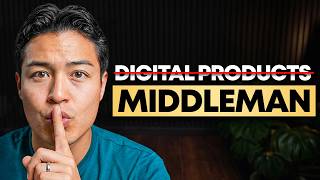

AI Destroyed a $14 Billion Company
54sThe dramatic Chegg collapse makes AI's threat to digital products feel real and urgent.
▶ Play Clip"The title accurately captures the core argument, though the video doubles as a pitch for the creator's paid program."
This video argues that selling digital products is dying because AI has made information free, and urges creators to pivot to physical products. The presenter proposes an 'AI middleman' business model where AI handles marketing and operations while you sell tangible goods, then explains how to validate a product, create AI-generated ads, and scale with Meta Ads and premium packaging.
AI has made information free, eliminating the value of PDFs, templates, and guides. People won't pay $20 for a PDF when they can get a better answer for free.
Chegg, a homework answer database, lost 99% of its value within 24 months after ChatGPT launched because its $20/month subscription competed with a free alternative.
AI can suggest solutions like painkillers or massagers but cannot manufacture and ship physical goods. Millions of problems require tangible products.
Use AI to run the business side (ads, copy, operations) while the product stays physical. AI accelerates growth instead of replacing you.
Example of Doorbot/Ring: the founder solved his own delivery problem, was rejected on Shark Tank, but rebranded to Ring and sold to Amazon for $1 billion.
You don't need a billion-dollar idea; taking an existing customer problem and selling a physical solution can yield a few million a year.
Look at what's being sold through ads and use tools to spot winning products. Avoid picking a product just because it's cool or trending.
Check ad comments for signals of real need, like 'Does this work for X?' or 'We need this.' Comments like 'cool' are not enough.
You must be able to describe the exact problem in one sentence within 60 seconds. If you can't, the product isn't a problem solver.
Competition validates demand. If 3-5 brands run ads for a product, the market is early; 10-20+ means saturated.
Organic content on TikTok/Instagram (algorithm dependent), hiring creators (slow), or AI-generated ads (fastest and scalable).
Use a custom Claude skill to write ad scripts, then generate videos with tools like Arcade Ads or Hekskfield.
Selling price - product cost - shipping = max cost per customer. Write this number down before spending on ads.
Use one CBO campaign at $50/day, broad targeting, no interests, with 3-5 different creatives and hooks.
CTR above 1% after a few days is good. Compare cost per purchase to break-even; don't touch the campaign before spending $100-150.
Increase budget by 25% every 2-3 days, e.g., $50 -> $62.5 -> $78, letting the algorithm optimize.
Custom packaging increases trust, repeat purchases, and word-of-mouth. Use Team Drop to get low MOQ packaging.
Team Drop lets you order packaging with MOQ as low as 1 unit, including branded boxes and inserts. You can also ship faster with lines like Yun Fast.
The key to thriving after the AI information crash is to sell physical products that AI cannot deliver, using AI as a force multiplier rather than a competitor. Validate a real problem, generate ads with AI, scale with Meta Ads, and build a credible brand with premium packaging.
Why did Chegg lose 99% of its value after ChatGPT launched?
Because ChatGPT offered free homework answers, making Chegg's $20/month subscription obsolete.
00:55
What is the 'AI middleman' business model?
Using AI to handle the business side (ads, copy, operations) while selling physical products that AI cannot deliver.
02:16
What are the three 'painkiller filters' for validating a physical product?
Engagement (real need in comments), problem clarity (describe the exact problem in one sentence), and demand (competition level).
04:34
What does a CTR of above 1% after a couple days indicate in Meta Ads?
It means people are stopping and engaging with the ad, which is a good sign.
09:49
How should you scale a profitable Meta Ads campaign?
Increase the budget by 25% every two to three days, e.g., $50 to $62.50 to $78.
10:17
What is the break-even formula for cost per customer?
Selling price - product cost - shipping = maximum you can spend to acquire a customer.
08:57
Why is custom packaging important for a new product brand?
It makes the product feel premium, increasing trust, repeat purchases, and word-of-mouth.
10:43
How can Team Drop help new sellers bypass high MOQ packaging?
Team Drop offers custom packaging with MOQ as low as 1 unit, so you can brand products without ordering hundreds upfront.
11:32
What is the difference between 3-5 brands and 10-20 brands running ads for a product?
3-5 brands indicate an early-stage market you can enter; 10-20+ means the market is likely saturated.
06:19
Physical products are AI-proof
This reframes the AI threat from job loss to product vulnerability, showing where durable business value lies.
01:49Problem-first product validation
The Ring story proves that starting with a customer problem can lead to a billion-dollar outcome.
02:58Competition as demand signal
The counterintuitive point that competitor presence validates demand rather than scaring off sellers.
05:41Broad targeting with Meta Ads
Letting the algorithm find buyers beats manual targeting — a key efficiency lesson for paid traffic.
09:10Branding through packaging
Even early-stage sellers can mimic premium brands with low-MOQ packaging, turning unboxing into marketing.
10:43[00:02] software businesses are going to disappear in the next couple [music] years. And it's not because the businesses are saturated. It's because digital products have a problem that can't be fixed, and AI just made it way
[00:14] going to tell you why digital products are dead and what products you should making hundreds of thousands of dollars a month selling this type of product show you how you can start doing the same in three simple steps. So, first
[00:29] let me explain why I think digital products are in fact dead. Now, most people, they assume that saturation killed digital products. Right now, anyone can create a PDF guide or template in less than 5 minutes with AI.
[00:42] them, the information did. AI just made information free. Why would someone pay $20 for your PDF when they can get a better answer for free? They're simply not going to. AI basically eliminated the value that they had overnight. And
[00:55] the crazy part is that this isn't just affecting people that are selling It's hitting entire companies. Chegg was a company that gave you access to a database of homework answers. Now, by 2021, millions of college students were
[01:09] subscribed. I was actually one of them paying $20 a month, and it was worth over $14 [music] billion. And the reason why they looked bulletproof was because they spent years upon years and hundreds of millions of
[01:21] dollars getting people to solve every problem [music] in that database. And overnight. But then ChatGPT launched, and their $20 subscription was now competing with something that's free. Especially for college students who were
[01:34] already broke, why would you pay for something that is free? You [music] public company to say that AI was destroying their business. And over the next 24 months, Chegg lost 99% of its value. So, if AI is killing the value of
[01:49] the move? You want to build something where the value is something that AI literally cannot replace. And what is that? That's physical products. If you have back pain, you can ask AI for a solution and it'll tell you what
[02:03] painkiller to take or recommend you a back massager, but it cannot manufacture those products and ship them directly to your door. And just like back pain, there are millions of problems that can only be solved with a physical product.
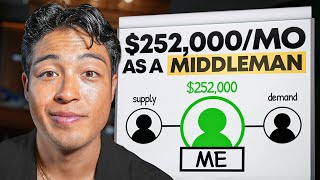
[02:16] Dry skin, knee pain, your dog destroying furniture. These are all problems that AI can't solve. So the model is pretty simple. I call it the AI middle man. Use AI to run the business side, but what you're actually selling stays physical.
[02:30] AI helps you grow instead of replacing you. And there's very clear proof of this. Theragun was launched in 2007 and was making nearly $400 in annual revenue. And when ChatGPT launched, the business didn't slow down. They just
[02:44] started using those new tools to move faster. And now it's considered one of the most valuable recovery tech brands in the world. AI didn't replace them, it the kind of business worth building right now. Before any of that, there's
[02:58] believe it or not, it's not your product. It's the problem. So quick little story, there's this guy working out of his garage in 2011. He could not and kept missing deliveries. So he thought about how he could solve that
[03:12] problem and he created Doorbot, which is a doorbell connected to Wi-Fi that sent an alert to his phone and let him see and talk to whoever was at his front product, pitched it to Shark Tank and every single shark actually rejected
[03:27] kept building. Rebranded the company to Ring and 4 years later, Amazon acquired it for a billion dollars. So he built a billion-dollar company out of a problem success story of the last decade started the same way. Not with a product, but
[03:42] with a problem that someone had. You don't want to be in the product problem-solving business. Because the The doesn't care how cool your product is. That's just reality. They don't. If
[03:54] for a real person, the business is not going to work. Now look, you're probably not going to build the next Ring. You're probably not going to make a billion dollars either, and that is totally fine. You can make a few million a year
[04:07] just like I have and a lot of people that I know just by taking an existing customer. To actually find a product, looking at what's being sold through ads. You can also use tools that tell
[04:20] now, but don't pick a product just because you think it looks cool or because it's trending. The product that you choose needs to pass through three filters. I call them the painkiller filters, and I run every single product
[04:34] through these before I test anything. The first one is engagement. Now when you see a product ad or you find a product in a research tool, don't look hunt for signals that tell you that people absolutely need this thing.
[04:48] Comments where they ask a question about the product like, "Does this work for a specific situation?" People tagging their friends saying things like, "Sarah, we need this for our trip." Or straight up comments like, "This is
[05:00] literally what I've been trying to find." If you can only see comments saying that the product looks cool, that's generally not a good sign. The the product and describe it in one sentence the exact problem people who
[05:15] buy this product face. So for example, for a posture corrector, this will be something like, "My shoulders round forward, I'm at my desk all day, and I'm for something like a silicone food cover, it'll be something like, "My
[05:28] leftovers dry out in the fridge because plastic wrap never seals properly." Now if you're having trouble describing your problem in, let's say, 60 seconds, that means that it's not a problem solver and you should not try and sell it. The last
[05:41] filter is demand, and most people, they think that the best markets are the ones and that couldn't be further from the truth. That just means that there is no demand. So, the way that you validate this is just by looking for competition.
[05:54] and search for the product or one of the you're wanting to sell. And if the ads have been running for, say, two plus weeks, that means that people are actively trying to solve their problems
[06:07] and they are buying the product because no brand is going to keep spending money on ads if they're not getting sales because Meta ads cost a lot of money. But, at the same time, you don't want too much competition either. So, you
[06:19] can look for how many brands are selling these products. Anywhere from three to five brands running ads means that the market is still in its early stages and you can enter. But, if there are 10 to 20 plus brands running ads for the same
[06:32] product, it means that the market is likely saturated. So, run these every you've got something worth building around. If it misses one, find another about getting people to buy. Here's the
[06:45] thing about physical products. You can't just put your product up in a store and wait for customers to magically find you. Physical products, they need there are really only three ways to do this. So, number one, you can make
[06:58] content and post it on TikTok, Instagram, but then you're completely dependent on the algorithm catching onto you and if it doesn't pick up on you, you're not going to get any traffic. The other way is to hire someone to create
[07:11] an ad for your product and this works a lot of brands go this route, but it takes a lot of time. You got to find creators, negotiate rates, wait on drafts, send revisions, and by the time that you actually run something, weeks
[07:23] have gone by. And if that angle doesn't land, you are basically you're just option doesn't have that problem. You can use AI to create your own ads even how it works. First, you use Claude to write the actual ad script, so what's
[07:39] going to be said in the video. I built a custom Claude skill specifically for this. So, if you've never heard of what a Claude skill is, it's basically just a set of instructions that Claude reads every single time that you open up a new
[07:51] chat and you reference it. So, instead of having to re-explain what you want each and every time, it already knows exactly what to do. And this skill right here, it knows the full structure of a converting ad. I've actually trained it
[08:05] so it understands everything. So, you just have to describe your product and attach to give it context of what you're selling. Then the skill figures out who will actually buy your product and write a description of the avatar that will be
[08:18] in the ad. It also gives you a full production prompt with everything that will be in the ad and exactly what the avatar is going to say out loud. If you want this Claude skill, I created a Notion guide for you guys to download
[08:31] description, completely [music] free. Then, you can take what Claude gives you and drop it straight into a software like, for example, Arcade Ads or Hekskfield to bring the whole thing to life with AI. I'm not going to go in
[08:44] that. You can watch this video if you are interested. Now, before you put any money behind it, there is one thing that you need to figure out first, and this is way more important than most people realize. It's your break-even. So, you
[08:57] can take your selling price, subtract your product cost and your shipping, and maximum that you can spend to get a customer and still make money, right? You want to write that number down. Everything that you're about to see gets
[09:10] going to run paid ads, I would recommend starting with Meta Ads. The reason is that the algorithm is the best at finding buyers for you. You don't have to figure out the targeting anymore. You just give it the creative and let it
[09:22] going to have one campaign, CBO, campaign budget optimization, at $50 a set, which is going to be broad. You're going to put no interest in there, no to touch it other than maybe who you want to target, which would be men,
[09:37] women, and then the countries. So, just pick your countries and leave everything else open. And then you want to run three to five creatives, which each have different hooks, different angles of the same product that you're selling. And
[09:49] data. The first thing I look at is the CTR, which is your click-through rate. Above 1% after a couple days means that people are stopping. Below that, your cost per purchase. You want to compare it to your break-even number. Now, if
[10:04] you haven't spent anywhere from $100 to $150 yet, don't touch it. It needs more data to optimize. Now, if you've spent over $200 and the cost per purchase is to have to cut that cuz it's not profitable. If you're under your
[10:17] break-even and you spent enough to trust the data, you want to let it continue to run. And when you find something that's profitable, don't just double the budget or increase the budget 10x overnight. Instead, you want to increase the budget
[10:31] 25% every two to three days and let the algorithm do this. So, if you have it at $50 a day, increase it to 62.5 after two to three days. And if it's still performing and holding after another two to three days, increase it another 25%.
[10:43] It should be $78. That's really all you have to do. The numbers are going to know what exactly you're looking at. Here's what most people miss at this stage. So, you've got the product, you've got the ads, but the stores that
[10:55] are actually building something lasting all have one thing in common. They look like a real brand. And the fastest way to get there is going to be custom packaging. So, branding on [music] the package that arrives your customers. And
[11:07] now, the thing is, when someone gets your product and actually feels premium when it arrives at their front door, they're way more likely to either post about it, come back and buy again, and probably just trust you with their next
[11:20] purchase. Now, when I was first starting, you had to order hundreds of units, which was an MOQ, before you've proven anything, right? So, in order to get custom packaging, you would have to work with a manufacturer and then
[11:32] pre-purchase, say, 500 units and then they will make the logo on your product a sticker. But, let me show you how to bypass that. So, this website right It's called Team Drop. So, once you sign up, your dashboard's going to look
[11:47] something like this. The app is entirely free to use. So, you have the option to a ton of really quick shipping lines. That's why I like using them is because we look at the options they have. Yun Fast selector, you can get the product
[12:00] to the customer within 5 to 8 days. Now, of course, this is like a heavier item, that you can get your product to your customer within 5 to 8 days is absolutely insane. So, the main use case for us here is going to be the
[12:13] packaging. So, if we go into packaging products, you can see that you can send out any of the products that you want with all these options. So, if I went in and pulled up this tin box right here, the MOQ is one. You only need to buy
[12:26] one, right? Some of these do have an MOQ of let's see, yeah, this one is 200, so thank you letter, custom printed cards, you need to buy at minimum 200, but they're 10 cents. For the most part, a lot of these are no MOQ or very low MOQ,
[12:40] quantity, you only have to buy one or two to actually get this product sent to your customer. So, let's just say for example that I was selling, say, selling this watch right here, right? I'm selling this watch and I want to
[12:53] differentiate myself from my competition. Couple ways I can do that is ship the product faster, okay? So, cool, we have different get the product out of the customer in 5 to 8 days. May it cost a bit more, but we can back that
[13:05] want to go to the extra extent, make myself look ultra professional, I go back in to packaging, packaging products, and we can browse and see what we can actually sell our product in. Right here, octagonal watch packaging,
[13:19] MOQ of one. So, that means that I can have this product right here packaged inside of this professional branded looking case with my logo on top of it sent directly to the customer. Now, in order to do that, pretty simple. All you
[13:33] have to do is press this WhatsApp icon right here. It's going to then open up a WhatsApp chat, which is simply a chat where you have access to your own agent just got to tell them, "Hey, you know what? I want this product right here
[13:48] sent inside of this fancy box." And that's going to cost you $2.60 plus a $1.80 and then however much it costs to ship depending on which line that you choose. So, really awesome feature that they have and this was
[14:02] something that was never accessible when I was first starting, but it's a massive just don't know about this. You can insert stickers. You got all kinds of the main thing is that you're not waiting until you're doing an insane
[14:16] amount of volume to start looking like a real brand. You can start building that way earlier than most people think. All right, so look, you have everything that Everything that I just showed you can be done today. But, here's what most people
[14:30] don't realize until they start building the whole thing themselves. Those first you're getting orders, you're scaling, but new problems arise. Ad costs go up, account gets banned. And that's the exact phase that I built my program for.
[14:45] seven-figure brands using this exact model and dealt with every one of these problems along the way. So, that experience is what we bring when we work what product to test, how to build
[14:59] super honest, we can't work with everyone simply because there are only so many hours in the day, but we do have spots open right now. I'll leave an in. Either way, thank you for watching. Hope you enjoyed. See you in the next
[15:13] Hope you enjoyed. See you in the next one. Peace.


⚡ Saved you 0h 15m reading this? Transcribe any YouTube video for free — no signup needed.