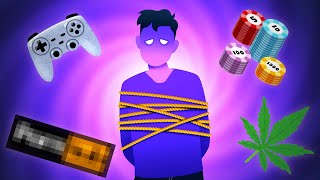

Cold Showers Don't Boost Self-Control
60sDebunks a popular self-improvement trend with science, sparking curiosity and debate.
▶ Play Clip"Delivers on the promise of explaining the science of self-control with research-backed insights, though the sponsor segment and some repetition add minor padding."
The video explains the neuroscience of self-control, arguing that it is not a fixed trait but a dynamic process rooted in the brain's conflict-monitoring system. It presents research showing that self-control is essentially the capacity to monitor internal conflicts, and that awareness itself is control. The video offers practical advice on how to improve self-control by re-internalizing awareness, especially through meditation and emotional regulation.
People want to eat healthier, exercise more, and manage time better, but struggle to follow through. The video sets up the common problem of lacking self-control.
Common attempts like cold showers or supplements don't work because they don't translate to general self-control. The video notes that cold showers only make you good at tolerating cold showers.
Recent studies suggest that self-control doesn't exist as a separate trait; it's actually the capacity to monitor internal conflict. This reframes the entire concept.
Research from the 90s and 2000s showed that self-control is not fixed but a diminishing resource, like a mana bar, that can be depleted by emotional regulation and stress.
Suppressing emotions and experiencing stress drain self-control reserves. The video explains that emotional regulation shuts off internal awareness, and stress externalizes attention.
The anterior cingulate cortex monitors internal conflict. When we stop monitoring conflict, we lose self-control. This is the neural basis of self-control.
We lose control not after winning or losing a battle, but when we stop monitoring the conflict. This explains why we often give in without realizing it.
To improve self-control, address emotional turbulence (through therapy, journaling) and re-internalize awareness when stressed (e.g., 15-30 minute check-ins).
Increasing awareness of internal states boosts the conflict monitoring system. Self-control and awareness are the same thing, not separate.
Meditation works because it trains conflict monitoring. The video concludes that awareness is control, and paying attention to internal conflict is the key to self-control.
Self-control is not about forcing yourself but about maintaining awareness of internal conflicts. By re-internalizing attention and practicing mindfulness, you can effectively boost self-control.
What is the anterior cingulate cortex responsible for?
Monitoring internal conflict.
07:24
What two factors most severely drain self-control?
Emotional regulation (suppressing emotions) and stress.
05:48
According to the video, what is self-control essentially?
The capacity to monitor internal conflict.
07:55
Why do cold showers not improve general self-control?
Because they only make you good at tolerating cold showers; skills don't translate to other areas.
02:41
What happens when we stop monitoring internal conflict?
We lose self-control.
08:51
How does stress affect self-control according to the video?
Stress externalizes attention, causing us to stop monitoring internal conflict, thus reducing self-control.
11:37
What is the relationship between awareness and control?
Awareness is control; they are the same thing.
16:55
Self-control doesn't exist as a trait
Challenges the traditional view of self-control as a fixed characteristic, offering a new paradigm.
03:07Anterior cingulate cortex role
Identifies the specific brain region responsible for self-control, grounding the concept in neuroscience.
07:24Emotional turbulence and self-control
Links emotional regulation to self-control depletion, suggesting that addressing emotions is key to improving self-control.
12:33Awareness is control
Provides a counterintuitive but actionable insight: increasing awareness is the direct path to better self-control.
16:55[00:01] science of self-control and evidence-based techniques to boost your is that you want to do stuff right you want to eat healthier you want to
[00:16] exercise more you want to wake up on time you want to go to bed on time you want to spend less time on your phone but the problem is that you don't really listen to you right and so what we end up doing is we try to find Solutions for
[00:30] Google search or watch a YouTube video about how to eat healthy or how to actually go to bed on time hey y'all I want to take a moment to thank the sponsor of today's video Babel Babel is the top language learning app worldwide
[00:44] of what I love about Babel is that it's designed by real language teachers so they know exactly what a student needs to learn a language and they also use evidence-based techniques to optimize learning in a short amount of time I
[00:58] really wish that I had access to this when I was actually in med school because they make learning so easy I'm learning a lot of very common phrases that doctors would actually need to use to communicate with their patients I for
[01:10] example am learning medical Spanish which I wish I had access to when I was actually in med school so I'm learning how to say B AA e which means drink really love about Babel is that it's
[01:24] very accessible in all of the in between spaces in my life so part of the problem is that learning a new language takes a lot of time but I love that I can replace the boring wasteful stuff that I do on my phone with actually learning
[01:36] medical Spanish so I can't thank Babel enough for sponsoring today's video and strongly recommend that youall check out the awesome offer which is 60% off your subscription in the link below thank you once again to Babel for sponsoring
[01:49] content on the internet free and so we end up trying to fix these problems individually but in the back of your mind you probably know that if you could just be better at controlling yourself all of these things would get better if
[02:03] you were better at self-control you'd be able to eat healthy you'd be able to be more motivated at work you'd be able to suppress and control your burnout and so then we end up doing things to try to boost our self-control like sometimes
[02:16] we'll even take supplements that are supposed to be cognitive enhancers or we'll do really hard things like take cold showers because taking a cold shower is hard and if I can force myself to do it then I should be able to force
[02:29] myself to do all of the other stuff and it turns out though that that doesn't really work because if cold showers increased everybody's self-control then we'd have a lot of data supporting that and everyone would be taking cold
[02:41] showers it turns out that if you look at it scientifically what cold showers make you good at is tolerating cold showers and that's what's so elusive about self-control that we can get good at a particular task but that doesn't
[02:54] actually translate over into the other parts of our lives and the reason for that is because we have haven't really understood the science of self-control until now and there have been a couple of in my opinion revolutionary studies
[03:07] that have completely changed our perspective on self-control in fact they've shown us that self-control doesn't really exist and paradoxically it's through understanding this that we will learn the best scientifically
[03:19] validated methods to improve our self-control and if this is so about it and why aren't people talking about it there are a couple reasons for actually really really hard to understand because it completely changes
[03:33] our perspective on self-control and the second thing is that the discovery isn't sexy at all in fact it is quite disappointing and at the same time now that we know this now that we literally understand where self-control originates
[03:46] in the brain we can actually do things to significantly boost our self-control so let's start by understanding what we do know about self-control so a couple thousand years ago a group of yogis sitting in India basically discovered
[03:59] something that awareness precedes control and when I teach this principle either as a psychiatrist or a meditation instructor I kind of point out that okay if you kind of go to the dentist and you get something numbed up you can't feel
[04:12] your mouth anymore and if you can't feel your mouth anymore you can't control your mouth water will spill out talk like this you can't really like can understand you right so I sort of use this kind of analogy that okay if
[04:26] control it anymore and it turns out that while that analogy seemed really good it's actually wrong and it goes way deeper than that in the 9s and 2000s tried to figure out what is going on with self-control what is it really
[04:41] because the basic idea that we had at the time was that self-control is characteristic it's a part of who you are and if you've got the right genes that if you're 20 years old and you've been raised with discipline then you
[04:56] will continue to be disciplined we thought it was a fixed aspect ECT of who you are as a person and this group of researchers basically discovered that it's not a fixed aspect of who you are as a person but a diminishing resource
[05:08] it's not something that's on your character sheet as a trait it's actually like a Mana bar that can be depleted over time and this sort of makes sense some days we're able to control ourselves but on days where there's a
[05:21] lot of stuff going on and we have to exert a lot of self-control when I've had a really rough day at work and I want to yell at my boss and I strain myself all day at the end of the day I can't bring myself to eat a salad and I
[05:34] just order a pizza and I sit down and like I'm just done with the day so they basically discovered that the more self-control you exert the more it figured out that it is a diminishing resource naturally the next thing that
[05:48] they looked at is what diminishes self-control the most and what we basically figured out is there are two things that severely severely drain your self-control the first is emotional Reg regulation so if you spend a lot lot of
[06:01] time suppressing or regulating your emotions if you want to tell someone to go screw themselves and you have to hold that in then you will diminish your reserve of self-control that's number one the second thing which reduces
[06:16] self-control is stress because let's be honest stress is bad at everything going to reduce your self-control but they literally found that they found that people who were in more stressful situations had a lower reserve of
[06:30] self-control and could not exert that to do healthy behaviors and that kind of makes sense right because stress makes everything worse and then there were a said okay what can we do to boost self-control and no surprise meditation
[06:44] helps us boost self-control because you should meditate more if you meditate you but then like I said earlier this gets us back to the original problem where if I had the self-control to meditate every day I wouldn't need to meditate every
[06:57] day if I could force myself to sit down then I wouldn't be in this problem in the first place and this is where we come to the truly revolutionary research they sort of figured out okay so we know that emotional regulation and stress
[07:10] reduce our capacity for self-control then they ask the question what's going on in the brain when emotional regulation and stress actually drain our self-control which part of the brain is actually being drained and they used
[07:24] measures the electrical activity of the brain and they discovered something part of our brain called the anterior singulate cortex and the anterior singulate cortex is responsible for monitoring internal conflict and what
[07:40] they essentially discovered is when we stop monitoring our internal conflict our capacity for self-control goes out the window so this was kind of a weird finding because it sort of suggested that self-control isn't really a thing
[07:55] but simply that what self-control really is is our capacity to monit monitor internal conflict and if you sort of stop and think about it you'll notice this right because when do we exert self-control we only exert self-control
[08:08] when there is an internal conflict so generally speaking in human be Behavior I have an automatic impulse I want to eat a slice of pizza and then there is another part of my brain that says actually we should eat a salad and in
[08:22] that moment when you exert self-control there is actually a conflict because between one part of you and the other part of you that's literally why we call it self-control because you are trying to control yourself and the self
[08:34] actually wants to do something else now we've assumed based on our subjective experience that there's actually a control aspect going on but it turns out turns out that what these researchers discovered is as long as the conflict is
[08:51] being monitored we will be in control but the moment we stop monitoring the conflict we lose all control and you may may have actually noticed this because like pay attention to your particular circumstance where you fight a battle in
[09:06] your mind and then as long as you're fighting that battle you're still sort of in control but the moment that you stop paying attention and the moment the battle disappears is the moment that we lose control now this is where we think
[09:20] that the reason we stop monitoring the battle is because we've lost or we've won right that's what we sort of assume the battle is over that's why I sto natural because the two happen really closely together we stop thinking about
[09:33] it after we lose right and then we kind of give into the behavior but it turns out that it's actually the other way around it is that when we stop monitoring it that's when we lose the battle and you may have kind of noticed
[09:46] you're kind of arguing with yourself but you sort of like eh and then you stop thinking about it and before you realize it your phone is in your hand and you're kind of waving it around and you're scrolling in bed before you realize that
[09:59] you've turned on the light or opened up your tablet and You' started to watch addiction psychiatrist when I talk to patients about their relapse they don't relapse after a long and drawn out Battle of like resisting resisting
[10:13] of give up in your mind and you kind of stop thinking about it and then you're engaging in the behavior before you even realize it and so this is exactly what the researchers discovered that conflict monitoring is self-control but hold on a
[10:28] second okay what about all this stuff around emotional regulation and stress because we know that those two things deplete self-control the most but you're telling me that simply monitoring conflict is self-control how does that
[10:40] relate and it turns out that it fits perfectly so if we look at emotional regulation what are we literally doing in emotional regulation we are suppressing our internal emotions I want to tell my boss to go screw himself but
[10:56] instead of paying attention to that I'm I'm going to shut off that part of my mind and shockingly when I shut off my internal awareness I shut off my ability
[11:09] to monitor conflict and as I shut off the part that is responsible for self-control shockingly my self-control worsens so emotional regulation fits perfectly because literally what you're doing is shutting off that conflict
[11:23] monitoring part intentionally so that it getting pissed off doesn't take control and actually cause you problem right so that sort of makes sense that as we suppress our internal awareness we will lose the capacity for self-control what
[11:37] about stress though so stress is also something that fits perfectly because when we are stressed out literally what our brain is doing is externalizing our attention when you are stressed out you are not thinking or paying attention to
[11:50] this you are paying attention to the problems outside that are going to screw a test I'm not paying attention to the internal environment I'm thinking about the test when I'm stressed out about my boyfriend or girlfriend breaking up with
[12:04] me I'm not thinking about how I feel I'm thinking about how do I prevent This Disaster so now we see another really interesting point of evidence which is that when we are stressed out literally what our brain does is externalizes our
[12:17] attention to solve the problems that cause us stress and shockingly when I externalize my attention what do I stop paying attention to my internal conflict so we actually see that this old research about emotional regulation and
[12:33] stress causing reductions in self-control fits perfectly with this model that conflict monitoring is literally self-control and so what does that mean for you a couple of really simple things the first is that the more
[12:47] of your emotions that you have to suppress the worse your self-control because if we look at addiction Psychiatry the more emotionally turbulent someone is the more more likely they are to use and relapse and
[13:01] not control their behavior the crappier your life is emotionally the more likely you are to give into bad behaviors binge eat comfort food when do you need
[13:13] comfort food when you need comfort when do you need comfort when there's Badness in here so the first thing that we've got to do is learn how to alternately everything from going to therapy to
[13:25] journaling to taking walks but what you need to understand is that you cannot improve your self-control if you are emotionally turbulent that fixing the emotional turbulence is the same thing as improving your self-control that's
[13:37] as improving your self-control that's number one number two what about stress okay Dr qu are you saying that as long as I'm stressed out that I won't be able to control myself and that's where the science really comes in and says not
[13:51] quite because I'm not saying that you have to solve all of your problems but instead what you need to do is re internalize your awareness and this is focused on solving problems let's say I have a a final coming out up and I'm
[14:06] afraid to fail it what I start doing is stop paying attention to myself I stop stop paying attention to my fatigue signals I stop paying attention to everything in here because I'm so focused out there so it's not that you
[14:20] need to fix all of the problems in your life to gain self-control it's that you need to re internalize your awareness so anytime you're feeling stressed out try to take 15 minutes 20 minutes 30 minutes
[14:34] to just check in with yourself sit down or go for a walk and just ask yourself how am I feeling right now just take take a moment to literally re internalize your awareness just pay attention to what's going on and then
[14:47] you may say but Dr K that won't be enough even if I pay attention how do I start doing healthy things and this is the Revolutionary and confusing thing is that the two are actually the same literally all you need to do is increase
[15:01] awareness of the internal self as you increase that awareness you will be boosting that conflict monitoring system in the anterior singulate cortex it's not that self-control is separate from awareness it's that the two are actually
[15:14] exactly the same thing so as long as you can pay attention to your internal signals literally your self-control will improve because the circuits are one and improve because the circuits are one and the same what we subjectively experience
[15:27] as self-control is different from what is actually going on in the brain so a good example of this is if I'm nervous I will say I have butterflies in my stomach but I don't literally have butterflies in my stomach it is just the
[15:40] way that I subjectively experience nausea or anxiety or whatever and instead there's an actually discreete neuroscientific mechanism and so if you solution to getting rid of butterflies in your stomach is not to remove the
[15:55] address what's actually going on in the brain and so even if you accept that you internalize my awareness when I'm stressed out but then what how do I exert self-control and this is exactly why this is so hard to understand you
[16:10] don't actually need to do anything else that self-control and awareness of your internal State specifically awareness of conflicts within you is literally the sounds really confusing because subjectively that's not really what it
[16:25] feels like right and this is exactly what the problem is is myself we don't find any good evidence-based answers because one none of them exist and now we actually come full circle to meditation because why is
[16:39] meditation so good at improving self-control because when I'm doing attention to my breath that's not controlling my breath it's not resisting that's literally because these two functions are the same in the brain so
[16:55] it turns out that the yogis actually had it right all along and even what I was saying earlier about awareness precedes control is actually incorrect it's not that awareness precedes control it's that awareness is control and so the
[17:08] last thing that you can do which I know sounds crazy is actually meditate but even in this way you don't have to do a formal meditation practice literally the muscle of self-control is the muscle of conflict monitoring so all you need to
[17:22] conflict monitoring so all you need to do is pay attention to your internal conflict and the more that you s with that conflict the more you will be able to exert control and the last thing that I'll leave youall with is if you even
[17:34] kind of think about the times in your life where you exert self-control you kind of are aware of that conflict and then you kind of have this idea of just do it right you kind of make up your mind and you just do it and so if we
[17:47] becomes easy you're like yeah I just woke up one day and I just did it and so to just do it but that's hard because you don't know how to just do it and look at every person who has decided to just do it all of that just doing it was
[18:04] preceded by a very high awareness of internal conflict and if we're talking about someone who overcomes an addiction what we literally do in Psychotherapy is become aware of that conflict over and over and over again and then one day an
[18:18] addict wakes up and becomes sober they just wake up and they just do it and so if you want to do that for your life and develop self-control what you really need to do is actually not just do it
[18:30] you're trying to solve the wrong problem which is exactly why it doesn't work instead all you need to do is pay attention to your internal conflict and the longer you can be aware of it the more in control you will
[18:43] more in control you will [Music] [Music] be
⚡ Saved you 0h 18m reading this? Transcribe any YouTube video for free — no signup needed.