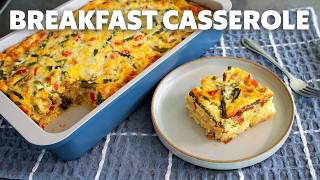

Perfect Breakfast Casserole Texture
40sReveals a rare, targeted texture for breakfast casseroles that most people fail to achieve, sparking curiosity and desire to learn the technique.
▶ Play Clip"Title promises an easy recipe and delivers—step-by-step without fluff, though techniques add depth beyond 'easy'."
Chef John demonstrates how to make a light and tender Easter breakfast casserole with asparagus, ham, potatoes, and a creamy custard base, emphasizing proper blanching and layering techniques for perfect texture.
Chef John introduces the breakfast casserole and begins prepping asparagus by slicing off tips and cutting spears into bite-size pieces.
Ham is cut into 1-inch strips then diced into quarter-inch pieces to match the size of the asparagus for even distribution.
Asparagus is blanched in salted boiling water until it returns to a boil, then immediately shocked in cold water to lock in color and flavor.
Quartered russet potatoes are boiled in the same water until tender, then drained thoroughly.
Diced onions and red bell pepper are sautéed in olive oil with salt until softened but not browned.
Eggs are whisked with salt, pepper, and cayenne for 30 seconds before adding milk and cream to avoid splashing.
Potatoes are layered in a greased dish using a palm-cutting technique, then topped with half the cheese, half the vegetable mixture, ham, asparagus, and remaining vegetables.
The custard is poured carefully over the layers, then the remaining cheese is added and the dish is tapped to settle the eggs into the crevices.
The casserole bakes at 350°F for 50-55 minutes until lightly browned and set; a skewer test ensures no uncooked egg remains.
The light texture comes from using a proper ratio of eggs to cream and milk, avoiding a dense, tough result like a frittata.
With careful blanching, layering, and the right custard ratio, this breakfast casserole achieves a tender, feather-light texture that sets it apart from typical dense versions.
What is the purpose of blanching asparagus in this recipe?
To lock in color and flavor since it will be cooked again in the casserole.
01:52
Why should you whisk eggs before adding milk and cream?
To avoid splashing because the eggs are thicker and the dairy would splash out if added first.
03:24
What technique does Chef John use to cut potatoes without a cutting board?
He holds the potato in his palm and cuts through with a butter knife.
04:04
What is the baking temperature and time for this casserole?
350°F for 50 to 55 minutes.
06:22
What is the key to achieving a light, tender texture instead of a dense one?
Using a proper ratio of eggs to cream and milk, with just enough eggs to hold the ingredients together.
07:15
Palm Cutting Technique
A fast, fun, and safe method passed down from Chef John's grandmother, using a butter knife and palm instead of a cutting board.
04:04Custard Ratio Insight
Explains why most breakfast casseroles are dense and how the right egg-to-dairy ratio creates a feather-light texture.
07:15Layering Method
Layering ingredients loosely instead of pressing them down ensures even distribution of egg custard and proper texture.
05:27[00:02] foodwishes.com with Easter breakfast casserole. method for making what I think is a perfect breakfast casserole. One that's beautiful to look at, delicious to eat,
[00:17] and features a tender custardy feather-light texture, which in the world of breakfast casseroles is a very rare thing indeed. And to get started, we will prep a couple bunches of asparagus, since we're
[00:29] definitely one of my favorite spring things. And after we slice off the tips, I like to cut the spears every inch or so, so we have some nice very user-friendly bite-size pieces.
[00:42] And these were very nicely trimmed, but of course, if you have any tough woody parts near the bottom, you want to trim those off and discard them. And then speaking of bite-size, whether we're using sliced up ham leftover from
[00:54] the holiday or stuff already sliced from the store, what I like to do is cut that in about 1-in strips, and then slice across every quarter inch to get some pieces that will be similarly sized to the asparagus, and
[01:07] And then what we'll do is give that a taste for quality control purposes before we pop it in the fridge, at which point we'll head to the stove with our and we'll transfer that into some generously salted boiling water.
[01:22] briefly. All right, literally as soon as this comes back to the boil, which is only going to take about a minute or so, back to a boil like this, we will grab a bowl of cold water, and we'll use our
[01:37] handheld strainer, which in the business we call a spider, short for spider web, asparagus in, which will immediately stop the cooking which is key cuz this is still going to get cooked in our casserole.
[01:52] So, all we're doing here is locking in the color, plus by blanching, we're flavor. And once that's set, we're going to multitask by transferring some peeled, quartered russet potatoes into the same
[02:04] And as you can see, we're using our spider to lower those down in, which is much safer than trying to transfer them in with your hands. they're fully tender, at which point we'll drain those very thoroughly, and
[02:18] And that's it. Once our potatoes are set, we will sauté some diced onions and diced red bell pepper in a little bit of olive oil set over medium-high heat. And we will also add in a nice big pinch of salt.
[02:33] And we will cook those stirring for a few minutes, or until our onions soften and start to turn translucent. And those peppers have lost their crisp bright And I know it looks like we cooked the onions golden brown, but that's mostly
[02:46] I mean, we can cook the onions actually golden brown if we want, but it's not really necessary as long as they've softened up. turn off the pan, and reserve that until needed, while we move on to the last
[03:00] major component, our egg custard. eggs into a bowl, and we will season those up with some salt, some freshly ground black pepper,
[03:12] and of course, a few shakes of cayenne. And then we'll grab our whisk and bust will give those a thorough mixing for about 30 seconds before we add our milk and cream.
[03:24] And the reason for that is because the eggs are a thicker viscosity, and if you whisking, especially in a bowl this small, you will 100% of the time have milk and cream splashing out. So, it's just way easier, and usually
[03:38] way less messy to do it this way. And that's it. Once our dairy's in, we'll give that a final mixing for about a half a minute, or until everything's At which point we we start building up
[03:51] which begins by cutting up some potatoes into a greased casserole pan or dish. And for that, I'm going to use a technique my grandmother and my mom used for potatoes, where they would hold a piece of potato in their palm, and then
[04:04] use a butter knife to cut straight down through the center, and then across into Okay, whether they were making potato salad or home fries, I never ever saw them use a cutting board. And they would always, every time, do it
[04:18] like this. Which is very fast and easy and kind of fun. But obviously, if you use this technique, the knife choice is very Okay, this would not be the time to try out your new sushi knife.
[04:32] up, once we have those sliced into bite-size pieces, we will scatter those At which point we'll transfer over half of our grated cheese. And once again, I'm using the classic Food Wish combo of half cheddar, half jack.
[04:48] And once our potatoes have been cheesed evenly, we will scatter over one half of our pepper onion mixture. And once that's done, we will apply all our ham, making sure we're separating every piece
[05:00] for optimal distribution. And once our ham's down, we could do the same thing with our asparagus, which like our potatoes, we drained very And of course, if you feel like adding some other tasty tidbits to this, like
[05:14] some crumbled up bacon or maybe some sautéed mushrooms, go ahead. I mean, you are after all the savior of your Easter breakfast casserole flavor. And if it would be good in an omelet, it will be good in this.
[05:27] not, we will finish up with the rest of the onion pepper mixture. And once that's been scattered over, we will carefully pour in our custard. Oh, and pro tip, as we place our ingredients in, we are not under any
[05:41] down. And the reason is, we want lots of space So, when we serve this, everything's been evenly dispersed. pressed against the bottom with our egg layer sitting on top.
[05:56] And once that's been poured in, we will finish up with the rest of our cheese. At which point we have to ask ourselves, are we DTT? Which of course stands for down to tap. And I really hope you are.
[06:10] Because once we give this the old shake-a shake-a, we really should give it the old tap-a tap-a. Which is going to settle our egg mixture down into every nook and cranny. And that's it. Once tapped, this is
[06:22] ready to transfer into the center of a 350° oven for about 50 to 55 minutes. Or until the top is lightly browned and our eggs are set. And it hopefully looks
[06:34] like this. Oh, yeah. Now, that looks gorgeous. And I could tell it was done. But, if you do want to test, you could use a skewer. uncooked eggs on it, it needs to cook a little longer.
[06:47] And then what we should do is let this cool for about 10 minutes or so. Just to let things tighten up a little bit. So, that's what I did before I grabbed a spatula to cut out a piece. And I went ahead and served that up and
[07:01] official bite. And this, my friends, is the lightest, tenderest, most perfectly textured breakfast casserole you will ever enjoy. All right, while the ingredients in most of these things are very similar, if you
[07:15] cream, and milk, you're going to end up with something tough, dense, and All right, this is not supposed to be a frittata or a baked omelet. is the contrast between all those rich, flavorful, savory ingredients and that
[07:31] extremely light, tender custard, which contains just barely enough eggs to hold everything together. And as long as you use roughly the same amount, this breakfast casserole technique will work no matter what you
[07:43] So, whether you do your own customized version or make this exactly as shown, breakfast casserole. And I really do hope you give it a try
[07:55] soon. So, please follow the links below for the ingredient amounts, a printable usual. And as always, And as always, enjoy.


⚡ Saved you 0h 08m reading this? Transcribe any YouTube video for free — no signup needed.