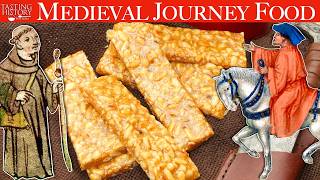

Medieval Road Trip Snacks
60sRelatable modern comparison to medieval travel food creates curiosity.
▶ Play Clip"The title accurately reflects the content: the video discusses what medieval people ate while traveling, including specific recipes and historical context."
This video explores what medieval travelers ate on long journeys, focusing on a 14th-century recipe for a portable candy called payn ragoun made from honey, sugar, pine nuts, and ginger. It also covers the realities of medieval travel, including roads, inns, and the importance of packing your own food.
Medieval people traveled more than commonly thought, for trade, pilgrimage, or to market towns.
Travelers packed portable, non-perishable foods like meat pies, cakes, marzipan, and nougat.
The recipe for payn ragoun comes from 'The Forme of Cury' (c. 1390) and includes honey, sugar, pine nuts, and ginger.
The candy can be made chewy (soft-crack stage, 270-290°F) or brittle (hard-crack stage, 300-310°F).
Travel options: boat (fastest), horse (fast but expensive), or foot (15-30 miles/day).
Roads varied from well-maintained Roman roads to dangerous paths with deep potholes.
Inns ranged from cheap and nasty to expensive and nice, serving meals like meat pies or perpetual stew.
The 'Codex Calixtinus' was a 12th-century travel guide warning about unsafe food and water in Spain.
Monasteries offered hospitality to pilgrims, often providing bread, wine, and a safe place to sleep.
Travelers to Jerusalem were advised to bring their own food, including hardtack, wine, and live chickens for eggs.
What is the name of the 14th-century pine nut and ginger candy?
Payn ragoun
0:15
Which English cookbook contains the recipe for payn ragoun?
The Forme of Cury, compiled around 1390
1:35
What are the main ingredients in payn ragoun?
Honey, sugar (of Cyprus), pine nuts, and powdered ginger
1:42
What temperature range does the video recommend for a chewy texture in payn ragoun?
Soft-crack stage (270–290°F / 132–143°C)
6:50
What temperature range produces a brittle, less sticky candy?
Hard-crack stage (300–310°F / ~150°C)
7:08
What does the medieval recipe mean by 'take up a drop thereof with the finger and do it in a little water, and look if it hangs together'?
To test if the sugar syrup has reached the right consistency by dropping a bit into water and seeing if it 'hangs together'
6:11
What were the three main options for medieval travel?
By boat, by horse, or on foot
9:00
How far could a typical medieval traveler on foot cover in a day?
About 15 miles per day, with some covering up to 30
10:44
What was the 'Michelin guide of the 12th century' mentioned in the video?
The Codex Calixtinus, a 12th-century guide for pilgrims to Santiago de Compostela
15:00
What dangerous concoction did John Arderne describe in his 1370 medical treatise?
A powder to make a person sleep against their will, potentially used to rob pilgrims
16:49
What is 'biscuit' in the context of medieval travel?
Hardtack (a type of hard, dry biscuit)
21:35
Medieval Travel Was Common
Challenges the common misconception that people rarely traveled in the Middle Ages.
0:31Soft-Crack Stage for Chewy Candy
Provides a practical temperature range for recreating the medieval candy with a chewy texture.
6:50Average Walking Distance per Day
Offers a concrete figure (15 miles/day) for understanding medieval travel pace.
10:44The Codex Calixtinus: A Medieval Michelin Guide
Highlights the existence of detailed travel guides in the 12th century, including food and safety advice.
15:00Monasteries as Safe Havens for Travelers
Explains the hospitality rule of St. Benedict and how monasteries provided food and shelter for pilgrims.
17:23[00:00] Let's imagine you're a medieval traveler heading out on a long journey. Where are you going to stay? How are you going to get there? And most importantly, what are you going to eat? Because medieval drive-throughs are not really a thing. So I suggest you bring something with you.
[00:13] Something like this 14th century recipe for pie nut and ginger candy called pain ragoon. So thank you to David Protein for sponsoring this video as we make the food of a medieval traveler. This time on Tasting History.
[00:31] People in the Middle Ages actually traveled a lot more than we typically think. Whether it was just to the nearest market town, which could still be a few days away, or maybe they were going on pilgrimage to someplace like Canterbury, Santiago de Compostela,
[00:45] or as far away as Jerusalem. But regardless of where or why you were traveling, the food along the way could be rather inconsistent. And so there are a lot of texts from the period that say to bring some for yourself.
[00:57] Now, today when I go on a road trip, I get Doritos and peanut m&Ms, but those were not options in the Middle Ages. So we have to look at documents like the Canterbury Tales, where travelers stuffed their packs with things
[01:09] like little meat pies and cakes. Then there's a Spanish text from the early 16th century where a notary named Juan Valés stocked up on candy, specifically marzipan and a nugget of nuts and honey similar to modern turon.
[01:22] And these were perfect because they were small and portable, but also they wouldn't spoil quickly. So since I am a fan of candy, I have gone with a candy recipe, which comes from the English cookbook The Forma of Curry, compiled around 1390 and is for pain ragoon.
[01:37] Take honey and sugar of cypress, and clarify them together and boil it with easy fire. And keep it well from burning, and when it hath boiled while, take up a drop thereof with the finger, and do it in a little water and look if it hangs together.
[01:49] And take it from the fire and do their two pine nuts, the tridentella, and powdered ginger, and stir it together till it begin to thicken and cast it on a wet table. Cut it in strips and serve forth with fried meat on flesh days
[02:01] or on fish days. So this is either going to be like a pine nut brittle or something softer like a pine nut nugget, just depending on how hot we decide to get the sugar. Also, this is just one of many of these types of recipes.
[02:15] They're in all sorts of old cookbooks, and sometimes they will use different nuts or thicken the nugget with things like breadcrumbs or in one case, in a 15th century recipe called Pynod
[02:28] with chicken. They added chicken to the candy, so it's sugar and ginger and pine nuts and chicken. And while that sounds absolutely awful,
[02:40] it would at least add a lot of protein to your to your candy, and you do want a lot of protein when you're traveling. So if you want, you can add some chicken, but I suggest just grabbing a David Protein bar, it's going to be a lot easier and a lot tastier.
[02:53] So over the past couple of years, I have really made an effort to get into shape. I'm now at that age where if I don't do it now, I'm never going to do it, and I do spend most of my day just sitting at a desk, reading or typing, so I'm doing my best to lose fat and gain muscle,
[03:08] and that takes a lot of protein to do. So I've been using David Protein bars to get in more protein. Their gold bars have 28 grams of high-quality protein and are only 150 calories with zero sugar,
[03:20] and then their bronze bars are a little more decadent with 20 grams of protein per 150 calories. The texture is nice and soft on the outside, and then kind of crunchy on the inside, and the chocolate actually tastes like chocolate.
[03:32] The peanut butter actually tastes like peanut butter, and to paraphrase Willy Wonka and the chocolate factory, these blueberries taste like blueberries. And right now, David is offering my viewers a special deal where if you get four cartons, you get a fifth carton for free
[03:45] when you use my link in the description or just scan the QR code on screen. And if you don't want to wait, you can just go buy David Protein bars, add Walmart and Target and Albertsons and Ralphs
[03:57] and a whole slew of other grocery stores. What you cannot get at a grocery store is some medieval pine nut candy without chicken. So I'm going to start making that right now. So what you'll need is two thirds of a cup
[04:09] or 200 grams of honey, one cup or 200 grams of white sugar, and we know it's white sugar because it says that it should be sugar of cypress. And at this time, the island of Cypress was really the only place in the west
[04:23] where they were refining sugar from Asia down into something that was white, similar ish to the sugar that we know today. Then one and a half cups or 200 grams of pine nuts. Also when the recipe mentions the pine nuts,
[04:36] it does so in conjunction with the word thridendella, which comes from like the third deal or the third portion. And exactly what it means in this context is up for some debate.
[04:49] But many people, including myself, believe that it is referring to the amount of pine nuts, sugar and honey all being the same. Like it's the third portion. The thing is it doesn't say if it's the same by weight
[05:04] or by volume and those things are very, very different. So I went by weight because that's just what I went with. Then one and a half teaspoons of powdered ginger. So start by toasting your pine nuts.
[05:16] And you can leave them raw, but toasting them in a dry pan for a couple of minutes will really help to bring out their flavor. Just make sure you don't burn them. Also the recipe isn't clear if the pine nut should be whole or ground up in the candy.
[05:28] There are other recipes for candy where they're whole and there are others like marzipan where they are ground up. So I'm splitting the difference in doing half ground and then half whole. Then add the sugar and the honey to a saucepan
[05:40] and stir them together and then set this over a medium low heat. And you don't want to rush heating this as it will easily burn. As it does heat, the sugar will melt into the honey and you can give it another stir to make sure the two ingredients are well combined.
[05:54] And then just let it continue to heat, not stirring it until it gets to the desired temperature. Now what that temperature is is kind of up to you. The recipe says that what you're looking for
[06:06] is a certain texture, a way that the sugar is going to act by saying to take up a drop thereof with the finger and do it in a little water and look if it hangs together. Do not do this. Do not take your finger and put it into molten sugar.
[06:20] You won't burn yourself. That's absolutely crazy. But you can actually test the doneness of sugar or the approximate temperature by dropping it into water using a spoon, not your finger, and seeing how it reacts.
[06:33] The thing is, it just says until it hangs together. But exactly what that means is unclear. I feel like that could be anything from the hard ball stage to the hard crack stage, which is like a 60 degree Fahrenheit difference.
[06:47] Personally, I kind of went in between and went for the soft crack stage, which is when it hits between 270 and 290 degrees Fahrenheit, 132 to 143 Celsius. And that should give us a nice firm, but still like chewy texture to the candy.
[07:02] But you could also make more like a hard brittle candy by taking it up to the hard crack stage, which is like 300 to 310 degrees Fahrenheit or about 150 Celsius. Whichever you choose, when it gets to the desired temperature,
[07:16] you want to remove it from the heat and immediately add in the ground nuts and stir them in and then add the ginger and mix that until it is fully dispersed. And then lastly, you can add the whole nuts. Then pour this out onto a piece of parchment paper or aluminum foil
[07:30] and it should spread out on its own. But since we're going to cut them into strips, it helps to guide the mixture into a square or rectangle shape. You could also put it in a mold if you really want straight lines. As it is, I'm just kind of doing my best,
[07:43] but it sort of did its thing and you know what? Good for it. Then you want to let it cool for just a few minutes before cutting it into strips. You can't let it cool completely or it does become very hard to cut, especially if you go with the hard crack stage.
[07:56] So you just kind of have to figure it out and cut it when it's cutable. Then before I actually try this confection of the Middle Ages, I wanted to ask you to like this video and subscribe to Tasting History. It does help the channel a lot
[08:09] and it helps to push these videos out to more tasteoreans so they too can learn more about what you should eat on a medieval journey. During the Middle Ages, people traveled for all sorts of reasons.
[08:24] Merchants traveled trading and selling goods and common people traveled to market towns to buy those goods. Messengers crisscrossed the continent, delivering messages and monks, priests, and friars journeyed on religious work.
[08:36] Nights and mercenaries traveled off to war while diplomats visited courts to keep the peace. And countless people of all classes went on pilgrimage, either as an act of religious devotion or as a medieval form of tourism.
[08:50] But whatever your reason for traveling, you really had to plan ahead. And your first question to answer was, how am I going to get to where I am going? Now the three main options are either by boat,
[09:02] by horse, or on foot, and sometimes it was a combination of all three. Now boats were definitely the fastest, especially if you were crossing an ocean or on a navigable river. But sometimes you need to get between two places
[09:15] where it's just land, and so you have to go by land and the fastest way usually would be by horse. But it's also the most expensive way because yes, you might be able to travel 30 or 40 miles a day,
[09:29] but you one had to have a horse, and two had to feed and stable that horse. A document from 1331 shows that a party of seven people, three merchants and four servants, paid 10 pence just on fodder for their horses for one night.
[09:42] That was almost as much as they paid for all of their own food, which was five and a half pence on meat, four pence on bread, two pence on ale, one in a farthing on wine, and another farthing on some stew.
[09:54] Now considering a tradesman only made about two pence per day, that was a lot of money to spend on food and on horse fodder. Add to that the fact that sometimes traveling by horse was no faster than traveling by foot
[10:06] because you were often going in a group with some people who were walking or you were burdening down your horse with all your stuff and so they just couldn't go any faster than a person could.
[10:18] Like in 1297, Margaret, the Duchess of Rabal moved her clothes from London to her new home in the Netherlands and she put her wardrobe in a cart pulled by five horses and it took 18 days to travel just the first leg of the journey
[10:31] from London to Ipswich. 85 miles in 18 days, that's less than five miles a day. So provided you don't have to move a wardrobe, your best bet is probably going to be to travel by foot.
[10:44] Records show that most travelers on foot covered 15 miles a day with some covering up to 30 that is three miles an hour for 10 hours a day but people did it. Of course, it speeds things up if you are walking
[10:56] on a well-maintained road and a lot of the roads in medieval Europe were not well maintained, especially the smaller ones. There are actually stories about puddles
[11:08] like potholes in the roads being so deep that people would drown. In England, they actually had to put in a law saying that you could not dig a well in the middle of a road, who would do that?
[11:21] I don't know, but they had a law saying not to do it because travelers would come up and just think it was a puddle and then sink to the bottom of the well and die. But there were also some very well-maintained roads. These were usually the roads going in and out of towns
[11:36] and large cities, especially connecting the two or some of the old Roman roads were still maintained. Like in England, this was places like Iknild Way, Foss Way and Walkling Street.
[11:48] They were the Roman roads that still linked places that people actually wanted to go. But what you really wanted to travel on were the King's roads and these were the roads that the King used to get around the country. So he needed to be able to go fast
[12:01] and he needed to be able to go safely. In 1285, King Edward I decreed, it is commanded that highways leading from one market town to another shall be enlarged so that there be neither dike, underwood nor bush whereby a man may lurk to do hurt.
[12:16] Within 200 feet of the one side and 200 feet on the other side. Basically more than the width of a football field on either side of the road had to be completely cleared except for large oak trees, those were fine to leave.
[12:28] They had to be cleared so that robbers and stuff couldn't lurk and just jump out and steal all your stuff. And so what was going to be safer was if you were traveling in a group and not sleeping beside the road.
[12:41] People were not often just camping along the roads. They went and stayed at friends houses or in the barn of a hospitable farmer or most comfortably at an inn or monastery.
[12:53] When it comes to inn, these ranged from dirt cheap and kind of nasty to really expensive and very, very nice. They were basically just like the hotels that we have today and they often were going to serve you some food.
[13:05] So you would get a room or at least a place in the corner where you could sleep. And then a hot meal, sometimes a cold meal, but sometimes a hot meal, whether it was meat pie or fried results or a bowl of perpetual stew.
[13:19] This was the stew that was just kind of always going and when it was going low, then they would just add more ingredients and it could go on for centuries. Then there were some ends where the meal that was served was quite nice.
[13:31] Like in the 1330s, a merchant named John De Villers traveled through England and mentioned several meals including one in Lester where he was served bread, ale, and herrings and then he had a particularly fine supper in Nottingham
[13:43] where they served him meals and flounder served with garlic and onions as well as some fresh fruit. Also when he was in Nottingham, he used it as an opportunity to get some ingredients that I guess he couldn't get back in his hometown so he spent 18 pence on buying almonds
[13:57] and sugar and ginger and rice. But three of those things is basically what you need to make the dish that we're making today. Pine nuts instead of almonds but close enough. Of course he was traveling in England
[14:09] in his home country so he knew the cuisine well and he knew that it wouldn't upset his stomach but there were times when people traveled internationally and so they had to be aware of the changes in diet
[14:21] and how it affected them. Even today when you travel internationally, sometimes the food can disagree with you and so just like today there were actually travel guides that were written that told people how to make sure
[14:36] that they stayed healthy when traveling internationally. Now some of these guides would just say take all of your own food and drink lots of aquavite, the water of life basically distilled grain alcohol but that's impractical one to bring all of your own food
[14:50] and two the aquavite was not terribly common then in the middle ages like it is now you can't just go get a bottle of vodka. More practical was something like the Codex Calix de Nus which was a 12th century text written for those
[15:02] going on pilgrimage to Santiago de Compostela one of the more popular pilgrimage sites in Europe. The author maps out your journey through most of France and then through Spain and tells you all of the streams and rivers
[15:14] that you'll come up to and says if you can drink out of it or not and many of the inns and taverns along the way he says you know this person gives good food this one I wouldn't trust him I wouldn't eat there
[15:27] it was basically the Michelin guide of the 12th century except the writing is so much more interesting than any tire company you could come up with. In Spain and Galicia don't eat the fish called a barbos
[15:40] or any eel or tench because without doubt you will immediately die or fall very sick if by luck anyone eats and doesn't get sick they're healthier than most or have stayed longer in the country
[15:52] for all fish, beef and pork in Spain and Galicia make foreigners ill in Gascani on the other hand he says that the food is wonderful even if he's not a fan of the people that live there Gascani with its white bread and the best and
[16:06] reddest wine and the people fast talking obnoxious and sext craze they are overfed poorly dressed drunks they all sit around the fire rather than eating at a table and drink from one cup
[16:19] now another caution when eating at an inn is to make sure that you can see the kitchen and see who is actually cooking your food because there are those who would do you harm there is a medical treatise from 1370
[16:32] by John Ardern and it's actually a treatise on how to treat hemorrhoids and other issues down there but in it he talks about a concoction, a potion that you can give to someone
[16:46] basically if you're going to perform surgery on them he says it's a powder for to make a man sleep against his will that he shall not feel whatsoever is done to him now this makes sense for a medical text but then he also says
[16:59] that it's the kind of thing that you could give to a pilgrim at an inn that they may rob them of their silver when they are asleep why would you say that why would you include that in a medical text
[17:11] you've basically just given a medieval recipe for rufis why would you do that so it just gives you another reason to travel in a group or stay somewhere safe like a monastery
[17:24] and medieval monasteries were set up for hospitality in fact it was part of their rule the rule of Saint Benedict was to welcome in visitors let all guests that come be received like Christ for he will say
[17:36] I was a stranger and you took me in and let fitting honor be shown to all especially to those who are of the household of the faith and to pilgrims and it's true that they were particularly welcoming to men of the cloth
[17:49] and to people who were on pilgrimage in fact there were some monasteries that were actually the goal of the pilgrimage for example the abbiet cluny had a vast collection of religious relics like a
[18:01] supposed fragment of the true cross John the Baptist's tooth and the ashes of both Saint Peter and Paul all items that would have been on a medieval pilgrims bucket list also when you got there the first day they gave you a pound
[18:15] of bread and a portion of wine to drink the second day you got a half portion and a half pound of bread it was kind of their way of gently nudging you along your way I guess but when you did finally leave
[18:28] they gave you a penny kind of as a souvenir now you could only do this once a year they did keep track so you couldn't just keep coming back and get more pennies but still you get a night or two of good food and a safe place to sleep and a
[18:40] penny can't complain though a lot of the abbies did if not require then at least appreciate and expect a donation but still it was probably cheaper than staying in now there were monasteries all over Europe at this time and they were often
[18:52] placed on the paths of pilgrims so you could in theory just go from monastery to monastery but if your plan was to go to Jerusalem the super bowl of pilgrimages then at some point you probably were going to need to get onto a boat and during the
[19:08] middle ages boats were not as comfortable as a monastery in the 15th century the Englishman William Way went on a pilgrimage to Jerusalem and he wrote about his experience along with some do's and don'ts many of these do's and don'ts had to do with food
[19:22] things that you should be taking along with you and things that you shouldn't be taking along with you he also says that when you arrive in Venice which is where most of the boats left from that you should buy all of this stuff he gives a whole packing list
[19:36] when you leave Venice you should have confections, laxatives, restoratives, ginger, rice, figs, raisins, great and small, pepper, saffron, cloves, mace and powdered douce also take with you a little cauldron and frying pan, dishes, platters, saucers of wood, cups of glass
[19:53] a greater for bread and such necessaries also buy a cage for half a dozen of hands or chicken to have with you in the galley and buy you have a bushel of millet seed for them you may buy eggs when on land for cheap and they can be fried in olive oil or prepared for a coddle a coddle being a warm
[20:09] drink often thickened with egg yolks and it was very often thickened wine and wine does seem to be the drink of choice at least for William way he says you should buy three 10 gallon barrels
[20:22] and two of these barrels shall serve for wine and the third for water in the one barrel take red wine and keep it until you return from the holy land because it is good for the flux the flux being dysentery and yeah international travel especially back then was likely to give you some dysentery
[20:40] but to ward off the collie wobbles he says that there are certain foods you should bring with you just in case you can't find proper food to eat when you're there you must take biscuit with you for while you may dine at the table with your patron off time you will snack on your own bread
[20:56] cheese eggs fruit bacon and wine also sometimes you shall have feeble bread wine and stinking water so you will be full glad to eat of your own another traveler to the holy land fryer Felix Fabri try
[21:08] saying that five times fast he suggests that yeah most of the food that you're going to eat is probably stuff that you needed to bring yourself suggesting two jars of the best wine and a big bag with
[21:20] the best fish smoked meats cheese oil rice almonds raisins big and small vinegar salt and a good supply of other necessaries and above all huge quantities of biscuit having been instructed already
[21:33] that biscuit was a kind of desert currency biscuit in this case being hard tack and while that may be a practical food to bring along with you on your journey it's not the most delicious so if you are heading out onto that medieval road might I suggest packing up your bag filled with meat pies some cakes
[21:52] cheese and a nice stack of pain ragoon like the ones that I'm about to eat right now and here we are a 14th century recipe for pain ragoon or pine nut candy perfect for a medieval road trip
[22:04] so here it is now this is not the brittle form this one is a little bit softer but it still does break but it's very very sticky if you take it all the way to the brittle form to like 300
[22:16] Greece Fahrenheit 310 it'll be a little less sticky and more snap this it it does step but there is still some bend to it let's give it a taste
[22:32] hmm not really really good that's really really true it all you're going to be here for a minute so my first thing is it's fantastic the flavor is wonderful
[22:44] the fact that there is the honey and the sugar gives it such a more depth of flavor than if it was just sugar the pine nuts are definitely the first thing that you taste that's the dominant
[22:56] flavor and you don't taste any ginger until the very end and like as you finish the candy the ginger comes in and it's not super strong it's not like a ginger candy or anything like that
[23:09] it's really really nice the texture is crunchy and yet chewy at the same time which is interesting and it does get stuck in your teeth I think if you did brittle it wouldn't get stuck in your teeth
[23:24] as much or it would just be more of the crunchy and less of the chewy so it's really just kind of up to you which one you want but it's really really good I do think that you do kind of need to wrap
[23:37] each one individually because they are so sticky they will stick to each other so you know kind of wrap each one in a little piece of paper or whatever but yeah they're easy to make they're really
[23:50] really good you could also add different different spices some of the other recipes I've seen have some cinnamon or gollongal or grains of paradise pepper so you can kind of just play around and
[24:04] add whatever spices you want you can change the nuts to almonds or hazelnut or whatever you want yeah they're fantastic I could definitely see this you know going down the road just wanted to
[24:19] chew on something and yeah come on make me like this is something I would just make because that's how good they are so make some medieval candy head down the road on a medieval road trip
[24:31] and I will see you next time on Tasting History
⚡ Saved you 0h 24m reading this? Transcribe any YouTube video for free — no signup needed.