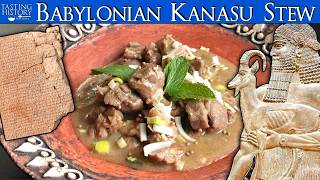

Cooking a 3,750-Year-Old Recipe
45sThe extreme age and mystery of the recipe create immediate curiosity and engagement.
▶ Play Clip"The title is accurate; the video genuinely presents and cooks a 3,750-year-old recipe from Hammurabi's era."
This video explores one of the oldest known recipes in history: a 3,750-year-old Babylonian stew called kanasu, dating from the reign of King Hammurabi. The host navigates the vague ancient instructions, interprets mysterious ingredients, and cooks a modern version of the dish. Along the way, he discusses Hammurabi's rise to power through food and his famous code of laws, many of which regulated food and agriculture.
The recipe is from a Yale Babylonian tablet, created no later than 1740 BC, during or just after Hammurabi's reign.
The recipe is extremely vague, with terms like 'prepare water' and unknown ingredients like 'kanasu', 'samídu', and 'šuhutinnu'.
Kanasu is likely an edible plant, possibly emmer wheat. Samídu is probably a shallot. Šuhutinnu likely refers to a leek or root vegetable.
The host uses lamb, shallots, coriander, cumin, emmer flour, garlic, leek, mint, and ghee. He sears the meat and simmers the stew for about 40 minutes.
Hammurabi strengthened Babylon by building granaries and canals to secure food, then used surplus to build an army and conquer rivals.
The code established innocent until proven guilty, due process, and punishment fitting the crime. Many laws regulated food, agriculture, and taverns.
The stew is thick like gravy, with balanced flavors. The meat is tender, and the raw leek adds crunch. The host finds it delicious.
When was the kanasu stew recipe created?
Around 1740 BC, during or just after the reign of King Hammurabi.
0:35
What is the likely meaning of the word 'kanasu' in the recipe?
It is some sort of edible plant, possibly emmer wheat used to thicken the soup.
2:50
What is the most likely translation of 'samídu'?
Most scholars agree it is some sort of allium, like a shallot.
3:06
What does 'šuhutinnu' likely mean?
It refers to something pulled out of the ground, possibly a leek or root vegetable like a turnip.
4:24
How did Hammurabi strengthen Babylon before conquering surrounding territories?
He built granaries and canals to secure the food supply, which allowed him to build an army.
11:05
What key legal concepts did Hammurabi's code establish?
The idea of innocent until proven guilty, due process, and the punishment fitting the crime.
14:08
What was the punishment for a tavern keeper who refused grain as payment for beer?
If a tavern keeper refuses grain for beer and accepts only silver, she shall be thrown into the water.
15:40
What was the punishment for a 'sister of God' entering a tavern?
If a 'sister of God' opens a tavern or enters one to drink, she shall be burned to death.
16:06
According to Hammurabi's code, who bears the loss if a hired ox is killed by a lion in the field?
The loss is upon the owner.
16:58
What is the 'act of God' clause regarding a hired ox that dies?
The man who hired it shall swear by God and be considered guiltless.
17:09
Age of the Recipe
Establishes the recipe as one of the oldest known, dating to 1740 BC.
0:35Hammurabi's Food Strategy
Reveals that Hammurabi prioritized food security to build his empire, a strategic insight often overlooked.
11:05Innocent Until Proven Guilty
Highlights that Hammurabi's code established the foundational legal principle of presumption of innocence.
14:08Food-Related Laws
Demonstrates that many of Hammurabi's laws directly regulated food and agriculture, showing their importance.
15:40Searing Meat for Flavor
Provides a practical cooking technique (searing) that improves the dish, even if not historically verified.
7:26[00:00] Today I am cooking one of the oldest recipes
[00:03] At over 3,750 years old this is a Babylonian recipe for kanasu stew
[00:09] made around the reign of King Hammurabi.
[00:12] So thank you to Squarespace for sponsoring this video as we make a stew from ancient Babylon
[00:16] this time on Tasting History.
[00:24] So this recipe and I use the term recipe very
[00:28] is one of 25 stews or broths which are found on one of the four Yale Babylonian culinary tablets.
[00:35] This one was created no later than 1740 BC during or just after the reign
[00:43] Hammurabi, a great conqueror but more famously known for his long enduring code of laws.
[00:49] Now I have made two other stews from this tablet. And in my mind, it was not that long ago. Like, I just did it.
[00:54] But actually, it was like over five years ago that I did these. In fact,
[00:58] both of them made it into the Tasting History cookbook, which came out 3 years ago.
[01:02] I made the tuh'u which is a beet stew, and then I made another lamb stew that has milk in it.
[01:09] Also, just a couple days ago, I finally finished writing my second cookbook,
[01:12] took me long enough.
[01:13] So more details on that coming up fairly soon.
[01:17] Anyway, it's been a while since I've done anything from these tablets,
[01:20] so I wanted to revisit them so I can talk a little
[01:25] Now, the recipe leaves a lot up to interpretation. It says
[01:31] "Kanasu stew. Leg of mutton is used. Prepare water, add fat.
[01:35] Samídu; coriander; cumin; and kanasu.
[01:38] Assemble all the ingredients in the cooking vessel and sprinkle with crushed garlic.
[01:42] Then blend into the pot šuhutinnu and mint."
[01:45] See what I mean? Not a lot of instruction there in that recipe.
[01:49] First off, what does prepare water mean? Does it mean to just
[01:53] gather water, put it in a big boiling pot? Do you have to boil it?
[01:58] Is it something that you have to purify, add salt, add something completely different?
[02:02] Was there a whole process that was just so common at that time that they didn't feel the need to write it down
[02:07] and now we just don't know at all and never will?
[02:10] Also, while I'm calling it a stew, you could also use the word broth
[02:14] or soup. It's been translated as both or sauce because really the word just kind of means a liquid.
[02:21] So it could be a sauce over the meat. There's nothing that actually says in the recipe. So
[02:29] kind of up to me. Then perhaps most frustrating is the fact
[02:36] or they have been translated but in multiple ways
[02:41] including the name of the soup kanasu and then samídu and šuhutinnu.
[02:46] For the word kanasu it's just known to be some sort of edible plant.
[02:50] Some people think that it is a sort of wheat like emmer wheat which could be used then as a flour to thicken the soup,
[02:57] but it could be something totally different but that's what I'm going to use.
[03:00] Then there is the word samídu which most scholars agree is some sort of allium
[03:06] like a shallot or something similar
[03:10] but there are people who actually believe that it means like semolina or fine flour.
[03:18] The reason is because similar words like semida in the Hebrew Talmud
[03:22] and semidalis in ancient Greek both refer to fine flowers. And it's where we get the word semolina.
[03:28] And this might be the case, but I'm always wary of making that kind of assumption
[03:33] because those languages aren't written down until well over a thousand years after this was written.
[03:40] And words can change a lot in a thousand years.
[03:48] that does not mean that they actually have anything to do with each other.
[03:52] Take the word island and isle.
[03:55] They sound similar. They mean the same thing.
[03:59] And yet, the words aren't actually related at all.
[04:02] One is from a Latin origin and one is from a Germanic origin.
[04:06] Just happens that they sound and mean the same thing.
[04:09] So while samídu may mean fine flour, I am going to go with most scholars and go with a shallot
[04:16] mainly because it's just going to add a lot more flavor than semolina flour.
[04:20] Finally, the word šuhutinnu, this one too causes a lot of confusion because
[04:24] really it just refers to something that has been pulled out of the ground. Some sort of vegetable that's been pulled out of the ground.
[04:31] That could mean a lot of things.
[04:33] A lot of scholars think that it is another thing like a leek or something like that.
[04:38] Others believe it's more like a root vegetable like a turnip or even a early carrot.
[04:45] Again, it's kind of up to you. I'm going to go with a leek because
[04:50] again I think it's going to add more flavor than
[04:54] So yeah, but there is no right or wrong answer or they're all wrong
[05:02] My thought is you just shouldn't take this too
[05:09] is not going to be exactly right because we just
[05:14] so just have fun with it. So, for this fun version of this recipe,
[05:20] my version of this recipe, what you'll need is 1 quart of water, 1 large shallot, 2 teaspoons of coriander seeds,
[05:26] 1 teaspoon cumin seeds, 1/4 cup or 30 grams of emmer flour, 2 or 3 cloves of garlic, a small leek,
[05:33] a handful of mint leaves, and a couple pieces of
[05:37] about enough to have 1 and 1/2 lbs or 680 grams of meat once cut off the bone.
[05:41] Then, 1 tbsp of salt and 3 tbsp or 45 grams of fat.
[05:45] Now there are a lot of options when it comes to
[05:48] It could have been butter or ghee or tallow or lard or sesame oil or olive oil that came in from the Mediterranean.
[05:56] Or more than likely, it would have been the fat from a fat tail sheep.
[06:01] Finding the fat is darn near impossible. I'm sure it's out there, but I've never been able to find it here in the US.
[06:07] But they're really popular in the Middle East. I
[06:12] they were really popular in antiquity. In fact,
[06:17] the fifth century BC Greek historian Herodotus, who says
[06:21] "They have long tails no less than four and a half feet long which,
[06:25] if they were allowed to trail on the ground, would be bruised and developed soores.
[06:29] As it is, the shepherds have enough skill in
[06:34] The carts are placed under the tails, each sheep having one to himself, and the tails are then tied down upon them."
[06:40] I did get, like I said, to try it finally when I went to Jordan last month, or two months ago.
[06:46] And it is really, really unctuous and kind of has a strong, buttery flavor.
[06:52] So, since I can't find it, I'm going to use ghee,
[06:57] So start this dish by chopping the shallots and crushing the garlic.
[07:01] And then add the coriander and cumin seeds to a mortar and grind them into a powder.
[07:06] Then get as much lamb meat off of the bone as you can and cut it into bite-sized pieces.
[07:11] You can also use pre-cut stew meat if you've got it.
[07:14] Another option would actually be to put the whole leg in the stew
[07:20] but I find that that doesn't give as much flavor.
[07:26] To do that just melt a bit of the fat in a pot over high heat and then add in the meat,
[07:31] and let it cook for a couple of minutes. Then move it around and continue to cook until it gets just a little bit of a browning.
[07:38] Then remove the meat from the pot and add some more of the fat and then the chopped shallots.
[07:43] Sprinkle in a little bit of the salt and toss them in the fat and let them cook for 3 to 4 minutes
[07:48] or until they're nice and fragrant. Then pour about 2 cups of water into the pot
[07:52] and scrape off as much from the bottom of the pot as you can. There's going to be a lot of nice flavor there.
[07:57] And then let it come to a simmer and add the rest of the fat to the pot and let it melt in.
[08:02] Then once it's melted, you can add the ground up coriander and cumin along with the salt and stir it all in.
[08:08] And then add another two cups of water and the flour and stir that in.
[08:13] And a whisk here really helps so you don't get too many lumps.
[08:16] Then let this slowly come up to a boil. And then you can add in the garlic along with the seared meat.
[08:22] Then lower the temperature to medium low and let it simmer for a moment.
[08:26] Then put the lid on and continue to cook for about a half an hour.
[08:29] And every once in a while you can check on it
[08:33] If you want something more like a broth or a soup or just keep the water as is
[08:38] if you want something thicker like a stew or even like the meat in a sauce.
[08:42] There really is no wrong answer there cuz there really is no right answer there.
[08:46] We just don't know. We are in a complete culinary limbo and I'm just going to have to make peace with that.
[08:52] Now as the soup cooks, chop up the mint as well as the leek.
[08:55] Now I always wash my leeks, of course, but yet once it's chopped, I find that there's still always like little bits of dirt between the layers.
[09:02] So I like to give them another rinse in the sink.
[09:04] Then, after the soup has cooked for about 30 minutes, you can remove the lid and add in about half of the leeks and most of the mint.
[09:11] Stir those in and let it continue to cook uncovered for another 10 minutes or until it is as thick as you want.
[09:17] As I mentioned, this recipe was written around the time
[09:24] the old Babylonian Empire. Now, in school, mostly
[09:31] you know, an eye for an eye, a tooth for a tooth, those kinds of things, the
[09:36] really rather harsh ones. But it turns out he also had a lot to say about the food of ancient Babylon.
[09:46] Before I get to Hammurabi, I just want to let you
[09:50] leading over the next year and a half. I'm going
[09:53] They are so much fun. It is just an experience filled with food and history and culture and learning.
[09:59] It is so educational, but it is a lot of fun and you're
[10:06] So, if you want to check those out, the first one is going to be starting in Paris going down the Seine, or up the Seine, through Normandy
[10:13] so you know it's going to be good food. That is in November 2026.
[10:17] If you want to sign up for those, I am going to put links in the description.
[10:21] And now onto Hammurabi.
[10:23] Hammurabi was the sixth Amorite king of Babylon.
[10:26] And he took the throne after his father's abdication around 1729 BC.
[10:30] But when he became king, Babylon was nothing that special.
[10:35] It was a small city state and it kind of had power
[10:41] but it was really surrounded by much bigger
[10:48] empire that Hammurabi would make it.
[10:50] Because while he is definitely most famous for his code of laws,
[10:54] Hammurabi was one of the great warrior kings
[10:59] But before he became a great warrior king, he strengthened Babylon through-
[11:05] well through food.
[11:06] See, just like in the early stages of the video game Civilization, one of my favorites,
[11:10] Hammurabi had to establish Babylon as an economic powerhouse if he wanted to conquer the surrounding territory.
[11:19] And he did that by building a ton of granaries and canals that went off of the Euphrates River
[11:26] that stopped the flooding from ruining the crops.
[11:29] "Its banks on both sides I turned into cultivated ground.
[11:32] I heaped up piles of grain, I provided unfailing water for the lands...
[11:37] The scattered people I gathered with pasturage and water I provided them,
[11:42] I pastured them with abundance, and settled them in peaceful dwellings.
[11:46] And it was only after he made sure that his people had ample food
[11:50] that he could use the surplus of resources to build a mighty army which in just a few years
[11:57] was able to defeat the much more powerful civilizations of Ilam, Larsa, Eshnuna and Mari.
[12:03] Now some of these places like Ilam he didn't actually conquer but he did defeat.
[12:08] And then other places like Mari, he pretty much wiped off the map before incorporating their lands into his empire.
[12:16] If you remember last year's video on the Mesopotamian desert, mersu,
[12:20] I actually talked about the great king of Mari, Zimri-Lim.
[12:23] He was an extraordinary builder in his own right and would have gone down as one of the greatest kings of the era
[12:29] had not Hammurabi come in and decimated everything that he had built. But
[12:34] before he did that, Zimri-Lim tried to get into Hammurabi's good graces by plying him with wine.
[12:41] "Hammurabi, king of Babylon, has written to me for wine...
[12:45] Open up the wine stockroom with Sidqummasi standing by,
[12:48] let him purify his hands, then select 11 jars of red
[12:54] Mix it in one vat, fill up 10 jars of red wine, seal them with this seal [I have sent],
[12:59] and give them to Bahdi-lim [to take to Hammurabi].
[13:02] Then convey to me 1 jar of the red wine that you are mixing, send it upstream..."
[13:07] Unfortunately, it doesn't seem that the wine actually worked because shortly after that,
[13:11] Zimri-Lim disappears from the history books and
[13:15] It was only after the utter destruction of most of his
[13:21] the wise judicious king that history remembers
[13:26] This is mainly because of the 7 and 1/2 foot tall diorite/basalt stele on which he inscribed 282 laws.
[13:33] Now it is not the first written code of laws but it was definitely the most enduring and influential in the ancient world.
[13:39] And I feel like in school we all learn about it but mostly just about the really juicy bits like
[13:44] "If a man destroy the eye of another man, they shall destroy his eye.
[13:48] If one breaks a man's bone they shall break his bone."
[13:51] All those tit fortat sort of laws that we associate with ancient justice. But actually
[13:56] most of the laws are far more mundane and deal
[14:02] and marriage and probably most important for
[14:08] the idea of innocent until proven guilty.
[14:11] See, if you accused somebody of something, you actually had to prove it.
[14:15] There was a presumption of innocence and the burden of proof was on the accuser.
[14:21] Also, there was due process. Everyone had a right to go in front of a judge and plead their case.
[14:27] And if you were the accuser and you were proven to be false making it up, well then you were punished.
[14:35] For "If a man has borne false witness in a trial, or has not established the statement that he has made,
[14:41] if that case be a capital trial, the man shall be put to death."
[14:46] It also established the concept of the punishment should fit the crime.
[14:50] Now the punishments to us may seem rather harsh, but
[14:54] the idea was that the punishment should be no more nor less than the actual offense.
[15:00] And this obviously seems, you know, like of course to us today, but that is not always the case.
[15:07] Even a thousand years after the law code was written, there were things like the Draconian laws of Athens.
[15:14] These put into place by Draco typically called for the death penalty for almost everything.
[15:20] Like if you steal a piece of fruit, death penalty.
[15:23] If you are caught sleeping out in public, death penalty.
[15:26] I would have got that many times when I fell asleep on the subway living in New York.
[15:30] As for Hammurabi's laws, the reason that I wanted to talk about them here on Tasting History is because many of them
[15:36] have to do with food and agriculture. Like
[15:40] "If a tavern keeper should refuse to accept grain as payment for beer but accepts only silver,
[15:45] and the price of the beer is less than that of the grain,
[15:48] she shall be convicted and thrown into the water."
[15:51] And some of these tavern based laws were really strict, like if someone is conspiring in your tavern
[15:57] and you're proven to know about it and you don't turn them in,
[16:00] then you are put to death.
[16:02] And "If a 'sister of God' open a tavern, or enter a tavern to drink,
[16:06] then shall this woman be burned to death."
[16:09] Then there is a huge section of law codes that have to do with farm labor
[16:14] and it even establishes a minimum wage for different types of farm work.
[16:19] It also gives protections or sometimes not protections to the people who are working the farm
[16:25] or people who are renting animals from your farm. Like if you rent an ox or you're working with an ox
[16:31] and you put its eye out, then you have to pay the owner, the farmer, half of the price of the ox.
[16:38] And "If anyone hire an ox, and break off
[16:43] he shall pay one-foruth of its value in money."
[16:46] Those are some very specific injuries, which make me think that they happened a lot, which is kind of sad for the ox.
[16:51] Also, the law codes give some protections to workers and renters that they had never had before.
[16:58] Like, "If anyone hire an ox or an ass, and a lion kill it in the field, the loss is upon the owner."
[17:05] Then there was even an act of God clause. For if you are using an ox
[17:09] "...and God strike it that it die, the man who hired it shall swear by God and be considered guiltless."
[17:16] To this day, insurance companies use that same excuse to get out of paying claims all the time.
[17:22] Now, while these laws may not be as famous as, you know, an eye for an eye kind of thing,
[17:27] they were actually probably a lot more commonly used by the average person
[17:32] because they dictated the most common things in life, namely things that had to do with food.
[17:39] And it's because Hammurabi paid attention to these rather mundane affairs
[17:45] that he was able to build and maintain his great empire.
[17:49] Unfortunately, his successors did not seem to have that same talent because
[17:56] basically right after he died, they started losing land. And within just a few generations,
[18:01] it was basically the size that it had been when Hammurabi had taken over.
[18:05] It'd be another thousand years before Babylon came roaring back with a sequel under Nebuchadnezzar II.
[18:11] Though this time it was around for even a shorter time, just a few decades.
[18:15] But as I said, that's a story for another time because that's a thousand years after Hammurabi and a thousand years
[18:22] after the recipe for this kanasu stew was written down.
[18:25] So once the stew is fully cooked to the desired thickness, serve it up with a little of the raw leak and mint and it is ready to eat.
[18:32] And here we are, kanasu stew from the reign of Hammurabi,
[18:35] one of the oldest recipes in history.
[18:39] Bon appetit.
[18:40] [nom nom nom]
[18:44] Hmm.
[18:45] That's delicious.
[18:51] So, the um-
[18:52] it's almost as thick as like a gravy, and it could be served that way, more, like I said, more like a sauce.
[19:00] What's really nice is having a little bit of the raw
[19:05] leek in there gives it some texture. There's a bit of a crunch. I also put some more coriander seed on top, which doesn't have a strong flavor,
[19:12] but again, it gives it some texture.
[19:14] What I love is that none of the individual flavors are like leaping out at you.
[19:22] And I was worried that the mint would because
[19:26] Lets have have a little bit more.
[19:27] [chomp]
[19:29] Hm.
[19:33] The meat just melts in your mouth.
[19:36] That's actually really really good.
[19:39] Yeah, there's not a lot I would change. Yeah,
[19:43] three millennia later and it's still absolutely delicious. Now,
[19:48] yes, there is the possibility that it was not served like this
[19:53] but it couldn't be that far off. Most of the ingredients are the same.
[19:58] So, really, you're just kind of talking about a texture thing
[20:02] leg of lamb in here? Was it all boiled?
[20:05] I do think searing it helps. It just helps to bring out some of the flavor. Purely boiled meat...
[20:10] not the most flavorful way to make it.
[20:14] But a wonderful, wonderful dish.
[20:17] So, yeah, if you want to join me in Paris traveling down the Seine this autumn,
[20:21] then I will put a link in the description
[20:25] and make this dish. It is definitely worth it. And as
[20:32] or I'll put the recipe up on the tasting
[20:37] which I made with help from today's sponsor, Squarespace.
[20:40] Squarespace is the easiest all-in-one platform for building a website. And you do not need to be a designer to make something really nice.
[20:49] See, their professionally designed templates give you
[20:53] And then you can use their intuitive tools like the drag and drop editing to
[21:00] And if your website is for a business, whether you
[21:04] then they have a wonderful suite of business tools that can
[21:09] do inventory, and make shipping and fulfillment a seamless
[21:13] And every month, I use their email campaign tools to send out the tasting history newsletter.
[21:17] And you can use it to keep in touch with your customers.
[21:21] So go to squarespace.com for a free trial and when you are ready to launch
[21:24] then go to squarespace.com/tastinghistory and you will get 10% off of your first purchase of a website or domain.
[21:31] And I will see you next time on Tasting History.

⚡ Saved you 0h 21m reading this? Transcribe any YouTube video for free — no signup needed.