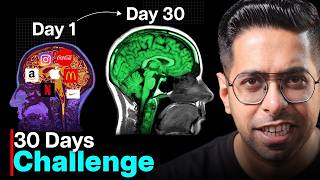

The Hidden Brain Trap: How You're Being Manipulated
42sThe opening clip immediately grabs attention with a visual experiment and reveals a hidden manipulation technique, sparking curiosity and self-awareness.
▶ Play Clip"Delivers on the promise of revealing brain tricks, but the 'deadliest' framing is hyperbolic."
This video explores the concept of neuromarketing, an invisible system that uses subconscious triggers to influence consumer decisions. It contrasts traditional marketing with neuromarketing, explains the science behind it, and provides strategies to resist its manipulation.
The video opens with a demonstration of how attention is directed, illustrating that brands track and influence decisions subconsciously.
Brands use subconscious tracking mechanisms to influence choices, such as the Pepsi vs. Coke preference and color associations like green for Lays and red/yellow for McDonald's.
Neuromarketing is an invisible system that tracks and influences decisions, using psychological triggers like FOMO, urgency, and social proof.
Traditional marketing relied on emotional storytelling, while neuromarketing uses direct brain stimulation through emotions like urgency and scarcity.
Neuromarketing targets the limbic system, the brain's emotional center, bypassing logic and reason.
Neuromarketing uses brain imaging and eye tracking to understand consumer reactions, as seen with Toyota and Frito-Lay.
The history of neuromarketing includes the invention of EEG in 1924, the Pepsi Paradox experiment, and the rise of AI in marketing by 2015.
Modern tactics include emotional branding (Apple), environmental manipulation (IKEA, Zara), and digital triggers like countdown timers and social proof.
The five main triggers are dopamine hijacking, fear activation, mirror copying (social proof), reward center activation, and memory associations.
To resist manipulation, implement the Pause Protocol, practice environmental awareness, and identify neuromarketing triggers.
Neuromarketing is a powerful force shaping consumer behavior, but by understanding its mechanisms and applying simple strategies, individuals can make more informed and intentional purchasing decisions.
What is neuromarketing?
An invisible system of modern marketing that tracks and influences consumer decisions subconsciously.
01:33
Which brain system does neuromarketing target?
The limbic system, which takes decisions emotionally without reason or logic.
06:08
What was the Pepsi Paradox experiment?
In a blind test, people preferred Pepsi, but with eyes open, they preferred Coke due to branding.
12:15
What percentage of Amazon's revenue comes from its recommendation engine?
35%.
13:56
What are the five key neuromarketing triggers?
Dopamine hijacking, fear activation, mirror copying, reward center activation, and memory associations.
17:03
What is the Pause Protocol?
A strategy to pause before making a purchase to let logic override emotional impulses.
18:49
Limbic System Targeting
Explains the core mechanism of neuromarketing: bypassing logic to trigger emotional decisions.
06:08Pepsi Paradox
Demonstrates the power of branding over actual taste, a classic example of subconscious influence.
12:15Five Triggers
Provides a concise list of psychological triggers used by marketers, useful for recognizing manipulation.
17:03Pause Protocol
Offers a practical, actionable strategy to resist impulsive buying.
18:49[00:04] First watch this clip. And now watch this clip. What was the difference between the two? Most probably, in one the child was just looking at you and in the other he was doing something. But you noticed that
[00:17] in the first clip your eyes were only on the child's face. In the second clip, she was on the toy he was playing with. What I did to you right now is based on a hidden technique of the world which tracks 95% of your decisions. This is
[00:35] exactly what brands are doing to you. Have you why the same time is shown in every watch ad in the world? Because if you are given Pepsi and Coke, most of you will
[00:49] choose Coke. Why does green packaging remind you of Lays? At packaging remind you of Lays? At McDonald's, when you say red or yellow, behind all this works a subconscious tracking mechanism due to which you decide your favorite
[01:02] car, favorite perfume, household ration and even which video to watch and which not. A psychological high jacker that leaves you with white sneakers, classy Air Buds, and a pair of dynam jeans. An invisible algorithm that
[01:18] knows more about you than you do. When do you feel most hungry? At what time do you need a cab most urgently and what is the thing that and what is the thing that you need the most at this time. This is
[01:33] Neuro Marketing, an invisible system of modern marketing. Do comes with the intention of buying just one thing, they will feel embarrassed by the empty basket and will
[01:48] buy more things. Why are biscuits, chocolates, muffins and all these things kept at the bottom? So that children can easily reach it. Can you see these people's watches? No, right? So that the customer does not feel that precious time is passing. Tempting items will
[02:01] also be kept near the counter so that children insist and their parents are forced to buy them. Remember the last time you went to a supermarket , the same thing happened to you there too. And this story is not just about supermarkets, there are many such marketing mechanisms in social media and digital world
[02:13] which are implemented on you. And most people do n't know anything about it. And to crack the same, my team and I read many case studies. Studied consumer behavior, understood data tracking and
[02:26] emotional marketing. And ultimately we got some data that every internet user should know. Why do today's ads seem boring? But they drain your money. Whereas the old ads were entertaining but could not get people to buy them. Meaning, what is the
[02:43] secret of modern neuro marketing? How was this marketing matrix created that knows your mind better than you? How do brands track what you think about in the morning ? What do you want in the afternoon and what are you going to buy at night? How the
[02:57] decisions you are taking unconsciously have actually been pre-decided for you by the brands. And most importantly, these three game-changing strategies will completely free you from this marketing manipulation in the next 30 days. But there
[03:14] is also a warning. If you watch this video completely, you may never be able to shop normally again. Because you will clearly see every trick, every manipulation that clearly see every trick, every manipulation that brands are using on you.
[03:50] Chapter One Traditional Marketing vs. Neuro Marketing. Made it
[04:06] because in our childhood, these were more interesting stories for us than AIDS. We felt emotionally connected to them. Because at that time, brands used to focus on emotional connections to connect with people and to create their name in people's minds.
[04:24] stories, funny tales or some shocking tales. And this is called traditional marketing. But now it is a matter of concern that we do not get to see those stories, tales and fun in any of today's ads. Be it a
[04:37] soft drink ad. Because traditional marketing has converted into today's neuro marketing. And let me tell you how different it is with an example. Imagine you are in the market. You're going to get yourself something to eat. But suddenly your attention
[04:51] goes to a voice. Come come come take the shirt. Just two for 500, two for 500, two for 500. You turn and look. So a guy is standing outside his shop and shouting this. then what is it? This is the technique of traditional marketing. But
[05:07] the longer you are looking at it, a bright light falls on your eyes. Just next to it is a shop which has a text written in high intensity light - Two Shirts for 250. What do you think is the matter? Here you can get two shirts for Rs 250.
[05:23] You move towards him. As you move forward, there is another board placed nearby. Sale Ends Today. Now think for yourself, from which of the two shops would you like to buy the shirt? Most likely from another shop. Now the fact is that on the
[05:37] from another shop. Now the fact is that on the board on which 'Two Shirts for 250' was written, a small 'etch' is written below 250. Which we cannot see from a distance. Instead of going closer and looking at it, we look at something else. That is Sale Ends Today. This is what neuro
[05:53] marketing is. Where there is an emotional connection but it is not interesting, instead of stimulating fun, sadness or connection, there are emotions here. There is FOMO, there is surprise, there is urgency. But why is it called neuromarketing? That's
[06:08] because these are all emotions that directly stimulate the limbic system of your brain. That is, the neural network of the brain which takes decisions emotionally without reason, without logic. Such as Big Festival Sale, Buy Two Get One, Super Saver
[06:24] Festival Sale, Buy Two Get One, Super Saver Week, 80% off up to Rs.599. These are all offers that hit the limbic system of your brain, i.e. emotions. Now many people say that I am not distracted by all this. Whatever I feel like doing, whatever I
[06:38] feel is right, I take that. But the fact is that neuromarketing works more on what you want than what you need. Are you confused ? Actually, whenever you think that I need this thing, it may be the
[06:55] effect of neuro marketing somewhere. You were needed or your need was created. To understand this, it is important to understand its testing mechanism.
[07:08] In traditional marketing, testing meant analyzing groups of people. Made some people sit , showed them the ad, asked for their reaction, whether they liked it or not. But in neuromarketing, testing means getting inside the brain and extracting reactions. Let me give you an
[07:23] interesting example. Toyota's Tobii eye tracking or EEG technology. Meaning, they started tracking
[07:37] On which part of the car does it stop and on which side does it focus. In fact, it was also observed how the brain reacts to different types of visuals. After all this, Toyota understood what kind of designs, elements and patterns their customers
[07:53] focus on the most while buying a car. What qualities and specifications trigger them emotionally. To take the final decision. After all this, they completely optimized their car experience and the result is Toyota, the world's best-selling
[08:08] car. Another great example is Fritless. They found that when people heard the crunching sound in a Doritos ad, the pleasure zones in their brains were activated. This means that they are influenced not only by taste but also by sound.
[08:22] All these were proofs of easy data. So after this discovery, he started highlighting crunch in his ads. after this discovery, he started highlighting crunch in his ads. also increased the actual crunchiness of the chips so that when someone eats the chips, they can feel the crunch more.
[08:37] And the result was that their sales got boosted. Meaning, now testing is not just for making ads. This is to make the product brain friendly. And that is why I said that when you are buying something after thinking carefully,
[08:53] hidden. Just think about it, what were your last five purchases ? Think, think now. Those blue jeans you bought on impulse because they said flat 70% off. I bought such a perfume because it was written limited edition. That subscription
[09:09] which you took because it was written that the first month is free and till now you are paying monthly. So actually it was your decisions or the brand's decisions that were implemented on you. Because statistics say that the average Indian urban youth spends
[09:23] say that the average Indian urban youth spends 23% of his monthly income on unnecessary purchases. Meaning if you earn ₹00 monthly then you waste ₹1,500 just because of marketing manipulation. And it's not just money,
[09:36] right? This is your financial freedom. Or you have future plans. You have the money for your actual dreams. Now it is a matter of thought that what happened that the old ads which we liked so much were changed into such boring ads. What was that turning point from
[09:50] where ads started thinking instead of just talking? And how everything happened in front of us yet And how everything happened in front of us yet we could not see it.
[10:14] open? Have you ever noticed something unusual in that when a new show comes on it, for example Stranger Things, then Netflix
[10:26] you generally watch thrillers, then similar thumbnails will be suggested for you. And if I watch more romcoms and am more interested in them, then there will be more chances of both 11 and Mike appearing in my poster. interested in them, then there will be more chances of both 11 and Mike appearing in my poster.
[10:39] know that both of us have different interests and brains that stimulate emotions. But what happened a few years ago? Movie poster same for everyone. No matter what age one was, no matter where one was watching from, the same poster was released for everyone. In
[10:52] fact, initially, neuromarketing was not just a scientific study limited to labs, but then it reached brands from labs. Then marketers realized that ads are not just shown but can also be delivered to the brain.
[11:07] So it all started 100 years ago when humans first succeeded in measuring the brain. Meaning invention of EEG. In 1924, German
[11:19] psychiatrist Hasberger first used EEG to measure the brain's electrical signals. This was the first step when we realized that we don't just have to guess but we can
[11:31] actually read other's brain. But it took 33 years for it to enter the advertising world. But it took 33 years for it to enter the advertising world. When in 1957, for the first time, a controversial cinema experiment took place in which a guy named James
[11:43] flashed some hidden messages in the middle of the movie in the theatre. Drink Coca Cola, Eat Popcorn. And then he claimed that people actually bought more Coke and popcorn. People even claimed it to be a fraud, but still, it raised a question: can
[11:59] humans really be influenced without knowing it? The answer to this question started coming when MRI was invented. When it was discovered that now human brain emotions can also be mapped. The term neuromarketing was officially used in 2002,
[12:15] and two years later, researchers conducted the very popular Pepsi Paradox experiment. Here, researchers performed not directly, they were asked to close their eyes and give Pepsi and Coke in their hands and do
[12:31] both the tests one by one. Without telling what soft drink they are drinking. Most everyone found Pepsi to taste better. But now he was told again to repeat the same thing with his eyes open. Taste it again and then everyone liked Coke more. The
[12:43] clear reason for all this was Coke's branding. Everyone knew that Coke sells more in the market and Pepsi is more popular. So subconsciously they started liking that and from here the concept of neuro marketing reached from the lab to the brands. While earlier
[12:59] only brain signals were being recorded, with time facial expressions, eye movements, heart beats, everything started getting measured. By 2015, started getting measured. By 2015, AI entered the market and changed the entire game.
[13:12] Now machines can learn how you scroll, where you pause, what you click on, and what you watch on repeat. In 2018, several startups created emotional AI tools that can read around 10,000 micro-expressions to tell what
[13:27] you're interested in and what you're interested in. Between 2019-20, Sara Ike said such retail brands started changing their environment. Background music, lighting and store layout
[13:43] started being designed according to the emotional response of the customers. IKEA put the cafe area in the middle of the store. What did Zara do? Limited Stock Strategy. Take it now otherwise it wo n't be left till next time. And frequently boat together on Amazon's site. Other customers
[13:56] also view all this started coming. Amazon itself says that the recommendation engine generates 35% of their revenue. Think for yourself to
[14:10] your own decisions. Just related to this, our next chapter is what are today 's modern neuro marketing tactics? If you get an offer of two smartphones of the same amount or almost the same specifications, which one would you choose between Apple and Samsung
[14:24] ? Most people will choose Apple and you chose Apple. After buying an Apple, you get the news that a Samsung smartphone has a fault, then smartphone has a fault, then how will you feel?
[14:40] neuroscience research where Professor Michael Platt did brain imaging of some Samsung users and some Apple users. This brain imaging was not done normally but was done brain imaging was not done normally but was done
[14:55] looked at the brain signals of Samsung users, they were completely normal. But whenever Apple users heard good or bad news about their brand, hearing news about someone close to them. This was a direct result of Apple's highly
[15:12] influential and connective branding. In fact, as per a statistic in the case of other brands also, fact, as per a statistic in the case of other brands also, 78% people feel emotionally connected to Nike when it comes to shoes. Meaning, hearing good or bad things about him
[15:25] affects us as much as speaking ill of ourselves. All this is possible because of subconscious manipulation. It means that marketing tactic which manipulates you not directly but indirectly without your conscious knowledge. Like the Share
[15:41] a Coke campaign where Coca-Cola Coca-Cola wrote what on the bottle to target people's emotions? Brother, father, mother. Which indirectly connected people emotionally. Not because of the taste of the soft drink but because of its
[15:54] name. But not just the name or emotional connections, but the environment also heavily impacts your decisions. An experiment was conducted in a supermarket. Easy senses were implanted in the brains of many customers. To
[16:09] shopping inside. So they went inside. I did my desired shopping and came out. Now in the second round, when some more people went inside, the background music was changed a bit without informing them. A soft tone was applied. The lighting was made a little warm and cozy.
[16:23] So when they came out after shopping, their bags were fuller. Meaning he did more shopping. According to researchers, the soft music relaxed their brain and heart rate, allowing them to stay in the store for longer periods of time
[16:37] and eventually do more shopping than necessary. In fact, you yourself might have noticed that when it appears, 'Only Two Left' or 'Offer Ends in 5 Minutes'. If you have 5 minutes, your heart rate increases a little. It's not you, it's your topamine
[16:50] reacting. Sites like Amazon capture this feeling and create Deal of the Day. They tested that simply writing "Deal Ending Soon" made people click more. People got FOMO, fear of missing out. Look, a lot happens.
[17:03] If I summarize what happens in five points. One your dopamine is hijacked. Show countdown timers with surprise discounts. Two Fear activation is done. Stock running out. Offer ending in 5 minutes. Third, mirror
[17:17] copy others. And brands know this, so they show you social proof. 10,000 customers have tried it. This book is a best seller. You see on Zomato that this is the most ordered. Fourth, activate the reward center of our brain. You will
[17:34] get cashback. Loyalty points will be earned. Buy two, get one more. and earned. Buy two, get one more. and Fifth Memory Associations. Associate things that are in our memory with Parleg's childhood logo, Cadbury Diwali because
[17:48] our memories are associated with Diwali. He has to ensure his survival by beating the competition. We have to
[18:05] save the jobs of our people. So my goal here is not suffer any loss. May it be beneficial to you. Buy what you want to buy. Do whatever hobby you want to pursue. But those decisions should be taken with understanding. It should not happen that you do not know and you keep getting
[18:21] money is running out before a certain date. The financial future is getting worse. You are not able to invest and save. Unable to fulfill my future dreams. It is round. So I want to share with you the solution on how to
[18:34] save yourself. How to immunize yourself. You cannot stop the things that come before your eyes. But what is its impact on your brain ? If you understand this then you can save your future and your money. So I am giving you three solutions which
[18:49] you should do intentionally for the next 30 days. After that it will become a part of your life or a part of your personality. The first is The Pause Protocol. Meaning a pause is necessary before making any purchase. Now, how long this pause should be depends on
[19:04] If you are thinking of buying something very expensive then there may be a pause of a week. It is a bit saw something on Amazon. Instead of buying it immediately, I will wait for one day. Not very expensive, just a little expensive. So definitely develop the habit of pausing, that I will think for a minute and
[19:18] then I will take it. I will think for 5 minutes and then take it. This allows you to calm your emotional search and allow your logic to get involved. When logic is involved, you avoid taking wrong decisions. Second is environmental awareness. There are
[19:33] many things happening in your environment that can influence your decisions. So you must look at the environment from this perspective to see what is happening. There are expensive things lying at my eye level but I can look a little down, look up.
[19:46] Low budget items can be found there. At the time of checkout, there must be some products which I want to sell. I want to ensure that I am not affected by this environment. This background music is slow so that I can spend more time.
[19:58] I have to take care. The scarcity timer has appeared before me. Usually these are fake. Bundle deals are created. Most of them are of no use. How can you beat this environment? When you go to the grocery store to buy something,
[20:11] n't get confused after going there. Fix your monthly budget. This is the budget for my aspirations and hobbies or wishes. I won't go outside of this. Third, keep identifying neuromarketing triggers. go outside of this. Third, keep identifying neuromarketing triggers.
[20:25] you know that when this thing is written, only few left cell ending, it is giving me FOMO. Fear of missing out. When it is written here on the side 100 people boat just now. This is giving me social proof. Doctors recommended these are trying to build authority.
[20:38] Limited Edition Member Exclusive This is see such words, remember this video that they are hijacking my dopamine. These are activating my mirror neurons. In this way, if you
[20:52] identify the triggers in 30 days, you will not become a victim. You will be able to take powerful decisions, you will spend money but only on what is useful to you , what is well thought out, what will give you happiness. In the last 12 years, I have made more than a thousand videos with the aim of
[21:06] How can I benefit you and I will keep trying in this direction. I hope this video will
[21:19] in the next video. Till then stay happy and keep sharing happiness. I love you all.
⚡ Saved you 0h 21m reading this? Transcribe any YouTube video for free — no signup needed.