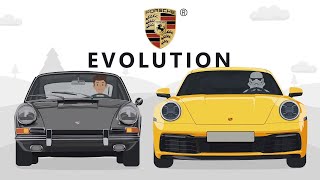

Evolution of Porsche 911: Iconic Sports Car
43sCaptures the iconic status and design evolution of the Porsche 911, appealing to car enthusiasts and nostalgia.
▶ Play Clip"Title accurately describes the content: an animated evolution of the Porsche 911."
The video traces the evolution of the Porsche 911 over eight generations, from the original 1963 model to the latest 992, highlighting key design changes, performance milestones, and production numbers.
For over five decades, the Porsche 911 has been an iconic sports car, synonymous with quality and performance.
The 911 succeeded the 356 with a rear-mounted 6-cylinder boxer engine. Unveiled in 1963, it had a 2-liter engine, 0-60 mph in 9 seconds, and top speed of 134 mph.
The 912 was a 4-cylinder model for the US market. Engine grew from 2 to 2.4 liters, output from 128 to 190 hp.
Released in 1973, considered the greatest classic 911. Had a 2.7L engine, 210 hp, top speed 150 mph, and the first rear spoiler on a production car.
Originally designated 901, but Peugeot claimed rights to three-digit names with a zero in the middle, so Porsche changed it to 911.
First major makeover with raised bumpers. Introduced the first 911 Turbo in 1974 with 3L, 260 hp, top speed 156 mph. Over 198,000 produced.
85% new components, first with 4WD, airbags, automatic transmission. 3.6L engine, 250 hp, top speed 162 mph. 78,008 produced.
Last air-cooled engine. Only 20% parts shared with 964. First six-speed transmission. GT2 had 184 mph top speed, 0-60 in 4 seconds. 57 GT2 units made.
First water-cooled engine. Controversial 'fried egg' headlights. 3.4L engine, top speed 180 mph. Over 179,000 produced.
Return to oval headlights. Base 3.6L, 325 hp; Carrera S 3.8L. GT2 first to exceed 200 mph. 24 model variants, over 215,000 produced.
Lighter aluminum construction. 3.4L engine, stop-start system. GT2 RS: 0-60 in 2.7 sec, top speed 211 mph, Nürburgring record 6:47. Over 233,000 produced.
Latest generation. Carrera top speed 182 mph. Turbo S: 3.7L, 641 hp, 0-60 in 2.5 sec, top speed 205 mph. GT3 lap time 6:55 at Nürburgring.
The Porsche 911 has evolved through eight generations, consistently improving performance while retaining its iconic character, becoming the most mass-produced sports car with over 1 million units.
What was the original designation of the Porsche 911?
Porsche 901
03:06
Why was the name changed from 901 to 911?
Peugeot claimed exclusive rights to three-digit car names with a zero in the middle.
03:06
Which generation was the first to have a water-cooled engine?
The 996 generation (1998-2004).
06:35
Which generation was the last to have an air-cooled engine?
The 993 generation (1994-1998).
05:02
What was the top speed of the original 1963 Porsche 911?
134 miles per hour.
01:46
How many units of the 991 generation were produced?
Over 233,000 units.
10:56
What was the Nürburgring lap time set by the 991 GT2 RS in 2017?
6 minutes, 47 seconds.
10:17
Which generation introduced the first rear spoiler on a production car?
The Carrera 2.7 RS (1973), part of the original 911 series.
02:29
How many model variants of the 997 generation were produced?
24 model variants.
08:50
What is the 0-60 mph time of the 992 Turbo S?
2.5 seconds.
12:05
First Rear Spoiler
The Carrera 2.7 RS featured the world's first rear spoiler on a production vehicle.
02:29Name Change from 901 to 911
Peugeot's trademark claim forced Porsche to change the model number, creating an iconic name.
03:06Last Air-Cooled Engine
The 993 was the final 911 generation with an air-cooled engine, making it a favorite among enthusiasts.
05:02Nürburgring Record
The 991 GT2 RS set a record lap time of 6:47, later beaten by the same car.
10:17Most Mass-Produced Sports Car
The Porsche 911 is the most mass-produced sports car with over 1 million units.
11:08[00:00] For more than five decades, the Porsche 9.11 remained one of the most iconic sports cars in the world. With its recognizable design, the 9.11 became synonymous with quality and performance.
[00:22] This is the evolution of the Porsche 9.11. Riding on the success of the 356, Porsche decided to create a more powerful successor. The 9.11 maintained the 356's fast-backed design, but the 4-cylinder was replaced with a more powerful rear-mounted 6-cylinder boxer engine.
[00:43] Almost 60 years after the first model rolled off the production floor, more than 1 million 9.11 models have been produced in eight distinct generations.
[00:57] Each series of the 9.11 has an internal code number, but they have been marketed and sold as the Porsche 9.11. The original Porsche 9.11 was unveiled in 1963. The luxury sports car was notable for having an air-cooled engine in the rear.
[01:14] It replaced the Porsche 356 and was much more powerful, larger and more comfortable. The 9.11 had a two-liter flat-six boxer engine capable of accelerating to 60 miles per hour in nine seconds.
[01:28] The production cycle of the 356 ended in 1965, but there was still a huge market for a 4-cylinder car, especially in the US. So the 9.12 was released the same year to bridge the gap between the outgoing 356 and the 9.11.
[01:46] The 9.12 wasn't nearly as fast as the 9.11. It had a top speed of 116 miles per hour, while the 9.11 could go to 134 miles per hour. Throughout its production cycle, Porsche kept improving the original 9.11, increasing the engine from 2 to 2.4 liters and the output from 128 to 190 horsepower.
[02:08] In 1973, the Carrera 2.7 RS was released and considered by many collectors to be the greatest classic 9.11 of all time. The name Carrera comes from the 356 Carrera, which had been named after Porsche's victories in the Carrera Panamera Conor races in Mexico in the 1950s.
[02:29] While RS stands for Ren Sport in German, meaning Racing Sport. The car had a characteristic ductile, which was the world's first rear spoiler on a production vehicle.
[02:42] The Carrera had a large 2.7 liter engine generating 210 horsepower. The Sport's car was much faster than the original 9.11 with a top speed of 150 miles per hour.
[02:54] In total, 81,100 units of the original 9.11 model were made. Fun fact, the original Porsche 9.11 was initially designated as the Porsche 901.
[03:06] However, Pugeot claimed an exclusive right to three number vehicle names with zero in the middle. Porsche, not willing to engage Pugeot in a legal conflict, simply replaced the number zero with one.
[03:19] In 1973, Porsche gave the 9.11 its first thorough makeover and produced the G-model. This generation of the Porsche 9.11 stayed in production from 1973 to 1989, which is longer than any other 9.11 generation.
[03:35] It received a new raised bumper design with a plastic bellow to meet the latest crash test standards in the United States. In 1974, the first Porsche 9.11 Turbo was unveiled.
[03:47] It marked one of the most important milestones in the 9.11 saga, with a three liter 260 horsepower engine and an enormous rear spoiler. At the time of its introduction, the Turbo was the fastest production car available in Germany.
[04:03] The Turbo could go 156 miles per hour and a few years later even boosted to a top speed of 165 miles per hour. The G-Series became very successful and in total, over 198,000 models were produced.
[04:18] The next generation of the Porsche 9.11 came at the end of the 1980s with the 964. While the car still looked like the original, it was radically revised and had 85% new components.
[04:32] For the first time, it had four wheel drive, airbags, and automatic transmission. It came with a naturally aspirated 3.6 liter boxer engine and an output of 250 horsepower.
[04:44] The 964 could go to 162 miles per hour. In total, 78,000 and 8 units of the Porsche 9.64 were produced. The 993 model released in 1994 was the last generation of the 9.11 to come with an air cooled engine.
[05:02] It received a different design and was much improved compared to its predecessor. According to Porsche, only 20% of the parts on the 964 were retained in the 993 model. Significant progress was made regarding the driving experience.
[05:17] The 993 was also the first to receive a six-speed transmission. The car was slightly faster than its predecessor with a top speed of 168 miles per hour.
[05:29] However, the 993 GT2 was much faster and could go to 184 miles per hour. It was the ultimate model of this generation and the fastest Porsche at the time.
[05:50] It could blast to 60 miles per hour in an impressive four seconds. In total, only 57 GT2 units were made. The 993 is still a favorite for many Porsche enthusiasts due to its design and because it was the last generation with an air cooled engine.
[06:08] With all variants combined, little over 67,500 Porsche 993 units were produced. Fun fact, all Porsche cars have been produced in the same factory located in Stuttgart, Germany since 1963.
[06:23] In the 1990s, Porsche was facing financial difficulties and realized that in order to keep the 911 in production, it would need radical changes. This led to the development of the 996.
[06:35] While it retained the classic character of the 911, it was a completely new car. The 996 was released in 1998. It was the first to be driven by a water cooled engine.
[06:48] Inside, drivers experienced a new cockpit since Porsche wanted to increase driving comfort. The 996 had a sleeker body and new, so-called, fried egg-shaped headlamps, which was a controversial change.
[07:03] On release, the 996 was offered as a rear-wheel drive coupe or a cabriolay and it came with a 3.4 liter flat-six engine reaching 180 miles per hour. While the Turbo S version could go to an impressive 197 miles per hour, in total, Porsche made well over 179,000 units of the 996 generation.
[07:25] Fun fact, the Porsche 996 can be seen in Pixar's animated movie Cars and is played by the character Sally. In 2004, Porsche unveiled the new generation Carrera models, referred to as the 997.
[07:42] It featured the same classic silhouette of the 911, but more notable was the return of the clear oval headlights with separate blinkers found in older models, which many people preferred over the fried egg-shaped headlights of its predecessor.
[07:56] The base model Carrera came with a 3.6 liter boxer engine and produced 325 horsepower. The car could go to 180 miles per hour. The Carrera S was a slightly faster version with a larger displacement of a 3.8 liter engine.
[08:12] In 2007, the GT2 was released. It was the first 911 to exceed the 200 miles per hour top speed barrier. It was also the most expensive in the 997 range as it was sold for $245,000 at launch, while the base model was sold for $77,800.
[08:33] Porsche made many versions of the 997 to suit driver's individual preferences, including the Carrera. Turbo, GTS, and many others. In total, a whopping 24 model variants of the 997 were made.
[08:50] This generation also became the most produced 911 model, over 215,000 units were built. The 991 released in 2011 marked a significant step in the history of the 911.
[09:04] The next generation set the bar even higher in terms of performance and efficiency. Although the 991 was larger than the 997, it was also lighter because of the predominant use of largely aluminum construction.
[09:18] The 991 Carrera model featured a smaller 3.4 liter engine, yet it was more powerful. To improve fuel economy, Porsche introduced new technologies such as an engine stop start system that turns the engine off at red lights.
[09:33] At the base level, the Carrera model can reach 180 miles per hour. Over the years, Porsche continued to add new models to the 991 generation. To celebrate the 50th anniversary of the 911 introduction, Porsche introduced the 911 50th anniversary edition in 2014.
[09:51] A total of 1,963 units were made, and only people who already owned a Porsche could buy one. In 2017, the 991 GT2 RS was unveiled at Xbox E3.
[10:05] It was unveiled, along with the announcement of the Forza Motorsport 7 video game. In the game, players can drive the car, and the GT2 RS is even on the cover of the game.
[10:17] The sports car is a beast and goes from 0-60 miles per hour in just 2.7 seconds, making it one of the quickest cars in the world. But that's not all. In 2017, Lars Kern set a new record with the GT2 RS at the Nürburgring Nordschleife with 6 minutes, 47 seconds.
[10:35] In 2021, Lars even beat his own record with the same car and is still, at the time of making this video, the record holder for the fastest production car lap time. The legendary race car is the fastest 911 ever made, with a top speed of 211 miles per hour. Only 1000 units of this model were produced.
[10:56] Throughout its production run from 2011 to 2019, more than 233,000 units of the Porsche 991 were made, this made it the most produced 911 model.
[11:08] Fun fact, the Porsche 911 with all its generations is the most mass-produced sports car in the world with over 1 million units made over a period of 5 decades.
[11:20] And finally, the latest generation of the Porsche 911 is the 992 released in 2019, continuing with the legacy of the Porsche 911.
[11:45] This model bears much resemblance to the outgoing 991 generation. However, like all generations of the 911, this model is distinct with several improvements in power and efficiency. The 992 Carrera has a top speed of 182 miles per hour, making it again slightly faster than its predecessor.
[12:05] In 2020, the Turbo and Turbo S were released with a 3.7 liter flat-six engine with 641 horsepower. The Turbo S can blast to 60 miles per hour in just 2.5 seconds.
[12:17] It was also a very fast car with a top speed of 205 miles per hour. In 2021, the latest Porsche 911 was released, the 992 GT3 version. Unlike other models, the GT3 is more track-focused and features a large rear spoiler with larger air vents, a bigger diffuser, and two large exhaust connections.
[12:40] The 992 GT3 recently said an impressive lap time at the Nurburgring reaching the finish in 6 minutes and 55 seconds. The car isn't as fast as the Turbo S, but can still reach 199 miles per hour.
[13:19] From the first Porsche 911 introduced in 1963, all the way to the latest generation released in 2019, Porsche continues to improve the performance of this icon, while still keeping the character of the 911 flows to its origins.
⚡ Saved you 0h 13m reading this? Transcribe any YouTube video for free — no signup needed.