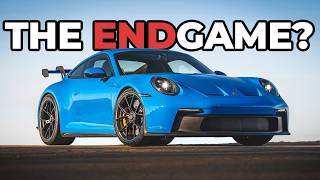

Why Every Car Enthusiast Ends Up Buying a Porsche
60sStarts with a relatable confession and sets up a compelling argument that resonates with car lovers.
▶ Play Clip"Delivers on the promise with a thoughtful analysis, though it could be trimmed by a few minutes."
The video explores the phenomenon of why car enthusiasts eventually end up buying a Porsche, framing it as a journey rather than a starting point. It traces Porsche's near-collapse in the early 1990s and its revival through the Boxster and Cayenne, discusses the evolution of the 911, and argues that modern Porsches are precise and trustworthy rather than raw, which is why they become the benchmark for driver's cars.
Most car enthusiasts start with other sports cars like Miatas, BRZs, S2000s, E46 M3s, Mustangs, Corvettes, and Supras. These cars are stepping stones that teach driving skills but are not the benchmark. Porsche becomes unavoidable because it consistently wins arguments about steering feel, chassis balance, confidence at the limit, and repeatability.
In the early 1990s, Porsche was in serious trouble. Sales collapsed from 50,000 units in 1986 to just 14,000 in 1993. In the US, they sold only about 3,000 cars a year. The lineup was aging, and Japanese manufacturers offered fast, reliable, and cheaper alternatives. Porsche was on the brink of bankruptcy.
The Boxster, a mid-engine roadster inspired by the Mazda Miata, launched in 1996 and became the best-selling Porsche of its era. In 2002, the Cayenne SUV arrived, which enthusiasts called a betrayal, but its profits funded every GT car, GT3, RS model, and special edition. The boring stuff built the exciting stuff.
Every generation of the 911 has been accused of losing its soul: air-cooled vs. water-cooled, hydraulic vs. electric steering, manual vs. PDK, lightweight vs. sound deadening. This cycle has repeated for decades. Modern 911s are precise, not raw, and that precision is what separates a fun car from a truly great one.
The calmness of a 911 is often mistaken for boredom, but boredom is the absence of drama, not trust. A 911 builds trust faster than almost anything else. The pedals make sense, steering weight is intentional, and the car waits for you to ask for more. It gives you performance without theatrics.
A driver's car is not defined by suffering or rawness, but by communication. A modern 911 still communicates better than almost everything else on the road. The steering is accurate, consistent, and readable. The chassis talks to you, and the rear-engine layout provides a unique feel. Porsche engineered out the parts that used to punish without purpose.
Porsche sells credibility, not just engineering. Owning a 911 signals that you value substance over flash and have done your research. Ferrari became fashion, Lamborghini spectacle, McLaren fragile genius. Porsche became the choice that does not need to justify itself. It makes you look like you already figured it out.
Most 911s on the road are regular Carreras, not GT cars or special editions. A base Carrera is devastatingly capable, fast enough to be irresponsible, balanced enough to be rewarding, and refined enough for daily use. It is the backbone of the brand and one of the best driver's cars on Earth.
At any track day, half the cars are Porsches because they do not overheat, melt brake pads, or grenade transmissions. You can track one all weekend, drive it home, and do it again. This reputation came from decades of motorsports and real-world use, not marketing.
After owning a 911, going back to other cars feels like running into an ex. The excitement is remembered, but so is the chaos. Other cars require more work to feel good. A 911 does not need that work. Eventually, enthusiasts stop chasing extremes and start valuing coherence, which is why they buy a Porsche.
The video concludes that every car enthusiast eventually buys a Porsche because they run out of reasons not to. Once you understand the benchmark, you do not go back. The 911's precision, trustworthiness, and cultural credibility make it the ultimate driver's car.
What was Porsche's sales collapse in the early 1990s?
Sales collapsed from 50,000 units in 1986 to just 14,000 in 1993.
02:06
Which two models saved Porsche from bankruptcy?
The Boxster (1996) and the Cayenne (2002).
02:34
What is the difference between boredom and the absence of drama?
Boredom is the absence of trust, not drama. A 911 builds trust faster than almost anything else.
04:26
What defines a driver's car according to the video?
Communication, not suffering or rawness.
05:06
Why did the Cayenne save Porsche despite backlash?
Its profits funded every GT car, GT3, RS model, and special edition.
03:18
What is the cultural meaning of owning a 911?
It signals you value substance over flash and have done your research.
05:58
Porsche's Near-Death Experience
Reveals that Porsche was once on the brink of bankruptcy, contradicting its current image of invincibility.
02:06The 911's Soul Debate
Highlights the recurring criticism of each 911 generation, showing a pattern of nostalgia vs. engineering.
03:33Calmness vs. Boredom
Reframes the perception of modern 911s as boring, arguing that calmness is actually trust.
04:26Cultural Credibility
Explains how Porsche sells credibility, not just engineering, which is a key reason for its appeal.
05:58Track Day Reliability
Provides concrete evidence of Porsche's reliability, earned through motorsports and real-world use.
07:28[00:02] person I know has said the same thing at some point. I am not a Porsche guy. some point. I am not a Porsche guy. >> Are you sure about that? really thought it through. Like it was a personality trait. Nah, Porsches are
[00:17] overrated. Too expensive, too boring, too corporate. I want something raw. >> That is how it always starts and I totally get it. I really do because I said some of the versions of that, too. Most of us did and [music] then slowly,
[00:32] quietly, one by one, we all bought one. So, today I want to talk about why that keeps happening. I'm now on my third and I absolutely love them. Why every car journey, no matter where it starts, seems [music] to end up in Stuttgart and
[00:46] are usually the ones who get [music] there the fastest. My gateway to the Porsche guy, let me know what your gateway car was to get there as well.
[00:58] >> [music] >> and let's go. Now, no one really starts at Porsche, they arrive at Porsche. It is a destination, not an origin story and almost every car you love before it is just stepping stones, whether you
[01:12] realize that at the time or not. Your first real sports car is usually a enough to justify, exciting enough to scramble your brain chemistry and plot you're missing yet. You know, things
[01:26] like Miatas, BRZs, S2000s, E46 M3s, Mustangs, Corvettes, Supras, cars like those. I mean, every one of those cars is a teacher, but none of them are the benchmark. The reason Porsche became unavoidable is simple. Every time people
[01:40] argued about what makes a truly great sports car, they kept landing on the same list. Steering feel, chassis balance, confidence at the limit, repeatability, a car that does not just feel exciting once, but feels right
[01:52] every single time. And whether people like it or not, Porsche kept winning that argument. Now, here's the part that really nobody knows. Porsche was not always untouchable. They were not always this premium engineering institution
[02:06] with a 70-year wait list for a GT car. There were moments when Porsche almost completely disappeared. I mean, in the early 1990s, the company was in serious trouble. Sales had collapsed from 50,000 units in 1986 to just 14,000 in 1993. In
[02:21] the United States, one of their biggest markets, they were moving around 3,000 cars a year. The lineup, it was aging. The 928 and 968 were not selling. The economy, it had turned. Japanese manufacturers were building cars that
[02:34] were fast, reliable, and half the price. Porsche was legitimately on the brink of And the thing that saved them was not the 911. It was a decision to build Boxster, [music] a mid-engine roadster, affordable by
[02:49] Porsche standards, inspired partly by the success of the Mazda Miata. Purists, they [music] hated the concept. Management knew it was their last shot. help redesign the assembly line and make production actually viable. And guess
[03:03] came out in 1996, and it was the best-selling Porsche of its era for years running. Then, in 2002, the Cayenne arrived, an SUV, [music] a proper family-hauling, grocery-getting SUV with a Porsche badge. The backlash
[03:18] Enthusiasts called it a betrayal, a sellout, the end of a real Porsche. And those Cayenne profits funded every GT [music] car, every GT3, every RS model, every special edition that enthusiasts now treat like religious artifact. The
[03:33] boring stuff built the exciting stuff. That is the real Porsche story. Okay, now, this is what gets me. Every single generation of 911 has been accused of losing its soul. The air-cooled crowd said it died with the water pumpers in
[03:46] 1998. The hydraulic steering crowd said it died when electric assist came in. The manual crowd said it died when PDK launched. The lightweight crowd said it died when sound ending went in. This cycle has been repeating for literally
[04:00] decades. Not louder, not scarier, better. This is the difference between nostalgia and engineering. Modern 911s are not raw in the way old ones were. They are precise and precision is what separates a fun car from a truly great
[04:13] one. A base Carrera right now will embarrass almost everything people call a driver's car on a back road and it will do it while feeling calm, composed, and completely predictable. That calmness is what people mistake for
[04:26] boredom. But, boredom is not the absence of drama. It is the absence of trust. A 911 builds trust faster than almost anything else on four wheels. I mean, when I sit in mine and everything just feels like it should be exactly where it
[04:39] is and it is, the pedals make sense, the steering weight is intentional, the car does not bite you. It waits for you to ask for more. When you do, it gives it to you without theatrics. This is why people who actually drive their 911s
[04:52] declares it is not a driver's car anymore. Almost every person who says that has [music] never pushed one. Okay, now yes, the 911 has gotten bigger. Yes, it's gotten heavier than it used to be and yes, Porsche sells SUVs and luxury
[05:06] sedans now. None of that disqualifies it. A driver's car is not defined by suffering. It's not defined by how much it tries to kill you or how raw the steering feels in a parking lot. It is defined by communication. A modern 911
[05:19] still communicates better than almost everything [music] else on the road. The anymore, but it is still accurate, consistent, and readable. [music] The chassis still talks to you. The rear engine layout still gives you that
[05:31] that nothing else on this planet quite replicates. And Porsche engineered out the parts that used to punish you without purpose. Old 911s demanded respect because they could genuinely bite. New ones reward respect by letting
[05:44] it back. [music] That does not make them worse, makes them usable and usability is exactly why they became so popular. Okay, this is another factor here that nobody likes to acknowledge because it feels somewhat
[05:58] uncomfortable. Porsche figured out what their car means culturally better than almost anyone. They did not just sell engineering, they sold credibility. Owning a 911 says something very specific about you. It says you value
[06:11] substance over flash, performance without screaming for attention. You've done your research. You have driven the alternatives. You ended up here. Ferrari became fashion. Lamborghini became spectacle. McLaren became fragile genius
[06:24] with a maintenance budget that could fund a small country. Porsche became the choice that does not need to justify itself. And that matters way more than people are willing to admit. A 911 does not make you look [music] like you are
[06:36] trying. It makes you look like you already figured it out. That is why it through the whole car journey. People who have owned the loud ones, the fast attention and still let you down. They realize they want something that just
[06:50] works every single time. Now, everyone fixates on the GT cars, RS models, special editions, the six-figure flipper bait. In reality, though, the vast majority of the 911s on the road are regular Carreras, base cars, lightly
[07:04] optioned. And those cars are the backbone of this brand. A base Carrera is still devastatingly capable, fast enough to be irresponsible, balanced enough to be rewarding, refined enough to live with it as a daily. For most
[07:16] drivers, that is the sweet spot. Not the halo cars, not the investment pieces, just the normal one. And the normal one is still one of the best driver's cars on Earth. There's a reason that you go to any track day and half the cars are
[07:28] Porsches. They do not overheat, they do not melt brake pads instantly, and they do not grenade transmissions after a few hard laps. You can track one all weekend, drive it home, and do it again the following month. That reputation did
[07:40] not come from marketing. It came from decades of motorsports and real-world use. It earned credibility and it matters if you actually drive your car instead of just talking about it online. So, every enthusiast has their exes, the
[07:52] aggressively, the ones that made you feel alive and also made you tired, the ones you swore were just as good. Going back to those cars after owning a 911 feels like running into an ex after you have been in a healthy relationship for
[08:07] excitement, you remember the chaos and then you remember why it didn't last. balance is not as intuitive, the compromise feels louder and you realize
[08:19] how much work you were doing just to [music] make the car feel good. A 911 does not need you to work that hard. That is the final stage of enthusiast's journey. When you stop chasing extremes and start valuing coherence, when you
[08:32] stop needing your car to prove something and start wanting to deliver something. eventually buys a Porsche. Not because they plan to, because they ran out of the reasons not to. And once you get there, you do not go back. You might
[08:46] them, you might have crossed a line, you understand what the actual benchmark is now and that understanding, well, it ruins you [music] Danger, this is Ideal Life. Subscribe so we can hit 2 mil by the end of the year.
[08:59] Check out some of these Ideal vids over here and promise me one thing. Buy a Porsche, keep living the Ideal lifestyle.
⚡ Saved you 0h 09m reading this? Transcribe any YouTube video for free — no signup needed.