
The First Porsche 911: Air-Cooled Legend
56sHigh nostalgia and curiosity about the original 911 specs and design by Ferdinand Porsche.
▶ Play Clip"The title accurately promises a breakdown of 911 generations, and the transcript delivers exactly that with detailed specs."
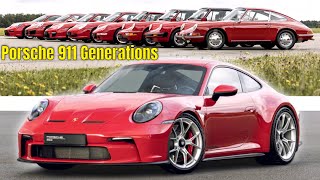
This video provides a comprehensive overview of the Porsche 911's evolution across its generations, from the original 1963 model to the 992 series. It details key technical specifications, design changes, and performance milestones for each iteration.
Featured an air-cooled, rear-mounted 2.0L 130hp flat-six engine, 5-speed manual transmission, and 2+2 seating. Styling by Ferdinand Porsche and Erwin Komenda.
Revived the Carrera name. Last of the original 911 series. Power: 207bhp (North America) or 231bhp (other markets). 0-60 mph in 5.4 seconds, top speed 150 mph.
85% new compared to Carrera 3.2. Introduced all-wheel drive (Carrera 4) and rear-wheel drive (Carrera 2). New M64 engine: 3.6L, 247 hp. Top speed 163 mph, 0-60 in 5.5 seconds.
Last air-cooled 911. Only 20% parts carried over. New light alloy subframe with coil and wishbone suspension. First 911 with 6-speed transmission. Power: 282-296 hp.
First all-new chassis platform and water-cooled engine. Shared development with Boxster. Multi-link rear suspension from 993. Switch to water-cooling due to emissions and performance needs.
Evolution of 996 with updated styling, including classic bug-eye headlamps. Larger 18-inch wheels standard. New S version with more power, sports suspension and exhaust.
Seventh generation, entirely new platform. Carrera: 3.4L, 345 hp; Carrera S: 3.8L, 395 hp. Direct injection.
Wider body, LED light strip across rear. Staggered wheel setup (20/21 inch). 3.0L twin-turbo flat-six, 443 hp. PDK transmission with extra gear.
The Porsche 911 has continuously evolved through eight generations, each bringing significant technical and design advancements while retaining the core rear-engine layout. From air-cooled origins to modern turbocharged water-cooled engines, the 911 remains a benchmark sports car.
What was the engine configuration of the original 1963 Porsche 911?
Air-cooled, rear-mounted 2.0L flat-six boxer engine producing 130 hp.
Which generation was the last air-cooled Porsche 911?
The 993 generation (1994-1998).
03:33
What was the power output of the 1984 911 3.2 Carrera for North American markets?
207 bhp at 5900 rpm.
01:33
What percentage of the 964 was new compared to its predecessor?
85%.
02:03
Which 911 generation introduced a water-cooled engine?
The 996 generation (1997-2006).
05:02
What was the top speed of the 964 Carrera manual version?
163 mph.
02:53
How many gears did the 993's transmission have?
6-speed.
04:42
What was the horsepower of the 992 Carrera?
443 hp at 6,500 rpm.
10:38
Which generation featured a glass canopy Targa roof?
The 997 generation.
06:56
What was the 0-60 mph time for the 1984 911 3.2 Carrera?
5.4 seconds.
01:51
Original 911 Engine
Established the iconic rear-engine, air-cooled layout that defined the 911 for decades.
993: End of Air-Cooled Era
Marked the end of air-cooled Porsche engines, a major milestone in 911 history.
03:33996: Water-Cooled Revolution
The switch to water-cooling was necessary for emissions and performance, fundamentally changing the 911.
05:02992: Modern Design Cues
Introduced a wider body and LED light strip, blending heritage with modern aesthetics.
09:15[00:00] The earliest edition of the 911 had an air-cooled rear mounted 2.0L 130hp flat-six boxer engine,
[00:17] similar to the 356's 4-cylinder 1.6L unit. It was mated to a 5-speed manual, type 901 transmission. The car had 2 plus 2 seating, though the rear was very small.
[00:31] Also like the 356, the styling was largely by Ferdinand Porsche, son of Ferdinand, Ferry Porsche. Erwin Komenda, the leader of the Porsche car body construction department, was also involved in the design.
[00:56] With the 911's future assured, 1983 saw the launch of a replacement for the successful SP Series. It was the My 1984 911 3.2 Carrera, reviving the Carrera name for the first time since 1977.
[01:18] The 911 3.2 Carrera was the last iteration in the original 911 series, with all subsequent models featuring new body styling with new brake, electric and suspension technology.
[01:33] With the new engine power was increased to 207bhp at 5900rpm for North American delivered cars and the 231bhp at 5900rpm for most other markets.
[01:51] This version of the 911 accelerated from 0-60mph in 5.4 seconds and had a top speed of 150mph.
[02:03] The 964 was considered to be 85% new as compared to its predecessor, the Carrera 3.2. The first 964s available in 1989 were all-wheel drive equipped Carrera 4 models.
[02:19] Porsche added rear-wheel drive Carrera 2 variants to the range in 1990. Both variants were available as Coupe, Targa, and Cabriolet. The 964 Carrera was the last generation sold with the traditional removable targa roof until the 2011 991.
[02:40] A new naturally aspirated engine called the M64 was used for the 964 model with 247 horsepower and it had 3.6 liters.
[02:53] Performance was as follows. Top speed 163 mph. 169 miles per hour for Tektronik version. 0 to 60 miles per hour 5.5 seconds for the manual
[03:08] transmission and 6 seconds for the Tektronik Quarter mile 13 seconds for the C2 14 seconds for the Tektronik 14 seconds for C4 version Fuel consumption was approximately 24 mpg combined
[03:33] The Porsche 993 is the internal designation for the Porsche 911 model manufactured and sold between January 1994 and early 1998,
[03:45] replacing the 964 model. Its discontinuation marked the end of air-cooled Porsche. The 993 was much improved over and quite different from its predecessor. According to Porsche,
[04:00] every part of the car was designed from the ground up, including the engine, and only 20% of its parts were carried over from the previous generation. Porsche refers to the
[04:13] 993 has a significant advance not just from a technical but also a visual perspective. Porsche engineers devised a new light alloy subframe with coil and wishbone suspension,
[04:28] putting behind the previous lift off oversteer and maintaining significant progress with the engine and handling, creating a more civilized car overall providing an improved driving experience.
[04:42] The 993 was also the first 991 to receive a 6-speed transmission. The naturally aspirated version of the 993's horsepower ranged from 282 horsepower to the 3.8-liter 296 horsepower.
[05:02] The Porsche 996 is the internal designation for the Porsche 911 model manufactured from 1997 to 2006. It was replaced by the 997 in 2004.
[05:15] The 996 had little in common with its predecessor, with the first all-new chassis platform, the original 911, and a new water-cooled engine. Technically, it was a major change, a complete breakthrough for the original car other than
[05:33] overall layout. Development was shared with its entry-level Sydney, a roadster-only Boxster, which was introduced around the same time, including the first suspension, various interior components,
[05:46] and the engine, all of which were enlarged to the 996. However, the multi-leg rear suspension was derived from the preceding 992. At its debut, the 996 featured the most significant change from the
[06:01] classic 911 series, a water-cooled engine replacing the previously air-cooled engine. Progressively stringent emissions and noise regulation, even our metal concerns a higher
[06:14] expectation for refinement and the need for a high-performance four-valve per-cylinder engine made the switch necessary. Porsche 997 is the internal designation for the Porsche 911 sports car manufactured and
[06:29] sold by German manufacturer Porsche between 2004 and 2012. of the Carrera and Carrera S Coupes began in early 2004 All the drive Carrera 4 and Carrera 4S began to be delivered to customers in November 2005 The Turbo and GT3 derivatives went on sale in late 2006 and the GT2 in 2007
[06:56] In addition to the Coupe and Cabriolet versions, Targa versions of the Carrera 4 and the Carrera 4S were also available, which carried on with the glass canopy-link design used in its first application on the
[07:14] 993 until the 901, which reverted to the classic Targa top layout unique on the early 911 Targa. The 997 was an evolution of the preceding 996, with the most significant changes being
[07:30] interior and exterior styling, the most notable being the replacement of the fried egg headlamps used on the Manatex with the classic bug-eye units. Larger 18-inch wheels were fitted as standard,
[07:45] and other engineering changes include slightly increased horsepower. However, the car is technically very similar to its predecessor. A new S version was offered with additional power
[07:57] from a slightly larger engine, sports suspension and sports exhaust. The Porsche 991 is the internal designation for the 7th generation of the Porsche 911
[08:10] sports car, which was unveiled at the 2011 Frankfurt Auto Show on the 15th of February as a replacement for the 997. The 991 is an entirely new platform, only the third since the original 911 launched in 1961.
[08:28] The 996 in the 1999 was the second new platform. Introduced as a 2011 Geneva Motor Show, the Carrera is equipped with a 3.4 liter boxer engine with direct injection generating a maximum power output of 345 horsepower at 7,400 RPMs
[08:48] and 280 horsepower at 60% RPM. The Carrera S has a 3.8 liter engine generating the maximum power output of 395 horsepower at 7,400 RPM
[09:02] and 325 horsepower at 60% RPM. The 992 shares its wheelbase with the outgoing car, but its body is slightly longer.
[09:15] Front and rear troughs widen by 40mm. The Carrera 2S and 4S models, the first of the 992 lot, share the same wide body, which is unlike in years past, when the rear wheel drive models were narrower than their all-wheel
[09:34] drive counterparts. The 992's parting piece is a LED light strip spanning the gap between taillights, a throwback to the 70's 911 Turbo. The effect widens the car visually enhancing use of the 992's swollen
[09:53] punches. The 992's wheels swell too because those dimensions only go one way. The setup is staggered both in width and in diameter The latter is another first for the 911 Purely P new tires wrapped with a gem wheel
[10:20] 1245, 35 out front, 305, 30 out back. The 992 Carrera is routine Porsche 3.0 liter twin-turbo flat-six. But there's new injectors, higher compression, reject turbos.
[10:38] The intercoolers straddle the engine now. Expanding their footprint and the car's heat capacity. The net effect, 443 horsepower at 6,500 RPM.
[10:55] 23 more horsepower than the outgoing car. routed through a PDK transmission that grew in ink gear to emphasize acceleration.
[11:28] Thank you.
[11:58] so
[12:14] so
[12:28] so
[12:40] so
[12:58] I'm sorry.
[13:28] .
⚡ Saved you 0h 13m reading this? Transcribe any YouTube video for free — no signup needed.