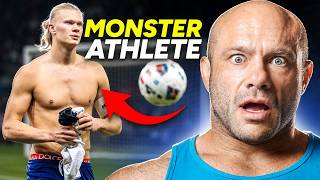

How to train like Haaland
56sDr. Mike breaks down the three key lower body training priorities for soccer, offering actionable advice that appeals to athletes and fitness enthusiasts.
▶ Play Clip"The title accurately reflects the content: Dr. Mike critiques Haaland's freakish athleticism, training, and diet using scientific reasoning."
Dr. Mike Israetel critiques Erling Haaland's freakish athleticism, training regimen, and dietary habits. He explains the science behind soccer-specific strength training, debunks common performance myths (like hypoxic chambers and wobble boards), and separates genuine best practices from mere routine.
Haaland is a 6'5" soccer star with a muscular build; Dr. Mike will review his training, daily schedule, and diet.
Sport training (drilling/playing) is the primary way to get good at a sport. Gym work is for strength, flexibility, and injury prevention.
Anterior chain (abs, hip flexors, quads) for kicking power; vertical pushing (squats) for sprinting/jumping; posterior chain (hamstrings, glutes, back) for acceleration and injury reduction.
For flexibility, regular intense holds (20–30 seconds) are needed; taper volume gradually after season, don't go from zero to high volume in preseason – a known injury predictor.
The wobble board and glute activation claims are pseudoscience; the only way to build strength is with maximal intent/resistance.
Hypoxic/high‑heat training depresses performance, so you cannot push systems to their adaptive threshold. Psychologically it may help, but physiologically it's inferior to training in optimal conditions. Separate passive hypoxia exposure if needed.
Raw milk offers no proven benefits and carries a small risk of infection. Pasteurization kills bacteria – a good thing.
Milk is a superfood – high‑quality protein, carbs, fats linked to disease reduction and longevity, great for muscle building.
Ethical treatment of animals and ethically raised meat/animal products are good; factory farming is likely to be viewed negatively in the future.
Some athletes' methods work, others don't; critical evaluation using sport science is essential. Promotion of free RP University lectures.
What are the three lower-body training priorities for soccer players according to Dr. Mike?
The three lower-body training priorities for soccer are the anterior chain (abs, hip flexors, quads), vertical pushing (squatting), and the posterior chain (hamstrings, glutes, lower back).
03:10
Why does Dr. Mike argue that hypoxic/high‑heat training is counterproductive for sport performance?
Hypoxic and high‑heat training depress performance, meaning you can't push your systems near their capacity, which limits the training effect.
10:21
In the sequence of muscles involved in kicking a ball for power, which muscle group contracts first and which last?
The anterior chain muscles contract first (abs), then hip flexors, finally quadriceps.
04:00
According to Dr. Mike, what is the most reliable predictor of injury in sport science?
Alterations and escalations in training volume are the most reliable predictors of injury in sport science.
06:43
What does Dr. Mike think about Haaland's wobble board exercise for glute activation?
Haaland claims the wobble board activates his glutes, but Dr. Mike calls it total BS because the resistance is too low to push the muscle to its limits.
09:01
How does Dr. Mike say you can train to do the crazy kicks and landings Haaland does?
Resistance training in the gym – mostly sets of 5 to 10 reps, a few sets a few times a week – is the way to become more flexible, kick harder, sprint faster, jump higher, and reduce injury risk.
02:24
What does Dr. Mike say about milk as a superfood?
An excellent source of the highest quality protein, carbohydrates, and healthy fats; whole milk is great for health and building muscle as long as calories are controlled.
14:44
What is Dr. Mike's critique of Haaland's belief in raw milk?
Haaland says raw milk is beneficial, but Dr. Mike states raw milk has no proven advantages over pasteurized milk and carries a small but real risk of causing illness.
14:07
Sport practice is primary
Dr. Mike clarifies that sport training, not gym work, is the main driver of sport skill – a key distinction often blurred in fitness media.
02:36Three lower-body training priorities
Provides a concrete, actionable framework for soccer-specific strength training: anterior chain, vertical pushing, posterior chain.
03:10Volume escalation = injury risk
Explains a foundational sport‑science principle: sudden increases in training volume (e.g., preseason) are a proven predictor of injury.
06:43Hypoxic chamber paradox
Shows the critical difference between psychological and physiological training effects, debunking a common elite‑athlete practice.
10:21Raw milk fallacy
Scientifically refutes the raw milk trend with a clear risk‑benefit analysis, while still endorsing pasteurised milk's benefits.
14:07[00:00] Oh, he's somehow pulled that.
[00:01] >> Whoa. That's like using your feet like
[00:04] tennis rackets.
[00:05] >> Bonado Silver arriving. HOLLAND
[00:07] ARRIVING. HOLLAND.
[00:08] >> I'M SORRY. I don't even know what
[00:09] happened that time. How do you train to
[00:11] do those things?
[00:16] [music]
[00:18] Hey folks, Dr. Mike here for RP Strength
[00:20] and a longtime professor of exercise
[00:21] sport science. And my most glorious
[00:24] achievement is that back in Russia when
[00:26] I was a little kid, I played a little
[00:28] bit of soccer at preschool.
[00:30] >> Okay.
[00:31] >> But somebody who played a lot more
[00:33] soccer is Mr. Erling Holland. And he is
[00:36] a giant soccer star from Europe. So for
[00:38] the Americans, this is a sport that they
[00:41] call football. Which I tell you what,
[00:42] brother. I've seen me some football.
[00:44] That ain't it.
[00:46] We're reviewing this young man because
[00:48] he is physically insanely imposing. 65
[00:52] and pretty jacked for a soccer player.
[00:54] Let's find out what he can do, what he
[00:56] does for this daily schedule, how he's
[00:59] training, maybe how he's eating, and uh
[01:01] see if we can't make some sense of shit.
[01:02] You know what I'm saying? Talk a little
[01:04] smack about how good I would have been
[01:05] if I was allowed by the powers that be
[01:07] to go up the ranks and eventually play
[01:09] for Man City, which is the proper way to
[01:12] say the name of that soccer team, which
[01:14] the other one is Man, you know it. You
[01:17] know it.
[01:21] Bernardo Silva arriving. Harland
[01:23] arriving. HARLAND. [screaming]
[01:27] >> You just kind of have to know where the
[01:28] goal is, huh? Intense.
[01:30] >> Why are you pretending? I knew you were
[01:32] that coordinated.
[01:33] >> This time into the penalty area in
[01:35] towards Harland.
[01:36] >> I'm sorry. I don't even know what
[01:38] happened that time.
[01:39] >> Oh, he's somehow put that.
[01:41] >> Whoa. That's like using your feet like
[01:43] tennis rackets.
[01:44] >> That was like the back of his side of
[01:46] his shin.
[01:48] >> Incredible. How on earth did he score
[01:50] that? He might well smile. Incredible.
[01:54] >> He bounced it.
[01:55] >> Yeah. He's like, I like what they did.
[01:57] Why is this man hanging on me? I don't
[01:59] like that.
[02:00] >> It had to be pre-ordained.
[02:03] >> Unreal.
[02:04] >> Say what you like. You just knew that
[02:06] Erling Harland WOULD HAVE THE FINAL
[02:09] WORD.
[02:09] >> One thing also that's impressive is the
[02:11] sacrifice the body instinct. He didn't
[02:13] so much care how he was going to be
[02:15] landing. He just kind of went for it.
[02:18] Unreal.
[02:19] >> So, how do you train for that, Mike? In
[02:20] ideal world, how do you train to do
[02:21] those things?
[02:22] >> How do you train to do those things?
[02:24] You just get real strong in the
[02:26] weightlifting movements and at some
[02:27] point you can just do that. You get huge
[02:29] and get on steroids and get a
[02:30] bodybuilder and then your soccer
[02:32] abilities just skyrocket. No, wait, I
[02:34] said that backwards. The way you get
[02:35] better at any sport [music] is
[02:36] predominantly playing and or drilling
[02:39] and or using some kind of subsection of
[02:41] technique from that sport. Sport
[02:43] training is what gets you good at
[02:44] sports. There are ways to be able to
[02:47] become more flexible, to be able to kick
[02:50] harder, to be able to sprint faster, and
[02:52] to be able to jump higher, and to be
[02:54] less likely to get hurt after landing
[02:56] and after getting kicked and shoved by
[02:58] other people. That is resistance
[03:00] training in the gym. Mostly sets of five
[03:03] to 10 reps, just a few sets a few times
[03:05] a week. For the large muscle groups of
[03:08] the body, especially for soccer, what is
[03:10] really, really critical is to train
[03:12] three qualities of the lower body. You
[03:14] can train the up body a little bit in
[03:15] soccer. That's totally cool. But the
[03:16] lower body needs three training
[03:17] qualities to happen. Three training
[03:19] priorities. One is the anterior chain.
[03:23] [clears throat] It is your abdominal
[03:24] muscles and your hip flexors and and
[03:26] technically the muscles that lift the
[03:28] front of your foot. And so these you can
[03:31] train with a variety of things. Leg
[03:34] lifts, crunches, all sorts of ab
[03:36] machines. And especially if you involve
[03:38] the hip flexors to a large extent, this
[03:40] can improve your technique and running
[03:42] speed and it can make you less prone to
[03:45] injury kicking and it can make your
[03:47] kicking power massive. So by the way,
[03:49] quad extensions, leg extensions are a
[03:52] part of this execution of the chain,
[03:54] which you know is a lot of the
[03:55] musculature involved in kicking a ball
[03:57] really hard. But remember, kicking a
[03:58] ball hard also because you pull your
[04:00] foot really far back before it stretches
[04:02] out the abs. So the first muscle to
[04:03] contract is your abdominal muscles. The
[04:05] next muscles to contract are your hip
[04:06] flexors, bringing your hips forward. The
[04:08] last muscles to to contract are your
[04:10] quadriceps in order to get that ball
[04:12] kicked at the very end of that chain.
[04:14] So, that's priority number one. Priority
[04:15] number two is most running and jumping
[04:18] is limited by vertical forces. And so,
[04:20] getting as much as you can uh in
[04:22] squatting, basically vertical pushing
[04:24] movements with your legs. You can leg
[04:25] press, you can hack squat. Squatting is
[04:27] probably a really, really good choice
[04:28] there. deep squats for sets of five or
[04:31] so increase that number and all of a
[04:33] sudden you're going to be just faster
[04:35] and you're going to be able to jump
[04:36] higher. And lastly is the posterior
[04:38] chain. That is your calves to some
[04:41] extent, but especially your hamstrings,
[04:43] your glutes, and all the way up your
[04:45] entire back, especially lower back. That
[04:47] is what allows you to pull along the
[04:50] track as you run. It's really, really
[04:52] critical in changing directions. And so
[04:54] posterior chain also reduces hamstring
[04:56] injuries a ton. So those are three
[04:58] priorities for lower body that are
[04:59] critical for becoming the best soccer
[05:01] player you can be. That is something
[05:03] we're looking for in very very good
[05:05] ancillary strength and conditioning
[05:06] training to regular sport soccer
[05:08] training. Remember strength conditioning
[05:09] for soccer can be like 2 hours a week
[05:11] total and that's really all you need.
[05:13] Maybe some of these folks do it, maybe
[05:15] some don't. It gets really wacky
[05:17] training professional athletes. At the
[05:18] end of the day, they're in charge of
[05:19] their training and not you as a strength
[05:21] conditioning professional. So a lot of
[05:22] them really kind of do sort of a pick
[05:24] and choose. So his motion when he come
[05:26] in the team was that you remember
[05:29] >> go further than this.
[05:30] >> Yeah, man. That's a problem. It's a
[05:31] problem because in the in the soccer
[05:33] field, your feet and legs will be put
[05:36] into positions randomly, maybe not
[05:38] randomly, but as part of the game game
[05:40] play that can overstretch some of your
[05:42] muscles. And so if you're more flexible
[05:44] and more mobile, you're going to have
[05:45] lower injury rate and more capability,
[05:48] especially in his case to kick with all
[05:50] those weird kicks we saw earlier. You
[05:51] need to have good mobility or
[05:53] flexibility to score these crazy goals.
[05:54] No, Mario. So, we need to keep this.
[05:56] This is really important.
[05:58] >> The important thing for flexibility
[06:00] training is that it has to be very
[06:01] regular like most days of the week. And
[06:04] it has to be pretty intense. You know,
[06:05] 30 second holds at a time, 20 second
[06:07] holds at a time, relatively painful.
[06:10] That that's how you do that if you want
[06:11] to push the pace on flexibility,
[06:13] mobility.
[06:14] >> Today, I feel extra stiff in both
[06:16] hamstrings, so I'm going to do both.
[06:18] I've seen so many people that come in in
[06:20] preeason, work crazy hard, after two
[06:22] weeks, you don't see them anymore.
[06:24] [music]
[06:24] >> Yeah. I mean, a lot of those people in
[06:26] preseason work crazy hard. This is a
[06:27] real big problem in soccer. A lot of
[06:29] folks just don't do very much before
[06:31] preseason starts and then preseason
[06:34] coaching staff decides it's going to be
[06:36] really hard cuz you want to kind of
[06:37] toughen the guys up and the volume
[06:39] skyrockets from almost nothing to
[06:41] something really high. One of the most
[06:43] reliable predictors of injury in sport
[06:45] science is alterations in volume,
[06:47] escalations in volume. So, if you go
[06:48] from very little volume to very much
[06:50] volume, the probability you're going to
[06:51] have a bad time is high. It's very high.
[06:54] And so, what he's talking about here
[06:55] makes perfect sense because a lot of
[06:57] guys go super super hard in preeason and
[07:00] then just get so mangled up and so
[07:01] injured in small ways and sometimes
[07:03] large ways that by the end of preseason
[07:05] they're just kind of washed out. Not
[07:06] what you want to do. The real secret to
[07:09] sport is to never back away completely
[07:11] from sport. you know, outside of 2 weeks
[07:13] after the end of your season, just go on
[07:14] vacation to wherever these guys go. But
[07:16] most of the time, you should be keeping,
[07:18] if it's soccer, you got to keep your
[07:20] feet on the ball most of the year. What
[07:22] you don't want to do is just like go
[07:23] months without doing the sport
[07:24] altogether. And then when you are ready
[07:26] to come back and let's say preseason's
[07:28] pretty tough, take a couple weeks to
[07:30] slowly ramp up how much volume and
[07:32] intensity you're doing. Take a little
[07:34] bit of um very easy half week before
[07:36] preseason starts and then they're just
[07:38] going to try to kick your ass in
[07:39] preseason, but you're already in good
[07:40] shape. So, we want to do is do less of
[07:43] this, right, in the yearly volume
[07:46] intensity fluctuations and more smooth
[07:48] curves. Smooth curves are going to keep
[07:50] you in shape more. They're going to have
[07:51] you're going to have a better time. Your
[07:53] skill and technique development is going
[07:54] to progress better and your probability
[07:55] of injury is going to be way way lower.
[07:57] Is it always fun? No. But if you're a
[08:00] pro alete, you got to do what it takes.
[08:01] And if you want to be the best athlete
[08:02] you can be, you got to do what it takes.
[08:04] >> I need to have good balance and I need
[08:06] to have good stability in my ankles.
[08:08] >> That's why I like to work with this kind
[08:10] of thing. Don't think of anything. Just
[08:11] stand a bit on it and work the brain and
[08:13] the ankle. Make the ankle work, not the
[08:15] body.
[08:16] >> Cool. So, ankles don't uh are actually
[08:18] composed of muscles. Those are the
[08:20] muscles in your leg that do that. Um,
[08:24] this kind of thing might work, but it's
[08:25] highly unlikely it does a whole lot of
[08:27] anything. This isn't specific at all to
[08:29] soccer whatsoever.
[08:31] um just moving around dynamically in the
[08:35] field of play uh with doing various
[08:37] drills and just playing soccer is going
[08:39] to take care of this way better and it's
[08:41] going to be more specific to soccer.
[08:42] It's not really clear that general
[08:45] balance improves in adults outside of
[08:47] with lots of volume of exposure.
[08:48] Specific balance, you can get better at
[08:50] this task, but does that transfer to
[08:52] soccer play? The answer is probably not.
[08:54] >> This is actually good for [music] my
[08:56] glutes as well. My glutes are strong
[08:58] now. They are working good. they're
[09:00] really activated, which is
[09:01] >> Yeah. So, that's just total BS right up
[09:03] front. And uh, you know, Erling's not
[09:05] the only person who thinks that, so I'm
[09:06] not trying to come down on him super
[09:07] hard. It's just the vast majority of
[09:09] people think that like when you can feel
[09:10] a muscle being active, that's a good
[09:12] thing. You know, like if you write with
[09:14] a pencil, your forearms uh something you
[09:16] can feel being [music] active. We don't
[09:17] exactly recommend like book authorship
[09:19] manually with a pencil as like the best
[09:21] form growth routine. Um, just cuz a
[09:24] muscle's active doesn't mean it's being
[09:25] pushed to its limits. The only way it
[09:26] can be pushed to its limits is if you
[09:28] ask it to move as quickly as possible
[09:29] for speed or as as much resist against
[09:32] as much resistance as possible with
[09:34] maximum intent to move for strength. And
[09:36] so none of these things are happening
[09:38] here. So really it's just kind of like
[09:39] practice doing a neat trick that's not
[09:42] so neat. Folks, there is still more
[09:44] video to come, but we have a juicier,
[09:46] lengthier, girthier, vanier version of
[09:48] this video in our member section. We
[09:50] also have tons of other amazing content.
[09:52] It's a super small amount of money, but
[09:53] a great value. Go ahead and give it some
[09:55] clicks and we're going to be back to the
[09:56] video right now.
[09:58] >> Going in the hypoxic chamber. 40° in
[10:00] there. 3,500 m above sea level. So, I
[10:03] need to have this on for a bit better
[10:05] [music] breathing.
[10:05] >> 40°. So, it's really hot and there's not
[10:08] a ton of air.
[10:11] >> Er, can you tell me what the benefits of
[10:13] training at altitude and heat are?
[10:16] >> Yes, I can. I struggle more in here. Go
[10:18] out on the pitch, I can run even more.
[10:21] >> Yeah. This is a common logic that's not
[10:24] entirely wrong and it's very sensible on
[10:26] on face value. And the idea is that if
[10:29] you make your training really difficult,
[10:31] then you go out on the pitch, you go out
[10:33] on the soccer field and it feels much
[10:35] easier. But there are two things going
[10:37] on here and we have to separate them.
[10:39] One is the physiological and one is the
[10:41] psychological. Psychologically is
[10:43] absolutely a valid thing. If you train
[10:45] like, you know, in total shitty
[10:46] conditions, very uh like low oxygen,
[10:50] very high heat, it's going to make your
[10:52] training miserable. And then when you
[10:54] actually go out and do the thing in real
[10:56] life, you're like, man, this feels easy
[10:58] and it's confident building and it's
[10:59] empowering and I love it. It's a great
[11:01] idea. The physiological thing is where
[11:03] the problem is. When you train your
[11:05] physiology, you want to train in
[11:08] conditions that push your physiology as
[11:10] much as possible. Imagine this. Imagine
[11:12] you were training a powerlifter. just to
[11:14] keep it super simple. And his job is to
[11:16] try to squat as much as possible. If you
[11:18] give him a bar that's wobbly and you
[11:21] give him a t-shirt that's slick, so the
[11:23] bar keeps moving on his t-shirt. You
[11:24] give him no chalk so he can't even grip
[11:26] the bar properly when it's on his back.
[11:28] You give him sandals instead of
[11:29] weightlifting shoes and [music] you make
[11:30] the floor slippery as well. What he's
[11:32] going to do is he's going to find that
[11:33] kind of training incredibly difficult
[11:35] and frustrating, which psychologically
[11:36] is awesome because when he gets a really
[11:38] good locked in setup with proper gear,
[11:40] proper bar, proper floor, proper shoes,
[11:42] he's going to be like, "Oh my god, I
[11:43] feel like aing machine." The problem is
[11:45] that when he's in that really nasty
[11:47] training situation where he's doing
[11:49] everything wrong and everything is all
[11:50] wrong with bad shoes, bad grip, bad
[11:52] floor, bad bar, bad shirt, he's his load
[11:55] that he can use for the reps that he
[11:57] wants to do is lower than otherwise.
[12:01] lower even than his adaptive thresholds
[12:04] main hump. So he's training so easy now
[12:07] it feels hard but it's so easy that it
[12:10] he's not even getting a good training
[12:12] effect in a hypoxic climate you get less
[12:14] oxygen. Um that is training high
[12:17] training at altitude or or or basically
[12:19] simulated altitude. And if you're
[12:21] training with high heat conditions,
[12:23] those both depress your performance,
[12:25] which means that you're not training the
[12:27] systems at close to their full capacity,
[12:30] which is how those systems get better.
[12:32] So the better idea is to train in a
[12:34] very, very pleasant condition. So you
[12:37] caning just go and reach maximum
[12:39] velocities, maximum endurance outputs,
[12:42] maximum backto-back performances, the
[12:43] whole thing. That's how you have to
[12:45] become uncomfortable in a way. the
[12:47] discomfort has to be concordant to you
[12:49] doing better, to pushing those systems
[12:51] to become better. That's awesome. And
[12:54] then if you want the extra
[12:55] cardiovascular ability, you can spend a
[12:56] few hours a day in a hypoxic chamber
[12:58] that doesn't cost you nearly as much
[13:00] fatigue, it's not interfering with your
[13:02] sport training, and you get a little bit
[13:03] of the best of both worlds. To be
[13:05] completely honest, if you just train
[13:06] really, really hard in normal
[13:08] conditions, and you also get lots of
[13:09] great recovery, this whole hypoxic super
[13:12] high heat situation, not ideal. There is
[13:15] a situation in which you would want to
[13:16] train in high heat and that's this. If
[13:18] you know for a fact your schedule
[13:20] includes going down to play the World
[13:21] Cup or some shit in like Saudi Arabia or
[13:23] like Brazil and it's going to be like
[13:25] 45° Celsius or like 110° F. Yeah, man.
[13:29] You better get some practice runs in
[13:31] really high heat cuz otherwise it can
[13:33] shock the out of you. And if you're used
[13:35] to it, heat adaptation takes typically a
[13:37] few days, few weeks to catch a little
[13:39] bit of a drift for you. Once you've
[13:40] caught it, man, the heat doesn't bother
[13:42] you as much. But that would be real
[13:43] smart. this. Yeah, I'm not so sure about
[13:45] this.
[13:46] >> I think a lot of things is logical. You
[13:49] should have a early start with fresh
[13:51] [music] daylight and fresh air. Ideally,
[13:53] go out for a small walk.
[13:55] >> Andrew Huberman,
[13:57] I go for a little walk in my perfectly
[13:59] [music] white kitchen. Everything's pure
[14:01] and Nordic looking. He's uh drinking raw
[14:04] milk.
[14:07] white people.
[14:09] Raw milk has no known advantages or
[14:12] hypothetical advantages over pasteurized
[14:14] milk except one advantage. White people
[14:16] have a lot of feelings about it. Whites
[14:18] stay calm. All love and respect. Um, raw
[14:21] milk does have the very low but known
[14:24] probability to get you substantially
[14:26] more sick because pasteurization does
[14:28] this crazy thing called killing
[14:29] bacteria. It's great. You should look
[14:31] into it.
[14:32] >> I think it's a really [music] beneficial
[14:33] thing to do and this is a logical thing.
[14:36] We need a little bit of this in milk.
[14:38] >> Milk. I love it. I can't get enough of
[14:40] that accent.
[14:42] >> Superfood as well.
[14:44] >> Milk is absolutely a superfood. Milk has
[14:47] the highest quality protein known to
[14:49] man. It's got excellent amounts of
[14:50] carbohydrates. It's got amazing fats
[14:52] that even if you have lots of milk fat
[14:54] that uh it's been shown to reduce your
[14:57] probability of all kinds of disease and
[14:59] help you live longer. Milk, minimally
[15:02] processed milk products [music] areing
[15:04] unbelievable for health and for getting
[15:06] you jacked and for everything. As long
[15:07] as you're controlling your calories,
[15:08] man, even whole milk is amazing. And you
[15:12] know, the Nordic peoples drink lots of
[15:14] milk and boy are they fun to look at.
[15:16] So, I think that's all a proof of what I
[15:17] need.
[15:18] >> It's [music] good for us. It's good for
[15:20] our stomach. It's good for our skin.
[15:22] It's good for our bones and muscles.
[15:25] >> All true. I like uh fatty steaks the
[15:29] most. It's good quality. That's what I
[15:31] like the most. And they take good care
[15:34] of the animals, which is also important.
[15:36] >> A dude, the Nordic peoples are the best
[15:38] peoples. We even care about the animals.
[15:40] You filth the Americans and with your
[15:42] slaughter fests. You couldn't care less,
[15:44] could you? You just need a bag of
[15:46] Cheetos and the bald eagle shaped soda
[15:49] can and you're you're happy.
[15:52] >> Bald eagle soda. Mike, if you want to
[15:54] start that business, I am in.
[15:56] >> Yes. Anyway, actually, cons all all due
[15:59] respect, uh concerns about animal
[16:01] welfare are super super awesome.
[16:04] Treating animals properly and only uh
[16:07] like for milk, treating them properly
[16:09] all the time and for meat only
[16:10] slaughtering them at the very tail end
[16:12] of their life. Um, [music] and taking
[16:15] care of them and having awesome free
[16:16] pastures for them and protecting them
[16:18] from sheepers
[16:21] and protecting them from disease and
[16:22] predators. It's just like a really swell
[16:24] thing to do. I'm super super for it. I
[16:26] think most people should be trying to
[16:27] eat either lab grown meat, which is soon
[16:29] to become available, or ethically raised
[16:31] meat and and animal products. That's
[16:33] awesome. Uh I think like factory
[16:35] farming, the really gross kind where the
[16:37] animals are super mistreated. I think
[16:39] we're going to look back at it in a few
[16:40] years, a few decades, and be like, "Holy
[16:42] shit, this is really, really bad." Uh so
[16:45] this is great that he's promoting this
[16:46] sort of thing.
[16:50] You guys, when good athletes do things,
[16:53] some fraction of what they do is like
[16:54] you can learn from because it's really
[16:56] good stuff. And like with all of us,
[16:58] some fraction of what they do just
[17:00] doesn't make them any better at sporting
[17:01] could actually be making them worse.
[17:03] Figuring out which is which is a matter
[17:05] of sometimes just like nobody knows. But
[17:08] a lot of times just learning sport
[17:09] science and stuff like that and learning
[17:11] training and and and physiology to like
[17:14] at least for the lowhanging fruit to
[17:15] make sense of stuff that some athletes
[17:17] are doing, it might not be a great idea.
[17:18] But we actually have an entire channel
[17:20] for that. If you just want to learn
[17:22] ultra in-depth physiology, anatomy, and
[17:24] well, really mostly just how to train
[17:26] people and how to help them diet and how
[17:28] to help them recover, especially if
[17:30] you're a coach or personal trainer, but
[17:32] not necessarily just for your own
[17:33] edification. We have an entire channel
[17:35] called RP University, RPU. People seem
[17:37] to like the channel. It's really just me
[17:38] on there twice a week yapping about an
[17:41] entire curriculum. So, we recorded a few
[17:43] summers ago, we recorded like 210
[17:46] lectures for entire university level
[17:48] curriculum to teach you how to do
[17:50] exercise properly and teach you how to
[17:51] impose it on others properly. It sounded
[17:53] weird, but I guess that's what I meant
[17:55] to be a great coach for yourself and for
[17:57] others. And it costs a bit of money,
[17:59] which is the money that it took for you
[18:00] to establish your internet connection,
[18:02] get a phone, cuz the shit is completely
[18:03] free. And we're just going to be posting
[18:05] all the lectures in sequence from now
[18:06] until a couple of years from now until
[18:08] we've posted all of them. And then we're
[18:10] also going to buffer that out with
[18:11] probably even more specific content, Q&A
[18:14] and all this other stuff. So, cuz you
[18:15] know, we've gotten to be pretty big as a
[18:16] channel now. We do mostly bullshit
[18:18] videos like it's just entertainment or
[18:20] whatever. Maybe you learn something
[18:21] maybe you don't. Some people seem to
[18:23] like, we are still science pill and and
[18:26] and all that shit completely. And so, an
[18:28] RPU channel, if you miss the old school
[18:30] RP style of just me lecturing about
[18:31] technicalities and making a couple of
[18:33] dick jokes every now and again, you're
[18:34] gonna love RPU. So, go ahead and check
[18:36] that out. And um Early Holland gets a
[18:40] very imposing Norwegian man out of 18
[18:45] and uh go and buy all the raw milk you
[18:48] can get naked.
[18:51] >> Okay?
[18:52] >> Just douse yourself with the raw milk.
[18:55] Record that. Send it to me. Mike's nasty
[18:58] webcam videos.com.
[19:01] And I will see you guys next time.
[19:03] >> Okay, hear me out, Mike. A raw milk ice
[19:07] bath inside a sauna wearing mouth tape.
[19:11] >> Only if we reduce the oxygen of the room
[19:13] as [laughter] well and I have to breathe
[19:15] the milk.
[19:16] >> Money.
[19:17] >> Look at me. I'm perfectly recovered in
[19:19] one second. [laughter] That's how it
[19:21] would work. These homies.
[19:24] [music]
[19:26] All right, that was fun. Scott, I feel
[19:28] like my generic Nordic accent is back
[19:30] and feels pretty good. What do you think
[19:32] about that?
[19:33] >> I love it.
[19:33] >> Good. If you love other things, they're
[19:36] right here for you to click on. See you
[19:38] next [music] time.



⚡ Saved you 0h 19m reading this? Transcribe any YouTube video for free — no signup needed.