
Master Blackjack with Flashcard Training
54sEducational content showing a practical method to improve blackjack skills, appealing to aspiring card counters.
▶ Play Clip"The title accurately describes the content—flashcards for blackjack training—but the video is essentially a product demo with some educational value."
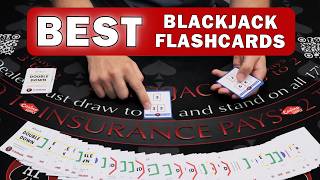
This video from A1 Blackjack demonstrates a set of flashcards designed to help blackjack players practice and memorize basic strategy and card counting deviations. The presenter walks through sample cards, explains how to read them, and highlights the importance of using flashcards for training. He also discusses the included deviation, non-deviation, and expanded cards, along with purchasing options.
The video introduces flashcards for practicing advantage blackjack, covering basic strategy, H17, and S17 variations.
Each card shows a player hand versus a dealer up card, with the correct decision in a green box and a phrase explaining the rule, e.g., 'Hard nine doubles against three through six otherwise hit.'
Nines split against dealer 2 through 9 except for 7, so this hand is a split. The phrase on the card is '9 splits 2 through nine except for seven otherwise stand.'
Fives are never split; they are treated as a hard 10. Since 10 doubles against 2-9 and hits against 10/Ace, this is a hit.
Soft 14 vs. dealer 4 is a hit; soft 19 vs. dealer 5 is a stand; soft 18 vs. dealer 2 is a double down (per Blackjack Apprenticeship's KISS model).
Threes split against dealer 2 through 7, so this is a split.
If surrender is available, surrender; otherwise, hit. The set includes surrender cards for games with that rule.
The set includes over 70 cards: basic strategy, surrender, and blank cards for custom situations. It covers common decisions but not all 300+ possibilities.
Cards are $15, with a link in the pinned comment. The presenter argues the cost is worth it compared to losing money at a table due to mistakes.
Deviation cards show the basic strategy decision, the deviation (e.g., double at true count +1), and a phrase like 'Normally hit, double at TC +1 or higher.'
Normally a hit, but stand at any positive running count. Surrender supersedes if available.
Soft 13 vs. dealer 5: double normally, hit at negative running count. Soft 19 vs. dealer 3: double at TC +5 or higher. 16 vs. dealer Ace: stand at TC +3 or higher.
Normally stand, but split at TC +6 or higher. This is optional due to heat, but useful for EV maximization on trips.
16 vs. dealer 9: stand at TC +4 or higher. 13 vs. dealer 2: hit at TC -1 or lower. Pair of fives vs. dealer Ace: double at TC +3 or higher (treat as hard 10).
Includes 10 non-deviations (e.g., 12 vs. dealer 6 in H17) and 9 expanded cards (e.g., pair of nines vs. dealer 7 splits at TC +3 or higher). These cover edge cases within TC +6.
An info card includes QR codes linking to videos on how to use the cards, and shows the front/back layout.
S17 and H17 sets are $19 each, but a bundle with basic strategy is $29, saving $5-6.
Flashcards are an effective tool for memorizing blackjack basic strategy and deviations, with a comprehensive set available for purchase. The video emphasizes the value of practice to avoid costly mistakes at the table.
What is the basic strategy for a hard 9 vs. dealer 2?
Hit (double only against 3-6).
00:29
When do you split a pair of nines?
Against dealer 2 through 9, except for 7.
01:23
How do you play a pair of fives vs. dealer 10?
Treat as a hard 10 and hit (never split).
01:49
What is the basic strategy for soft 18 vs. dealer 2?
Double down (per Blackjack Apprenticeship's KISS model).
02:17
When do you split a pair of threes?
Against dealer 2 through 7.
03:01
What is the deviation for 16 vs. dealer 10?
Stand at any positive running count (surrender if available).
07:10
What is the deviation for soft 13 vs. dealer 5?
Hit at any negative running count (normally double).
07:52
What is the deviation for soft 19 vs. dealer 3?
Double at true count +5 or higher.
08:08
What is the deviation for 16 vs. dealer Ace?
Stand at true count +3 or higher.
08:08
What is the deviation for pair of 10s vs. dealer 4?
Split at true count +6 or higher (optional due to heat).
08:23
What is the deviation for 16 vs. dealer 9?
Stand at true count +4 or higher.
09:06
What is the deviation for 13 vs. dealer 2?
Hit at true count -1 or lower.
09:06
What is the deviation for pair of fives vs. dealer Ace?
Double down at true count +3 or higher (treat as hard 10).
09:21
What is the deviation for soft 15 vs. dealer 4?
Hit at any negative running count (normally double).
09:51
What is the expanded deviation for pair of nines vs. dealer 7?
Split at true count +3 or higher.
11:09
Flashcard Design
Explains the clear layout of cards, making memorization easier.
00:29Soft 18 Controversy
Highlights a common point of debate in blackjack strategy.
02:17Cost-Benefit of Practice
Quantifies the value of flashcards versus potential table losses.
05:20Deviation Cards
Shows how to incorporate card counting into play with specific true count thresholds.
06:13Non-Deviations
Clarifies that not all close hands have deviations, preventing overthinking.
10:07[00:01] the importance of using flashc cards when it comes to practicing for advantage blackjack. Right, I have some basic strategy, some H17 and some S7 Let's start with the basic strategy flash cards and kind of before we get
[00:16] flash cards and kind of before we get into how to use them. Um, let's try to All right, and then I will kind of fan those, kind of get an idea of what we might be working with here. All right.
[00:29] this is these are your two cards versus the dealers up card. And so starting with a nine versus a dealers two. Um, I tried to pick a few cards, by the way, that have maybe some deviations or that maybe are a little bit tough and or
[00:43] gives us a little bit of variety. So a nine does have a deviation, but before we get to those, basic strategy says we should hit our nine versus a dealers, too. So on the back side, the way that you read this is you got the big
[00:55] kind of green box that says hit of course um which is the correct decision. But below that there's also some words or some explanations and this says hard nine doubles against three through six otherwise hit. So do we have a three
[01:11] through six? No, we had a two and therefore we're going to do what it says otherwise and that's to hit this hand. So that's kind of how you read and use these cards. How about this one? This is a pair of nines versus a dealer's nine.
[01:23] Nines splits against the dealers 2 through nine except for seven. And so since nine is in that region, we're going to split these. So yeah, that's exactly what it says. 9 splits 2 through nine except for seven otherwise stand.
[01:36] So kind of I have sort of memorized what these phrases are at the bottom. And that's kind of a great thing to do if you ever get these or if you make your own flash cards, you can uh do that same thing. All right. Pair of fives versus a
[01:49] dealers 10. Do we ever split fives? No. We treat them like a hard 10. And 10 is a double down against dealers two through nine. And then we can hit against 10 and ace. So this is actually going to be a hit. All right. And that's
[02:02] exactly what it says. 55 never splits. Um we treat them like a hard 10. And so Let's go a little faster with the rest of these. Pair of 10 versus dealers kind of the stop sign looking thing there for you. Um a soft 14 versus
[02:17] dealers four. This is going to hit. Okay. A soft 19 versus dealers 5 is going to stand. A soft 18 versus dealers 2. This probably the most controversial hand in all of blackjack. Um there is a
[02:32] things up once you get to that level. You'll know why it's controversial and other. But for right now, basic strategy, I kind of adhere to what Blackjack apprenticeship uses. That's the KISS or KISS keep it simple stupid
[02:49] model. Um and therefore this is going to be a double down. All right. Now there is a deviation which we can maybe talk about later. It's included in the um in the deviation flash cards but for right now that is a double. If you don't like
[03:01] that you can yell at me in the comments. It's fine. Um 3 three versus a dealer's three. Threes split against dealers two through seven. So threes in that range. So we're going to split these. And then these last two are both kind of the
[03:14] same, but they are slightly different depending on I tried to fit your needs here. So we have 16 versus dealers 10 on both. And if your region has surrender, this of course is going to be a surrender. If it doesn't, then you would
[03:29] surrender. If it doesn't, then you would just hit. Okay. And so um I have a few surrender cards in here. In fact, if I kind of fan through these, here's one. Here's one. And I think there should be maybe one more, but that's okay. Uh, but
[03:42] with this, if your game or if maybe you're going to travel somewhere that has surrender, you might want to put in the surrender cards and take out the hard total ones that are those same kind of situations. Uh, there should be about
[03:55] four surrender cards. Um, but if it doesn't, then maybe you want to take out the surrender cards and use the hard total ones as whatever your um game or traveling to, whatever you're trying to practice for is what you want to
[04:09] probably use for those cards. So, I do include some surrender ones as well as some blank cards. So, obviously I can't include all 300 plus decisions that are available to us in blackjack. There's tons of possibilities that you can get
[04:24] as well as like let's say uh if I pick a different one here. Let's go with this one. Uh this is an uh nine versus dealers 2. Well, this nine could be made dealers 2. Well, this nine could be made up of 72 or it could be you know 63 54.
[04:38] Um it could be lots of different things. Could switch order 27. And so that even even more. So if there's a particular one that's hard for you, you can write out your own, right? or if there's one maybe I didn't include, I try to include
[04:52] all the hard ones kind of along the borders of maybe one decision versus another on our basic strategy chart. Uh, but if there's some on there that you some blanks. So, I have lots of blanks. Um, altogether with the um surrender
[05:06] cards, the blanks, and just the basic strategy cards by themselves. There's strategy cards by themselves. There's over 70 different uh situations, 70 70 different cards I should say, that's available to you. And uh you can
[05:20] purchase these down below in the um pinned comment. I have a little link for you. And currently they're only 15 bucks. So kind of a good deal. In fact, uh a lot of times we play tables that are, you know, $25 minimums or even if
[05:34] it's $10 minimum or 10 or $15. Let's say two hands. If you didn't know what you were supposed to do versus getting these and practicing and now knowing so you don't look maybe stupid at the black check table. Well, that's two hands. So,
[05:47] that's 20 bucks. All of a sudden, you have paid for your cards with that. I think it's worth it. You may or may not. Maybe you want to make your own flash cards. That's totally fine. That's how I started out. But, uh, there was such a
[06:00] decided to make them for you. Uh, let's talk about some of the deviations. Now, talk about some of the deviations. Now, I have both S17 and H17 flash cards. Uh, we'll just go over one of them. They're pretty similar to each other. And so,
[06:13] I'll talk about these again. Let's do maybe 10 of them. and we'll kind of pump dealers 2. So, if you remember that first one we did with the basic strategy, that was also a nine versus dealers 2 because this a hard decision,
[06:27] right? A nine versus dealers 2 has a deviation to instead of normally hitting like basic strategy says, it now deviates at a true count of plus one or higher. So, if the count rises enough, you can deviate by doubling down. And
[06:41] so, the way you read these cards is we have the basic strategy decision at the top. nine versus two is normally a hit. And then the big decision in the middle says, "However, we're going to double down at a true count of plus one or
[06:54] down at the bottom, normally a hit double at a TC or true count of plus one or higher. All right, let's try again to pump through about 10 of these. Um, a 16 versus dealer is 10. Just like before, whether it was a surrender or a hit.
[07:10] Well, if uh the count goes high enough, a um we should normally surrender if we're going to instead of hitting, we're going to stand at any positive running count. So, that's what this should say here. 16 verse 10 is normally a hit.
[07:25] Stand at to to uh indicate a running count, a positive running count, I use an arrow. So, I say kind of above zero is what that's saying. So if I read this phrase, normally I hit stand at any positive running count and then in
[07:38] parenthesis says surrender 16 verse10 if available. So that's one where surrender kind of supersedes um whether it's the base strategy or the deviation. All right. Um how about a soft 13 versus a dealer's five. This one
[07:52] is normally a double, but we're going to deviate by hitting at any negative running count. So, that's kind of a that's a little bit of a rare rarer one. Um, a soft 19 versus a dealer's three. This one's going to double at a true
[08:08] count of plus five or higher. So, double at true count of plus five or higher. A 16 versus a dealer's ace. This one is going to stand at a true count of plus three or higher. Okay, so we're pumping through these. A pair of 10 versus a
[08:23] dealers four. This one's normally a stand. And this one, some APS differ on whether they use it or not because it tends to draw a lot of heat. But, um, you can split these at a true count of plus six or higher. So, I would probably
[08:37] use this one if I was maybe not at my local casino and I wanted to get as much EV out of a a trip as possible and maybe I knew I was leaving that day or lot of money because you usually have your max bets out at that point. So,
[08:52] let's see. We've done six of these. Let's do four more. A 16 versus a dealers's nine. This one is normally a hit, but we're going to stand at a true count of plus four or higher.
[09:06] A 13 versus a dealers two. This one is one that happens at a negative uh count. So, normally you would stand, but we're going to hit at a true count of negative one or lower. Normally stand hit at a negative one or lower. Pair of fives
[09:21] versus deals ace. 12. First off, you never split fives. And so, we have to treat them like a hard 10. 10 versus a dealer's ace is going to normally hit is what basic strategy says, but we're going to deviate by doubling down at a
[09:36] true count of plus three or higher. All right. And then I'll do maybe one more here. A soft 15 versus dealers four. This one's normally a double down, but we're going to deviate by hitting at any negative running count. So, that's one
[09:51] of my favorites. I like that one a lot. Um, along with our um kind of our deviations here, kind of your we got our hits, stands, double downs, and splits. All right, so it's kind of the same as before. Um, I also have included some
[10:07] before. Um, I also have included some nondeviations. 1 2 3 4 5 6 7 8 9 10 of those, which are ones that are really close that might look like they have a deviation, but they don't. For example, if I pick one out here, um, a 12 versus
[10:22] a dealer's six in an H17 game. This one actually doesn't have a deviation. Okay. actually doesn't have a deviation. Okay. Or maybe a soft um 15 versus a dealers Or maybe a soft um 15 versus a dealers 3. Um, now I included these. They sure
[10:39] you can find like it might happen at like a plus seven or something where you would double down, but anything above six, a true count of plus six, I did not include. If that's not good enough for you, I apologize, but I it really just
[10:54] such minimal EV that you gain by doing those really really high true counts. I kind of the Ghostbusters symbol. All right. Along with that, I also have nine right. Along with that, I also have nine expanded ones. 1 2 3 4 5 6 7 8 nine.
[11:09] Okay, so for example, let's just take this top one here. A pair of nines versus a dealer's seven. Well, if you know what basic strategy is, nines split against dealers two through nine except seven. But you might think, well, is
[11:23] kind of one random card that we don't use. And there actually is. So, uh, for no deviation, but there's kind of this little bubble at the bottom, and it says that we it is okay to split at a true plus three or higher. So, if that is if
[11:39] incorporate, I tried to include ones that are within again kind of plus six that are within again kind of plus six or um or le or less kind of from zero. And so, all of these happen at a true count of plus six or lower. So, they're
[11:55] they're a little bit um less rare than some of those ones. I also have a couple of blank ones. In fact, I had to fill out a blank one because I did not have was eight. You can tell that's my handwriting. All right. So, I said
[12:08] that's normally a hits, but we're going to stand at plus five or higher. But couple blank ones on here if you want to, you know, include some other ones that I had, so you want to add one of those expanded ones. There's also
[12:22] kind of an info card that has some QR codes that link to different videos on how you can maybe use these and things and it shows you on the back side how um I use these kind of what uh the front says versus what the back says. All
[12:35] right. And then of course there's other um deviations as well compared to the ones that we did for those first 10. So um down below in um the comment section in the pinned comment I have included a link to purchase these if you are
[12:49] interested. If not, no worries. You can make your own. Okay. But right now I am running a deal that if you want to purchase either the S17 which are very purchase either the S17 which are very similar and the basic strategy or the
[13:03] H17 cards and the basic strategy. So normally these are 15 and each one of these are 19 kind of by themselves. But together if you get these two together together if you get these two together or these two sets together I am giving
[13:17] you um kind of a discount where these are only going to be $29. So, you save uh five or six bucks there. So, kind of a good deal. Anyway, guys, until next a good deal. Anyway, guys, until next time, this is A1 Blackjack.
[13:29] time, this is A1 Blackjack. [Music]
⚡ Saved you 0h 13m reading this? Transcribe any YouTube video for free — no signup needed.