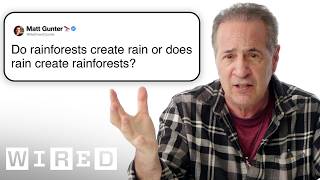

The Truth About Mother Trees
45sThe concept of 'mother trees' has been popularized by media, and this expert debunks or clarifies the science behind it, sparking curiosity and debate.
▶ Play Clip"Delivers solid, expert answers to tree questions, though some segments feel rushed and the title oversells the 'tech support' angle."
Forest ecologist Dr. Suzanne Simard answers a range of questions about trees and forests, from how forests regenerate after fires to the reality of the 'mother tree' concept. She explains the interconnectedness of trees through mycorrhizal networks, the importance of old-growth forests, and the impacts of human activities like logging and fire suppression.
Dr. Simard addresses the popular 'mother tree' concept, clarifying that while trees are connected via mycorrhizal networks and can communicate chemically, the idea of a single 'mother tree' is an oversimplification.
Forests regenerate naturally after fires through mechanisms like serotinous cones (e.g., Lodgepole pine) that release seeds in response to heat, and trees that sprout from roots or nutrient-rich soil.
Ancient forests looked different from today's; trees had not yet developed certain features, and the composition of species was different.
Trees are connected through mycorrhizal networks, allowing chemical communication. Research by Dr. Simard showed that trees can share resources and warn each other of threats like infestations.
In fire-prone areas like Southern California, Santa Ana winds propagate fires. Preparation includes using fire-resistant roofing, clearing defensible space, and managing vegetation.
Some trees, like the sandbox tree, have explosive seed dispersal and toxic spines, which can cause damage to people and animals.
Cleaning up the forest floor is not simple; removing fallen trees and leaves can actually increase fire risk. Forest management must consider ecological impacts.
There are about 760 million acres of forest in the US, mostly under private ownership. Management practices like logging slash can increase fire risk if not handled properly.
Tree rings reveal growth patterns; wider rings indicate better growing conditions. The living part of the tree is the outermost section, which transports water and nutrients.
Nine out of 10 wildfires are caused by humans, often accidentally, especially in areas with high road densities. Smokey Bear's message was originally about prevention but was later exaggerated.
Planting 20 million trees is beneficial but not as impactful as protecting existing forests, especially old-growth forests, which store significant carbon and provide critical habitat.
Boreal forests are cold, conifer-dominated forests near the Arctic Circle, supporting up to a billion migratory birds. Temperate forests, like those in the US, have diverse species like oaks and conifers.
Temperate rainforests, like the Olympic Peninsula, have enormous trees that support salmon habitats. Eagles and other animals contribute nutrients back to the forest.
Tropical rainforests are hot and wet, with high biodiversity. Fragments of these forests can have trees only 30 feet tall due to conditions.
Forests can be considered interconnected superorganisms, like aspen clones that share a single root system, spanning large areas.
Northeastern US forests were almost completely deforested but have regrown over a century. Many are now maturing, but they lack the complexity of old-growth forests.
While there may be more trees now than in recent history, only about 28% are primary forests. Planting trees cannot replace old-growth forests, which take centuries to develop.
Rainforests contribute to the water cycle through evapotranspiration. Cutting them down can lead to droughts and potentially turn the Amazon into savanna.
The Amazon is being cut down and burned, triggering droughts due to reduced water recycling. This could lead to a savanna-like state within decades.
Some trees are over 300 feet tall and can be hundreds of millions of years old. Trees absorb CO2 through photosynthesis and store carbon in their trunks and roots.
Pine forests smell like air freshener due to terpenes, chemicals that can attract insects and signal stress. Terpenes also have ecological roles.
Clear-cut logging is a major unnatural disturbance that harms wildlife habitat and releases stored carbon. Roads from logging can also cause erosion and other problems.
Trees experience natural mortality from insects and diseases. The American chestnut is functionally extinct due to a specific fungus, but some may survive and become part of old-growth forests.
Forests have distinct layers: the emergent layer (penthouse), canopy, understory, and forest floor. Gaps created by dying trees allow new growth.
Trees stop growing at a certain height due to water transport limitations. Coast redwoods rely on fog for water, allowing them to grow tall.
Tree farms are monocultures planted in rows for timber, lacking the structure and biodiversity of natural forests. Natural forests have varied ages and species, providing more ecological benefits.
Prescribed fires are low-intensity burns used to reduce fuel and maintain ecosystems that depend on fire, such as certain pine forests.
Trees compete for light and resources, with winners and losers. Some plants release allelopathic chemicals to inhibit competitors.
Trees and forests are complex, interconnected systems that provide essential ecological services. Understanding their biology and the impacts of human activities is crucial for effective conservation and management.
What are serotinous cones and how do they help forests regenerate after fire?
Serotinous cones, like those of Lodgepole pine, release seeds in response to heat from fire, allowing the forest to regenerate.
00:56
How do trees communicate through mycorrhizal networks?
Trees are connected via mycorrhizal networks, allowing chemical communication, such as warning of infestations and sharing resources.
02:11
What is the 'mother tree' concept and how does it relate to reality?
The 'mother tree' concept is an oversimplification; while trees are interconnected, there is no single 'mother tree' controlling the network.
What percentage of wildfires are caused by humans?
Nine out of 10 wildfires are caused by humans.
06:57
Why do trees stop growing at a certain height?
Trees stop growing due to water transport limitations; coast redwoods use fog to overcome this and grow tall.
18:52
What is the difference between a tree farm and a natural forest?
Tree farms are monocultures planted in rows for timber, lacking structure and biodiversity, while natural forests have varied ages and species.
19:46
How do prescribed fires benefit ecosystems?
Prescribed fires are low-intensity burns that reduce fuel and maintain ecosystems that depend on fire, such as certain pine forests.
20:38
What is allelopathy in plants?
Allelopathy is when plants release chemicals that inhibit the growth of competing plants, allowing the producer to prosper.
21:26
What is the current status of the American chestnut?
The American chestnut is functionally extinct in the wild due to a specific fungus, but some may survive and become part of old-growth forests.
17:35
How do rainforests contribute to the water cycle?
Rainforests take in rain and release water through evapotranspiration, contributing to the water cycle and creating rain.
13:12
Mother Tree Myth Debunked
Clarifies a popular misconception about tree communication, emphasizing the complexity of mycorrhizal networks.
Tree Communication via Mycorrhizal Networks
Explains the scientific basis for tree communication, a key concept in forest ecology.
02:11Planting Trees vs. Protecting Old-Growth
Highlights the importance of preserving existing forests over planting new ones for climate impact.
07:59Rainforests Create Rain
Demonstrates the critical role of rainforests in the water cycle and the consequences of deforestation.
13:12Tree Farm vs. Forest
Distinguishes between monoculture plantations and natural forests, emphasizing ecological value.
19:46[00:00] Let's answer your questions from the internet. [upbeat music] "I wish there actually was a mother tree
[00:15] I watched that movie too that connected everything in ecosystems And I had a similar experience
[00:29] The fungi were all lit up in bioluminescent colors. to walk through that rainforest that night And those trees are very unique
[00:43] When they are cut down, they don't come back because they have very specific pollinator relationships. "How do forests regenerate after fires naturally?
[00:56] One of the fascinating things about forest is it's not an ecological catastrophe. like the serotinous cones of Lodgepole pine
[01:13] There are trees that will sprout after a fire, of this nutrient-rich environment
[01:25] so that their progeny will develop into the next forest. and are both needed for the healthy systems to function.
[01:39] LeoPsy asks, "What did ancient forests look like?" trees were a lot different. had not really developed at that time.
[01:54] It has all kinds of needles on it. and was puzzled by how it was gonna climb that tree "How do trees access the internet on a camping trip?
[02:11] Well, there is some reality to that, Trees are connected through their mycorrhizal networks. to the roots of plants
[02:26] There has been some really interesting work done where she actually described connections that allowed them to communicate chemically to one another.
[02:42] between mother and progeny, the more connected the underground network was So trees have a lot of different ways to communicate.
[02:54] When there is an infestation coming, that are landing on the surface of the tree trunk. that they're under attack
[03:09] @richardbis asks, Seems like we have a lot there?" If you're living in Southern California,
[03:23] the Santa Ana winds. That will propagate fires through chaparrals, shrubby, you're going to get fires in forests
[03:38] to these ecosystems. and to allow their seeds to develop into larger trees There are unfortunate consequences
[03:53] and there are ways that we can prepare for that. that your roof is a composite or metal Make sure that your open vents for ventilation
[04:08] Make sure that you're clearing a defensible space so that your flames will not carry from the wild areas
[04:21] @zentreya asks, "My tree exploded. There is a tree that sort of explodes. and its leaves and its spine are toxic to humans.
[04:36] those seeds can be projected at high velocities and cause a lot of damage to people and animals. "What the [beep] do you know about forest management?
[04:49] and fallen trees from the forest floor. Well, no, it's not simple in cleaning up the forest floor.
[05:02] or the forest floor that get the leaves off the ground. that actually will make fire more prevalent There's about 760 million acres of forest
[05:17] most of which are under private ownership. of the national forest system. Most of them are open for a whole variety of uses,
[05:31] a lot of that logging slash, Some of it's treated, for these fast-moving fires.
[05:45] which is directing the federal agencies is actually gonna make them more prone to forest fires that are the most fire resistant parts of the forest
[06:00] and leaving a lot of flammable logging slash behind. "What do tree rings really prove?" of the tree's growth patterns.
[06:12] when I count up all the rings. it means that the conditions for growth during that year The wider the rings means that the tree was doing better,
[06:27] and the living part is the outermost section which is the tree circulatory system to different parts of the tree and water.
[06:42] So the bigger the tree, The more insulated it is from most forest fires. that have been laid down across the rings
[06:57] what year the fire was occurring in So Pundit Review ask, Nine out of 10 wildfires are caused by humans.
[07:11] When you add up all the fires across the nation, and it's associated with high road densities, that can cause a fire accidentally.
[07:27] Smokey Bear would appear in posters and logos and his motto was, "Only you can prevent forest fires." but then it got blown out of proportion
[07:42] to put out every fire start by 10 AM the next day, which is destructive and catastrophic to ecosystems and rejuvenation and aging processes.
[07:59] will MrBeast's 20 million trees project make?" but it is not going to make as big of a dent
[08:12] in the climate crisis as protecting our existing forest, So an old-growth forest is a biological cathedral. are really important habitat
[08:28] the accumulation of atmospheric carbon There's no replacing those trees to start accumulating that carbon.
[08:43] "I have to do a presentation in biology about the [beep] boreal forest. They are cool forests found in places that are very cold.
[08:59] just below the Arctic Circle is where these forests occur. growing in some extreme conditions
[09:11] You'll get conifer trees like pines They are the places where most of our migratory birds The boreal will support up to a billion birds
[09:27] that exist around the planet. In the United States, most of our forests are temperate. or the Pacific Crest Trail
[09:42] you're in a temperate zone. of really interesting tree species. They're a mixture of oaks, conifers, and aspens.
[09:55] And there's a subportion of the world's temperate forests An example would be the Olympic Peninsula in Washington The trees are enormous.
[10:11] They are as wide as this table. and giving so much habitat to the salmon They'll come up the streams and spawn
[10:26] The eagles will poop out their remains and that will be fertilizer for the rainforest trees. now we're talking tropical rainforests,
[10:40] in a very wet and hot environment. where there are only small fragments of rainforests They only grow to maybe 30 feet tall
[10:58] because they're blanketed by rainy conditions. and the type of tree species there. that is a single living organism?"
[11:15] Arguably, forests are interconnected superorganisms. it could have originated from a single aspen tree that would send out its below-ground runners, its suckers
[11:29] and be an entire group of trees from the single organism. to the Northeastern United States
[11:41] The Northeastern forests were almost completely deforested and that led to almost the entire elimination However, there's been a century or so
[11:58] that are now maturing So most of the forests that you get in the Adirondacks had been logged over a century ago,
[12:12] And that's the beauty of forests. if we don't log them the second time through, that make them uniquely old.
[12:26] that there are more trees on the planet right now Well, yeah, it is [beep]. The scale of that deforestation has increased.
[12:42] of what the forests were on the planet before all of this widespread deforestation had taken place. only about 28% are considered primary forests.
[12:56] So that's why you can't just say we're planting trees than ever in history. You can't plant an old-growth forest.
[13:12] It takes centuries for those forests to develop. "Do rainforests create rain It's actually both.
[13:24] Trees are remarkable because they take in rain and use it and then they go through evapotranspiration and becomes the water cycle again.
[13:38] And so when rainforests are cut down, But when that rainforest is removed, @seahaze55 asked,
[13:51] So this is a pretty general map of the Amazon rainforest. You can see in green color areas that are still intact. And then you see these other areas in orange
[14:06] Rainforests are being cut down, burned, and that then triggers these droughts because we don't have the return of water
[14:21] So if that keeps happening, into a drought-stricken savanna That could happen within the next couple of decades
[14:35] depending on the speed at which climate change progresses "Without cheating, Approximately 180 million years old."
[14:49] which has trees that are hundreds of millions of years old. They can be over 300 feet tall.
[15:01] which is an endangered animal in the upper canopies of these rainforests. "Trees suck in CO2, right?
[15:16] Through the miracle of photosynthesis, When it's absorbed by the tree, it makes its food. we store it.
[15:31] like a Sitka spruce in Alaska's rainforest, That carbon has been stored in its trunk and in its roots
[15:43] during the current climate crisis. why do pine forests smell of air freshener?"
[15:55] So trees will produce a terpene It's a chemical that you smell in the forest The really interesting thing about this is
[16:08] that can detect those terpenes accelerated towards the tree's death, it's creating habitat for all this wildlife.
[16:24] it is being recycled into the nutrients in the soil. on anthropogenic natural disturbances which is a fancy way of saying things that [beep] up trees."
[16:40] are clear-cut logging. that causes a major unnatural disturbance which causes all kinds of problems for wildlife habitat,
[16:56] because the trees are no longer storing it. because you need to have a road system and those roads are funneling
[17:10] And when there's a lot of trees dying in the forest will trigger an outbreak of insects,
[17:22] and turn the forest a kind of red coloration Trees also will experience natural mortality agents.
[17:35] The American chestnut is functionally extinct in the wild. that is very specific to American chestnut trees and become part of the old-growth forest.
[17:51] "Do you know the layers of a forest?" of a tropical rainforest. and you start at the top level, the penthouse,
[18:06] then you move down a couple of floors and that is where most of the trees are. They're the trees that have been suppressed
[18:20] Sometimes there's a tree that dies creating a gap as plants try to fill that gap in, And then we've got even more complexity
[18:36] You kind of think of that as the basement of the forest. and mycorrhizal fungi in some of these forests that we see in these older forests.
[18:52] why do trees stop growing at the same height? Trees will stop growing at a certain height. Really good example in California is the coast redwoods.
[19:06] and they stop growing up to the top of the tree canopy. by living in the fog belt.
[19:20] so that they don't have to figure out because they've already got water there from fog. all the way up to their stem
[19:34] It's like a series of tubes that allows them and out to their twigs and their branches.
[19:46] It's like the tree circulatory system. "What the difference between a tree farm and a forest?" where all the trees are planted in rows like a crop,
[20:01] that are grown mostly for timber yield. It's trees interacting with other vegetation,
[20:14] The trees are different ages. When you go into a Franken forest, There's hardly any structure.
[20:26] So you lose all of those special benefits that we get from the natural forest. "How do controlled burns work?"
[20:38] We like to call them prescribed fires. is they might light a fire under certain conditions in a low-intensity burn
[20:53] that need frequent fire in a low-intensity way. "Do trees compete with each other in nature?" When trees come back after like a natural disturbance,
[21:10] will give you a lot of tightly spaced trees and light levels in a forest because there are winners and losers
[21:26] eliminating those that are less fit Some plants will release a chemical called an allelopath so that plant will prosper
[21:42] So those are all the questions for today. [upbeat music]
⚡ Saved you 0h 21m reading this? Transcribe any YouTube video for free — no signup needed.