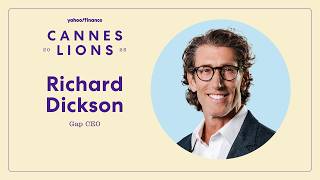

Gap CEO Admits Brand Lost Its Story
55sViewers get a rare, candid look at Gap's brand turnaround from a major retail CEO, making it highly shareable among business and fashion audiences.
▶ Play Clip"Delivers exactly what the title promises: a focused discussion of Gap's brand narrative."
In this interview from Cannes, Gap CEO Richard Dickson discusses how the brand is returning to its storytelling roots by focusing on individuality, originality, and music. He explains the company's creative collaborations, consumer trends across income groups, and its approach to pricing amid tariff pressures.
Gap shifted from being a great storyteller to just selling products. The company is going back to its origins of celebrating individuality, originality, and inclusiveness, with music and artistry as key calling cards.
Campaigns like Cats Eye with Troye Sivan, Jungle, and Young Miko blend content, commerce, and elevated product, creating a cultural flywheel that drives performance.
Beyond storytelling, Gap manages a complex supply chain, thousands of stores, and must deliver the right product, fit, value, and timing across the world.
The team actively scouts emerging talent and courts conversations, but authenticity is what resonates most with customers. Not every collaboration is perfect, and some creative chaos is accepted.
Contrary to being everywhere, Gap carefully curates its media so the brand appears in places that make sense to the customers it's courting, e.g., not on F1 cars.
Gap finds inspiration in its origin story of bridging the generation gap through music. The brand plans to expand into beauty and accessories, and relaunch Gap Body to build a 'Gap world.'
Gap has seen steady and consistent consumer behavior, with growth across low, middle, and high-income groups, despite market uncertainty.
The company has taken selective price increases where quality and value remain intact, and is also using cost savings and manufacturer partnerships to manage tariff pressures.
Gap's CEO emphasizes that the brand's revival hinges on blending storytelling, authentic partnerships, and operational precision, allowing it to stay steady in volatile times while expanding into new categories.
What three values did the original Gap brand celebrate?
Individuality, originality, and inclusiveness.
00:28
What was the primary 'calling card' of Gap's brand story?
Music and artistry.
00:28
What is the 'flywheel' that Gap is driving according to the CEO?
The mixture of content, commerce, and product.
01:11
Why does Gap avoid putting its brand on F1 cars?
The CEO wants brand placement with precision that makes sense to the customer being courted, rather than being everywhere.
03:39
How has consumer behavior been across income cohorts?
Steady and consistent, with growth across low, middle, and high-income groups.
06:00
What two methods does Gap use to mitigate tariff pressures?
Precision price increases where quality/value stays intact, plus cost savings and partnerships with manufacturers.
07:17
Storytelling over selling
Establishes the core strategic pivot that defines Gap's current brand direction.
00:28Authenticity as the key to collaborations
Highlights why the CEO values genuine creative dialogue over broad marketing deals.
02:32Origin story drives future growth
Shows how a legacy brand uses its history to justify new expansions like Gap Body.
04:16Consumer resilience across income levels
Provides a reassuring data point about Gap's performance in an uncertain economy.
06:00Precision pricing strategy under tariffs
Offers a concrete example of how a large retailer manages cost pressure without losing customers.
07:17[00:03] validation that our work is working and most cultural conversation and a lot of that happens here in Cannes. conversation before you came to this company. All right, let's just be
[00:16] And we would everybody you would hop on this earnings call for Gap and people would be like the analysts would ask, are you going to be on TV for the holiday season for Gap? That was the big question. But you've said, look, there's
[00:28] other stories we could be telling. Like what is the story of Gap you're trying >> Well, first of all, Gap is one of our brands, but it is the flagship brand of the company. And and to your point, I think, you know, with the history that
[00:43] we have, which is incredible history, we went from being kind of a a great storyteller to selling stuff. And we had to get back to storytelling and go back to the origin story of what made Gap brand so great to begin with. It was all
[00:58] about celebrating individuality, originality, and inclusiveness. And it had a primary sort of calling card with music and artistry. And so we brought that back. And in the context of that conversation,
[01:11] Cats Eye, which is of course, you know, one of the great works that we've done recently. Troye Sivan, Jungle 74, Miko, Young Miko was an incredible campaign. But it's the mixture of content and commerce and product. The
[01:26] product has elevated, the storytelling has elevated, and we're driving a And that ultimately is what's working. And that's the flywheel that we've got of culture, not easy.
[01:40] over the world. And oh yeah, you have a supply chain. And thousands of doors and getting the right product with the right fit at the right value proposition at the right time. So, it's a complex business, but
[01:53] we're driving, you know, better performance. And we just got to keep it >> I I told you this. Um it was off camera at some point when I heard a lot of people you signed these deals with. And I've dated myself and
[02:07] I've aged myself out. But all these deals have seemed to pay off well and are you finding some of these creative folks to work with? Like is there some secret data lab you have inside of Gap saying, I need to work with this brand
[02:20] this creator because they're about to break out in a big way? Because look, just need to get cooler. Yeah. >> You're pretty cool, Brian, but you know, a little notch it up. >> Look, I think first of all, our team is
[02:32] on it. And I and I think, you know, to the extent that we're out in the world we're meeting people, we're we're developing partnerships, we're on the, you know, recognized emerging talent list and with the work that we're doing,
[02:46] we're actually courting conversations. But authenticity is a really important part of that dialogue. I mean, there's a lot of collaborations out there. I think that that's a marketing methodology that everybody's doing. But it's authenticity
[02:59] that actually resonates most. And I think what I'm most proud of is our team's ability to really dialogue with creative and creative communities that create that authenticity that customers today recognize and value. Not
[03:13] everything goes perfectly, but that is part of the creative conversation and sometimes it's a little creative chaos. But I think our consumer really >> So you're not going to we're not going to find the the Gap and Old Navy name
[03:25] plastered on the F1 cars. Because look, I mean there's no more space on these F1 stuff? >> That's that's probably not our space, example, you know, is is the brand filter F1 or is it something else? And I
[03:39] think, you know, you can get really as a brand owner, if you will, you you you want to see your brand everywhere. But really what you want to see your brand is everywhere with precision that makes
[03:51] sense to the customer that you're trying to court. And so, that is a careful curated marketing and media, I'd say, adventure, which obviously, you know, with. >> You quickly turned into a Gap historian
[04:03] when you took over this job. How far do you want to take Gap back to that initial store? I I get you're not going to sell music because you go on Spotify and use that. But, is that store still an inspiration for you? And if it is,
[04:16] year? >> Yeah. Well, I I can tell you we we we find our inspiration with the origin stories of every one of our brands. You know, these were brands that uh broke through not because people
[04:28] needed it, but because we created the want. And in the context of Gap's story, again, when you think about the origin story of bridging the generation gap, we brought generations together, and music was a key component of that. And so, I
[04:42] think as we venture into the space of relevance for today and drive revenue associated with that, it is music, it is storytelling, and it's great product. and certainly the ones that we've
[04:54] remodeled, you feel that energy, you feel that vibe. Uh you see great product and great storytelling with great music and great service. That is a model that, by the way, is not easy to replicate into the context of real scale, but it
[05:07] is the quest that we have to be high-performing. And as Gap evolves, and we drive categories like beauty and accessories, and we relaunch favorites like Gap Body, you know, Gap will continue to propel itself and create Gap
[05:21] world. And that is essentially what we're so excited about is that now that we have momentum and connectivity, really the sky's the limit in terms of >> I've uh I've talked to a couple consumer CEOs
[05:34] here. Uh e.l.f. Beauty CEO Tarang Amin, he he told me lower-income uh shopper has responded positively. Checked on, that's cool. Marriott CEO Anthony Capuano I me that July 4th
[05:47] out it looks good too as well. Have you seen any improvement in the in how your consumer is shopping the store this summer? >> Yeah, we we've seen I'd say steady and consistent behavior from our, you know,
[06:00] consumer base. I mean we we've reported in our earnings we've been growing across all income cohorts, low, middle, and high. We've seen a steadiness uh in the context of uh consumer reaction to our business. I would say, you know,
[06:13] world today, you know, and and to some extent all the uncertainty that we all deal with, the consumer's reaction is pretty steady. And ultimately, you know, it's our job to create that demand and want and need in the in the sea of
[06:27] competitive, if you will, landscape. But um but the consumer's out there. And when you offer great product at great price with great branding, they respond. that. >> Lastly, I walk, you know, I go into
[06:40] Banana Republic. And I've told you this before, I went in there recently and prices. It felt a little more expensive, okay? Especially on the bathing suit side. What type of cost pressures is your company still dealing with at this
[06:53] point in the tariff drama? >> So, I think we're all dealing with the tariff uh situation, but I think in in terms of our case, our team has >> And also, I'm not knocking you, but stuff is higher quality. So, I just
[07:05] bathing suit today. >> the shirt. I I actually have it in my bag. >> I'm glad it's working for you. Look, we we have with precision taken price increases where we believe the quality
[07:17] and the value proposition remains intact uh given the breadth of our portfolio and the size of these brands, um it is a very careful orchestration and arguably with precision pricing, we've been able to mitigate. Um it's not the only form
[07:31] scenes there's a lot of cost savings, there's partnerships with our manufacturers that we work uh in tandem with. But ultimately, again, as we present our portfolio, it's a really important aspect to present the
[07:44] equation. Occasionally, it's too high. Occasionally, we're selling things at and the science combined in the in doing what we do. the best dressed men uh here at Cadillac. Good to see you, Richard. I
[07:57] Cadillac. Good to see you, Richard. I appreciate it.
⚡ Saved you 0h 07m reading this? Transcribe any YouTube video for free — no signup needed.