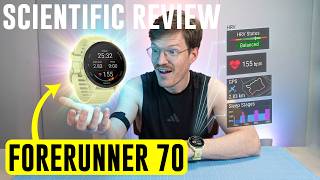

Garmin's Watch Lineup Explained
45sConfusing product lineup sparks curiosity and debate among watch enthusiasts.
▶ Play Clip"Delivers exactly what the title promises — a detailed scientific review of the Garmin Forerunner 70, backed by substantial data."
This scientific review of the Garmin Forerunner 70 provides a data-driven analysis of its performance, comparing it against other Garmin models. The video covers heart rate tracking during various exercises, sleep tracking, and GPS accuracy, culminating in overall scores and recommendations.
Product is the cheapest in the Forerunner 70 series, offering training readiness, status, HRV, suggested workouts, and more.
Upgrading to the 170 adds barometric altimeter, compass, Garmin Pay, and cycling features. The 170 Music adds storage and Wi-Fi.
The 265 adds multi-band GPS and full triathlon support, making it the first true triathlon watch in the lineup.
The 570 shifts to premium hardware: newer sensors, AMOLED display, microphone, and smartwatch features.
The flagship 970 adds offline maps, sapphire glass, titanium bezel, flashlight, ECG, and advanced metrics (needs HRM strap).
Indoor cycling heart rate correlation was 0.98, which is considered very good but not the best.
Running heart rate correlation was 0.99, placing it above 73% of tested devices.
Outdoor cycling had a lower correlation of 0.84, with misses in peak detection; a chest strap is recommended.
Weightlifting HR correlation was 0.78, with missed peaks; not recommended without a chest strap.
Hiking had a correlation of 0.81, poorer than running, possibly due to using trekking poles.
Sleep stage agreement: 89% for deep sleep, 65% for light sleep, 50% for REM sleep. Potential algorithm improvement.
GPS tracking showed excellent consistency across repeated runs and rides, scoring 90/100.
Contains repeated mentions of task details and filler like 'Of course, including', which are deviations from the main content.
What was the heart rate correlation for indoor cycling with the Forerunner 70?
0.98
07:25
What was the heart rate correlation for running with the Forerunner 70?
0.99
10:30
What was the heart rate correlation for outdoor cycling with the Forerunner 70?
0.84
11:41
What was the heart rate correlation for weightlifting with the Forerunner 70?
0.78
14:16
What was the heart rate correlation for a hike with the Forerunner 70?
0.81
14:56
What overall heart rate rating and score did the Forerunner 70 receive?
Good, with scores of 93 (heart rate during exercise) and 68 (sleep stage tracking)
31:31
What were the agreement percentages for deep, light, and REM sleep stages?
89% for deep sleep, 65% for light sleep, and 50% for REM sleep.
20:56
What was the GPS tracking score for the Forerunner 70?
90
31:15
Forerunner 70 offers most running metrics for less
Shows that the entry-level model covers nearly all essential running analytics, making it a high-value choice.
06:13Excellent running heart rate accuracy
A 0.99 correlation is exceptional for a wrist-based optical heart rate sensor.
10:30GPS testing method: repeated routes
Demonstrates a reliable method to assess GPS consistency by running/riding the same route multiple times.
27:08Price correlates with features, not performance
Highlights that as you spend more, you gain sensors and smartwatch features, but not necessarily improved running accuracy.
06:28[00:03] would personally get and a device I can recommend to many people and I have the data to back it up. Now, to understand why we have to take a look at its performance, but also compare its features against other Garmin models.
[00:18] Now, what you probably know is that Garmin is the king of releasing relatively similar watches at different price points >> or at the very least having a ton of devices with similar names, mostly
[00:31] similar designs that confused most newcomers. And in that vein, the Forerunner 70 right here is the cheapest in the 70 series of Garmin Forerunner devices. And even if we just look at some of the latest released Garmin
[00:46] Forerunner devices, there's already four devices out there. So, there's the 70, devices out there. So, there's the 70, the 170, the 570, and the 970. And of course, there's still the 265, which will likely soon be replaced with the
[01:00] 270. And the difference between each of these devices is often both hardware and But when upgrading to the next most expensive device, that's usually quite a bit of extra money, like $100 to $300. So, not insignificant. And the
[01:16] differences can be big, but sometimes also quite small, honestly. Now, for channel, my name is Rob and I'm a post-doctoral scientist specializing in biological data analysis. And that will be the focus of this video, data and
[01:32] data science. And I have a lot of data. But first, let me quickly walk you through the upgrade ladder from the Forerunner 70 all the way up to the flagship 970. Now, the Forerunner 70 is actually where
[01:48] things got most interesting for me. Garmin has pushed a huge amount of their training ecosystem down into this watch. You already get training readiness, training status, heart rate variability status, daily suggested workouts, Garmin
[02:02] running dynamics, advanced sleep tracking, pulse ox, and over 80 sports modes. So, this is all I would need. In other words, for pure running, this watch does almost everything that I would need and that many of you would
[02:17] need. And in some ways, it does far more than entry-level Garmin watches used to Now, when you move to the Forerunner 170, you're not really getting more in terms of running analytics. Instead, you're getting more sensors. So, Garmin
[02:32] adds a barometric altimeter, barometer, compass, gyroscope, thermometer, and Garmin Pay. That means real-time elevation data, ascent and descent tracking, storm alerts, better navigation, support for cycling power
[02:47] meters, smart trainers, so also the Garmin cycling coach, and open water swimming. So, this upgrade is more for trail runners, cyclists, and other trail runners, cyclists, and other athletes. Moving from the 170 to the 170
[03:00] music, that's quite a small difference. It's the same watch, but now you get onboard music storage, Wi-Fi, offline Spotify and other music services, plus phone-free listening with Bluetooth headphones. Now, performance metrics
[03:14] stay more or less identical on the music or non-music variant. The jump from the or non-music variant. The jump from the 170 music to the 265 is hard, since this is still the previous line of Garmin Forerunners, and there's no 270 at the
[03:28] moment that I'm recording this video. The biggest addition is multi-band GPS and SatIQ, which could improve GPS accuracy in difficult environments, such as dense cities or forest. But more importantly, the 265 becomes a proper
[03:43] triathlon watch. You get full multisport and triathlon modes, automatic transitions between sports, and more advanced course navigation. If you're training for triathlons, this is arguably the first watch in the line of
[03:55] that really makes sense. Next comes the Garmin Forerunner 570, and with this watch right here, Garmin shifts from sports features towards premium hardware
[04:07] and smartwatch functionality. You get Garmin's newer heart rate sensor platform with skin temperature tracking, a brighter AMOLED display, an aluminum bezel, a microphone and speaker, phone calls from the wrist, voice commands,
[04:21] Garmin triathlon coach, custom multi-sport workout, and several new training and recovery tools. Interestingly, the core running experience is actually not that dramatically different from the 265. So,
[04:35] for many runners, it is more sort of a premium lifestyle upgrade than really a performance difference. Though, that new sensor might perform slightly better in terms of heart rate tracker if you're not using external heart rate monitor.
[04:48] And finally, there's the flagship Garmin Forerunner 970 right here. Now, this has much of the same features as the 570, but it builds upon it by adding a full-color offline map, turn-by-turn
[05:04] navigation, dynamic round-trip routing, sapphire glass, a titanium bezel, an LED flashlight, ECG functionality, and significantly more storage, and also better battery life. And of course, Garmin's newest performance metrics such
[05:20] as running tolerance, running economy, and step speed loss. But, those last two require the HRM 600 chest strap to go with it. But, these are currently some of Garmin's most advanced running metrics. So, in summary, the 70
[05:34] basically all essential Garmin running analytics. We move up to the 170, it adds an altitude sensor, Garmin Pay, cycling features, and open water swimming. With the music, you just get offline music and Bluetooth headphones.
[05:48] Then there's at least at the moment the Forerunner 265, which has multi-band GPS Forerunner 265, which has multi-band GPS and full triathlon support. The 570 has more premium hardware, the sort of Gen 5 sensors, calls, voice control, and newer
[06:01] coaching features. And then the 970 adds maps, sapphire, titanium, flashlight, ECG, better battery life, and Garmin's most advanced performance metrics.
[06:13] That's in some way the real key takeaway. The Forerunner 70 already gives you most of the running metrics. And as you move up the lineup, you're paying less for basic running analytics and more for additional sensors,
[06:28] triathlon features, smartwatch capabilities, navigation, and more premium hardware. But as you will see, the performance difference aren't that huge, and the Forerunner [music] 70 gets you most of the way there. And I'll show
[06:42] you in this video that it matches some of Garmin's best performance in many categories. And as always, I want to start with the heart rate tracking performance. And specifically in this case, we're going to start with one of
[06:55] the easiest exercises for a device to track, indoor cycling or spinning. I did several of the same exercise to see how good the Garmin Forerunner 70 perform which is an ECG chest strap that's along the horizontal axis and the Forerunner
[07:11] 70 along the vertical axis. And if they would perfectly agree, all points should be on or close to this blue line. And luckily, most points are on or close to blue line, so I'm really happy with that. There were a few moments with some
[07:25] minor deviation, but overall, this is looking very good with a correlation of Now, the correlation cannot be higher than one, so 0.98 is actually quite good already. Not the absolute best, but I would say good enough. But let's take a
[07:40] look at some individual indoor bike rides. So, here we have the first one. I that drop in heart rate and that increase in heart rate with the reference in blue green and the 4970 in red. And you can see a really good
[07:54] agreement, some minor deviation right here. Otherwise, really good agreement. This second example session, generally very good with some minor deviations, but super minor. This also looks very good again, minor deviation.
[08:08] This session right here had a little bit more deviation, but still quite good. So, overall, really good performance for indoor cycling. Now, this is one of the easiest exercises for devices to track. So, we need to move on to harder
[08:21] exercises like running, which is what this device was made for. But before results, the one you probably care about most, running, a quick note on the lack of offline navigation. When I use more affordable Garmin devices like the 70
[08:36] without maps and navigation, I often rely on my phone during hikes, runs, and bike rides. On longer activities, that makes keeping my phone charged really
[08:48] important. Now, this video is sponsored by Ugreen, and this is their MagFlow by Ugreen, and this is their MagFlow magnetic power bank. It has a 10,000 mA hour capacity while remaining slim and portable. Qi 2 wireless charging
[09:03] delivers up to 15 W, so my phone aligns magnetically right here and starts charging without a loose cable, so that's really good. There are also two USB-C connections with up to 30 W of wire charging, allowing me to
[09:18] charge my phone, a Garmin, and another device at the same time. It uses safe battery cells and is airline safe, so it can be carried onto flights. It's only 13.9 mm thick, and the integrated cable
[09:34] doubles as a carrying strap as well. Now, from July 20th until August 2nd, Now, from July 20th until August 2nd, it's 31% off on several European Amazon locations, like for instance, Amazon Netherlands, reduced from $64.99
[09:48] I would really recommend following the link in the description below to take advantage of this offer before it ends. I've really been using this thing a lot and I really like it. Thanks to Ugreen for sponsoring this video. This thing
[10:01] has been super helpful, especially on my longer bike rides. So, really check them out. But, let's get back to the testing results and let's start with the results right here. So, we're testing the heart rate with the reference again along the
[10:15] rate with the reference again along the horizontal axis and the Forerunner 970 along the vertical axis. And luckily, again, almost all points are on or close to the blue line right here. So, it's looking really good with an even higher
[10:30] correlation now than we had for indoor cycling. So, a correlation of 0.99. So, I'm really happy with that. But, let's take a look at some individual runs. So, again, we have the reference in blue green, the Forerunner 70 in red,
[10:44] and we see a really good agreement for this first run. The second run looks even better. Maybe a tiny bit of deviation right here and some deviation here. Otherwise, definitely good enough. Also, this run looks really good. Also,
[10:58] right here, really good results. Some of these dips are not fully detected and right here, but otherwise, this is definitely good enough. Also, this run looking really good. Same for this run, also this run. So, heart rate tracking
[11:13] with the Forerunner 70 looks really good for indoor cycling and running. Some of the best performance I've gotten with Garmin devices. So, really happy with But, where Garmin sometimes starts to struggle is with outdoor cycling, so
[11:27] biking. So, let's take a look at those results and these are right here. And here we can see some of the struggles. Yes, most points are still on or close to the blue line, but we have quite a few points now below the blue line,
[11:41] indicating it detected too low heart rate. The correlation is also quite a bit lower now at 0.84, and this would likely not be good enough for me. Now, I want to give you some examples of bike rides that look good and that look less
[11:56] good. Now, you might see some minor shifts sometimes. These aren't actual shifts. I allow my algorithm to find the best correlative match for each individual exercise, and because the agreement here wasn't perfect, it tried
[12:10] to find the best fit, but you can definitely see some deviation between device. For other bike rides, there's just some small delays in picking up on changes in heart rate. This one looks quite good,
[12:24] really good. Here, I would have nothing to complain about. Similar with this nothing too bad. But then again, here we see some bigger deviations. So, some delays in picking up on increases and also some delays in
[12:39] picking up on increases. Also, here some delays right here. Also, a too high And then there are sessions like this one where full peaks are missed.
[12:51] And again, my algorithm doesn't know how to best fit the data from the Forerunner those deviations, there was likely a slight shift that gives the best agreement. Also, this session right here isn't
[13:05] deviation. And then again, here we have a session where the heart rate was very different as detected by the Garmin Forerunner 70. So, it sometimes detected too high heart rate, sometimes a too low heart rate,
[13:19] and my algorithm really couldn't find the best fit. So, what was the best fit here? Probably led to a shift in the end, where the best fit was actually better than reality. Overall though, I would say that for
[13:32] Forerunner 745 did better than for others, but I don't think it is reliable enough to use without an external chest strap. So, if you're getting the Forerunner for biking, and your performance will be similar as it is on
[13:46] my body, I cannot recommend the Forerunner 745 for that in particular. getting an external chest strap to go with it. Now, to close off, there's two exercises left, actually. And the first one I wanted to look at is weightlifting
[14:01] or going to the gym. So, how did it perform for that? Well, not that great, honestly. It detects a way too low correlation in the higher heart rate ranges. So, the high heart rate range, according to the reference, means it
[14:16] detects it to low heart rate right here. We can also see that the correlation is We can also see that the correlation is super low now at 0.78. So, really not that good. That likely means that not all the peaks in my heart
[14:28] based on some of the examples. Especially this session right here, right here, most of the peaks are missed. So, really not that good of a performance for weightlifting. Then again, most devices don't do well for
[14:43] weightlifting. So, if you're into weightlifting, and you care about your heart rate, which I don't know if that's the most important thing there, a chest Now, to close off, I quickly wanted to look at this one hike that I did, which
[14:56] for some reason didn't have a really high correlation. So, it actually only had a correlation of 0.81. Now, this is a single hike, so I don't really know why, but it detected too high heart rate here in the beginning,
[15:09] and then had some other deviations where it didn't detect all the peaks in my heart rate. So, I'm not sure why hiking was harder than running. I've seen this before for some watches. Maybe because sometimes I do use sticks, so that could
[15:23] Not really too sure, but you can see that it struggled a bit more than for running even. I'm just showing you the results as they are. Overall though, if we take a look at the main exercises I always test, so indoor cycling, outdoor
[15:39] cycling, running, and weightlifting, the Forerunner 70 actually didn't do half bad. Starting with spinning, there's a correlation of 0.98, that's along the vertical axis here, and that's really high. Now, each other dot here is
[15:53] another device, it can be any of the devices I've ever tested, and amongst those the Forerunner 70 is not the absolute best performer, but it is correlation of 0.98, and it did do better than about 55% of
[16:08] devices I've tested. But 0.98 is just good enough. Next, let's actually take a look at those running results right here. And here it did really well, did better than 73% of devices out there, so that's probably your main purpose, and
[16:21] I'm really happy with that. Now, for biking right here, it isn't that good with a quite low correlation, and about 34% of other devices I've tested were 34% of other devices I've tested were worse, but that also means that 66% of
[16:35] devices I've ever tested were better than the Forerunner 70. And finally, also for weightlifting, I cannot really recommend it with a correlation of 0.78, and only doing better than 31% of other devices I've
[16:49] tested. So, based on my results, on my body, for cardio exercises like indoor cycling and running, I can recommend the Garmin Forerunner 70, but for biking,
[17:01] struggle. Also, always check out some other reviewers, but these are my results, and I did a lot of different exercises of each type with the Forerunner 70. Now, to close off the heart rate tracking section, we can
[17:13] actually score these results, and I usually score a cardio performance of these devices taking into account the spinning, the biking, and the running correlation, averaging those, and then we get a total score of 93
[17:30] for the Forerunner 740, which gives it a heart rate rating of good. And that's definitely how I feel about the Garmin Forerunner 740. For most of my exercises, like indoor cycling and running, it's just good, and I'm really
[17:44] happy with it. Only for outdoor biking and weightlifting, I would use a chest strap. So, that's the heart rate tracking during exercise. But, what is becoming equally important is tracking your sleep metrics, including your heart
[17:56] rate, heart rate variability, and sleep stages. So, let's take a look at those results. And let's start with the heart rate tracking during the night, which is plot, but now we want the points to be as close to the black line as possible,
[18:10] and the blue line is the best-fitting line through these points. And as you can see, this is looking really good. We have a relatively narrow range of about a heart rate of 37 until maybe, let's say, 60 bpm. And
[18:24] within that range, the Garmin Forerunner 740 was able to distinguish well between happy with that result. We can take a look at some example sessions. So, we have the reference in red here, and the
[18:37] Forerunner 740 in blue green. We see a really good agreement for this night. Also here, really nice agreement over the night. Same for this night. Same here. Same here. And I have many nights of data. Overall, I'm very happy with
[18:52] those results. So, heart rate tracking during the night, very good. But, what about heart rate variability? Well, this we can also compare. I strap, and I measured individual heartbeats with Elite HRV.
[19:07] And if we compare the two, we actually see quite a nice agreement. Though, Garmin, when my HRV is a bit higher, tends to estimate slightly lower HRV values. Though, generally, they're still a very good agreement. If we take a look
[19:21] at some individual sessions, we again have the reference in red and the Forerunner 745 in blue green, we generally have a very good agreement. Though, here in the higher heart rate range, it's a little bit lower for
[19:33] Same right here. Usually, in the higher heart rate range, the Garmin detects slightly lower HRV values. But, if we look at the general patterns, they match very well between the two. I'm just very happy with these results. I'll quickly
[19:48] scan through them. Here there was one night where there was a bigger deviation But, overall, from night to night, this should give you very good results and a very good indication of if for that
[20:01] night your HRV was higher or lower. So, overall, looking at heart rate and heart rate variability during the night, I'm very happy with these results. What is even harder to measure is your sleep stages, so whether you were in deep
[20:15] sleep, light sleep, or REM sleep. And this I don't compare against ECG, but against EEG. So, I use the Zeemax EEG headband as a reference, which is specifically designed for sleep tracking during the night. It's sort of a silver
[20:29] standard, not the gold standard like PSG, but good enough to give us a general impression of which devices are really good and which devices are not so good at sleep stage tracking. And right here we have the results for the
[20:42] Forerunner 745, where the results for the Forerunner 745 on the left and the reference device is on top right here. And I specifically want to focus on deep sleep, light sleep, and REM sleep.
[20:56] Now, first of all, about 89% of what the reference said was deep sleep was also detected as deep sleep by the Forerunner 745, so that's very good. Light sleep agreement isn't quite as good, but still decent at 65%
[21:11] and REM sleep is the stage that Garmin struggles with most with only 50, so struggles with most with only 50, so 50%, what the reference set was REM sleep also being detected as REM sleep by the Forerunner 70. Still, it seems to
[21:23] be slightly better than some of the results I've gotten in the past with Garmin. I emailed them to ask if there were changes in the sleep stage tracking algorithm over the last 9 to 6 months or so. They didn't get back to me with
[21:35] specifics yet. If I get any of that info, I'll add it in the pinned comment. But there seems to be potentially a slight improvement. If you know anything about these updates in general sleep stage tracking of different Garmin
[21:48] comments below. But let's now take a look at some individual nights and let's see how the reference on top right here compares against the Forerunner 70 over the night, where first I want to look at some deep sleep. So the deep sleep as
[22:03] detected by the reference is marked in purple right here, generally agrees very Garmin just detects a little bit of extra deep sleep. And this is also true for this second example night right here. So most of the deep sleep matches
[22:16] very well. Just some extra deep sleep tends to be detected by Garmin. Now, REM can see that for this example night, for instance. >> So often the rough positions do somewhat match, but then the durations are
[22:30] different. So it detects a little bit more REM sleep and it's shifted right here. This one matches generally well. For this third segment right here, it detects too little REM sleep and right here it's again slightly shifted and
[22:44] also a little bit too much. Overall, not bad for this night, but not And this second night is an even worse example. So near the end of the night, Some shift again and not the exact duration,
[22:58] but it misses this full REM sleep segment right here. So according to Garmin during the first half of my night, I had zero REM sleep right here, and that's just very unlikely. That's likely why we only got to a 50% REM
[23:12] But, it still seems to be better than some of the results I've gotten in the some of the results I've gotten in the past. So, we have the Garmin Forerunner 70 right here. So, this is an overview of many devices
[23:26] that I've tested with the average sensitivity along the horizontal axis and the worst sensitivity along the vertical axis. And the better the agreement with the reference device, the more to the top right the device is,
[23:38] which means that the best devices are here all the way on the top right. And then the worst devices are of course on the bottom right, which tend to be some of the older Huawei devices. We have some Coros devices and the U Band. And
[23:51] some Coros devices and the U Band. And the best devices include five brands at the moment, I would say. Those are right here. So, those are different Fitbit and Pixel devices. There's the Whoop Strap, the Oura Ring,
[24:04] and of course also Apple Watches, and finally the Eight Sleep Pod. Now, the Eight Sleep Pod is not just a sleep tracker. It's a very expensive sleep improvement device because it can cool and heat each side of the bed
[24:17] independently, both the surface and the blanket. So, for me this has been a lifesaver in the hot summer days where I can just cool my side of the bed really girlfriend, she can cool and heat her side of the bed independently. So, that
[24:32] for sleep stage tracking, even though it does that very well without wearing sensors are integrated into the mattress cover. But, for me this has been a lifesaver. But again, only get it if you can really afford it. If you want to try
[24:46] it out and get the best discount possible, use my affiliate link up here or down here. You'll be supporting your wallet with the best discount and back to the results and the Forerunner 70, it's definitely not amongst the best
[25:00] devices out there, but there is potentially an improvement of my old testing of Garmin devices to the new Garmin Forerunner 70, and also some newer testing I did with the Garmin Forerunner 570 and worn on the biceps.
[25:15] I didn't release that video in the end, but somehow potentially the sleep stage tracking of Garmin has improved somewhere over the last few months. Or this could be a fluke. I'm not sure what's going on, but it does seem that
[25:30] Garmin is slowly moving into sort of that second high third tier of devices right here, which includes Amazfit devices, Galaxy watches, and now potentially also Garmin. But, more testing will have to show whether that's
[25:45] the case or not. I can already tell you that my testing of the Forerunner 170 seems to show much of the same, but that video is coming soon as well. Overall, potential improvement that Garmin is showing, and I think it is moving
[26:00] slightly higher in this graph right here, leaving other brands like Polar behind potentially. And we've seen that other brands have been improving as well, like Fitbit and Pixel devices have been getting better, and also Galaxy
[26:13] watches since last year have been seeming better as well. And we can actually also then rate the sleep stage tracking performance. So, again, taking the average correlation over these three stages, we get a sleep score of 68,
[26:27] which is a rating of good. So, I'm really happy with that. It's not perfect, but I'm happy that at least based on my testing, they might be moving in the right direction. So, so far we've looked at the heart rate
[26:40] good, the sleep stage tracking during exercise, which is also good, and then variability measurements during the night. I don't have a scoring system for it yet, but I would call it great. But, the one thing we're still missing is the
[26:54] GPS tracking performance. And I did a lot of GPS tracking testing. So, let's take a look at those results. And the way I test the GPS tracking performance is by running or riding this same route several times and then seeing if the
[27:08] signals overlap. And if they do overlap, that more likely means that the GPS signals are very different, that's a pretty clear indication that the GPS actually want to start by looking at three runs that I did. And I ran in a
[27:23] circle or a sort of rectangular shape right here. And again, we want those signals to overlap very well. Well, on the right, there's actually a wall right big wall which can interfere with the
[27:37] signal. Which means that often devices have a cleaner signal here on the left than on the right. But, overall, I would say the Forerunner looks pretty great on both sides. But, this is just one run. Let's take a look at two more runs. This
[27:51] run looks even better. So, on the right side, the signals are super close. But, also on the left side, the signals are very close. So, again, nothing much to complain about here. And then also, the third run right here looks super clean.
[28:05] I'm really happy with those results. The running results are just very solid. So, even though it doesn't have the most advanced GPS tracking, did really well the wall.
[28:20] Well, let's also take a look at the cycling results. And the way I test the GPS tracking for cycling is by cycling the same route to and from work several times. And these are nine times I cycled to work. So, the signal was always
[28:33] beginning cuz a few of them were quite close to my home. But, as you can see, the signals are quite close to each other. So, not a lot of deviation. They're really staying close together. Okay, right here near
[28:45] the Oper Kasse Plads, there's an overhang. so there you can see it have noticed one signal disappeared. I accidentally moved it and I couldn't get it back into the right location, but still the remaining eight signals are
[28:57] We see that the signals are super close to each other. I'm just really happy with this performance. Really nothing to complain about. Again, here there are Overall, just looking very good. A little bit of deviation right here, so
[29:12] little bit of deviation right here, so not quite perfect. But this looks very good, honestly. So, nothing to complain about. So, no major notes for Garmin especially given that this doesn't have the most premium sensor. Now, to close
[29:25] the most premium sensor. Now, to close off, let's take a look at about eight or nine times I cycled back from work. Again, signals are quite almost instantly, which is good. And then, if we look at signal consistency,
[29:38] the signals are quite close together, so really happy with that. A little bit of deviation right here, but otherwise no major complaints. Also around the roundabout here, looking very clean. Some devices struggle right there. Here,
[29:51] Here again, we have a little bit of deviation near the overhang, but nothing too bad. Here there is one signal that deviates a bit from the rest, otherwise quite good. And also right here, really close. Also
[30:06] near the radio tower, it doesn't really struggle. So, I'm really happy with that. A little bit of struggle, you can see that signals go a bit further apart bad. And I don't want to be a broken record, but given the price point,
[30:20] especially the price point of some other Garmin devices, I'm just really happy with this performance. And even though you don't get all the features that you get with some of these more expensive Garmin models, if running is your main
[30:32] sport and you don't need maps, this is really a device I can recommend. Yes, you can upgrade and for instance get the Forerunner 170 music if you want your phone, but for me, since I always have my phone
[30:46] on me for most of my exercises, I wouldn't need that. I don't even like many devices since it can mess up the signal. So, overall for me, this would probably be the one I would go with. So, this would be the best price-quality
[31:01] ratio when it comes to Garmin devices for running, even Garmin devices in general. This is really likely a choice I would make for myself. But, okay, to close things off, let's give the GPS tracking a score. So, given how good the
[31:15] GPS tracking was, I would give it a score of 90 out of 100, which gives it a rating of great. So, let's put all scores on screen right now. GPS tracking score 90, great. Sleep stage tracking score 68, which is good. And then
[31:31] finally, with our heart rate tracking during exercise, which had a score of 93, which is also good. And even though there's not an official score yet for heart rate and heart rate variability tracking, I would say that's pretty
[31:45] great. So, a very well-rounded device by Garmin. Something I would get for myself, and I would not have any difficulty recommending this to friends. Something like a Forerunner 970 is even
[31:58] better, but it's so much more expensive that this isn't a direct recommendation for me. However, a Forerunner 70 is something I can easily recommend to someone getting into running, getting into cycling, if they don't mind getting
[32:12] an ECG chest strap for the cycling part. And given how solid Garmin devices are, and for me, none of them have broken so far, this is something to recommend to many more casual athletes, I would say, or those who would just focus on
[32:26] running. Now, if you do end up getting yourself the Garmin Forerunner 70, maybe you want to add music and get the 170 Music, or you have a lot more money to spend and you want to get yourself a Forerunner 970
[32:39] or 570 or you're just more into outdoor and you want a Garmin Fenix or Epix series, you want to support the channel and at the different affiliate links in the description below, some of which give
[32:53] you the best discount possible. [music] There's also a general Amazon affiliate discount, but it still supports the channel and it doesn't cost you any extra even if you buy something as small as toilet paper or coffee beans. There's
[33:06] down there, too. For instance, the Oura Ring or the Whoop Strap or my favorite sleep improvement device, the Eight Sleep Pod, all of which give you the best discount possible. Thanks again to Ugreen for sponsoring this video and I
[33:19] really recommend checking out this charger. I really like how easy it is to use. Now, given that you watched this video on the Garmin Forerunner 70, I think you might like this video on a running watch alternative from Amazfit
[33:32] or this video on the Eight Sleep Pod. or this video on the Eight Sleep Pod. Oh, oh.
⚡ Saved you 0h 33m reading this? Transcribe any YouTube video for free — no signup needed.