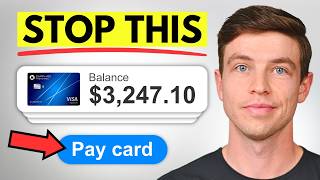

My Credit Score Dropped 44 Points Overnight
39sRelatable shock when responsible users see unexplained score drops.
▶ Play Clip"Delivers on the promise with actionable steps, though includes some filler and sponsor-like segments."
The video explains why credit scores can drop even when you use credit cards responsibly, due to credit utilization reporting on the statement closing date. It provides a four-step strategy to quickly boost your score by manipulating utilization, emphasizing that utilization has no memory and can be easily controlled. The key insight is that paying down your balance before the statement closing date to a low single-digit percentage (1-3%) can significantly improve your score without any cost.
You can have a credit card with a $3,000 limit, spend $1,000, pay it off on time, but still see your credit score drop because the statement balance reported to credit bureaus shows high utilization.
The statement closing date is when the credit card company reports your balance to credit bureaus. This reported balance (utilization) affects up to 30% of your credit score.
Make a one-time payment 3-5 days before the statement closing date to reduce the reported balance. For example, if you owe $1,000, pay $970 to leave a $30 balance, resulting in 1% utilization.
Low single-digit utilization (1-3%) is best for boosting your credit score. Zero utilization is neutral, and anything above 30% hurts your score.
Unlike late payments, utilization resets each month. A drop due to high utilization can be reversed quickly by paying down the balance before the next statement closing date.
Instead of paying down early, you can request credit limit increases or open new cards. Higher limits automatically lower utilization percentage. Tips: pay on time, use the card, report income increases.
Request to change due dates so they fall on the same date across cards. This simplifies tracking and allows early payments before the statement closing date.
By understanding and manipulating credit utilization through early payments and increased limits, you can quickly recover and boost your credit score without any cost. The process is simple and can reverse drops caused by one-time large purchases.
What is the 'statement closing date' for a credit card?
The date when the credit card company reports your balance to credit bureaus, affecting your credit utilization.
01:07
What percentage of your credit score is credit utilization?
About 30% (or nearly one-third).
01:32
What is the optimal credit utilization percentage to boost your score?
Low single-digit, around 1-3%.
05:21
Does credit utilization have memory?
No, it resets each month. High utilization one month can be fixed the next.
07:09
How can you lower credit utilization without paying early?
By increasing your credit limit through requests or opening new credit cards.
09:26
What is the 'grace period' for a credit card?
The period between the statement closing date and the payment due date, during which you can pay off the balance without interest.
02:12
If your statement balance is $1,000 on a $3,000 limit, what is your utilization percentage?
33%.
02:53
What is one reason credit bureaus consider high utilization a risk?
It can be a warning sign of financial distress, even if you pay on time.
03:06
What should you do to align credit card due dates?
Request a payment due date change within your account to make all due dates fall around the same date.
11:54
Utilization over 30% drops score
Explains why responsible card users see score drops despite paying on time.
02:53Pay before statement closing to control utilization
Core actionable step to manipulate reported balance.
03:441-3% utilization is optimal
Provides specific target range for maximum score benefit.
05:21Utilization has no memory
Key principle that reduces anxiety over temporary drops.
07:09Increase limits to lower utilization
Alternative strategy that doesn't require micromanaging payments.
08:43[00:01] finance because they don't always behave the way you'd expect them to. For example, you could have a credit card with a $3,000 credit limit. You could other spending on that card in a certain month. So, let's say $1,000. And then at
[00:14] credit card bill where you pay off that $1,000 with no problems. You did the paying on time, not carrying a balance, not paying interest, and not getting paying off your bill, you see that somehow your credit score had a massive
[00:28] that's happened to me plenty of times in the past, including earlier this year when my score dropped from being over 800 down to 766. However, I actually let to make this video showing you exactly how I turned around and then boost up my
[00:42] credit score so that it exploded all the way back up by 44 points to 810 the very ever seen similar decreases in your score by just using your credit cards one-time purchase with them, you're not doing anything wrong financially, but
[00:55] credit score system the way it was weirdly designed. So today, I want to show you four steps that can increase your credit score fast for no cost and to pay your credit card bill as a part of that. But first, we're going to start
[01:07] to understand something I call your credit card statements picture day. So, probably remember picture day at school when some photographer would come in and school yearbook. You'd get all dressed up, maybe brush your hair, or just make
[01:20] than usual. And just like you'd want to make yourself look good for picture day, picture day about once per month that you want to make them look good for as the statement closing date. And along with your credit card statement balance
[01:32] and credit limit, those three things all play a big role in affecting your credit of your credit score. Credit utilization and amounts owed make up around 30% or nearly one-third of your score. So, here's how it all works. If we go back
[01:45] $3,000 credit limit, let's say your credit card's billing cycle began with a statement opening date of June 1st and then ended with a statement closing date between June 1st and June 30th, you made $1,000 of total purchases and then did
[01:58] when the statement closing date of June 30th comes around, what'll happen is basically going to take a picture of your $1,000 statement balance on that picture over to the credit bureaus like Experian, Equifax, and or TransUnion.
[02:12] cycle is over, you'll have what's called a grace period of anywhere from around closing date and your payment due date, which we'll say was July 24th in this timeline here. And as long as you pay off that $1,000 statement balance on
[02:27] you'll be good to go. Like I said, you won't be carrying a balance. You won't getting charged any late fees. But because your picture day or your statement closing date showed a $1,000 statement balance relative to a $3,000
[02:39] see your credit score drop because of how the credit bureaus look at this. that statement balance that's being reported on your statement closing date, card's credit limit to calculate that you've got a 33% credit utilization. to
[02:53] them, a utilization that's above 30% is considered too high because it kind of yourself, even though you know you're going to pay off that $1,000 statement 24th due date. I know that feels like a broken system that's penalizing you for
[03:06] way things work because for some people who actually are struggling with credit cards, having a high utilization can be a warning sign that they're in financial missing payments or not paying back what they owe. So, because the credit bureaus
[03:18] financial distress or not, they're just going to drop your credit score a bit so be careful when deciding to approve you for some type of credit or at least compensate them for potential additional credit risk. Again, you're not doing
[03:31] you're still using your credit cards responsibly and paying them off. But by to your credit limit, you've essentially made the mistake of forgetting about without making yourself look as good as you might want to. So, that's going to
[03:44] increase your credit score, and that is to manipulate your credit utilization by balance you like reported on your statement closing date each month. Now, basically explains the best day to pay your credit card bill, which is actually
[03:58] can lower your statement balance is by your billing cycle, at least roughly 3 to 5 days before your statement closing on that picture day can be essentially whatever you'd like it to be. So, what
[04:11] here, let's say it's June 25th and you've already made $1,000 in purchases cycle, which makes that your current balance, and you don't plan to do any end of the month. So, what you can do on June 25th is you can make an optional
[04:25] onetime payment of maybe $970. That will now leave you with a $30 current statement balance on the statement closing date of June 30th, which we can date, just like we originally planned. But now we've effectively paid our
[04:39] making that larger one-time pay down before the state and closing date and payment due date by paying down our statement balance early to only $30 relative to a $3,000 credit limit, that's just a 1% credit utilization that
[04:54] I've learned after using credit cards over the past decade is that having a singledigit percentages just like that is amazing for my credit score. But I out there that kind of confuses people about what exactly the best credit
[05:08] websites out there claim that you should aim for 30% or lower, which isn't say the lower the better. But then others say you should aim for 10% and below. And then some people even recommend a 0% utilization. So here's a
[05:21] simplifies things. Ideally, again, you want to aim for having a low singledigit utilization percentage of around 1 to 3% on each of your mostused credit cards if you don't use in a certain month or cards that you pay off in full before
[05:35] going to have a 0% utilization reported, that's sort of like a neutral thing when utilization basically shows that you're not using the credit on that specific score, but it's not really going to help it either. So, a low singledigit
[05:49] utilization if we're looking at things strictly in terms of boosting your better than a utilization that's in the range of 10 to 30%. and all those are going to be better than having a much higher credit utilization of above 30%.
[06:03] looking at each credit card account you have individually as well as across all And in many situations, all it takes to drop your credit score is having a very high statement balance reported on just one credit card from a single one-time
[06:17] that I'll see is that somebody opens up an Apple card to take advantage of the 0% financing offered on new Apple products. And then they get, let's say, a $5,000 credit limit, but they buy a $2,500 MacBook Pro. They let a month go
[06:29] by and their statement closes with a $2,500 statement balance. And even though they plan to pay off that $2,500 interest free at 0% over the course of immediately decreases because they're running that Apple Card at a 50%
[06:42] utilization. Even if that person has a bunch of other credit cards with low going to be holding their score back from being as high as it should be me to step number three here, which is to relax and reset because it's not the
[06:55] happens to you. And you can actually reverse this drop in your credit score made a larger one-time purchase like a laptop or some furniture for a new that spiked my credit utilization and dropped my credit score like I mentioned
[07:09] important thing to do when this happens is just to take a deep breath and then utilization has no memory. So unlike affects around 35% of your credit score, where a single missed payment can stay
[07:23] negatively impacting you, credit utilization on the other hand is going each and every month, your credit score is going to basically rise and fall to some furniture using my credit cards towards the end of 2025 and beginning of
[07:37] 2026, I wasn't really actively trying to pay down my statement balance that early utilizations because there wasn't really any need to. And because of that, my the whole point anyway of having an 800 plus credit score is to get the very
[07:50] loans you might need or to get approved for the best credit cards. And since I trying to open up any new cards at that time, I didn't really care that I had like a 10% utilization on one card or a 20% utilization on another. So all I did
[08:04] statement balance by the payment due date so that obviously I never paid any interest. But then to boost my credit score back up to 810 after it bottomed out at 766. All I did in the following month's billing cycle is I just made an
[08:16] lower my balance down to 1% of my credit limit before the statement closing date. right back up. Now, there are some newer credit scoring models that do look at your credit utilization trends over time, but those are not really as widely
[08:29] to worry about them. So, my best advice here is that it's okay if your credit because of high utilization, since over the long term, you can fix that pretty just another tool you have for your personal finances. So, it's a good idea
[08:43] control when you can, if it serves a purpose for getting you approved for opinion, I don't think you really have to obsess over constantly having those time. Now, all of that was how you can manipulate your credit utilization to
[08:57] there's also a few other tips I have to lower utilization in a much more natural going to be step number four in this video. So, in that credit utilization on a certain card and then divide that by the card's credit limit to get a
[09:11] about, the main way to lower that percentage is to decrease the top again, instead of $1,000 balance divided by a $3,000 limit for a 33% utilization, we can lower that to $30 divided by $3,000, which is a much better 1%. But
[09:26] just not really that interested in micromanaging our utilization by making statement closing date like we talked about. So the other option we have to lower our utilization is to actually increase the bottom denominator of that
[09:38] credit limits. So, just for easy numbers here, if we had the same $1,000 statement balance versus a $3,000 limit for a 33% utilization, what if instead of paying down that $1,000 balance early, we just had a $50,000 credit
[09:52] $1,000 balance get reported on the statement closing date without really score because 1,000 bucks versus a $50,000 credit limit is only a 2% credit are just for easy math here because going from a 3K limit to 50K all at once
[10:08] getting credit limit increases is definitely doable with just a few tips I keep saying, always make your credit card payments on time and in full on-time payments is really going to show lenders that you're being responsible
[10:22] been given. Number two, don't request a credit limit increase on a card you you're actively putting spending on a certain card and then paying that down. that a credit limit increase actually makes a lot of sense for the issuer of
[10:35] three, if you ever have any income increases, then make sure to let the to them, the money that you make is going to have a direct correlation with higher limits they might want to give you. And tip number four, sometimes the
[10:48] might not even be to ask for a higher limit on a card you already have, but it instead because then you can get both a new credit limit and a valuable signup links down below in the description to a few of my favorite credit cards that
[11:02] check those out. But another bonus pro tip I have here is that some issuers limits between cards as well. So let's say you've got one card that you're using on a lot of everyday spending with a $5,000 limit and instead of asking for
[11:15] a credit limit increase on that card directly, you just open up another card credit limit of let's say $10,000 along with a valuable signup bonus. What you turn around and ask that issuer to move some of that credit limit from the new
[11:29] the old card just had some benefits or multipliers that you like. So, let's say limit. Now, you've doubled the credit limit on your old card, which you can keep using, but you've also got a new card with a separate leftover $5,000
[11:42] reporting on-time payments to help your credit score as well. And you took could be worth a lot of money. Now, personally, I don't recommend opening because you don't want to lose track of things and then just have all these
[11:54] dates that are spread out all over the place. But one other tip I have here to due dates to fall on the same date or very close to the same date if possible. request a new payment due date right within your account. And this is
[12:08] credit cards by just making all my due dates fall somewhere around the 23rd to billing cycles are pretty much aligned. So that way I can make any early have to. And I can also make any final payments before the due dates as well.
[12:23] just understanding how all this stuff works can be a huge help in boosting from dropping randomly in the future. But there's actually several other credit score as well, like payment history, which I mentioned before, plus
[12:36] things like hard inquiries, age of credit, your credit mix, and more. So if to get an 800 plus credit score and then keep it there, then you definitely have over here on the screen next that dives into how you can optimize every single
[12:49] thanks so much for watching and I'll see you in the next one.


⚡ Saved you 0h 12m reading this? Transcribe any YouTube video for free — no signup needed.