
Is Iran a Dictatorship? Harvard Professor Explains
45sDirectly addresses a common question with a nuanced, surprising answer, sparking curiosity and debate.
▶ Play Clip"Delivers substantive answers to common questions, though the title oversells 'government questions' slightly."
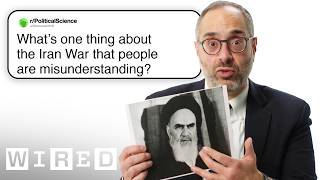
Professor Tarek Masoud from Harvard University answers questions about Iran's political system, the role of the Islamic Revolutionary Guard Corps (IRGC), the selection of the Supreme Leader, and the prospects for democracy in Iran. He explains the hybrid nature of the regime, the significance of the IRGC, and the dynamics of protest and reform.
Iran is a dictatorship with electoral features. The Supreme Leader holds ultimate power, setting policy and controlling the military, while an elected president manages social policy. This hybrid system is designed to withstand stress.
The Islamic Revolutionary Guard Corps (IRGC) is a full-fledged military force alongside the regular army. It includes the Quds Force and the Basij, and it controls a significant portion of Iran's economy (estimates range from 20% to higher). It is ideologically committed to defending the regime against internal threats.
Khamenei was chosen as Supreme Leader despite not being a marja' al-taqlid (top religious authority). The constitution was changed to allow this, indicating a political rather than religious rationale. His son Mojtaba is close to the IRGC, which is a key power broker.
Iran has periodic protests, such as the Green Revolution and the 2022 protests after Mahsa Amini's death. The regime represses protests brutally, but elections sometimes allow reformist candidates to emerge, which can absorb some reformist energy.
In the current war, the information battlefield is more level. Iran uses propaganda videos, and the regime could survive bombardment but might lose if the Iranian people turn against it. Assassinating the Supreme Leader is a scenario to watch.
After Iraq and Afghanistan, the US is more modest about imposing democracy. However, Iran has high literacy and education rates, especially for women, suggesting that if given the chance, Iranians could build and sustain a democracy, which would benefit the world.
Iran's regime is a resilient hybrid dictatorship, but its long-term stability is uncertain due to internal protests, economic issues, and the potential for change if the Iranian people's capabilities are unleashed.
What is the hybrid nature of Iran's political system?
It is a dictatorship with electoral features; the Supreme Leader holds ultimate power, while an elected president manages social policy.
00:14
What is the IRGC's role in Iran?
It is a full-fledged military force that defends the regime, controls a significant portion of the economy, and includes the Quds Force and Basij.
02:20
Why was Khamenei chosen as Supreme Leader despite not being a marja' al-taqlid?
The constitution was changed to allow it, indicating a political rather than religious rationale.
04:22
What event sparked the 2022 protests in Iran?
The death of Mahsa Amini after being arrested for not wearing her headscarf properly.
06:53
How does Iran's information warfare differ from traditional warfare?
The information battlefield is more level; Iran uses propaganda videos and social media to shape narratives.
07:49
What educational indicators suggest Iran could sustain a democracy?
High literacy rates and high education levels for women, with women achieving more educational attainment than men.
11:13
Hybrid Dictatorship
Clarifies the complex nature of Iran's political system, combining authoritarian control with electoral elements.
00:14IRGC's Economic Power
Reveals the IRGC's significant economic influence, which is crucial to understanding regime durability.
02:20Political Selection of Supreme Leader
Highlights the political pragmatism behind religious leadership selection, challenging assumptions.
04:22Level Information Battlefield
Explains how modern warfare includes a propaganda component where Iran can compete effectively.
07:49Iran's Human Capital
Points to Iran's educated population as a foundation for potential democratic success.
11:13[00:00] I'm Professor Tarek Masoud from Harvard University. This is Tech Support, Iran. [upbeat music]
[00:14] "Is it wrong to call Iran a dictatorship?" The Islamic Republic of Iran absolutely is a dictatorship, but it also has some electoral features
[00:27] but they're not totally meaningless. says that the leadership of Iran must reside
[00:40] of great knowledge and virtue, the supreme leader. that the affairs of Iran will be governed And so they have an elected president
[00:57] and they even elect the body The supreme leader is definitely on top. He sets policy, he hires and fires
[01:13] the heads of the military apparatus. Everybody looks to him. The president gets to set things like social policy.
[01:26] It's a system that really does have these hybrid features. with the whole system was this man Ayatollah Khomeini, and he was the supreme leader until his death in 1989.
[01:40] He was replaced by this man, Ayatollah Ali Khamenei. This guy, by the way, was the president under Khomeini. in February of this year.
[01:53] And he was replaced by his son Mojtaba. And many of the senior leadership Could we say that the political system in Iran
[02:08] They've managed to hold on so far, and some people might say that the regime is built precisely to withstand this kind of stress.
[02:20] is under the most serious strain that is ever faced in its nearly 50 years of history. MeganHasHemorrhoids asks, "Explain like I'm five.
[02:33] Sorry about the hemorrhoids, Megan. are what is known as the Islamic Revolutionary Guard Corps are one of two armed forces
[02:48] It's basically a full-fledged military. It also has a kind of special forces called the Quds Force or the Jerusalem Force.
[03:05] And it also has a group called the Basij-e Mostaz'afin that the Iranian regime relies on mainly for mobilization, And that IRGC sits alongside
[03:20] If you think about it, Their job is basically to defend Iran's borders. The job of the IRGC in contrast
[03:34] They are the ones who play a major role They're also the arm of the state across the Middle East like Hezbollah and like the Houthis.
[03:52] The IRGC, by the way, is not just a military force. and you can see estimates that they control anywhere from 20 and they're involved in all kinds of industries
[04:07] Part of the reason that this regime and so durable in the face of repeated public protest is that they have a very ideologically committed group
[04:22] to defend the regime even against their own citizens. "How was Khamenei chosen as supreme leader
[04:34] Ayatollah Ali Khamenei, and it is true that when he was chosen to be supreme leader And Ayatollah is a very senior religious cleric
[04:51] Shia Islam differs a little bit from Sunni Islam you are supposed to pick a very senior Ayatollah and religious authority.
[05:06] actually wasn't widely thought of and he certainly wasn't thought of who has the status of what is called a marja' al-taqlid
[05:21] somebody who Shiites can choose to follow. because he'd been president for eight years They even changed the Iranian Constitution
[05:37] The rationale then was political and not religious. how come he was succeeded by his son? This was not like a monarchy or a dynastic succession.
[05:52] the selection of the son was political. Mojtaba Khamenei is very close to the IRGC, are the king makers in Iran today.
[06:08] "Iran has major protests every few years, Iranians do often protest their regime. you had something called the Green Revolution,
[06:22] took to the streets to protest an election that was rigged and in favor of a conservative presidential candidate Ever since 2017,
[06:37] and some of those protests are about economic issues, One of the big ones happened in 2022. and that was after a young Iranian woman named Mahsa Amini
[06:53] for not wearing her headscarf properly. The main thing is that they get repressed brutally It's difficult to exaggerate
[07:07] just how willing the Islamic Republic's regime is But another factor also that ends up maybe mitigating some of the protests is that Iran does have elections.
[07:21] And sometimes in these elections for the presidency, And so sometimes that soaks some of the energy for reform.
[07:34] that they think can change things. Masoud Pezeshkian, is just such a reformist candidate. Iranians are going to continue to protest,
[07:49] and when this war ends, protest in Iran will not. about the current Iran war One of the things about this war
[08:02] as it is a war on the battlefield. the battle space is actually a lot more level. The Iranians have access to all of the tools
[08:16] They can make glitzy AI videos that make it look like they are scoring dramatic battlefield victories. viral propaganda videos.
[08:30] in which they presented themselves of American aggression going all the way back and even to the genocide against Native Americans.
[08:47] is much more even is not just because the Iranians but that the soldiers in the information battlefield
[09:00] Basically anybody who's unhappy with this war and then get boosted by their networks. about believing what we see on the internet
[09:15] The second thing I would say is that the regime could survive this bombardment that would allow them to come out
[09:30] and say, "We survived a sustained bombing campaign the two greatest air forces in the world," but they could still lose because the Iranian people
[09:43] And it may be that the capabilities of the regime will have been so degraded after this war and the regime shifts in the people's favor.
[10:00] that people should pay a little bit more attention to by assassinating the supreme leader of Iran, And it remains to be seen
[10:15] for the United States by making our rivals more compliant and pliable or a bad thing by making our leaders less safe Ok_Breadfruit4005 asks,
[10:28] Americans typically think is for them to have a liberal, And after our experiments
[10:41] in building democracies in Iraq and Afghanistan, we become a little bit more modest about that view. that in Iran the best outcome is a democracy.
[10:55] it's something that I do think the Iranians It's a real tragedy that the images that we see with very stern faces, 'cause that is a very deep and rich
[11:13] It has a very high rate of literacy. There's a very high rate of education for women in Iran. women achieve more educational attainment than men in Iran.
[11:27] that if Iranians got the chance to lift the boot of the IRGC they'd be able to build a democracy and to keep a democracy.
[11:40] it would also be really good for the world. how extraordinary the Persian people are. have made enormous contributions.
[11:54] which is like the Nobel Prize for math, There are major Iranian engineers I mean, this is a society
[12:09] and technology and to human civilization. And you can't help but think that if somehow the Iranians and also from a situation
[12:24] that the benefits to them and to the world civilization would be incalculable. I've only read it in translation. I don't speak Persian.
[12:39] "Somewhere out there beyond ideas of right and wrong I will meet you there." and I really hope that sooner rather than later,
[12:53] 'cause I think only good things will happen. Thank you for watching Tech Support, Iran. [light upbeat music]
⚡ Saved you 0h 13m reading this? Transcribe any YouTube video for free — no signup needed.