
Iran vs Arab: Key Differences
45sQuickly clarifies a common misconception, sparking curiosity and cultural interest.
▶ Play Clip"Delivers on the promise of answering Iranian history questions with expert insight, though some answers are brief."
In this video, Harvard professor Tarek Masoud answers questions about Iran's history, culture, and politics, addressing topics such as whether Iran is an Arab country, the influence of Islam, the symbolism of the flag, the pre-revolutionary era, and the possibility of a monarchy restoration.
Iran is not an Arab country; Persian is an Indo-European language, distinct from Arabic, a Semitic language. Despite shared Islamic faith, Iranians have their own cultural identity.
Iran practices Shia Islam, which venerates descendants of Prophet Muhammad. Some clerics wear black turbans to signal direct descent from the Prophet, and some Iranians claim Arab ancestry.
Arabs and Persians hold stereotypes of each other. Arabs point to contributions like algebra (Al-Khwarizmi) and algorithm, while Persians highlight figures like Avicenna, a founder of modern medicine.
Iran became Islamic after the Arab conquest, but retained Zoroastrian traditions, such as Nowruz (spring festival) and fire-jumping rituals. Some Zoroastrians still exist, including Freddie Mercury's family.
Iran became the Islamic Republic after the 1979 revolution led by Ayatollah Khomeini, replacing the monarchy of Mohammad Reza Shah Pahlavi. The government is theocratic with clerics in senior positions.
The current flag has three colors: green (Islam), white (purity), red (blood). The pre-revolutionary flag had a lion and sun, replaced by a stylized tulip symbolizing martyrdom. The 22 'Allahu Akbar' inscriptions commemorate the 22nd day of Bahman.
Iran under the Shah was more secular and Westernized, with women in miniskirts, but it was authoritarian with no democracy, leading to backlash.
Unlike many Middle Eastern countries, Iran's borders were not created by colonial powers. They resulted from wars with the Ottoman and Russian empires and British mediation in the 19th century.
Factors include the Shah's authoritarianism, secret police (SAVAK), extravagance (e.g., $20 million banquet), liberalizing reforms, his cancer, and economic distress from Saudi oil overproduction.
The pretender to the throne, Reza Pahlavi, is not widely supported. Iran's 40% ethnic minorities, including Kurds and Arabs, do not look fondly on the Shah's era, which suppressed their expression.
Iran's complex history and identity are shaped by its Persian heritage, Islamic faith, and revolutionary past, and the video clarifies misconceptions about its Arabness, flag symbolism, and political evolution.
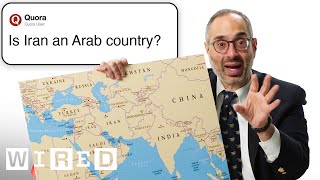
Is Iran an Arab country?
No, Iran is not an Arab country; Persian is an Indo-European language, distinct from Arabic.
00:15
What is the significance of black turbans worn by some Iranian clerics?
They signal direct descent from the Prophet Muhammad.
01:26
What is the origin of the word 'algorithm'?
It comes from the name of the medieval mathematician Al-Khwarizmi.
02:21
What Zoroastrian traditions are still retained in Iran?
Nowruz (spring festival) and fire-jumping rituals.
03:32
Who led the Iranian Revolution?
Ayatollah Ruhollah Khomeini.
04:14
What does the stylized tulip on Iran's flag represent?
It represents martyrdom.
05:40
How many 'Allahu Akbar' inscriptions are on Iran's flag?
22, commemorating the 22nd day of the month of Bahman.
05:58
Why were Iran's borders not drawn by colonial powers?
Because Iran was an independent state, and its borders resulted from wars and British mediation in the 19th century.
08:55
What was one of the causes of the Iranian Revolution?
The Shah's authoritarianism, extravagance, and economic distress from Saudi oil overproduction.
10:06
Why do ethnic minorities in Iran not support a monarchy restoration?
Because the Shah's era suppressed their expression.
12:53
Iran is not Arab
Clarifies a common misconception about Iran's ethnic and linguistic identity.
00:15Zoroastrian influence persists
Shows how pre-Islamic traditions survive in modern Iran.
03:02Flag symbolism explained
Provides a clear breakdown of the current flag's elements and their meanings.
04:57Revolution causes multifaceted
Lists concrete factors that led to the revolution, offering a nuanced view.
09:38Monarchy restoration unlikely
Explains why the pretender lacks support, especially among ethnic minorities.
11:58[00:00] I'm Professor Tarek Masoud from Harvard University. This is Tech Support Iran. [upbeat music]
[00:15] If an Arab country is a country then the answer is no. And Persian, even though it's written
[00:30] to somebody who doesn't know the language, And so there's lots of words in Persian like the word for name is nam,
[00:44] the word for mother is madar, Arabic is a Semitic language. which is spoken in Israel,
[00:56] spoken in Ethiopia. That said, there's obviously a lot of traffic After all, they practice Islam.
[01:11] The brand of Islam that they practice, Shia Islam, one of its core features is veneration that descendants of the Prophet Muhammad
[01:26] have infallible religious authority. Many of the senior clerics, like Khameneim or Khomeini, Those black turbans signal descent,
[01:40] direct descent from the Prophet Muhammad. "We're descended from Arabs." as unsophisticated as Bedouins.
[01:55] My tie has grasshoppers. Arabs also have their negative stereotypes of Persians.
[02:07] the Arabs will point to as examples of Arab contributions So, for example, there was a medieval mathematician
[02:21] The word for algorithm comes from his name. "We invented algebra, we invented the algorithm." The founder of modern medicine, Avicenna, also a Persian.
[02:35] In fact, the greatest Arab grammarian This is a guy who codifies Arab grammar So Iran is not an Arab country,
[02:48] just like the Arabs have experienced serious Iranian-Persian influences. "How did Iran become an Islamic country in the first place?"
[03:02] that practices Islam, well, that really starts with the Arab conquest of Persia Before the Islamic conquest, Iran was a Zoroastrian country.
[03:16] in which fire and the sun And they ultimately converted to Islam but they still retain a lot of Zoroastrian traditions.
[03:32] which is the start of spring, Right before that, where they leap over fire
[03:45] and giving to the fire their ailment, In fact, there are still Zoroastrians. Many of them live in South Asia.
[03:59] the lead singer of Queen. become the Islamic Republic, with a revolution against the king of Iran at that time,
[04:14] an American client, Mohammad Reza Shah Pahlavi. that was ultimately led by this man, And he basically was the man who came up
[04:27] that governs Iran today. that has at its top a senior religious leader. Senior positions are held by Islamic clerics.
[04:42] Day-to-day life on the streets is mandated to conform So if you're a woman in Iran, you have to dress Islamically. If you like to party, well, you're out of luck in Iran.
[04:57] to what are considered to be Islamic standards of behavior. "What's going on with Iran's flag?" So this is Iran's current flag, three colors.
[05:11] White represents purity. And this is the pre-revolutionary Iranian flag.
[05:23] which is the lion with the sword and the sun behind it. of royal power. The Iranian flag, after 1978, was adapted.
[05:40] and they replaced it with this kind of stylized tulip, It kind of represents martyrdom. It also looks like a stylized form
[05:58] The other differences that you have here, the words Allahu Akbar, God is Great, there's 22 of them. which is the 22nd day of the month of Bahman,
[06:14] Now, today, you'll often see people It's kind of like an act of rebellion JediBlight asks, "Just how liberal/progressive
[06:31] was Iran prior to the 1979 revolution?" Iran was run by a king which was at that time a conservative society,
[06:46] Mohammad Reza Shah Pahlavi was the second Shah, or king, The first was his father who did a military coup
[06:58] He got a little too cozy with the Nazis, and installed his son in his place in 1941. And his son engaged in all kinds of reforms,
[07:13] the role of Islam in society. more secular and more Western. dressed in miniskirts or looking the way
[07:28] And that certainly was the case But again, the vast majority of the people in that country
[07:40] as a modern and progressive leader. of progressiveness in his program. this was a leader who was authoritarian.
[07:53] Iran was not a place where there was democracy And that of course generated some of the backlash YogurtclosetOpen3567 asks,
[08:11] whose modern borders were not created by colonial powers?" This is a map of the Middle East and some of South Asia.
[08:26] like Iraq, Syria, and Jordan, the borders between them are very straight. after the end of World War I,
[08:40] and the British and the French took over. essentially with rulers and pens. The way that Iran's borders were worked out
[08:55] Iran fought a series of wars with the Ottoman Empire It fought wars with the Russian Empire Its Eastern borders were also mainly
[09:11] in wars with British India and with Herat in Afghanistan. because they actually were drawn by British mediators in the 19th century.
[09:25] But essentially, because Iran was an independent state, of the League of Nations, from the standard Middle Eastern country
[09:38] This is from the No Stupid Question subreddit, from FArandylahey. Well, the first thing to note about the Iranian Revolution
[09:52] The American president at the time, Jimmy Carter, and toasted it as an island of stability But they say hindsight is 20/20.
[10:06] And today, there are a lot of factors that people point to The first is that the regime of the Shah He relied on his secret police to keep order,
[10:19] people were sent into exile and tortured. leading the Iranian Revolution, Ayatollah Ruhollah Khomeini, because of his opposition to the Shah in the 1960s.
[10:32] was extremely wasteful with the country's resources. that by some accounts cost almost $20 million.
[10:46] said that the banquet for that celebration And so Iranians looked at something like that And then the Shah's reforms, the liberalizing reforms,
[11:04] He was also, by the end of this, very sick, he had cancer. And his wife, the Shahbanu, was not terribly popular.
[11:18] and caused the Iranian Revolution that was caused by Saudi overproduction. And that caused some serious economic distress in Iran.
[11:31] to see some weaknesses in the regime And the conditions ultimately ended up being ripe
[11:43] to take over and ride it into power Currymvp2 asks, "The son of Iran's last Shah But do Iranians really want another king?"
[11:58] So this is the pretender to the Iranian throne, And he is the son of Mohammad Reza Shah Pahlavi, Now, today, in some of the protests
[12:14] or at least that were happening before the bombing campaign, saying Pahlavi will return. as to whether that means they really want this guy back
[12:28] "That hated dynasty that we overthrew He hasn't been in the country for 47 years,
[12:40] actually has the wherewithal to govern Iran Iran is made up of 40% ethnic minorities.
[12:53] Kurds, there's a small Arab minority in Iran. And those people don't look fondly on the time of the Shah. who suppressed their expression
[13:10] So they're not really yearning for a restoration of the so-called peacock throne. Thank you for watching Tech Support Iran.
[13:23] [upbeat music]
⚡ Saved you 0h 13m reading this? Transcribe any YouTube video for free — no signup needed.