
How Shepherd's Pie Changed My Life
40sNostalgic and relatable story of a picky eater longing for a friend's meal creates emotional engagement.
▶ Play Clip"Title promises a failed ambitious recipe and delivers exactly that—raw and honest, not clickbait."
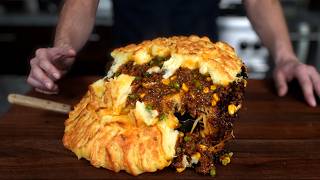
In this video, the chef attempts to create a hash brown-crusted shepherd's pie, but due to a shoulder injury and structural issues, the crust fails. Despite the failure, he provides a detailed cooking tutorial for both the shepherd's pie filling and the hash brown technique, embracing vulnerability and sharing the recipe anyway.
The chef recalls first seeing shepherd's pie at a friend's house in 7th grade, describing it as a glorious mix of stewed ground beef, peas, corn, and baked mashed potatoes.
He admits the recipe didn't turn out as planned, and for the first time, he shows raw, unpolished footage of a failed attempt.
Explains that par-cooking and chilling potatoes gelatinizes the starch, expelling moisture and enabling crispiness—a technique called retrogradation.
A baked potato is done at an internal temperature of 205°F; for par-cooking, potatoes should be removed at 175°F and cooled below 42°F.
Uses ground lamb (or beef for cottage pie), mirepoix (onion, carrot, celery), tomato paste, Worcestershire sauce, Guinness, broth, and frozen corn/peas.
Pulses roughly chopped vegetables in a food processor to a mince, saving time and ensuring fine texture.
Press lamb into a hot pan, season, then break up with a flat spoon, letting moisture evaporate until the meat browns and forms small clusters.
Adds half a can of Guinness stout to deglaze the pan, contributing rich, deep flavor to the stew.
Realizes the stew is too thin and thickens it with a flour slurry, acknowledging this was a mistake in consistency.
Grates par-cooked potatoes, presses them into a tart pan, and bakes at 425°F for 30-45 minutes, spritzing with oil to promote browning.
Makes mashed potatoes on the stiffer side by limiting cream and butter, then adds an egg yolk to help them hold shape during baking.
The hash brown crust becomes too dark, partly due to the broiler and uneven shape; the chef describes it as 'both delicious and shitty'.
When trying to remove the tart pan, the hash brown crust breaks apart, revealing the structural failure of the dish.
Despite the screw-up, he decides to share the video and provides the recipe for both shepherd's pie and hash browns, encouraging perseverance.
The hash brown shepherd's pie was a noble but failed experiment, teaching that even well-tested ideas can fall apart under physical strain. The chef's vulnerability in showing the failure makes the video relatable and offers valuable cooking techniques regardless.
What is retrogradation in the context of potatoes?
A process where potatoes are cooked and then chilled to gelatinize the starch, which then expels moisture, allowing them to become crispy when fried or baked.
02:33
What internal temperature indicates a fully baked potato?
205°F.
03:14
At what internal temperature should par-cooked potatoes be removed from water for retrogradation?
175°F.
03:28
What is the difference between shepherd's pie and cottage pie?
Shepherd's pie uses ground lamb; cottage pie uses ground beef.
04:20
What are the ingredients in a mirepoix?
2 parts onion, 1 part carrot, 1 part celery.
04:34
Why should mashed potatoes for shepherd's pie topping be on the stiffer side?
To prevent them from melting and losing shape during broiling.
16:32
What is the purpose of adding an egg yolk to the mashed potatoes?
It helps bind the potatoes and allows them to hold their shape while baking, almost soufflé-like.
16:45
How long should the hash brown crust be baked at 425°F?
30 to 45 minutes.
14:33
Retrogradation technique
Explains the science behind making crispy hash browns at home, a key principle for potato cooking.
02:33Shepherd's pie vs cottage pie
Clarifies the often-confused difference between the two dishes: lamb vs beef.
04:07Meat browning technique
Demonstrates a professional method for achieving even browning and small meat clusters by controlling moisture.
08:07Crust collapse
Captures the moment of failure despite thorough testing, highlighting the unpredictability of cooking.
20:34Embracing vulnerability
The chef shares a rare raw moment, teaching that failure is part of the creative process.
21:16[00:02] life is the moment I discovered Shepherd's pie and it doesn't involve me eating it. Around 7th grade, I was on a play date after school playing video games at my friend Gavin's house when suddenly a bowl was placed in front of
[00:15] him. Nothing for me, only for Gavin. Some kind of glorious situation. Stewed Some kind of glorious situation. Stewed ground beef with peas and corn crowned with this fluffy baked mashed potato. Everything about it made sense to me. It
[00:28] had twice baked potato energy and for a picky eater like me, ground beef This is what a five-star meal looked like to me and with nothing for me, I just sat there sad watching my friend eat this Michelin star meal while I just
[00:42] fiddled my controller. I've never forgotten that moment or Shepherd's pie. and today we give it the upgrade it deserves. This is the hash brown deserves. This is the hash brown Shepherd's pie.
[00:58] video didn't turn out as planned. Now after doing about 650 videos and eight years on this channel, when I fail typically you never see that. You see a polished product. Something that was tested and refined before you get to see
[01:12] it. And while I spent all week on this, polished is not what I would call this recipe. It looks both delicious and shitty all at the never even be posted, but you're about to see me in rare form as I deteriorate
[01:26] physically in front of your eyes. I can't describe to you how much this one can't describe to you how much this one hurt cuz this one physically hurt. seemingly never ending. So let's get back into the video.
[01:41] God damn dude, I don't know what to do. Now the first thing we have to do is handle the hash brown crust. It is a bit of a tricky one if you don't do a few steps to save yourself a bunch of headaches. Now I don't do much science
[01:55] stuff here. I think it takes you too far out into la-la land, but this is something important to know if you're a fan of crispy potatoes. If you've ever tried to make hash browns at home, usually you take a raw potato, you grate
[02:07] it on a box grater, you ring out all the moisture, and then you toss it into a pan, and you cook it. But, almost always the potatoes turn gray or red, they oxidize. There's so much moisture in them that they steam instead of fry, and
[02:21] they're pretty much never crispy. It's why most people don't like In-N-Out fries is because as admirable as it is to cut a potato fresh and then fry it, there's too much moisture in it to stay crispy. We need to achieve a thing
[02:33] called retrogradation. This is when we cook the potato up into a certain point, and then chill it down to a certain temperature, gelatinizing the starch, which actually makes the starch inside the potato, instead of retain moisture,
[02:46] it gelatinizes and expels the moisture, allowing this to get crispy. And so, here I just have some par-cooked potatoes chilled. And to do this, it's very, very easy. All you have to do is add some rinsed russet potatoes to a pot
[03:00] add some rinsed russet potatoes to a pot and fill it with cold water. to a simmer, and gently simmer the potatoes almost all the way through. If
[03:14] you ever curious what the internal temperature should be to a perfect baked potato, it's around 205°. Knowing that, I can temp the potatoes, and when they reach about 175° I know they're about 3/4 of the way
[03:28] cooked, still a bit al dente in the center when they're poked. That's when I want to remove them from the water, place them on a wire rack, and allow them to cool a bit before placing them in the fridge overnight uncovered, or
[03:41] until the internal temperature dips below 42°. We're at 36, that degradation process has been achieved. Not only will they get crispy, they're sort of cooked but firm, which will allow us to shred them.
[03:54] This is what would give you like real diner style hash browns, crispy, lacy. Or you could dice them up, cut them into fries, and you're going to ensure a We're going to take care of those once our beef is cooking cuz it's going to
[04:07] take a minute. And here are the base ingredients to make an incredible shepherd's pie. Now, we've got our ground lamb, about 1 and 1/4 lb, something like that, of ground lamb. Now, shepherd's pie is ground lamb. If
[04:20] you wanted to add ground beef, that's fine. You're making cottage pie. Same thing. We've got our mirepoix. A mirepoix is about two parts onion to one part carrot celery. So, we'll do about 8 oz of onion, 4 oz of celery, 4 oz of
[04:34] carrots. Tomato paste, Worcestershire sauce. My little secret is some Guinness. That's going to add some deep richness to it. We've got some brodo, you want. Frozen corn and peas. And those add a bit of a pop at the end,
[04:48] sweetness, texture. And we add those at the end so they kind of maintain some of Now, this is where the cracks in my armor start to appear. This is the moment I start to sense that this is going to be a problem for me. Let's see
[05:02] how chopping vegetables feels. Something like this, a chili, a bolognese, a shepherd's pie, we're going to use basically similar methods. Obviously, without red wine, we're using stout. But we need a mirepoix, and we're going to
[05:15] use a food processor to dice it up the same way we would make bolognese. So, we don't need to dice it, thank god. We do like to break it down just to ensure a nice even processing in the food processor. Now, I don't know what's
[05:28] there's not one comfortable position to sleep in, and thus I haven't slept in a week. It's just this radiating sharp pain that seems to get worse when I sleep. I'm a bit delirious, and now the pain is just
[05:42] starting to take over. Just cut it into segments, into chunks. Get it into a Celery, take the tops and the bottoms off, dice them up. need. Just going to peel it.
[05:57] Cut it into little planks. Just give it a rough little dice. Smash some garlic to release it from their papers. Toss those in as well. We everything in. We're just going to pulse it. You just want to process it to a
[06:12] mince, not into a puree, just to kind of blend in with the ground lamb. Clean up the sides a little bit. This is just like we would with chili or little bit coarse. You can kind of make it how you want. And get it into a bowl.
[06:27] we're going to just use it a bit later for the potatoes. Make sure it's dry going to thicken this with a roux. So, we're going to need about 3 Tbsp of butter and an equal amount of flour. You can eyeball it. Now, while we're here,
[06:40] we can prep and dice the potatoes that are going to go on top. Doing potatoes two ways here. Now, I've had bad shoulders for 20 years.
[06:52] usually you find me leaning up against the wall with a ball working out a knot in my neck. Does anybody else do this? It's the only way I feel like I can find any sort of relief, even if momentarily. Nothing like a granite countertop corner
[07:05] to get a knot out your back. For a moment, I feel a touch of release. Look at that, functionality back. So, we go ahead and peel our potatoes. I'm going to drop it in some cold water to keep it from oxidizing. The other
[07:20] little rivet at the end of the peeler, that's to do this. It's to scoop it out. half, lay them flat, and we're going to slice them in half again. Then we're going to dice them up and get it back in the water.
[07:39] rinse out that water, add some fresh water, and we can throw those onto the stove, and I think we're ready to get everything cooking. Now, to start, I'm stove. You could use a Dutch oven, or I'm going to use my saucier. I'm going
[07:52] to get it nice and hot, and then coat the pan with some olive oil. Once it's hot, I'm going to take my ground lamb and press it into the pan. Try and get a nice flat layer of meat making contact with the hot oil. Then I'm going to
[08:07] season that side of the meat, and I'm going to use a flat wooden spoon and just start breaking up the meat, chopping it. I usually make my way across the surface one way, then turn the spoon and sort of chop it into dices
[08:20] the other way. That's not going to break them up, but then we stir up the beef, and we just keep working it until the meat form tiny little clusters, which is easier to do when some of that meat is still a little pink. Once it kind of
[08:34] cooks through, it's harder to break them up into a tiny mince. After you've separated all of the meat, the pink should be just about cooked through. And now, there's a lot of moisture being released from the meat, and just like we
[08:46] make a bolognese, we're going to allow that moisture to release, start steaming in the pan and pooling, and then allow it time patiently to evaporate, leaving only the fat and the oil in the pan, which starts to fry the meat. You start
[09:01] to hear almost like a steaming sizzling sound transitioning into a frying popping sound. And that's what you're looking for. Now, we can see some color starting to develop on the meat, and once it's nice and browned, we can
[09:14] remove the meat with a slotted spoon, create space for the vegetables. Once the meat is out of the pan, we can add in the vegetables. We can season the vegetables are going to release moisture. It's actually going to deglaze
[09:27] the bottom of the pan, and just like the meat, we want to cook and evaporate all of that moisture so that we can start to develop the natural sugars in the vegetables. Once the moisture has released and you can start to see some
[09:40] browning developing inside of the pan, we can go ahead and add the meat back to the vegetables. Stir them together, make sure the vegetables distribute into the meat. After a few minutes, I can see some of the grains of vegetable and meat
[09:53] which is at the point in which I want to start to add in the flour. I'm going to add in about 3 Tbsp of flour and get that distributed into the meat. Get it stirred in and cook it for about a minute or two before you add in the
[10:07] tomato paste, which since my arm feels like it's falling off, I must have forgotten to add. We'll add that in a second, but after you added the tomatoes paste and you cooked out the rawness of the tomato, then you would deglaze the
[10:19] pan with about a half a can of Guinness. That's a stout. It's got rich, deep flavor that's going to add a ton of character to our shepherd's pie. Deglaze the pan, scrape up all those bits from the bottom of the pan and cook the
[10:32] alcohol down. Another core flavor for shepherd's pie is Worcestershire sauce. So, we're going to add a few tablespoons of that into the mix. Get that stirred in. There it is. Now I remember. So, we got the tomato paste in and then we can
[10:44] go in with the beef stock. And you only want to add about a cup or two. You don't want to loosen it up too much cuz you want a very thick mixture at the end. So, once the stock is in, stir it, add in a sprig of thyme, a bay leaf,
[10:57] down to a simmer. We're going to allow the mixture to thicken and for some of that excess moisture to reduce. And if I'm being honest, in retrospect, this is too loose at this stage for how thick I wanted at the end. And that's probably
[11:12] going to become an issue for me later. We're going to set it off to the side on a super low burner while we get our potatoes onto the stove. I'm going to get a small pot onto the stove and then I'm going to drain off the potatoes I
[11:25] diced that have been soaking in water and add them to the pot. Fill the pot up with some cold water. Bring that mixture up to a boil, drop it down to a simmer, and then we're going to cook them until they're extremely soft. No resistance in
[11:40] them whatsoever. And while these two things cook, we can prepare our crust. Now, before we go any further, does anybody else feel like being on the internet these days requires you to have to dodge a barrage of bullets like
[11:52] you're in the Matrix? Online safety is more important than ever. But, I'm done being so vulnerable and exposed. And that's all thanks to our sponsor today, CyberGhost. CyberGhost routes your traffic through a secure, encrypted
[12:06] tunnel, keeping your IP hidden and your data private. Just turn on CyberGhost VPN before you browse. It encrypts and reroutes 100% of your traffic through their secure servers, so no one even knows about your online activity. Not
[12:20] that you have something to hide. Instead of you going straight to the internet, you go through a server that's encrypted and protected, which then takes you to the internet, so the internet doesn't know where you are. What's more,
[12:32] CyberGhost VPN doesn't keep logs, so not even they know what you do online. With just a few clicks, you can change your virtual location and unlock geo-blocked content with tons of streaming services, including Netflix, Amazon Prime, and
[12:46] many more. CyberGhost works on all major platforms, Windows, Mac, iOS, Android, even works on smart TVs and consoles. And it's perfect for sharing with your family cuz one subscription covers seven devices. And right now, they're offering
[12:59] $2.03 per month plus four free months. That's per month plus four free months. That's 84% off along with a 45-day money-back 84% off along with a 45-day money-back guarantee and 24/7 support when you sign
[13:12] Now, let's jump back into the video. Now, while those get cooking, we can work on our crust. Now, the skin should kind of come right off. You just sort of potatoes are pretty be I'll bet frying up all these little
[13:27] potato skins would be a really good snack or a topping. So now we got our food processor with our greater attachment. I want to go like that, right? Problem is I need this to hit the safety latch. So I'm just going to lift
[13:39] this up, then press down, then I'm going to go. make some perfect hash browns. Now for this technique, we're going to need a
[13:52] tart pan. I got a fairly deep one. That's better if you have it and one that the bottom pops out of. First step, got some cooking spray and I'm just literally going to start to build the wall. The wall is going to give it some
[14:05] structure. It's also going to shrink a little bit. lightly, then we can build the base. You can use a cup measure for this.
[14:20] stability everywhere. There's no real gaps. You don't really want them hanging with the spray. Just like, you know, a this extra that I'll save for breakfast hash browns. They're going to hold real
[14:33] nice. Now I've got a 425° oven preheated. This is going to get popped right in there. Now it's going to cook for about 30-45 minutes. We're really going to try and look to massage color. That's not an evenly shaped
[14:46] see is the edge start to darken a little faster and we want kind of uniform browning, so we're going to work through it. After about 35 minutes or so, the potatoes are cooked and as we learned earlier around 205, it's about the
[15:00] I'm going to take the potatoes off the stove. I'm going to drain out the water, add them back to the pot, and then very essential step in making nice fluffy mashed potatoes is allowing them to steam dry. Let all of that excess
[15:14] moisture evaporate. We don't want them in our mashed potatoes. Now our stew has been cooking. It's reduced, but it's still not where it should be. I'm going and I'm going to start to check the consistency. And it's a nice sauce
[15:28] consistency, but for shepherd's pie, it's still too loose. So, to thicken it, I'm just going to add a little bit of a slurry, about a tablespoon of flour. I'm going to mix some water into it to make a nice loose paste, and then add it into
[15:40] the mixture, and let's see how that thickens it up. We're just going to let that cook, see if it thickens up, see if it reduces a little bit more. But, you the potatoes cool, we can shred some cheese. And the basic is some sharp
[15:54] aged cheddar. You know, it's got some of that crystals in there. This adds just a little bit more flavor. I'm just going to shred some of that. I There's my cheese. It wasn't worth it,
[16:07] but that's ready. Now, we can take our potatoes, and add just like a tablespoon or two of cream. We don't really want this super crazy creamy. And then, at least four, five, maybe six tablespoons of butter. Load it in your potatoes, and
[16:20] of butter. Load it in your potatoes, and then just run them through potato ricer. that in, and assess the creaminess. A little salt, handful of that cheese. And
[16:32] now, it's important to remember, for these mashed potatoes, we don't need them super loose, or like a puree, pomme puree. We need them on the stiffer side, so they don't melt when we broil them on
[16:45] top of the pie. And once it's cooled down, I'm going to take an egg, yolk's going to sort of help it bind together, hold up while it bakes, almost souffle it. Next, we're going to fill it a piping bag.
[17:01] And I just want to kind of work it down as far as I can get it. I don't want to fill it up too much. I'd rather do two than fill it up, cinch it up, and then use a rubber band to hold it in place. Now, if you need to keep
[17:13] simmering water, and just let it stay at temperature. Now, I'm constantly checking the crust, and every time I check and it looks a little dry, I give it a spritz of oil just to help facilitate some even browning across the
[17:26] surface, which is inherently difficult because of the shape. So, now that's what it's looking like so far, right? We're getting some nice crisping. Now, I just made these little pie edges. I'm hoping to really gently
[17:40] sort of build a little guard. And we're going to keep letting that go. to 450, try and get a little bit more color on it. So, in the sake of trying to get that center to brown as fast as the edges are, I popped the broiler on,
[17:55] to get some color and to create some stability to hold the shepherd's pie in the center. It seems to be working. The idea is to get some color going there, then to allow it to bake and solidify
[18:07] Now, that's crisp. We're going to still pop it back in, turn the broiler off, go back to 450, and just try now gently, evenly golden brown. Could probably start working it and filling it now, but more golden brown we get it, the more
[18:21] secure we get it. And so, now our meat is ready. We go ahead and add in the frozen corn and peas. Starches in that also help to thicken it up a bit more. I don't know about you, but to me that's glorious. Richness of flavor. It tastes
[18:35] Irish. With little pops, beautiful. So, now I'm just going to keep this warm, just removed the guards. We give it another spritz of oil just to get that inside going, try and get it nice and
[18:47] fill it up. Then I go try and rehab myself, try and carried away. And as you could see, the crust is a little dark. I wouldn't call it burnt, but a little dark. Are you sure about that?
[19:01] >> Now, what's nice is some of the frayed bits we can sort of just pick at, get them into the center and hide them. Looks beautiful to me, to be honest. So, protective layer, a little cheese in the bottom, our slightly cooled and
[19:15] thickened stew meat. Then we take our potatoes and we cut a nice sharp angle. You're going to see it come out on the side. You're going to stand it up and you're going to start to pipe.
[19:42] Back into that oven. Once I start to see a little bit of that browning around the edges of the potato, it's a good sign. From there, I like to turn the broiler on and try and create a nice crust on the surface of the potatoes. That crust
[19:55] is sort of what's iconic in shepherd's pie. It's why I love it so much. It's that twice-baked potato vibe and the broiler helps us achieve that effect beautifully. Then we can get it out of the oven, see how we did. Isn't that
[20:08] glorious? We just got to let it cool down. Now, honestly, I'm thinking I did it. I'm thinking I got out of this thing alive. I had an incredible idea that I've executed properly. Can't wait to go and relax when this is done. So, now I
[20:21] have a little bowl. This is going to allow the bottom of the tart pan to pop out if we're lucky and what I'm looking for the outer part of the tart tin to just slide off like it did in all of my tests and reveal a perfect hash brown
[20:34] tests and reveal a perfect hash brown crusted shepherd's pie. Wait, maybe if I turn it, it's going to look good.
[20:46] And in this moment, the feeling of defeat settles deeply inside of me. Oh my god. That's particularly painful. I tested this for days. I'm blacking out in pain. And so I called Dave, my producer, my
[21:01] bad news to him. Oh, god damn, dude. That looks uh both delicious and shitty at the same time. Now, I don't often share with you my
[21:16] screw-ups. I actually spend a lot of time screwing up behind the scenes so I four times this week various different ways. I was positive this was going to work, but it didn't. My shoulder physically can't make it again tomorrow,
[21:30] and so I'm going to lean into my vulnerability and share the screw-up you screw it up like you still at least get an incredible shepherd's pie. Sure, keep cracking at this and maybe we'll revisit it another day. This video was a
[21:45] struggle for me. You saw it. This dish has been a struggle the moment I laid my eyes on it. I am human and I do screw up. Today is one of them and you got to see it. I'm not quite sure if it's cuz I was blacking out in pain most of this
[21:58] video or if the idea is structurally not viable, but we'll revisit it another day. We don't give up. How do you think we got here? I'll actually provide the recipe for both the shepherd's pie and the hash browns, and you and I keep this
[22:11] just between ourselves, right? Don't go to tell nobody that this happened, okay? Like, this is the reality I'm coming to grips with as a guy who just turned 40 with bad shoulders who can't really afford any sort of hiccups in his
[22:23] schedule. Thankfully, my arm is feeling better a few days later. I don't know regardless. Now, we're going to move past from this. I'm going to still work on that crust, but we're on to the next video and I appreciate you watching this
[22:36] disaster. Thank you to CyberGhost for sponsoring this video. Anyway, that's all that I have today. I'll see you next time. Until then, take care of yourself and go feed yourself. Ow!



⚡ Saved you 0h 22m reading this? Transcribe any YouTube video for free — no signup needed.