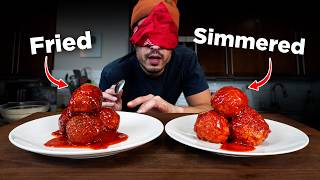

Fried vs. Simmered Meatballs: The Ultimate Showdown
42sThe classic culinary debate instantly sparks engagement as viewers pick sides and defend their family traditions.
▶ Play Clip"Title promises family drama but delivers a solid, methodical cooking experiment — mostly on topic, slightly overhyped."
The video explores the culinary debate between frying and simmering meatballs, presenting a blind taste test to determine which method is superior. It covers the preparation of a classic meatball recipe, tests both cooking methods, and concludes with a surprising verdict.
The video introduces a playful yet intense debate: frying vs. simmering meatballs in sauce. It sets up a blind taste test to determine which method is better.
The recipe uses 1.2 lbs of a 1/3 beef, 1/3 veal, 1/3 pork mix. Eggs are blended into the meat first, then a panade of breadcrumbs, pecorino romano, ricotta, tomato sauce, parsley, garlic, and salt is prepared separately.
The panade is made without egg so it can be tasted for seasoning. The meat and panade are combined to distribute flavor evenly.
The meatball mixture is chilled to firm up, making it easier to form balls. This step is crucial for achieving nice, sealed balls.
For the simmered method, raw meatballs are added directly to a simmering tomato sauce. Proponents argue this captures all the fat and flavor, resulting in a more tender meatball.
For the fried method, meatballs are browned in olive oil. A common criticism is that flavor is lost in the pan, but this can be mitigated by deglazing the pan and adding the fond back to the sauce.
A blind taste test revealed that the simmered meatballs were more tender, while the fried ones had a firmer texture. The fried meatballs' sauce had a deeper, richer flavor.
The final recommendation is to fry half the meatballs and simmer the other half, combining the flavors of both methods. This yields a more complex sauce and a variety of meatball textures.
The Egg Coating Technique
Explains a nuanced step—coating the meat in egg before mixing—that ensures even flavor distribution.
01:11Tastable Panade
A clever trick: preparing the panade without egg so you can taste and adjust seasoning before mixing with meat.
01:41Deglazing the Fond
Offers a practical solution to preserve flavor from frying, countering a common criticism of the method.
06:27The Best of Both Worlds
Concludes with a hybrid approach—frying half and simmering half—to maximize both flavor and texture.
09:05[00:03] Whichever one that is, it's money. They use the same ingredients, made from the same recipe, cooked in the same sauce, but they are different. The question at hand is which is better, frying your meatballs or simmering them directly in
[00:17] the sauce. The answer probably a bit more surprising than you think. The only question is if you're prepared to accept if your known's been wrong all along. And by the end of this video, I think you'll have a clearer picture of where
[00:29] you land with your meatballs. Do you fry them or do you simmer them in sauce? if you watched my last video on meatballs, my updated 2.0 video, you
[00:43] know we got these dialed in, but there's always more to refine. If you haven't link down in the description, but we'll fly through it quickly. Now, I've got fly through it quickly. Now, I've got about 1.2 2 lbs of meat. One/3 beef, 1/3
[00:56] ve 1/3 pork. To that, two eggs. This is sort of where things separate. Usually, people might just toss everything in here. The secret to meatballs is not going to take the egg and we're going to start to squeeze everything together.
[01:11] The idea being to get every morsel blended and coated in that egg. Once that's taken care of, in a separate bowl, we then combine everything else to essentially make a panad. We're using about a/2 cup of breadrumbs, equal
[01:26] amount of pecorino romano, riot, start with about 1/4 cup, a little tomato sauce, chopped parsley. We got one clove of garlic. We never want to do too much. And we're going to grate that on a microplane into the mix. And then salt.
[01:41] Get it mixed up with your hand. And because there's no egg in it, now we can actually taste it. It tastes seasoned. I almost want it overly seasoned to compensate for the lack of seasoning in the meat. Now you're going to combine
[01:53] everything. So now instead of little pockets of flavor that are kind of like isolated, all that flavor is distributed throughout all of that meat. And now the test is if a ball can hold. Now, because we just worked it, we want to do is
[02:06] chill it down, firm it up so it's easier to form nice balls, nice shaped balls fridge. Now before we get into it, good coffee used to require equipment and
[02:18] skill in order to make at home. But thanks to our sponsor today, Cometier. Good coffee at home now requires neither. Cometier is a new way to make or should I say melt coffee at home with no machine and no skill required. They
[02:32] some of the world's best specialty coffee roasters like Counterculture and Onyx. They brew the coffee at 10 times the strength and then immediately flash freeze it into these little recyclable aluminum capsules to lock in the
[02:46] a simple hot coffee lover, all you got to do is pop out one of the pucks and add 6 to 8 oz of hot water and boom, fresh coffee in an instant that tastes like a barista just brewed it in your
[02:58] home. Or maybe you're more of a latte person. Just melt the pod, pour it over beautiful latte without an espresso machine. Do you want to know my favorite thing to do? Place a scoop of ice cream down in a bowl. Add one melted pod.
[03:11] Little flaky salt. You got a beautiful little avocado. As classic as Italian gets. And Commenters never concentrated dried or evaporated. So zero flavor is lost from bean to cup. And you don't need to brew your coffee with a plastic
[03:24] machine. For a limited time, Cometier is offering their advent calendar with 24 unique coffees you can drink every morning or gift to the coffee lover in your life. You can get $30 off your advent calendar at
[03:37] cometier.com/notcooking show30 or by visiting my link down in to make meatballs, just pull them out of the fridge and we can start forming balls. You can use your hands to sort of pinch little balls out to do the
[03:51] portioning. You can use an ice cream scoop. The size is really up to you. I like mine on the smaller size. Then use your hands to roll them into a nice smooth ball, ensuring they're like sealed and void of any large cracks. Now
[04:03] we have the meatball recipe taken care of. Next is the real test. The best method for cooking them. Now both of the methods start the same. The first step is to prepare the sauce. We're just making a simple weekday sauce. A little
[04:16] oil in each pan. A clove of garlic to infuse that oil. You could add basil if you like, but we're trying to keep it simple for this test. Once that garlic it, or you could keep it in if you'd like. Then we're going to lower the
[04:28] heat, allow that oil to cool slightly, and then we're going to pour in our tomato. one jar per pot. And we're going to rinse those jars with water and add them to add a little bit more moisture in them to compensate for the long cook
[04:40] start simmering. Now, you should see at this stage, it should be a bit looser than you might want it for like a pasta. It's going to start to reduce down and don't want it too thick to start. Now,
[04:54] real debate. In this part, we're going to just drop the raw meatballs into the sauce. We're going to get that sauce simmering gently and we're not going to method, I'm going to make a few assumptions. The main thing is by not
[05:09] placing them straight into the sauce, the sauce is now capturing all of the fat of the meat rather than losing it in another pan and then transferring them in. They say all the flavor remains in the sauce and you get a more tender
[05:22] meatball. One of my assumed knocks on this method is that you lose the flavor development you get in the mayard reaction of browning meat, but it's a much less messy method and a bit of a lazier one versus the way that I prefer
[05:35] meatballs in a healthy amount of olive oil about a/4 in coating the bottom. And I'm only cooking a few, so I'm going to use a smaller pan. Once the oil is at a them clockwise. And it's important to remember that because we're going to
[05:48] flip them in the same order we added them. Once you see those edges browning, give it a little flip. And then we're just going to go ahead and brown that other side. Now, one of the assumptions here that people argue is by doing this,
[06:00] frying them in a separate pan, you're losing the fat and the flavor even if you add them to the sauce. In my opinion, a crust is put into a sauce will soften in the sauce. The sauce sort of pulls that flavor from the brown
[06:14] meat. Now, like I said, one of the knocks of frying is that you lose all that flavor. the fond that gets stuck on the bottom of the pan. If simmering them captures all the flavor, then by simply draining that oil, delazing with a
[06:27] little bit of water, clean that bottom of the pan, scrape up all those bits, then we can add them back to the sauce. And it's important because we're not testing the meatballs impact on the sauce. And we will not be cooking these
[06:41] sauce. And we will not be cooking these meatballs any longer than 45 minutes. As we've talked about, the fallacy of cooking meatballs all day is just a lie. going to pull them off the heat and we're going to let allow them cool down
[06:53] a little bit better. First thing we want to see is the consistency of the sauce, before. Now, we can see when we pour it over the meatballs, it kind of coats it. You never want the sauce too thick. And there's a slight darker hinge to the red
[07:08] of the fried meatballs than there are to the simmered. The simmered sauce smells This smells richer and like kind of deeper, more complex. Once this cools
[07:20] test the meatballs and the sauce of each. Okay, so as you can see, labeled fried, labeled simmered. Add the sauce.
[07:34] My friends all have kids. I don't have anyone to do this blind taste test. So, what we're going to do here, these are going to blindfold me up. Isaac, let this run one shot. Just so they know there's no fooling around. So on the
[07:47] street, just like the four card monty or whatever it is
[08:07] going to go over here. Feels a little tougher. Tougher to cut through, but more tender in the bite.
[08:29] I kind of tend I kind of lean towards over here.
[08:52] I like this one better. These two probably edge out these two.
[09:05] taste the simmered meatball and the fried sauce. The result breaks some of the assumptions. I personally never bought into the idea that simmering in browning something and then cooking it in a sauce. Instead of just choosing one
[09:19] method or the other, how about we meet in the middle? Start it like we normally will. Get your sauce on the stove and you're going to take half your meatballs and you're going to put them straight into the pot. And then in a separate pan
[09:31] with the olive oil, fry the rest of the meatballs. By doing this, you get the best of both worlds. You get a variance of the meatball which are good whichever way you cut it, but you get the deep flavor in the sauce, which is bar none
[09:44] better than the simmered sauce cuz the texture of the simmered sauce, it is more tender. Now, we're talking the nittygritty here. This is how you get great at cooking. You find your recipe in the best way to execute it and you
[09:56] continuously over time improve it. We don't keep going over meatballs to show the same thing. We keep covering it to push it a little bit further. So, I encourage you to give this a shot. I'll leave a recipe for the meatballs down in
[10:09] today. I'll see you next time. Until then, take care of yourself and go feed then, take care of yourself and go feed yourself.

⚡ Saved you 0h 10m reading this? Transcribe any YouTube video for free — no signup needed.