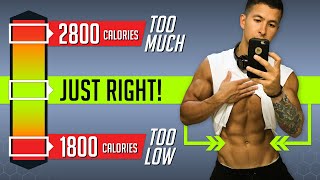

Calorie Deficit: Don't Screw It Up!
30sHigh relatability and urgency for anyone trying to lose weight, highlighting common mistakes.
▶ Play Clip"The title accurately reflects the video's content, which provides a clear, step-by-step method for calculating calorie intake for fat loss."
This video provides a science-based, three-step method to calculate your ideal calorie intake for fat loss while preserving muscle. It emphasizes the importance of a personalized approach, avoiding common mistakes like eating back exercise calories, and fine-tuning based on progress.
Multiply body weight in pounds by 10 to 13; higher end for younger/leaner/more active, lower end for older/less lean/less active.
Aim for 0.5-1% body weight loss per week; use body fat % divided by 20 for a personalized rate.
Track calories and morning weight for 4 weeks; adjust calories by ~10% if actual loss differs from target.
Fitness trackers overestimate by at least 20%; a full-body resistance workout burns only ~160 cal (men) / ~80 cal (women).
Only increase intake for unusually high activity like competitions or two-a-day training.
What is the simple calculation to estimate your starting calorie intake for fat loss?
Multiply your body weight in pounds by 10 to 13.
01:26
What is the recommended rate of weight loss per week to minimize muscle loss?
0.5% to 1% of your body weight per week.
02:45
What is Greg Knuckles' formula for a more personalized rate of weight loss?
Divide your current body fat percentage by 20.
03:16
After how many weeks of tracking should you analyze your weight loss data to fine-tune your calorie intake?
After about four weeks of tracking, analyze the data, dismissing week one due to water weight loss.
04:39
If Steve is losing weight slower than his target, what adjustment should he make to his calorie intake?
Drop his calories by another 10% or so.
05:23
Why is eating back calories burned from exercise problematic?
Fitness trackers, cardio machines, and humans are terrible at estimating calories burned, often overestimating by at least 20%.
06:28
According to a 2019 paper, how many calories does a full-body resistance training workout burn on average?
About 160 calories for men and 80 for women.
06:54
When is it appropriate to eat back calories burned from exercise?
If you are an athlete with a big sports event, competition, or two-a-day training session.
07:50
Muscle Loss and Weight Regain
2020 research shows muscle loss during dieting is linked to increased appetite and weight regain, emphasizing the importance of preserving muscle.
02:15Personalized Weight Loss Rate Formula
Greg Knuckles' formula (body fat % / 20) provides a more accurate, personalized rate of weight loss to maximize fat loss while minimizing muscle loss.
03:16Calorie Burn from Resistance Training
A 2019 paper quantifies the actual calorie burn from a full-body resistance workout (160 cal for men, 80 for women), debunking overestimation.
06:54Activity Levels Already Accounted For
The three-step method already averages activity levels, so eating back exercise calories is unnecessary and counterproductive.
07:37[00:00] The fact that you've decided to click this video tells me that you know the importance of calories when it comes to dieting and lose fat, regardless of how clean your diet may be. And you likely also understand that in order for fat loss to occur, you need to be eating
[00:15] the right amount of calories to force your body to start burning the stored fat that you have for energy. Now this sounds simple, but in practice, people often screw this up. And they screw it up by either eating too many calories to see any noticeable change, or
[00:29] they'll eat too few calories and end up burning the harder muscle off for energy instead of fat. In today's video, I'll clear up the confusion for you and show you how to pinpoint exactly how many calories your specific body needs a day in order to maximize your fat loss while
[00:43] minimizing muscle loss in any other negative effects. The first step is to get a general estimate of the amount of calories you should be eating to start experiencing fat loss, which we can then refine later on.
[00:55] Now, to get this estimate, there's an overwhelming number of different equations and calculators out there for us to choose from. But keep in mind that even with the most accurate of the equations out there, like the catch from a cardio method, for instance, they are all estimates, and are not going to be 100%
[01:10] accurate methods for pinpointing exactly what your calorie intake should be to lose fat. Instead, they all require some fine tuning based on how you progress, which is what we're going to do in step two. So for now, just to avoid overcompicating things, what I'd recommend is to instead use a very
[01:26] simple calculation that for most people is going to put them into a calorie deficit and is a good starting point for us to then refine. All you do is you take your body weight and pounds and you multiply that by anywhere from
[01:38] 10 to 13. If you're a younger, leaner, and or more active individual, then go with a higher end of this range. If you're an older, less lean, and or less active individual, then go with a lower end of this range.
[01:51] This will then give you a good estimate of the number of calories that you should start eating that per day in order to lose weight. The next step is to determine what an appropriate rate of weight loss would be based on your specific body.
[02:03] This is important for us to get right because if we eat too few calories and lose weight too quickly, not only is this unsustainable for most of us in the long run, but it also puts us at a greater risk for muscle loss.
[02:15] And we want to avoid that from happening, not only because it will take away from our physique once we do lose a bunch of weight, but also because of what happens after we diet. For example, recent 2020 research found that muscle loss one diet in is associated with an increased
[02:31] appetite and increased weight regain after the diet is over, leading its subjects to end up in a worse position than they were before they started their diets. Meaning that for the best chances of both short-term and long-term success, maintaining your
[02:45] muscle mass as you diet down needs to be your priority. We can do this by using an appropriate rate of weight loss. And a good general guideline to stick to is one recommended by the work of Dr. Helms and colleagues, which is the aim for a rate of weight loss of no more than 0.5 to 1% of your body
[03:01] weight per week. However, taking this guideline one step further, we know based on past research that the more body fat that you have to lose, the faster you can lose fat without risking muscle loss, which is why we see a range with Dr. Helms' recommendation.
[03:16] So what you can do to refine and personalize this guideline a little bit more is to use a simple calculation developed by Greg Knuckles, which is to take your current estimated body fat percentage and divide that by 20.
[03:28] The number you get will be a more accurate percentage rate of weight loss that you'll want to aim for per week. And it's going to enable you to maximize fat loss with minimal or no muscle loss. So for example, if you're currently at 20% body fat, you can safely lose around 1% of
[03:43] your body weight per week. For 190 pound individual, this would equate to a rate of weight loss of roughly 2 pounds per week. But in other case, for 180 pound individual at 15% body fat, using the body fat percentage
[03:56] divided by 20 calculation, they could safely lose around 0.75% of their body weight per week, which is a slower rate of weight loss of around 1.5 pounds per week. So just take a look at this body fat chart, estimate your current body fat and use this
[04:12] simple calculation to determine what the appropriate rate of weight loss would be for you. Once you have this number down, it's time to implement it and fine tune it with step three. We want to start adhering to and monitoring your daily calorie intake as well as tracking
[04:26] your morning body weight. We're going to use this data to fine tune your calorie intake so there's no longer a rough estimation of what we should be eating that to lose fat, but instead, much more accurate and fine tune to use specifically.
[04:39] To do so, after about four weeks of tracking, analyze the data. Week one we can often dismiss since most people will lose quite a bit of water weight during this initial period of dieting. But in the following weeks, we want to look a little bit more closely at the numbers.
[04:53] More specifically, how has your weight changed relative to your calorie intake? For instance, let's say Steve at 15% body fat 160 pounds has a goal rate of weight loss of about 1 pound per week and is eating at 2,000 calories a day to try to achieve that.
[05:09] But after implementing this from weeks two to four, he found that his actual weight loss was slower than his target as he only lost on average about half a pound per week. This is good, but indicates that his estimated calorie intake was just a little bit too high.
[05:23] So to adjust, only if he felt like he could do so, he would simply drop his calories by another 10% or so to hit his target rate of weight loss a little bit more accurately. On the other hand, if Steve was losing weight too quickly, so for example, two plus pounds
[05:38] per week, then he'd actually want to do the opposite and increase his calorie slightly just to slow this down to minimize the risk of muscle loss. And that's basically all there is to it. You put your original estimate into practice and then find to this number based on how your
[05:52] weight progresses throughout the week. But also taken to consideration how sustainable the calorie deficit you're adhering to is. Science aside, if your recommended weight loss is 2 pounds per week, yet you just personally
[06:04] find this pretty difficult and too aggressive of a deficit, then slow it down. It's not a race. Stick with the rate of weight loss as sustainable for you as that's ultimately what's most important for long-term success.
[06:16] Now with that being said, there's one all-too-common mistake that people make with these three steps that you'll want to avoid, which is attempting to eat back the calories that they burn from their workouts or from exercise in general.
[06:28] And this is problematic for a couple reasons. The first reason is because fitness trackers, cardio machines, and even us as humans are terrible at estimating the calories we burn through exercise, and we almost always overestimated
[06:42] by at least 20%. In typical weights workout, for example, you actually don't burn very many calories at all. Illustrating this is a 2019 paper which found that after a full body resistance training
[06:54] workout, male subjects on average burned an additional 160 calories during the workout and females burned about half that at about 80 calories. Plus an additional yet insignificant eight calories burned from that afterburn effect, which
[07:09] is much at all and becomes problematic because after a ruling leg day, for example, oftentimes we'll have a cheat meal or just eat everything in sight, thinking that we'll easily offset it from the calories that we burned during the big workout, which just isn't true.
[07:24] Cardio is a little bit better at burning calories, but still, people overestimated calories that burn here just as bad. And secondly, the three-step method that I previously went through, it already takes into account and averages your activity levels.
[07:37] Therefore, the calories that you burn from physical activity and throughout the day are already accounted for. And if you do end up losing weight too quickly because of your additional exercise, then you would just adjust this by eating more as we discussed earlier.
[07:50] So just keep it simple. The only times when this would potentially apply is if you're an athlete and have a big sports event, competition, or two- a day training session coming up where you would burn considerably more calories than you normally would.
[08:03] In this case, it would be advised and recommended to bump up your intake for that day mainly with carbs just to fuel your performance. So to wrap everything up for you, here is a step-by-step example of how you could start applying
[08:16] this right away. First, determine what your estimated calorie intake should be to lose fat based on the simple equation of line to step one. Then determine what your optimal rate of weight loss should be based on the simple equation
[08:28] of line and step two. And finally, implement this while monitoring how your weight progresses throughout the weeks and if needed, adjust your calorie intake so that your actual rate of weight loss is closer
[08:40] to your target. And that's pretty much all there is to it. This does, however, assume that you're tracking accurately in the first place and being consistent with your activity levels. So don't overlook those other variables as well as they are just as important.
[08:53] For a step-by-step program that shows you how to easily set up, track, and monitor each of these important variables while equipping you with a science-based nutrition and training program designed to transform your body as efficiently as possible and simply head on
[09:08] over to builddesigns.com and take our analysis quiz to discover the best program for you and your specific body. Within the program of also developing nutrition software that will take care of all the guests
[09:20] for for you by adjusting your calories and macros for you as your progress throughout the weeks. So check it out as it really has been a game-changer for all of our members. Anyways, that is it for today's video guys. I hope you enjoyed it.
[09:32] Please don't forget to show you support by giving the video a like. Leave any comment down below as to what you'd like to see me cover next. Subscribe to the channel and turn it on notification for the channel as well as this all really does help me out. Thank you so much everyone. See you next time.


⚡ Saved you 0h 09m reading this? Transcribe any YouTube video for free — no signup needed.