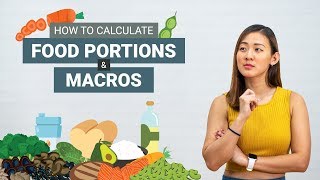

Why Your Macros Matter More Than Calories
39sEducational foundation that explains the three macronutrients and their impact on fitness goals.
▶ Play Clip"The title promises a guide to counting portions and macros, and the video delivers exactly that with step-by-step calculations."
This video by Joanna provides a detailed guide on calculating personal food portions and macronutrients (macros) based on individual body composition, activity level, and goals. It explains the formulas for resting energy expenditure (REE) and total daily energy expenditure (TDEE), and then shows how to derive grams of carbs, protein, and fat for each meal.
Macronutrients (carbs, protein, fat) provide energy in calories. The body uses carbs first, then fat, then protein. Balancing macros impacts fat loss, muscle gain, or weight maintenance.
REE is calories burned at rest. The formula for women: 10 * weight (kg) + 6.25 * height (cm) - 5 * age - 161. Example: 50 kg, 159 cm, 29 years gives 1187.75 calories.
TDEE = REE * activity factor. Activity levels: sedentary (1.2), lightly active (1.375), moderately active (1.55), very active (1.725), extra active (1.9). Example: 1187.75 * 1.55 = 1841.01 calories.
For weight loss, reduce 300-400 calories daily. For muscle gain, increase calories.
Balanced diet: 40% carbs, 30% protein, 30% fat. Fat loss/blood sugar: 30% carbs, 40% protein, 30% fat. Keto: higher fat, low carbs. Endurance athletes: higher carbs.
Using 1800 calories and 40% carbs: 720 calories from carbs → 180g (720/4). Protein: 30% = 540 cal → 135g (540/4). Fat: 30% = 540 cal → 60g (540/9).
70% of daily macros in main meals, 30% in snacks. For carbs: 126g for 3 meals = 42g per meal; 54g for 2 snacks = 27g per snack.
Good calories (nutrient-dense foods) lead to better health and energy. Bad calories hinder weight loss and cause sluggishness. Don't obsess over counting; focus on awareness.
Counting macros increases awareness of food quality and quantity, helping you choose healthier options to achieve personal fitness goals. The video ends with a call to share your own macro breakdown and subscribe.
What are the three macronutrients?
Carbohydrates, protein, and fat.
00:24
How many calories per gram do carbohydrates provide?
4 calories per gram.
04:41
What is the formula for Resting Energy Expenditure (REE) for women?
10 * weight (kg) + 6.25 * height (cm) - 5 * age - 161.
01:36
What is the activity factor for a moderately active person?
1.55.
02:39
If your goal is fat loss, how many calories should you reduce daily?
300 to 400 calories.
03:10
How many grams of protein are in 120 grams of salmon?
Approximately 32.5 grams of protein (as per the example).
07:32
What is the optimum fat intake per kilogram of body weight?
1 gram per 1 kilo of body weight.
07:59
If you have a total of 135g of protein daily and want 70% from main meals, how many grams per meal if you have 3 meals?
31.5 grams per meal (94.5g / 3).
07:01
What does REE stand for and how is it defined?
Resting Energy Expenditure: the total calories a person burns at rest doing nothing.
01:09
What is a good example of a high-fat food mentioned?
Avocado, oils, butter, nuts, seeds, fatty fish.
07:59
Macronutrients Definition
Fundamental concept that underpins the entire video; essential for understanding energy balance.
00:24REE vs TDEE Distinction
Clarifies the difference between resting and active calorie needs, a core principle for personalized nutrition.
01:09Not All Calories Are Equal
Emphasizes food quality over mere numbers, a key principle for long-term success.
09:35Don't Obsess Over Counting
A sanity check reminding viewers to use awareness, not stress, to make healthier choices.
09:50[00:00] 30-minute workouts, 20-minute recipes, 10-minute mindfulness. Ready to become? Get feel on the App Store or Google Play. Hey guys, it's Joanna here. Let's talk about
[00:12] calculating your food portion and macros. Everybody's body composition is different. Hence, my daily food portion and macros will never be the same as yours or another person.
[00:24] Let's first understand what exactly are macros. Macronutrients provide energy in the form of calories and make up the three major components of food, carbohydrates, protein and fat. Our bodies use carbs first, followed by fats,
[00:43] and then protein as a fuel source, consuming the right balance of macronutrients can significantly impact your results, whether it's fat loss, muscle gain or weight maintenance.
[00:55] What I want you to do right now is grab a calculator as well as a pen and paper because we're going to figure out how many calories you need in a day as well as your macronutrients break down.
[01:09] Let's first figure out your calorie needs based on your body composition and lifestyle. We need to determine two things. Your resting energy expenditure or REE, which is the total calories
[01:22] a person burns at rest, that means doing absolutely nothing. Second, total daily energy expenditure or TDE. The total calories you burn in a day including
[01:36] the body's internal and external activities. Here are the REE formulas for both men and women. Mine will be 10 multiplied by 50 kilos, 6.25 multiplied by 159 centimeters, and 5 multiplied by 29 years old.
[01:58] Once you have the numbers, let's calculate your REE, which is 500 plus 993.75 minus 145 minus 161,
[02:11] which gives me a total of 1187.75. And that's my REE. Now let's move on and calculate your total daily energy expenditure.
[02:23] The formula for this is to take your REE multiplied by your activity level. Now let's determine your physical activity. Sedentary, lightly active, moderately active, very active, or extra active.
[02:39] I'm going with moderately active, so my TDE is 1187.75 multiplied by 1.55. And that gives me a total calories of 1841.01.
[02:57] For this video, let's just go with 1,800 calories in a day. Calories can either be added or subtracted from your total expenditure in order to achieve different goals.
[03:10] For example, if your goal is weight loss, then you should consume fewer calories than you expand. You may want to reduce between 300 to 400 calories daily. If you want to gain muscle mass or increase your weight,
[03:23] then you need to increase your total calories. Decide your macronutrients breakdown. Depending on what diet you're following or your goals, your macros will be different. For example, if you're following a balanced diet, then the macros will be 40% cups, 30% protein, and 30% fat.
[03:43] If your goal is to lose excess body fat and have better blood sugar control, then you may do better on 30% cups, 40% protein, and 30% fat. If you are currently on a keto diet, then the ratio would favor fat more with fewer cups.
[04:00] For an endurance athlete, they will need a higher cup intake. Hence macros ratios vary depending on your dietary preference, fitness goals, and activities. How to calculate your macros?
[04:14] Once you've decided your ratio, let's learn to calculate your macros. For this video, I'm going with a healthy balanced diet, which is 40% cups, 30% protein, and 30% fat.
[04:27] Now, let's decide how many meals you intend to have in a day. I'm going with three main meals and two snacks. Let's start with cups. Cups include sugars, starches, and fibers.
[04:41] For your greens, beans, lentils, vegetables, fruits, and dairy products. Cups provide four calories per gram. The optimum intake is three grams of cups per one kilo of your body weight.
[04:54] If you are on a low-cap diet or if you're looking to lose weight, then you can go with two grams. So, 40% out of 1,800 of total calories in a day equals to 720 calories of cups per day.
[05:10] Hence, the total grams of cup allowance is 720 divided by four, which means 180 grams of cups. You want to keep your main meal to about 70% of your total daily intake, and the remaining 30% for your snacks.
[05:27] Hence, 70% from 180 grams equals 126 grams. Now, let's divide that by three meals. That means 42 grams of cups per meal.
[05:41] The remaining 30% from 180 grams equals 54 grams of cups divided by two snacks that gives you 27 grams of cups per snack.
[05:53] This is just to give you an idea of the cup content in some common foods. So, a main meal portion can consist of half a cup of rice, half a cup of broccoli, half a cup of carrots and half a cup of edamame.
[06:08] That will equate to 36.5 grams of cups. And a snack can be one banana. Let's move on to protein. Similar to cups, protein provides four calories per gram.
[06:21] Examples of protein-rich foods include eggs, meat, poultry, fish, soy, beans, and lentils. The optimum intake is between 1.5 to 3 grams per 1 kilo of your body weight.
[06:36] Now, this calculation depends on your lifestyle and also your training intensity. So, 30% out of 1,800 calories equals to 540 calories of protein per day.
[06:49] So, the total grams of protein allowance will be 540 divided by 4 calories. That gives me 135 grams of protein.
[07:01] Now, let's first look at your main meals. So, let's take 70% from 135 grams of protein. That means you have 94.5 grams divided by 3 meals giving you 31.5 grams of protein per meal.
[07:17] And the remaining 30% out of 135 grams of protein equals to 40.5 grams divided by 2 snacks. That gives you 20.25 grams of protein per snack.
[07:32] These are the protein content for some of the common foods. For example, my main meal can be 120 grams of salmon and half cup of edamame, which equals to 32.5 grams of protein.
[07:46] And my snack can be a protein shake. Finally, fats. Fats have the most calories of all macronutrients providing a total of 9 calories per gram.
[07:59] Fats are found in foods such as oils, butter, avocado, nut and seeds, meat, fatty fish and dairy products. The optimum intake is 1 gram per 1 kilo of your body weight.
[08:13] If you're on a low fat diet, then it will be 0.5 grams. And high fat would be between 2 grams up to 2.5 grams. Fat will be the remaining 30% from 1,800 calories.
[08:27] That gives me 540 calories of fat per day. So my total fat allowance equals 540 grams divided by 9 calories. That means 60 grams per day.
[08:41] Let's assume that you do not include any fat into your snacks. Let's take 100% from 60 grams of fat divided by 3 meals. That gives you 20 grams of fat per meal.
[08:54] For example, my main meal can be fat from 120 grams of salmon and quarter of an avocado. And that equals to 23 grams of fat. My macronutrients breakdown in a day will be 180 grams of cups,
[09:10] 135 grams of protein and 60 grams of fat. And that gives me a total of 1,800 calories. You don't have to be extremely precise with the macronutrient count for each meal,
[09:23] because some meals may be bigger than the others. But in to hit your total macros and calories from all your meals in a day. Remember, not all calories are equal.
[09:35] Consume more good calories and you will be healthier, have more energy and achieve your fitness goals quicker. If your diet is filled with bad calories, then it will hinder your weight loss goal and you will feel sluggish.
[09:50] Should we obsess over counting calories or macros? No, it should not stress you out. I believe that we should learn to count our macros to increase our awareness of the quality
[10:03] and amount of food we consume in a day. As a result, this will encourage us to choose healthier nutrient dense food to achieve our personal fitness goals. Let me know what are your macronutrients breakdown in the comments below and your total calories in a day.
[10:20] If you find this video extremely useful, then give this video a thumbs up, share this video and be sure to subscribe to my YouTube channel. Do also check out my other fitness videos on my channel or the best.
⚡ Saved you 0h 10m reading this? Transcribe any YouTube video for free — no signup needed.