
Profit in Both Directions!
45sThe promise of a strategy that profits whether the market goes up or down is highly engaging and counterintuitive, sparking curiosity.
▶ Play Clip"Title accurately reflects the strategy's ability to profit without guessing direction, though it oversells 'professionals' slightly."
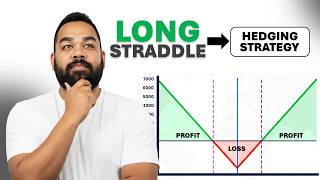
This video explains the long straddle options strategy, which allows traders to profit from significant market moves in either direction while limiting losses to the total premium paid. The strategy is ideal for volatile market conditions such as news events, breakouts, or breakdowns.
The video introduces a strategy where traders can profit whether the market goes up or down, unlike simple call or put buying which only profits in one direction.
A long straddle involves buying both an ATM call and an ATM put at the same strike price. For example, with Nifty at 25713, buying 25700 call and put. Total premium paid is the sum of both premiums.
Straddles are deployed in volatile conditions like news events, result days, breakouts, or breakdowns where sharp movements are expected. It is a debit strategy for intraday use.
Profit occurs when the premium of one leg increases more than the total premium paid (e.g., if each premium is ₹100, total ₹200, profit when one side exceeds ₹200). Loss occurs if the market stays near the ATM strike, causing both premiums to decay.
Choose strikes with similar premium values to balance the strategy. For example, using 25650 call (₹110) and 25750 put (₹109) gives a total premium of ₹219, with a loss range of about 150 points up and down.
Straddles should be used only when technical analysis indicates high volatility, such as breakouts or breakdowns. Avoid using OTM strikes; always use ATM for better premium growth.
The long straddle is a powerful strategy for volatile markets, offering unlimited profit potential with limited risk. Proper timing and strike selection are crucial for success.
What is a long straddle?
A strategy where you buy both an ATM call and an ATM put at the same strike price to profit from large moves in either direction.
01:25
What is the maximum loss in a long straddle?
The total premium paid for both options.
09:42
When should you use a long straddle?
When expecting high volatility, such as during news events, result days, breakouts, or breakdowns.
02:10
Why should you choose strikes with similar premiums?
To balance the strategy so that the gain from one leg offsets the loss from the other, reducing the required move for profitability.
07:30
What happens if the market stays near the ATM strike at expiry?
Both options expire worthless or lose value, resulting in a loss equal to the total premium paid.
05:40
Should you use OTM strikes in a straddle?
No, always use ATM strikes because they have higher delta and premium growth potential when moving ITM.
13:10
Straddle Definition
Core concept of the strategy: buying both call and put at same strike.
01:25Market Conditions for Straddle
Emphasizes that straddle is not for all markets; requires volatility.
02:10Strike Selection Tip
Practical advice to choose strikes with similar premiums for better balance.
07:30When to Use Straddle
Reinforces that technical analysis should guide the decision, not random expiry days.
11:58[00:02] In today's video, I am going to tell you such a strategy of option buying you can make profit in both directions, whether the market goes up or down.
[00:30] goes up then he has to buy a call or if the market goes down then he has to buy a put. But if the market goes up then it is fine. But there are two conditions for its loss. If the market remains sideways or the market remains against it.
[00:45] He will suffer loss in both the conditions. He can make profit only under one condition. Now, in the same way, if we look at a put buyer,
[00:57] remains sideways. Even if the market moves up against him, he will still incur a loss. Now if I want to manage both these things and I and I want to have only 33% loss then I will have to
[01:11] make a strategy. So what will happen with this strategy? Even if the market goes up, there is profit. Even if the market goes down, there is still profit. Only if the market remains sideways, you will incur loss. What will we do to create this strategy? Let us assume that the
[01:25] market is currently at 25713, then 25700
[01:37] is an ATM premium for the call for us. ATM is the strike price and the put at 25700 is an ATM strike price for me on the put side. If I buy both these strike prices at the same time, then
[01:55] a strategy is formed here which we call straddle. Studdle is a strategy that is dual directional. In this strategy, we directional. In this strategy, we
[02:10] that a volatile condition will develop in the market. Meaning, an important thing is coming up here that first we will have to understand the market conditions. We cannot deploy this strategy everywhere. So we deploy this strategy
[02:25] in such market conditions where the market can be volatile and there can be many different logics for being volatile. Let us assume that there is some news in the market or there is any kind of result day in the market due to which there can be a big movement in the market. There
[02:42] result day in the market due to which there can be a big movement in the market. There such days there are volatile moves in the market. If seen from a technical point of view, let us
[02:54] assume that there is a breakout or a breakdown in the market. Now at the time of breakout or breakdown we have seen that there is
[03:06] a sharp movement in the market. Sharp movement either in the direction of breakout or breakdown or many times we have seen that the market reverses due to liquidity gap. we have seen that the market reverses due to liquidity gap.
[03:20] is possible. And this type of strategy is a debit strategy. We plan this mostly for intraday. An intraday strategy
[03:32] in which we want to gag the market momentum. Debit strategy means where we have paid the premium and where the premium has been paid, we have to think that it will give us profit only when the premium grows. So let's say
[03:48] we designed a straddle and in this straddle we bought one call and one put. in this straddle we bought one call and one put. For an example, the price of the call is also ₹100 and the price of the put is also ₹100. One lot of Nifty is worth Rs 65. Meaning,
[04:05] to make this strategy you have to pay ₹6500 here and ₹6500 here. Your total investment is approximately ₹13,000. Now if the market
[04:19] moves strongly up then the prices of our calls will grow. From 100 it will become 200 , it will become 300, it will become 400. But in the same condition, the prices of our puts will be lower. Meaning, we will make profit from one leg and we will incur loss from the other leg.
[04:37] and we will incur loss from the other leg. And this is where Stadel shows his behavior. Straddle is a strategy that will generate profits from one leg and losses from the other. that will generate profits from one leg and losses from the other. Meaning, if one premium is ₹100 and the
[04:50] other premium is also ₹100, then you will make profit only when the premium of one side is profit only when the premium of one side is more than 200 points. This means that more than 200 points. This means that
[05:05] example we have taken here, we have bought both ₹100 plus ₹100. The total we have bought both ₹100 plus ₹100. The total premium we have paid is ₹200. If the premium goes above ₹200. Let's say it could be 205 or 210 or 250. Only then will we make
[05:23] profit. Because when the premium on one side grows, our premium on the other side will also decrease. And there is only one condition where we can incur loss if the market expires near ATM. Meaning the
[05:40] premium on either side is not growing comparatively. Here, we will not get profit due to increase in premium of any one side. Our premium should grow with the total paid premium. Our premium should grow with the total paid premium.
[05:56] Only in that condition can it give you profit. Meaning here there should be high volatility in the market Meaning here there should be high volatility in the market or we can say that there should be high momentum or we can say that there should be high momentum move. How to capture high volatility or high
[06:08] momentum moves? This is a technical understanding. Here today we are just talking about it. How to make profit if the market is volatile? You do n't have clear directions. You do n't have this understanding. There
[06:22] is no strong view whether the market will go up or down. But you have the view that But you have the view that a volatile move will definitely come from here and in that condition we create a long straddle. So whenever it comes to option trading,
[06:36] my first preference is right. Because in the right platform I can see everything on one platform. Here, when I want to trade Nifty options and create a straddle, it is very important for me to get
[06:49] very important for me to get also have to see the chart of Nifty and both the things are visible to me on the same screen. Here I see both things together. If the market is going up, are
[07:03] call premiums increasing? If the market is going down, are put premiums going up? If we can see this together, our trading journey becomes even better. Also, if you want to start by opening an account on the Sahi platform,
[07:16] if you want to start by opening an account on the Sahi platform, you also get free brokerage for the first 30 days. So look here, this strike price is running around 25713. And my call side ATM is 25700
[07:30] and put side ATM is 25750. If I talk about 700, then its strike price value is ₹81 and if we see its strike price value if we see its strike price value then it is ₹19. Now this
[07:44] premium difference is where there is a catch. Mostly when we talk about strudel, people just blindly look at buying it at ATM. But here it is important that you choose such strike prices whose premium values are almost similar.
[07:59] whose premium values are almost similar. Look here, the strike price value of 25650 is ₹110 and this is ₹19. So, here I can shift to an ITM and here I will remain stuck at ATM. Meaning I will choose ATM here
[08:15] and ITM here. What is the reason behind this? Because we know that the premium on one side will grow. It will reduce the premium on the other side to zero. So if there is a difference in the premium of both the strike prices then one premium of
[08:31] yours will be reduced quickly. The second premium will grow slowly. So I want that whatever premium one side loses, at least the premium on the other side should grow to that extent. Theta effect and IV effect will definitely occur simultaneously. But still, there should be an overall
[08:47] understanding that if one premium is decreasing then the other premium should increase. So the premium we are paying here is ₹110 and here it is ₹109. We have paid a premium of approximately ₹210. Let's try this.
[09:01] So here we will buy the call of 25650. So the current value of our strike price is ₹110 and if I add the order at this strike price to the basket, it will
[09:14] if I add the order at this strike price to the basket, it will Look here, I have added one quantity one lot on the buy side here. And here I will add the strike price of 750 on the put side to the basket
[09:30] and add it to buy. I am buying two lots in total here. And here if we look at the payoff graph, you can see here what is my maximum loss
[09:42] showing? Of 6727. Because this is my total investment. Of 6727. Because this is my total investment. Ok? If I look at my estimated pay, my maximum loss is Rs 6727.
[09:58] But my profit is unlimited. If I keep the probability of profit aside for a while, it not. So in the pay off graph we see that if the market remains in which range
[10:14] then I will incur loss. If the market remains only that condition will be there in which we will incur loss. If it
[10:29] goes outside this range then we will make profit. Meaning, look at it this way that even if the market goes down strongly, we still make profit. Meaning the market is currently around 700 points. So if the market
[10:44] goes down by 200 points or goes up by 200 points then we will make profit and if it remains in the middle of this range. 150 points up from here 150 points down from here 200 points. If the market remains in this range, we will incur a loss. So here you are understanding another thing
[10:59] that how much volatility should be there in the market. Market at least broke out of this range. Now let's try changing it a little bit. Like I have
[11:11] bought the one of 25600 here. I showed you this earlier, it has to be done for 650 because the premium value here is higher. Now let's change it a little bit and see. Look, here instead of 650, I will try it with 650 instead of 600, sorry.
[11:27] Now see the change in it. When I did it with 650 my max loss increased a bit. But here my range has become smaller. Look here, the range was earlier showing us around 500 and now my range here has become
[11:44] and now my range here has become around 550. Meaning, here it got fixed 150 points up and 150 points down. When should we make a strudel? Why should we make a straddle? It is not that you do not have any direction idea in the market.
[11:58] No idea what the directions are and you can make strudel at any time. Behind any strategy, you should have an understanding of what kind of behavior the market can show right now. You will not blindly place a strudel anywhere
[12:13] or think that today is the expiry day. There might be a big movement today so I should make a strudel. Straddle should be specifically created only in such conditions where the market may be volatile or your analysis or technical
[12:28] analysis defines that there may be a strong movement in the market today. I have given you some specific conditions. If there is a breakout in the market, it can go up very strongly after the breakout. Or if the breakout fails, it can go
[12:43] down very strongly by robbing the liquidity. The second condition is if there is a breakdown in the market , if any support is broken, then the market can go down very fast from there market can go down very fast from there or it can
[12:56] go back up from there by siphoning off that liquidity with volatility. If you keep these conditions in mind and If you keep these conditions in mind and understand it on a good time frame, its movement will be very strong on intraday basis. Another thing you need to keep in mind about this strategy is
[13:10] that straddles are never made with OTMs in the market. Straddle defines ATM strike prices where your probability
[13:23] probability of premium growth increases significantly. Because as soon as an ATM strike price converts to ITM, its premium shoots up significantly. So keep this thing in mind that you should
[13:39] not place it anywhere and never make the stud with OTM.



⚡ Saved you 0h 13m reading this? Transcribe any YouTube video for free — no signup needed.