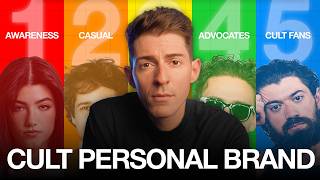

The 3 Behaviors of Cult Fans
59sClearly defines what makes a cult-like brand different from a regular one, using concrete behavioral examples that viewers can relate to and aspire to.
▶ Play Clip"Delivers a clear, actionable framework despite some repetition and self-promotion."
The video presents a four-step framework for building a cult-like personal brand on social media. It defines cult-like fandom through three behavioral differences: consuming all content, sharing it, and buying immediately. The framework includes direction, comprehension, effectiveness, and likability, with a focus on category fandom rather than peak fandom.
Cult-like personal brands have fans who exhibit three behaviors: they watch all content, share it, and buy immediately. These behaviors drive growth and revenue.
Regular fans watch some content, don't share, and think before buying. Cult fans watch all, share actively, and buy instantly due to high trust.
Peak fandom is being the number one favorite across all categories (e.g., Taylor Swift). Category fandom is being number one in a specific niche, which is more achievable for business owners.
The four components are direction (topics), comprehension (clarity), effectiveness (results), and likability (X factor). These drive the three cult behaviors.
Direction means creating content that is useful, non-obvious, and tactical. High value density increases the hit rate of valuable content, building trust and habit.
Comprehension is how well messaging sticks. Use shorter words, simpler sentences, and clearer examples to improve absorption. Chunk information like bite-sized pieces.
Effectiveness is whether viewers can implement tips and get results. If they do, it creates a reinforcing loop of trust and loyalty.
Likability includes personality, humor, and authenticity. It's the icing on top that makes content enjoyable. Three ways to increase it: look, confidence, and authentic interest.
Direction is 30%, comprehension is 40%, effectiveness is 20%, and likability is 10%. Following this formula consistently for 12-24 months builds a cult-like brand.
Building a cult-like personal brand is achievable by consistently creating content that is directionally valuable, easy to understand, effective, and likable. Focus on category fandom and execute the four-step playbook over time.
What are the three behavioral differences between regular fans and cult fans?
Cult fans watch all content, share it, and buy immediately; regular fans watch some, don't share, and think before buying.
01:06
What is the difference between peak fandom and category fandom?
Peak fandom is being the number one favorite across all categories; category fandom is being number one in a specific niche.
06:33
What are the four content components for building a cult-like brand?
Direction, comprehension, effectiveness, and likability.
10:42
What does 'direction' mean in the context of content strategy?
Direction refers to the topics, insights, and takes that are useful and non-obvious to the target audience.
11:21
How can you improve comprehension in your content?
Use shorter words, simpler sentences, and clearer examples; chunk information into bite-sized pieces.
13:45
What is the importance of effectiveness in content?
Effectiveness ensures viewers can implement tips and get results, creating a reinforcing loop of trust.
15:33
What are the three ways to increase likability?
Improve your look, build confidence, and show authentic interest in your topic.
17:24
What are the weights of the four content components?
Direction 30%, comprehension 40%, effectiveness 20%, likability 10%.
23:17
Three behavior differences
Provides a clear, objective definition of cult-like fandom based on observable behaviors.
01:06Category fandom is key
Explains why focusing on a niche category is more practical than aiming for peak fandom.
06:33Comprehension is 40%
Highlights that clarity is the most important factor in content strategy.
13:45Likability as X factor
Breaks down the mushy concept of likability into actionable components.
17:24[00:01] on the internet is a cult-like personal brand. And there is nothing even close. If you make content, building a stronger personal brand should be your number one goal. So, the million-dollar question really is this. Is there a repeatable
[00:14] blueprint for building a cult-like personal brand? And the answer that may surprise you is yes. Now, I've studied hundreds of the top cultlike personal brands in the world. And it turns out there are a bunch of common patterns
[00:26] I'm going to walk you through a four-step playbook for how to design your content strategy so that it builds a cult-like personal brand. If you care the most valuable video you ever watch. By the way, I'm Callaway. I have a
[00:41] million followers. I've done a billion views, and content is all I do all day through the four-step framework for how to adjust your content to build a cult-like personal brand, first we need to define what does cultlike actually
[00:54] mean? Because the term cultlike is a bit mushy. It sounds cool, but in order to reverse engineer how to actually build one, we need a more objective definition for what cult-like behavior actually looks like. So, here's how we define it.
[01:06] There are three main differences between a regular personal brand and a cult-like one. And these differences really are variations in behavior. Cult fans just behave differently than regular ones. And that's why cultlike brands grow so
[01:19] fast and drive so much revenue. So, in order for us to actually build a cult-like audience, we first need to figure out what are the behaviors that a cult-like fan actually exhibits. So, then we can make content that drives
[01:31] those behaviors. Now, for each of these differences, as I describe them, assume we have two fans in a room. They're twins, exact clones of each other. On one side, you've got a regular fan of a normal personal brand, and on the other
[01:43] cult-like personal brand. So, let's break down those three behavior can really understand what cultlike behavior actually looks like. Okay. Now, the first main difference is what I call some versus all. And this refers to what
[01:58] percentage of your content does the fan watch and how aggressively do they pursue going to watch it. With a regular personal brand, a casual fan falls into the some category. And this means they watch some of what you put out. I like
[02:11] consumption as defensive. They're letting the content come to them. Now, brand, the consumption patterns are completely different because they are appointment television for them. Saturdays at 11:00 a.m., they do not
[02:27] miss. They go on offense to seek your stuff out and are willing to go down a know your inside jokes. They watch every minute of what you say. You see the difference? Some versus all. Cultlike brands have fans that watch and consume
[02:41] every single thing you do. And I like to think of this as a proxy for depth of fandom. Cultlike personal brands are just way deeper with their cult fans than regular personal brands are with theirs. Because that's the first big
[02:53] And I'm telling you, once we get through all three of these behavior differences, it will be like a light bulb moment for you in understanding what cultlike Now, the second big behavior difference is watch versus share. And this really
[03:07] is the biggest reason for why cultlike personal brands seem to grow so fast and personal brands. With a regular personal brand, a casual fan will just watch the of a longer leash when they're watching. They might hang on for an extra second
[03:23] primary action is to watch and then bounce. With a cult-like personal brand, a cult fan is actively looking for reasons to both watch and share your content with others. They want to go on offense to help amplify you. They like
[03:38] grow, spread your messages, and share the secret that you exist to others. And this share rate is the number one reason why cultlike personal brands seem to grow so much faster than regular ones. If there was a K factor or a viral score
[03:53] it would be because of this dynamic, the watch versus share. And this concept really applies to the breadth and reach potential of your personal brand. So the first concept we covered was depth. This one is breadth. Okay, so that's the
[04:06] group just watches, the other one watches and shares. Okay, now the third big behavior difference between a regular fan and a cult fan is think versus buy. And this really is where the conversion and monetizability of your
[04:20] personal brand comes in. With a regular personal brand, a casual fan will see offer or product that you're selling, and then think about whether or not that product or offer is for them. In other words, they're thinking, not buying. And
[04:34] because they don't have the problem that your product or offer can solve, but because they aren't sure if they trust you enough that your solution will solve their problem. With a cult-like personal brand, a cult fan will typically just
[04:47] buy immediately. And this is a result of them already having max trust in you and commitment to your ability to deliver value to them. In other words, they don't think, they just buy because they already trust you so much. So, think of
[05:00] this third piece. this third behavior difference as the monetization potential of your personal brand. So now we've covered all three aspects. Some versus all, which is the depth potential, watch versus share, which is the breadth or
[05:12] reach potential, and think versus buy, which is the monetization potential. differences between a regular fan and a cult fan. So what does all this really mean, and how does it help us adjust our content strategy to build the cult-like
[05:26] personal brand that we want? What this really means is that in order to build a of your viewers and what your content needs to drive is to create someone that consumes all of your stuff, watches, comments, and shares, and is willing to
[05:40] buy immediately anything that you sell. Those are the variables or fan behavior attributes that we need to be true in order to convert a regular viewer into a a cult-like personal brand, all you have to do is create that behavior change at
[05:54] scale for as many people as possible. Okay, so that was part one. We wouldn't be able to do the content strategy until we were clear on what the behavior change needed to be. Now we know we need people that want to watch everything we
[06:06] make, share everything we make, and buy everything we make. And yeah, that is really important to the whole picture. Okay, so now from here, the big question is this. Is there a way to engineer the content we make to drive
[06:20] is, or else I wouldn't be making this video. There are four things you have to do to your content that when you do them will create this behavior transfer way four-step framework, I just want to quickly define the difference between
[06:33] the two types of cult fandom and which one you're actually going for. Hearing promise. There are two types of cult fandom. Peak fandom and category fandom. Peak fandom means you are a person's number one favorite creator or personal
[06:47] brand in the world. Period. Across all categories, you are their number one. Think of someone like Drake or Taylor Swift or Steve Jobs. There are people in the world that those people are their absolute number one favorites, bar none.
[06:59] Now, I know that Taylor Swift is a huge Callaway fan. So, Taylor, when you watch that I'm about to say. But for everyone else that is not named Taylor Swift, you are not going for peak fandom. You're going for category fandom. Category
[07:13] fandom means that you're a person's favorite creator or personal brand in a specific category. So, for example, I am a cult fan of Childish Gambino for music. I'm also a cult fan of David Senra for podcast. I'm also a cult fan
[07:25] of Tiger Woods for golf. For you, if you're watching this and your name is not Taylor Swift, presumably you're building a business through content. So, all you need to do to build a cult-like personal brand is be number one in a
[07:37] category in the viewer's mind. And the reason category fandom works is because humans see the world in topic category buckets, almost like folders in their brain. And they make room to be cult fans of different people in different
[07:49] categories. They can hold top fandom across all those buckets. So you're almost better off being first in a niche category than being third, fourth, or fifth in the overall ranking in someone's mind. And this is because when
[08:01] people have specific pain points, they often go to the topic folder in their brain, remember who they think of as their favorite in that category, and So, if you want to build a cult-like personal brand that actually prints
[08:14] do is be the top number one favorite person they think of in that specific give you a specific example of this delineation in practice. I'm going to use myself and my personal brand so it makes more sense. The space or category
[08:29] that I'm playing in is content strategy and content marketing specifically right now with video content. Short form video for social media, long- form video on YouTube. That is all I do. It's a specific narrow slice on purpose.
[08:41] Because my only goal to try to build this cultlike personal brand fast is to become your number one favorite creator or personal brand for that category, video content. Now, if I am your number one favorite creator or personal brand
[08:55] across every category, amazing. you're a true diehard fan, but there not going to be that many of you because when you open it up to peak fandom, I'm now competing with Tom Brady, Kendrick Lamar, Jennifer Anderson, there are just
[09:07] so many people that are excelling in all different types of domains. It's hard leaderboard in your mind. But when it comes to my category, video content, trying to be the number one most valuable or most helpful person that you
[09:22] think of immediately. And the more people that have me, Callaway, as the video content problem set, the bigger and deeper my cult personal brand will be. And why does it become more cultlike? Because when I'm number one in
[09:35] that category, people will seek out my stuff, watch all of it, share it with sell. And those are the three behaviors we needed to drive to create cultlike sense. We're not going for peak fandom.
[09:48] it's an important distinction to make because if you can define your category more clearly, it becomes easier for people to know which folder to put you in. This is why personal branding around a word or a topic is so valuable. Okay,
[10:02] far before I go through the four-step framework for how to actually shift your content to make all this work. So far, we've covered two main things. First, we broke down what a cult-like personal brand actually means. What is cultlike
[10:15] between regular viewers and cultlike ones? Then we talked about the difference between peak fandom and category fandom and why what you're trying to build a business online is category fandom which makes it easier as
[10:28] long as you define your category. Okay. So now the third piece and probably the tactical shifts that you can make to strategy to help facilitate those behaviors. In other words, how do I make
[10:42] my content in a way that more people become cult fans quicker? There are four components. direction, comprehension, effectiveness, and the X factor. Now, specifically, tactically, and how you can engineer them into your content.
[10:55] Again, remember, all we need to do is make content that drives these three behaviors. A, the viewer proactively seeks out our videos to consume all of them. B, the viewer actively wants to share all of them. And C, the viewer
[11:07] trusts us enough to be able to insta buy anything that we sell. Okay, here we go. The first content ingredient or content shift is direction. And when I say direction, what it maps to is the topics, insights, takes, opinions,
[11:21] content. It's what you're making content about. And I start here because everything. In order to build category fandom in a specific category, you need to talk about topics that are of value to people in that category. It sounds
[11:36] simple, but what does of value actually mean? Of value means useful. the topics, thoughts, takes, lessons, tips, they have to actually be useful to the people example, if you're trying to build a cult-like personal brand in e-commerce,
[11:52] are the topics you're talking about and your takes, opinions, or lessons actually useful to people that have pain points in e-commerce? The more useful more cult-like your personal brand will become. Now, let's go a step further.
[12:06] What does useful actually mean? Useful means tactical walkway utility that is sharing something they hadn't known or heard before that they can immediately apply to their life or business to solve a painoint? These could be tactical
[12:21] frames or mental constructs. There's a lot of things that fit into the category you're assessing direction and how to fix your content strategy, this really is the question. If you share a 100 pieces of content, what percentage of
[12:35] the hundred fall into this bucket? Onarget, non-obvious, tactically this hit rate and the more often you post, the more people that are going to a seek out your content and b trust that you know what you're talking about when
[12:49] category. And it makes sense, right? If I'm an elephant in the desert and I'm hole and that watering hole has had water there nine times before, well then the 10th time it's going to have water and so I'll feel good about going back
[13:04] watering hole three times and only once it had water, well then I'm not going to hesitant to go check it out. It's the same thing with content and personal somebody value that is non-obvious and
[13:18] associate you as the person that can solve their problems. So the first your content strategy is that you're going to increase the ontarget hit rate of topic and direction in the content you make a higher percentage. I call
[13:33] this value density. You want the quantity of the value content you make to be higher. How valuable or useful is everything you make and how often can matters. The more often you do this, the faster you will build a habit in the
[13:45] are a person of value and the quicker you will build that cult fandom. All to shift your content to build a cult-like personal brand is comprehension is the degree to which your messaging actually sticks in the
[14:00] understanding what you're saying, or are they just a glazed over water sack ridiculous to even say this, but most people are watching content and not actually absorbing what is being said. They're not understanding the words. Air
[14:14] hitting their ears and face, but nothing is happening in their brain to process happens, you can be on target, directionally useful, valuable as much as you want. But if nothing sticks, it's just coming in one ear and out the
[14:28] adjust your content to increase this cultlike personal brand stickiness is to adjust the way you say things so that the comprehension goes up. And the way you do this is by improving how you frame your points. I talk about this
[14:42] other videos because it's so critical. But in short, the way to improve your comprehension, shorter words, simpler sentences, clearer examples. You basically want to dumb down your points into the simplest possible form so that
[14:55] highest rate. For example, if I asked you to eat a chicken breast, would you eat more if I handed you the entire chicken breast with a spoon altogether, or if I cut it up into bite-sized chunks and fed them to you one at a time? Of
[15:07] always going to be easier to eat more and absorb. So, with content, you need to figure out how to deliver your messaging into smaller chunks that you so they absorb more of it. This is a critical second piece. The more people
[15:21] you're saying, the more they're going to like you because they can start to apply that value in their life. Okay, so so far we've covered two of the four components for how to change your content or improve your content strategy
[15:33] behavior change from regular viewers into cult fans. The third component is effectiveness. And the good news is this one is pretty simple. At this point, the content and absorbed all of it at a high rate. Great. Point one and two solved.
[15:48] Now the question is, how effective was the tip or lesson that you actually shared? Whatever it is you told them or gave them, are they able to implement it and actually unlock the value or improvement that you promised? For
[16:00] build a cult-like personal brand as an accountant. You want to be thought of as for small business owners. So, you make content to give useful tips to CEOs about how they can change their bookkeeping to increase tax savings. And
[16:14] understand with great examples. Awesome. Now, when they go to apply the tips or effectively able to save money on their taxes or not? Because if yes, this will build a reinforcing loop in their mind
[16:28] value to solve problems in that category. And that's what we want. cult fans. It's really simple. Three behaviors. A, they proactively seek out all your content. B, they want to share your content with others. And C, they
[16:44] trust you enough to insta buy anything you sell. If the things you tell them to watch everything you put out. They're going to share it with all of their going to insta buy anything you sell that promises a bigger result. So
[16:57] effectiveness is a critical piece in this equation. The things you say have their pain points. And when I'm talking about this, it can seem like I'm only talking to educational style creators. This applies to everything. If you're a
[17:10] musician and the product is the music and the promise is how it will make them feel, does it actually make them feel the way they want or not? Right? That's the equivalent to a non-educational business focused content example. Okay.
[17:24] is what is going to get a lot of you nodding your head. And this is probably envisioned when I said cultlike personal brand. So far, we've covered direction, comprehension, and effectiveness. And a lot of this has to do with the topics
[17:38] person can understand what you're saying and apply them in their own life. If you make content just following those three things at a high volume consistently for You will build a cult likelike personal brand over a decade, I promise you
[17:53] with the biggest cultlike personal brands, there's something else beyond the consistent value, the ease of understanding, the effectiveness of the implementation. There is some X factor. And that X factor is likability. And
[18:07] this one is the mushiest and hardest to define objectively, but I'm going to try my best. Likability is one giant soup that contains things like personality, that contains things like personality, rz, juice, sauce, taste, quirks, humor,
[18:21] and visual aesthetics. It is the miscellaneous icing on top that makes you you. Typically, people that have super strong cultlike personal brands, especially they grow them fast, have a high degree of likability to go along
[18:35] mentioned. They say useful stuff and people just like watching them. Now, as someone who is introverted, monotone, and by all accounts has a mild case of hand Tourette's, you would think that someone like me would have about as hard
[18:49] of a time establishing likability as anyone. And hopefully, if you've watched watching, I've grown on you at least a little bit. So, how did I, despite all the headwinds I just mentioned, build some level of likability? I'll tell you,
[19:01] and hopefully this will serve as more of an objective formula for how you can take inputs and improve your likability. There are three things that go into likability when it comes to content. If you want to increase yours and level up
[19:13] the X factor, try to do these three things. The first one is your look. I don't care what anyone says. The visual packaging, the aesthetics, the way you look, the vibe visually, it matters. It 100% matters when it comes to building a
[19:25] cult-like personal brand. And it matters not because I have a black background and golden lights. That's not what is the answer. It matters because I look different than what you would expect to see in this category. And I look
[19:38] difference is registering in the subconscious brain of the viewer. You don't know why you like this look, but you like it. And the reason you like it typically see for this type of category. There's a reason that most traditional
[19:52] salespeople wear suits despite how uncomfortable they are. And the reason different than a schmuck in a hoodie selling something doortodoor. The wouldn't wear a suit to sell cuz that's not my vibe. But the reason they're
[20:05] doing it in their category is because it looks different. People's subconscious mind get intrigued by difference because it releases a small amount of curiositydriven dopamine. So, one way to increase that subconscious liability and
[20:17] pull more people towards you is to level up your look. Now, this is why it's mushy. Look can mean a lot of different things. This what you're seeing is my interpretation of what a better look looks like that fits my vibe. Whatever
[20:29] your vibe is, invest in upgrading the quality and I guarantee likability will go up. It could be your clothes, your background, the camera quality, the lighting, your posture. All of that fits into this one bucket, which is your
[20:43] look. Increasing the look will increase likability. Now, I will say this, your look alone will not get you to a cult-like personal brand. And the other to go through matter more than look, but I started with look because it's one
[20:55] that you can visually see and it's easier to change overnight. Okay. The second factor in how to increase likability is confidence. And what really is confidence? You can hear in my voice that I know what I'm talking
[21:07] about. Not in a cocky way, but in a I'd hate to go against that guy because he confidence comes from the fact that I actually do know what I'm doing. When you have a stable level of consistent confidence, your aura and likability
[21:20] goes up. It just draws people towards you because they trust you more. Now, to have this type of confidence, you can either be a con artist or actually know the latter. So, if you want your confidence to go up and improve that
[21:32] likability through confidence in your content, spend more time actually mastering the skill or the topics that you're talking about. You really around some topic unless you have a deep foundational knowledge set of that
[21:46] when you've spent more hours than most people on it, it's easy to be confident about. Okay. Now, the last piece of liability is actually the most important confidence, matter a ton, but this one actually matters the most. And it is an
[22:01] authentic interest in the topic you're actually talking about. And this authenticity is like an invisible magnet that will just draw people to you. Now again, authenticity is a very mushy word. What does that actually mean? What
[22:13] it means is that you act the same way alone that you do on camera and that you would in a group of people in public. So an authentic interest in the topic means topic whether someone was watching or
[22:26] business. I love storytelling. I love psychology. I love explaining things to people. You can tell this is not an act. I actually like this. My look, my vibe, my confidence, my delivery. This is who I am 247. It's not a character. It's
[22:39] actually me. And when you're able to fully surrender into an unapologetic version of how you actually are, whether the lights are on or off, it makes it way easier to signal that you have an authentic interest in the topic, and it
[22:51] will draw people to you. So, those are the three ways you can increase likability as an X factor. And again, these are a little bit less objective. I into variables that you can actually change. So, those are the three things I
[23:03] would try to change to increase my likability. My look, which you can only comes from a long time of proof, and then my authentic interest in the Now, to zoom back all the way out, over the last 10 minutes, we just covered the
[23:17] four content shifts, the ways you want to change your content strategy to drive more cultlike fans. And the reason those four things, direction, comprehension, drive more cultlike fans, is because when you do those things, people want to
[23:30] watch your content more, share your content more, and want to buy from you they actually understand, that they can implement, and that they enjoyed watching. When you do those four things, people will gravitate towards you. They
[23:44] that at scale, you build a cult-like personal brand. Now, this is important. four factors, it would look something like this. Direction is 30%. actually understand what you're saying, the direction doesn't actually matter.
[23:59] Effectiveness is 20%, and likability is 10%, the icing on top. All you have to do is make content that satisfies those four things as I've explained them consistently at a high volume for a couple years and you will build a number
[24:12] one category cultlike personal brand in whatever category you want. Just follow this formula, this playbook, and it'll work. It's very simple, but it's a lot of hard work executed consistently over time. And if you study all the great
[24:24] thing they did as well. All right, guys. That's all I've got for this video. As a recap, we covered a ton of ground in this one. I hope it was clear. I try my and break them down into variables that you can actually execute. So, please
[24:37] was clear or if you didn't really like it. This is a summary of the video, down the core behavior differences between a regular personal brand and a cult-like one. And as a reminder, those three differences were A, cult fans will
[24:50] seek out all your content to watch it. B, cult fans will actively share all your content with others. And C, cult fans trust you more and will insta buy anything you sell. So mapping out those behaviors was super helpful to figure
[25:02] out what types of content we needed to make to drive those behaviors to get quickly explained the difference between peak fandom and category fandom. And if business owner, how you're pretty much going for category fandom makes it way
[25:16] for peak fandom. Third, I walked through that four-step framework for how to strategy so you can build more of that cult-like behavior faster and grow brand. And those four components, of course, were direction, comprehension,
[25:32] factor. The truth is, all you have to do is make content across those four attributes at a high volume consistently for a long time. And in 12 to 24 months, you should have a cult-like personal brand in any category. It really is that
[25:45] consistent work. And as always guys, if you're a business owner and you're to grow your business faster, you know content is the way to do it, that's why I made this channel. So make sure to subscribe. And also, if you're not
[25:57] already a member of Wavy World, it's my free community for entrepreneurs. You should be. There's 27,000 people in there. We've got trainings, playbooks, People are in there helping each other, doing content reviews. It's free.
[26:10] be in there unless you don't want to grow faster. So I've got an invite link That's Wavy World. And until the next video, we will see you guys then.


⚡ Saved you 0h 26m reading this? Transcribe any YouTube video for free — no signup needed.