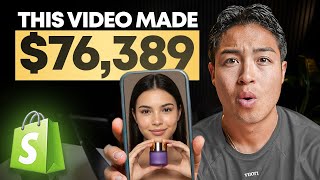

Why This NYX Ad Converts Better Than Yours
60sUses a real NYX ad to show how hyper-specific emotional hooks beat generic marketing.
▶ Play Clip"Valuable hook framework, but the title promises AI and dropshipping-specific tactics that never appear in the video."
This video breaks down why most viral product ads don't actually generate revenue, while unglamorous, highly specific ads quietly drive sales. It explains a three-part hook framework, how modern ad algorithms use creative as a targeting signal, and why smaller brands can't copy big-name viral campaigns.
Most product ads with massive views and engagement aren't actually making money. The ads that drive revenue look completely different from the viral ones.
A period underwear ad targets only moms whose daughters have heavy flows and avoid sleepovers — a quality-of-life problem, not just a product problem.
Effective hooks (1) filter for the right person immediately, (2) acknowledge the real pain up front, and (3) promise a specific emotional transformation.
Going broad attracts non-buyers and can get a million views but only $200 in sales. Narrow targeting may get 100,000 views, but those viewers are qualified buyers, lifting conversion rate.
Dr. Squatch can run viral, generic-hook ads because people already know and trust the brand. Newer brands can't copy this because their hook must do all the work without existing brand recognition.
Meta ASC+ and TikTok Advantage+ read your creative — transcript, keywords, visuals, pacing — to decide who sees the ad. The hook itself tells the algorithm your ideal customer profile.
Smaller stores need hooks that filter for qualified buyers, address objections immediately, and promise specific transformations — every view counts.
Use: 'If you [specific problem] and you've tried [previous solution] but [why it failed], here's what actually works.'
Vague hook: 'This serum changed my skin.' Template hook: 'If you have dark spots from old acne and you've tried vitamin C serums, but they irritated your skin, here's a gentler formula that actually works.'
'If you have acne and you've tried everything' filters no one. Hyper-specific details like 'cystic acne exactly 7 days before your period and tried 0.1% gel' can filter down to only about 45 people.
Early-stage buyers may have only tried drugstore creams; sophisticated buyers have tried prescription retinoids. Same product, same framework, but different execution.
Evaluate any hook: (1) Does it filter for a specific person with a specific problem? (2) Does it acknowledge what they've already tried? (3) Does it promise a specific transformation? If not, rewrite with the template.
For most brands, the path to profitable ads isn't more reach — it's a hook specific enough to filter for buyers, acknowledge their past failures, and promise a clear transformation. Run every hook through the three-question audit before spending money on distribution.
What are the three elements of an effective ad hook according to the video?
1) It filters for the right person immediately. 2) It acknowledges the real pain up front. 3) It promises a specific transformation.
01:40
Why can Dr. Squatch run generic viral hooks while smaller brands cannot?
Because Dr. Squatch has brand affinity — people already know and trust the brand, so the hook doesn't have to work as hard.
03:26
What is the exact three-part hook template taught in the video?
'If you [specific problem] and you've tried [previous solution] but [why it failed], here's what actually works.'
07:09
How do Meta ASC+ and TikTok Advantage+ use creative to target audiences?
The algorithm reads the creative — transcript, keywords, visuals, and pacing — and uses it to figure out who the ad is actually for.
04:31
What are the two specificity mistakes people make when writing hooks?
Being too vague (e.g., 'if you have acne and you've tried everything') and being too specific (e.g., 'cystic acne exactly 7 days before your period... 0.1% gel'), which filters to only 45 people.
09:29
What example hook does the video give for a skincare serum using the template?
'If you have dark spots from old acne and you've tried vitamin C serums, but they irritated your skin, here's a gentler formula that actually works.'
08:26
Why does a generic hook fail with modern ad algorithms?
Because the platform has nothing to work with — it doesn't know who to show the ad to, so it tests random people, burns budget, and keeps CPMs high.
05:11
What are the three questions to audit your current hook?
Does it filter for a specific person with a specific problem? Does it acknowledge what they've already tried? Does it promise a specific transformation?
11:39
Specific beats broad
Proves that narrowing the audience to a precise painful situation creates higher conversion than mass appeal.
01:40Creative is the targeting signal
Explains a fundamental shift in paid media: the algorithm reads your ad content to find buyers, replacing manual audience selection.
04:31The 'If you... and you've tried...' template
Gives a directly usable copywriting formula that pre-qualifies buyers and handles objections in one sentence.
07:09Three-question hook audit
Provides a quick checklist anyone can use to diagnose why their hooks aren't converting.
11:39[00:01] that are going viral. And most people [music] have this completely backwards. of views, crazy engagement, everyone's sharing it. Looks like it's absolutely actually making money, it's a totally [music] different story. So I spent the
[00:15] product ads, the ones that are actually driving revenue, and I compared [music] to be copying. And the way that these hooks work, completely opposite. [music] So, in this video, I'm going to break down exactly what separates the ads that
[00:29] Because if you're making product content right now and your sales don't match let me show you what I mean. This right here is an ad from NYX. They make period this hook really quick. >> Okay, moms, can we talk about period
[00:45] has a heavy floor and for years that meant dain, sheet, anxiety, and avoiding >> Do you see how specific that was? It's not for everyone dealing with periods. heavy flows and are literally avoiding
[01:00] sleepovers because of it. That is not even really a product problem. That's a quality of life problem. So your kid is missing out on being a normal teenager because of period anxiety. And notice what they do. They acknowledge what has
[01:13] >> Daughter has a heavy full and for years that meant stain sheet anxiety and avoiding sleepovers. They were talking about the regular products, the anxiety, all of it. Then the transformation isn't just no leaks. It's [music] my daughter
[01:27] can finally relax. So you compare that to something like the best period underwear for teens. That could be literally anyone. And honestly, it that a lot of these mothers are having. It's really just generic. So here's
[01:40] what's happening in that hook. There are three specific things. First, it filters for the right person immediately. So it's not just moms. It's not even moms with daughters who have periods. It is for moms whose daughters are avoiding
[01:52] sleepovers because they have those heavy flows. That is ultra super narrow. And that is the whole point because these moms, they are absolutely ready to buy They're dealing with this problem right now today. Second, it acknowledges the
[02:07] real pain up front. They're not saying periods are annoying. Instead, they're saying your daughter is missing out on being a normal kid. That is what ends up keeping parents up at night. That's the emotional cost, not just the functional
[02:20] problem. And then third, it promises a specific transformation. So they're not saying reliable protection or even leak proof underwear, but instead they're saying your daughter can finally relax and be herself. That is the emotional
[02:33] are actually buying into. It's peace of mind for their kid. Now, here's the doing any of this. They're trying to go everyone. They're essentially casting the widest net possible. And yeah, you
[02:47] might get more views and engagement that way, but views don't pay your bills. Sales do. Because here's what actually happens when you go broad. You attract a ton of people who are never going to buy anyway. So your ad gets a million
[03:00] impressions, maybe goes viral and you make $200. But when you filter for the right people upfront, you might get a tenth of those views, 100,000 views instead of a million. But those are qualified buyers, people who actually
[03:12] have the problem that you can solve. And that is when your conversion rate goes whole point of this approach. Make more money with less waste. So, let me show what big brands are doing. You guys have probably seen Dr. Squatch everywhere,
[03:26] right? They're on a bunch of ads, soap ads specifically. They get millions of views, super viral. Everyone's trying to replicate them. And honestly, I get why. crushing it. And they are absolutely crushing it. But here I want to show you
[03:39] this really quick. >> Three silent ice breakers that work every time. [music] One, wood barrel bourbon. Now this is definitely one of >> The funny thing is these ads work. They
[03:52] They've been running these ads for months on end. But here's the thing. You can't do what they're doing. Not yet, at least. Because Dr. Squatch is a massive brand at this point. When someone sees their ad, they probably already know who
[04:05] They've seen it before. they've heard about it, maybe smelt it at a friend's place. This is what's called brand affinity. Pretty much just means people they even see the ad. So, the hook doesn't have to work as hard. They can
[04:18] >> you're guaranteed to get numbers left and right when using this. Want women to go absolutely feral for you. >> And it works because people already know and trust Dr. Squash to deliver on that promise. But when you're starting out,
[04:31] when no one actually knows who you are, you can't rely on that. Your hook has to do all your work. And here's the thing that makes this even more important. Right now, the way that media buying works has completely changed. As of
[04:43] Tok, they're running everything through ASC+ and Advantage Plus now, which picking your audience anymore. You don't need to pick your audience anymore. The algorithm is literally reading your creative. It's scanning the transcript.
[04:58] It's pulling the keywords. It's looking at the visuals, even analyzing the pacing of the video, and it's using all of that to figure out who the ad is actually for. So, your creative, aka your video or your image, is the
[05:11] targeting signal now, not the audience setting in your ads manager. The hook itself is telling the platform, okay, this is for moms with daughters who have period anxiety, or this is for busy parents cooking for a family. Which
[05:24] means that if your hook is generic like get numbers left and right or this will change your life, the platform has literally nothing to work with. It see. And Facebook's going to spend your money anyway. It's going to test random
[05:36] people. It's going to burn through your budget and your CPMs are going to stay in. But if your hook is specific, the platform immediately knows who to show your conversion rate is going to go up because you're reaching the right people
[05:50] from day one instead of wasting money on broad audiences. So when you're writing these hooks, you're not just convincing the viewer, you're also giving the algorithm the information it needs to find your ideal buyers, your ICP, your
[06:03] ideal customer profile. Which is why when you copy the Dr. Squatch approach, when you lead with pure aspiration, like this will make you more attractive or everyone will want you. You're not just asking people to trust you before you've
[06:15] platform zero signals about who this is actually for and that's why it doesn't convert. The hook isn't filtering people who actually have a problem. It's not addressing what they've tried before. It's just promising a desirable outcome
[06:28] to literally anyone, which is fine if you're Dr. Squatch with this massive brand recognition, this huge company. You can show your ad to a million people people to convert. But if you're running a smaller store like most of us, you
[06:43] need every view to count. You can't just afford to attract people who are never you actually need, and this is what that NYX hook does, is hooks that do the work upfront. So, it filters for qualified buyers, and it addresses objections
[06:57] right away, immediately, and it promises specific transformations. All right, so framework. Now, I'm going to show you a template that works for pretty much any product. Now, you're not going to copy this word for word, but once you
[07:09] pretty much apply it to anything that you plan to sell, any ad that you want to create. Here it is. If you insert your specific problem and you've tried, insert the previous solution, but explain why it failed. Here's what
[07:22] actually works. That is it. It's three parts. The first part is if you, like I said, the specific problem. This is where you pretty much pre-qualify. So, you call out that exact person who has the exact problem that you can solve.
[07:34] better skin, for example. That's want to do is if you have hormonal acne that flares up every month, that is ultra super specific. you are filtering immediately. The second part is you've
[07:47] tried previous insert the previous solution but why it failed. Insert why address the objection. So it acknowledges that they've been burned before. Something along the lines of you've tried drugstore retinol but it
[08:00] dried out your skin. So now you are saying I know what didn't work. This is completely different. And the third part is here's what actually works. So you transformation. And you don't want to say this is absolutely amazing, but give
[08:14] them the actual solution. So, for example, here's a retinol formula designed for sensitive skin that won't cause dryness. So, it's a very specific outcome and it's a very specific fix. So, let's just say that you are selling
[08:26] a serum. Here is how most people would write the hook. So, pay attention. This serum changed my skin. The best product I've ever used. So, just take a look at that. Could be for anyone. It doesn't tell you what that problem solves. It
[08:39] gives you zero reason to trust what has just been said. Now, here is that same product using this template. If you have dark spots from old acne and you've tried vitamin C serums, but they irritated your skin, here's a gentler
[08:51] formula that actually works. Do you see the clear difference here? Now, I know exactly who this is for. It's for people who have acne scars, who have tried vitamin C and have had a bad reaction to it. And I know that it addresses my
[09:04] specific objection and I know what I'm getting, which is a gentler formula. And this same structure works across any product. We could even take home organization for instance. If your pantry is a mess and those Target bins
[09:16] don't fit your shelves, here's a modular system that works in small spaces. For baby products, if your baby wakes up when your phone dies playing white noise, here's a dedicated machine with a 12-hour battery. So, it's problem
[09:29] time. All right. So, before you start writing these, let me just show you where I see most people messing up. So, you get the formula, you understand the then you write something like, "If you have acne, and you've tried everything,
[09:43] what we want to do. It does in fact sound good. It's got all three parts, solution. But it is way too vague. You've tried everything. What does that
[09:55] even mean? Drugstore, prescription, natural remedies, it could be anything. The person listening or reading the video has no idea if you're talking to they just scroll [music] past. But here's where it gets tricky. Now, you
[10:09] can also be too specific. So, if you said something like, "If you have cystic exactly 7 days before [music] your period and you've tried different 0.1% gel, now you're filtering to like 45 people. That is your whole audience that
[10:25] you're working for. So, the real skill isn't just following the formula. It's knowing exactly how specific to get. And that depends on your audience's sophistication level. Basically, how aware are they of the solutions that are
[10:37] out there? Are they in the early stage? So, you've tried drugstore creams, but they didn't work. Are they in the sophisticated stage, which might be you've tried prescription retinoids, but couldn't handle the purging phase. It's
[10:49] the same product. It's the same framework. It's a completely different execution. And this is where most people mess up because you can't just plug. You actually have to know your customer. And here's why getting this right actually
[11:01] money you're going to make. Because a generic hook, it might get views. It might even go viral, but it's attracting people who aren't ready to buy, who who are just casually strolling. A
[11:14] specific hook, it filters for buyers, people who have the exact problem, who've already tried to solve it, who are ready to literally pull the trigger right now. And the difference in ROI, it is massive. you are spending the same on
[11:27] ads but actually making money instead of just chasing views or engagement. All right, so here is what you need to know. Take your current hook, whatever you're using right now, and run it through these three questions. Does it filter
[11:39] for a specific person with a specific problem? So if your hook could apply to anyone, it is too broad and you need to narrow it down. Two, does it acknowledge what they've already tried? So for example, what didn't work before, you
[11:52] could lead with that. This is where you get past the biggest objection. Three, does it promise a specific transformation? So the actual outcome. So what actually changes for them, right? Not some vague amazing result,
[12:06] hook doesn't check all three of these boxes, rewrite it using this template. If you insert your specific problem and you've tried insert the previous solution, but insert why it failed, here is what actually works. All you [music]
[12:20] got to do is fill in those blanks. Be as specific as you can, but remember what I just said about not going so narrow that you're literally only talking to 45 people. [music] So, you're looking for that sweet spot, specific enough that
[12:33] the right person knows that you're talking directly to them and not so entire market. And when you find that balance, that is when things start to go up, the actual money that you're making, and not just the views that
[12:48] you just learned the framework. Honestly, that is the easy part. Most good hook. That is not where people get stuck. Where people actually get stuck is when they need to write 20 variations of this. Test them against each other.
[13:01] Figure out which angles your audience actually responds to. Scale the winners. Iterate on new creatives. Do it across multiple products, multiple ad accounts, managing inventory, dealing with customer service, running your actual
[13:14] business. So, yeah, you can write a better hook now. Okay, cool. But can you produces winners? Can you test fast enough to find them before you burn your budget? Can you scale without your ads turning generic? That is where most
[13:28] people fail. They understand the concept, they just can't execute it at my team help with in my mentorship program. It's the complete system, the product validation, the story strategy, the creative media buying, scaling, the
[13:41] of people one-on-one. Every week we meet. We look at your actual ads, your actual store, your actual numbers, and we build it together. It's, you know, truly a hands-on implementation, and I can only take on a few people at a time
[13:54] because we just can't give this level of attention to everyone. So, right now, we've got a couple spots open. So, if you're serious about building a real business, I will leave a link in the description. Apply and we'll see if it's
[14:06] yet, that is totally fine. You just got a ton of value from this video, a ton of value from this video, hopefully. to go execute on it.


⚡ Saved you 0h 14m reading this? Transcribe any YouTube video for free — no signup needed.