
Why You MUST Hold the Clutch When Starting
50sThis safety tip is often overlooked by beginners, making it a surprising and shareable insight that prevents accidental car movement.
▶ Play Clip"The title accurately reflects the content; the video delivers a comprehensive lesson on driving a manual car, including clutch advice."
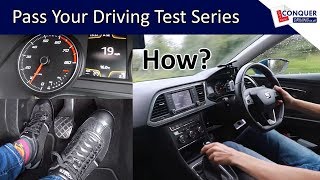
This video is a comprehensive guide for beginners on how to drive a manual car. It covers starting the engine, moving off, changing gears, and stopping safely, with a focus on mastering the clutch's bite point. The instructor also demonstrates common mistakes and provides tips to avoid them.
Turn the key to the first click for ignition, then press the clutch down and turn the key fully to start the engine. This prevents the car from moving if it's in gear.
Press the clutch, move the gear stick left and forward for first gear, release the handbrake, and gently press the gas to 1,000-2,000 RPM.
Slowly lift the clutch until the car starts to move (the bite point), hold it steady, then fully release once the revs rise.
Release the gas, press the clutch, move the stick to the next gear, then gradually lift the clutch to the bite point again while adding gas.
Check mirrors, signal, cover brake and clutch, press brake to slow, press clutch down when revs reach 1,000 RPM, then stop. Apply handbrake and shift to neutral.
Not giving enough gas leads to stalling; not pausing at the bite point causes jerky movement; keeping the heel on the floor reduces clutch control.
Keep the ball of your foot on the pedal and your heel up to maintain control. Put your heel down only to stabilize at the bite point.
How do you start the engine in a manual car?
Press the clutch to the floor and turn the key all the way.
0:41
Why should you hold the clutch down when starting the engine?
To prevent the car from shooting forward if it's in gear.
0:56
What is the gear stick position for first gear in most manual cars?
Left and forward.
1:30
What RPM range should you aim for when setting the gas to move off?
Between 1,000 and 2,000 RPM.
2:33
What is the 'bite point' of the clutch?
The point where the clutch starts to engage and the car begins to move.
3:19
What should you do once you reach the bite point when moving off?
Hold the clutch steady at the bite point until the revs rise and the engine pitch increases, then fully release.
3:23
What are the steps to change up a gear?
Release the gas, press the clutch to the floor, move the gear stick, then gradually lift the clutch to the bite point again.
4:27
At what RPM should you typically change up a gear?
Around 2,000 RPM.
4:30
What must you do with the clutch when stopping to avoid stalling?
Press the clutch down when the revs reach 1,000 RPM to prevent stalling.
6:00
After stopping, what two things must you do before releasing the foot pedals?
Pull the handbrake up, then shift to neutral.
6:22
How can you confirm the car is in neutral?
The gear stick can be moved side to side freely.
6:43
What is one common mistake beginners make when moving off?
They don't give enough gas because they're afraid of the noise.
8:18
What is another common mistake that leads to jerky starts?
They don't pause on the bite point and lift the clutch continuously.
9:00
How should you position your foot to maintain control of the clutch?
Keep your heel up and use the ball of your foot to lift and lower the pedal.
11:02
How long should beginners aim to hold the clutch at the bite point when moving away and when changing gear?
About 4 seconds when moving away, and about 1 second when changing gear.
10:00
Safe Engine Start
Explains the crucial safety step of holding the clutch down to prevent the car from lurching.
0:41Finding the Bite Point
Describes the core skill of clutch control—lifting to the bite point and holding it steady for smooth movement.
3:12Smooth Gear Changes
Provides a clear, step-by-step process for changing gears without jerking.
4:27Controlled Stopping
Demonstrates the correct sequence of brake and clutch use to stop smoothly and safely.
5:40Common Mistake: Insufficient Gas
Highlights a frequent error and explains why more gas actually helps control the car better.
8:18Proper Clutch Foot Position
Offers a practical tip on foot placement to maintain consistent clutch control.
11:02[00:02] this is a very brief guide on how to
[00:04] drive a manual car it's going to include
[00:06] how to move how to change up gears and
[00:08] how to stop
[00:10] the first thing you need to do is turn
[00:12] the engine on now there's two stages to
[00:14] turn the engine on the first is your
[00:15] ignition so if you turn the key
[00:18] normally the first click
[00:20] little lamp little lights come up on the
[00:22] dashboard these little symbols that
[00:24] means your ignition's on and when your
[00:25] ignition's on your electrics work so you
[00:27] have electric windows your fans work
[00:30] your stereo your lights etc but your
[00:32] engine isn't running and you know your
[00:35] engine's not running because it says
[00:37] zero on the tachometer there the tack
[00:40] to get the engine running what i
[00:41] recommend you do is hold the clutch down
[00:43] which is this left pedal here
[00:45] clutch to the floor all the way to the
[00:46] floor when you press it down
[00:48] and then turn the key all the way
[00:51] and then the engine fires into life as
[00:53] you can see the engine is now spinning
[00:56] the reason i recommend holding the
[00:57] clutch down when you turn the engine on
[01:00] is not only some cars require you to do
[01:02] this but if your car was in gear and you
[01:05] turn the engine on the car would shoot
[01:07] forwards in a forward gear and backwards
[01:09] in reverse gear
[01:11] okay so once your engine's started your
[01:13] gas is now going to work this is your
[01:15] gas pedal here
[01:16] but you're not going anywhere and that's
[01:18] because you're not in gear
[01:20] so to put it in gear make sure you press
[01:22] the clutch down as my clutch is already
[01:24] down i'll just leave it down or if it
[01:26] wasn't down i'll just press the clutch
[01:28] down then i'll move it into gear one by
[01:31] pushing the gear stick all the way to
[01:32] the left and forwards
[01:34] most cars are like this when i say most
[01:36] cars nearly all cars these days are like
[01:38] this some have what's known as a dog leg
[01:41] gearbox
[01:42] but you really don't see them these days
[01:44] only in older performance cars where
[01:46] first would actually be where second is
[01:48] but
[01:49] left and forwards for first
[01:52] and what you need to do next is take the
[01:53] handbrake off now if this was a hill and
[01:56] you took the handbrake off the car would
[01:58] roll so i don't recommend practicing uh
[02:01] driving a manual car on a hill until you
[02:04] first of all practice on a flat the way
[02:07] i'm going to teach you here is not going
[02:08] to work on a hill very well so i'll take
[02:10] the handbrake off to do that this is the
[02:12] handbrake i'll lift it up that allows me
[02:14] to press the button in
[02:16] now hold the button in as i push it down
[02:19] now the handbrake is off
[02:22] now i need to set the gas and what i
[02:24] mean by set the gas is give a little bit
[02:27] of gas so there's a little bit of power
[02:28] so this is the right pedal this is my
[02:30] gas pedal
[02:31] i'm going to press that gently until the
[02:33] revs build up somewhere between one and
[02:36] two thousand rpm
[02:38] some underpowered cars
[02:40] may need you to have as much as 2000 rpm
[02:44] but most cars are okay somewhere between
[02:46] one and two as i have now practice
[02:48] keeping that steady before you try
[02:50] setting off because it's quite a hard
[02:52] pedal to keep steady as there is a delay
[02:55] you move it a bit it then increases
[02:57] later you you come off the gas a bit a
[02:59] little bit later it goes down so you end
[03:01] up sort of chasing your tail but going
[03:03] up and down all the time so press it a
[03:04] little bit wait and it will gradually
[03:06] build up normally about the thickness of
[03:08] a pound coin seems to do the job nicely
[03:12] the next stage is to move
[03:13] simply all i need to do is lift the
[03:15] clutch this left pedal that i'm
[03:17] currently on at the moment
[03:18] up to the bike point now you know when
[03:20] you're at the bike point because the car
[03:22] starts to move
[03:23] once i reach the bike point it's really
[03:25] important that i stay at the bike point
[03:28] if i continue to lift the clutch the car
[03:30] will kanger up the road or it may stall
[03:34] holding the clutch on the bike point
[03:35] will give the clutch chance to do its
[03:38] job
[03:39] of course going to make sure no one's
[03:41] coming before i do that until my
[03:42] windscreen wipers on as well as it is
[03:44] raining here in sunny england there's a
[03:46] car behind so let's wait for that car to
[03:47] go past
[03:49] and another car behind i'm waiting for
[03:50] that one as well
[03:52] i check my right blind spot that makes
[03:54] sure there's no one on my right and it
[03:55] looks clear now so i'm going to
[03:57] gradually lift the clutch until the car
[03:59] starts to move so i'm slowly bringing
[04:00] the clutch up with my heel in the air
[04:02] and when it starts to move i'll hold it
[04:04] steady and i'll put my heel down just so
[04:06] i can support my leg now i'm going to
[04:08] hold the clutch steady until
[04:10] the engine starts to go up in pitch and
[04:12] the revs start to rise like they are now
[04:15] now i can come fully
[04:17] off the clutch and i'm moving i'm not
[04:19] moving very fast i'm not trying to move
[04:20] fast i'm a learner doing their first
[04:23] lesson don't forget
[04:25] and now i want to change up a gear so to
[04:27] change up a gear what i need to do is
[04:29] when the revs reach around 2000 i'm just
[04:32] above 2000 now so that means i'm overdue
[04:34] a gear change i will come off the gas
[04:37] pedal i'll press the clutch to the floor
[04:39] i'll move the stick into gear two and
[04:42] then i'll gradually come up to the bite
[04:44] point again so i'll do that now i'll
[04:45] come off the gas pedal gently
[04:48] clutch to the floor
[04:49] move the gear stick to two i bring the
[04:51] clutch up gradually until i feel the
[04:53] bite point and when i feel the bike
[04:54] point i'll hold it there add a little
[04:56] bit of gas and gradually come all the
[04:58] way off the clutch after holding it for
[05:00] about a second or so just to make sure
[05:02] it's smooth
[05:03] and now i'm in gear two
[05:05] and i want to go to gear freeze the revs
[05:06] have already gone up to about 2000 so
[05:08] i'll do the same thing again i'll
[05:10] gradually come off the gas pedal clutch
[05:12] all the way to the floor
[05:14] i'm going to move the gear stick to free
[05:15] which is into the middle make sure it's
[05:17] properly in the middle then forwards
[05:19] that's gear free and then i'll bring the
[05:20] clutch up until i feel the bite point i
[05:22] know the bite points there because i can
[05:24] feel there's a connection it starts to
[05:25] slow a bit and then i'll add some gas as
[05:27] i gradually bring the clutch all the way
[05:29] up
[05:30] i'm coming up to some temporary traffic
[05:31] lights now so i'm not going to do the
[05:33] demonstration on how to stop i'm going
[05:35] to go past these traffic lights and find
[05:37] somewhere else and i'll be back with you
[05:38] in about one second
[05:40] okay now that i've gone past the traffic
[05:42] lights i can show you how to stop a
[05:44] manual car it's actually really easy
[05:47] just check your mirrors behind you
[05:48] signal to anyone that you're going to
[05:50] pull over by singling left say i'm going
[05:52] to pull over left side of the road
[05:53] there's no one behind me so i don't need
[05:54] to do that all i need to do is cover the
[05:56] brake and clutch the car starts slowing
[05:58] down start adding brake to stop where i
[06:00] want to stop and the clutch must come
[06:02] down and stay down once the revs reach a
[06:04] thousand like i've just done just there
[06:06] line up with the curb
[06:08] modulate the brake so that you don't
[06:10] stop too early or too late so i'm just
[06:11] giving myself enough time to line up
[06:13] nicely then i'll finish the braking and
[06:14] stop completely
[06:16] and now you cannot come off the pedals
[06:18] if you look off the pedals the car would
[06:20] stall or shoot forwards
[06:22] what i first must do is pull the
[06:24] handbrake up so hold the button in
[06:26] pull it up when it's firm let go of the
[06:28] button then it should stay up
[06:30] and that means i can come off the foot
[06:31] brakes the handbrake has taken over the
[06:34] work of the foot brake for me and i must
[06:36] put it into neutral
[06:38] before i come off the clutch and to now
[06:40] i'm in neutral is i'll put the gear
[06:41] stick in the middle and to double check
[06:43] i'll go from side to side and if i can
[06:46] go from side to side like this it's in
[06:47] neutral if it's in gear it will go from
[06:50] side to side but not very much so that's
[06:52] a good way to know you're in neutral
[06:54] definitely in neutral there so i'll come
[06:55] off the clutch
[06:57] and i'm secure and stopped
[06:59] i'm going to go quiet now and let you
[07:01] watch me drive i'm going to move away go
[07:03] up the second gear then third gear and
[07:05] then stop again that way you can pause
[07:08] and rewind and watch it as many times as
[07:10] you like
[08:14] now i'd like to demonstrate some of the
[08:15] things that people get wrong when
[08:17] they're trying to learn this the first
[08:18] thing is they don't give enough gas
[08:20] they don't give enough gas because
[08:22] they're afraid of the noise and they
[08:23] think if they give gas the car is going
[08:24] to go shooting forwards out of control
[08:27] but actually
[08:28] giving more gas will help you keep the
[08:30] car slower because you'll be able to
[08:32] hear the bike point a lot earlier
[08:35] this is a demonstration of trying to
[08:37] move away without enough gas so clutch
[08:40] down
[08:41] first gear hand brake off
[08:44] i'm going to
[08:45] cover the gas for good luck
[08:47] and i'm going to bring the clutch up to
[08:48] the bike point without any gas
[08:51] and i've stalled
[08:53] now if i had gas i would have heard the
[08:55] clutch bite point a lot easier and been
[08:57] able to pause on the bike point and that
[08:59] brings me on to the next problem the
[09:01] next problem is they don't pause on the
[09:03] bike point they come off the clutch
[09:05] slowly but continuously and that's not
[09:08] how the clutch works i'm just going to
[09:10] restart the engine now it's still by
[09:11] holding the clutch down
[09:13] and turning the key so now it's started
[09:15] again the hand brake still off is still
[09:17] in gear so i'm still ready to go
[09:19] this time i'm going to use gas but when
[09:21] i bring the clutch up instead of holding
[09:23] it on the bike point when i feel the
[09:24] bike point i'm going to keep lifting it
[09:26] higher and higher and higher and then
[09:28] see what happens
[09:30] so it moved away but it was a very big
[09:33] kick and there certainly wasn't any
[09:35] control there just going to stop now so
[09:38] clutch down
[09:39] and break
[09:42] hand brake up so and come off the foot
[09:43] brake and neutral
[09:45] so i can lift the clutch up
[09:48] now that would be a big problem moving
[09:50] away like that especially if you had a
[09:51] car in front of you or if you were
[09:53] parking
[09:54] you need to be able to control your car
[09:55] and control it slowly for the tighter
[09:57] more tricky situations
[09:59] don't hold the clutch indefinitely at
[10:01] the by point though beginners should aim
[10:03] to hold the clutch for about four
[10:04] seconds when moving away and about one
[10:06] second when changing gear here is an
[10:08] example of kangarooing this happened
[10:10] because i lifted the clutch up too high
[10:12] without giving any gas
[10:14] another common reason people struggle
[10:16] with the clutch is because they keep
[10:18] their heel on the floor as they lift the
[10:20] clutch what i mean by that is when the
[10:23] clutch is down the heel stays on the
[10:25] floor and as they lift the clutch this
[10:27] pedal now gets a lot lower under the
[10:29] foot
[10:30] and when you're in traffic you have to
[10:33] lift and lower the clutch many times
[10:35] without fully coming off it so you come
[10:37] up to the bike point and now you've got
[10:38] to push the clutch back down again so
[10:40] the pedal's lower under your foot you've
[10:42] got to lift it again as you want to move
[10:44] and you get to the bite point start
[10:46] moving and the pedal is even lower and
[10:48] now you're going to press the clutch
[10:49] down and you struggle to get it down and
[10:51] the next time you do it you've really
[10:52] got no control over the clutch at all so
[10:55] it's really important not to keep your
[10:57] heel down like you would for the gas and
[10:59] the break but to keep your heel up
[11:02] how you want to do it is keep the ball
[11:03] of your foot near the bottom of your
[11:05] pedal and the toe of your foot near the
[11:07] top of your pedal keep your heel up and
[11:09] that way you can lift the clutch up and
[11:11] down
[11:12] without the pedal moving under your foot
[11:15] which is really important and when you
[11:18] get to the bite point if you want to
[11:19] stabilize your foot instead of using all
[11:21] your leg muscles then put your heel down
[11:24] just to support yourself and then you
[11:26] can do small adjustments because the
[11:28] pedal doesn't really move much for the
[11:30] small adjustments and if you need to
[11:32] press it back down again you lift the
[11:33] heel up down and then when it wants to
[11:35] come back up to the bite point again
[11:37] with the heel up bring it up to the bite
[11:38] point
[11:39] support your foot with your heel and
[11:42] when you want to come off the clutch
[11:43] fully just lift your heel again and
[11:45] gradually come off
[11:47] this video is by no means a replacement
[11:49] for a driving instructor you really need
[11:51] to practice and you need to practice
[11:52] where there's no traffic also make sure
[11:55] you're in a road legal car
[11:57] if you're practicing without an
[11:58] instructor make sure you have insurance
[12:00] get 20 pound off by the link in the
[12:02] description to collingwood who provides
[12:04] specialist learning insurance that
[12:06] allows you to practice in a friend or
[12:07] family member's car without risking
[12:09] their no claims bonus if you want to
[12:11] insure your own car click on the link to
[12:13] confused.com i have found that they have
[12:15] the widest selection of cheap insurers
[12:17] for young drivers well that's all for
[12:19] this one like it if you think it was
[12:21] good and subscribe if you want to get my
[12:23] future videos i'll see you on the next
[12:25] one
⚡ Saved you 0h 12m reading this? Transcribe any YouTube video for free — no signup needed.