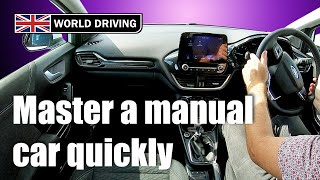

Getting a Manual Car Moving
45sThis segment provides a clear, step-by-step guide on the most fundamental skill for driving a manual car, which is highly engaging for beginners.
▶ Play Clip"The video delivers a thorough 19-minute tutorial on manual driving, exactly as promised."
This video provides a comprehensive guide to driving a manual car, covering essential techniques such as moving off, stopping, changing gears, clutch control, and hill starts. The instructor demonstrates each step clearly, emphasizing safety and practice.
The accelerator (gas pedal) and foot brake are operated with the right foot, while the clutch pedal is for the left foot. Position your right foot between the gas and brake pedals, pivoting on the heel for quick access.
Ensure the car is in neutral and the parking brake is on. Press the clutch fully down and start the engine. For key-start cars, turn the key to ignition, then press clutch and turn key to start.
Press clutch fully, select first gear, set gas to 1-1.5 revs, find the biting point (feel the car dip), check mirrors and blind spot, signal if needed, release parking brake, and keep feet still for 3 seconds as car moves.
Check mirrors, signal, release gas, press clutch and brake gently to stop. Apply parking brake, select neutral, release pedals, cancel signal.
Off gas, clutch down, change gear, clutch up gently, back on gas. Practice gear positions while stationary. Use palm facing left for first/second, right for third/fifth, and let gear lever spring to neutral.
Change up at about 10 mph for second, 20 mph for third, but listen to engine sound. Lower gears for pulling power, higher for speed. Change down when slowing or needing more power (e.g., uphill).
Use clutch to control speed between 0-5 mph. Raise clutch to biting point with gas to creep forward; lower clutch slightly to slow down. Useful in traffic or maneuvering.
For uphill, use parking brake, set more gas (revs to 2 on steep hill), find biting point, release brake. For downhill, no gas needed; use clutch and brake to control speed.
Mastering manual driving requires practice of clutch control, gear changes, and hill starts. The video emphasizes using engine sound over dials and staying safe by checking mirrors and blind spots.
Which foot operates the clutch pedal?
Left foot.
0:54
What should you check before starting the car?
Ensure the car is in neutral and the parking brake is on.
1:20
How do you find the biting point?
Slowly raise the clutch until you feel the back of the car dip slightly and the engine sound changes.
3:27
What is the recommended rev range for setting the gas when moving off on a flat road?
Between 1 and 1.5 (thickness of a pound coin).
3:03
How do you release the parking brake?
Pull the parking brake up slightly, press the button, then fully lower it and release the button.
5:13
At what speed do you typically change up to second gear on a flat road?
At about 10 miles per hour.
9:39
What is engine braking?
Driving in low gears when going down steep hills to keep the car slower without using the brake as much.
12:24
What should you do if the car starts to judder when driving slowly?
Press the clutch down to prevent stalling.
15:32
How much more gas should you set when moving off on a steep uphill?
Revs up to about 2.
17:39
Can you move off downhill without using the gas pedal?
Yes, gravity will make the car move; you may use a little gas if desired.
18:08
Finding the Biting Point
Essential skill for smooth starts; described with clear physical cues (car dip, engine sound).
3:27When to Change Gear
Provides practical speed guidelines and emphasizes listening to engine sound over dials.
9:10Clutch Control for Slow Speeds
Demonstrates how to use clutch to creep forward in traffic, a key skill for real-world driving.
15:44Hill Start Technique
Explains parking brake method to prevent rollback, with specific gas adjustment for steep hills.
16:44[00:05] Today I'm going to show you how to drive a
[00:12] stop, how to change gear and when, plus clutch
[00:47] so you can find the pedals quickly and as they're
[00:54] The clutch pedal is on the left. Use your
[01:20] gear then it won't move much side to side.
[01:43] If you're driving a car with a key then turn
[02:13] To move off, I'll press the clutch
[02:35] Memorise this diagram in your car and remember
[03:03] Now I need to set the gas. This is a
[03:18] Then hold your foot still. You might overdo
[03:27] You would need to give it a bit more gas if you
[03:52] feet still. This is the car wanting to go
[04:04] I'll do it again.
[04:11] The first part of raising the
[04:20] If I raise the clutch too high then the car
[04:50] Now I need to make sure it's safe
[05:13] able to release it just by pressing the button.
[05:36] If you release the clutch too soon then it could
[05:56] I'm now going to pull up on the left in a safe,
[06:17] Keeping both feet on the brake and clutch, parking
[06:46] Now you can release the pedals and cancel
[07:19] gear lever springs back to neutral. This will
[07:24] It's well worth practising while you're
[07:37] Let's go through all the gears. Neutral to first.
[07:44] When you change from first to second have slight pressure to the left on the gear lever
[07:54] Don't forget the spring is
[08:04] Second to third. Palm facing to the right, push
[08:23] Straight back for fourth. Push forward slightly
[08:31] To change to sixth, have slight pressure to
[08:38] Changing down to fifth, slight pressure to
[09:10] Now you know how to change gear, let's have
[09:39] road you change up to second gear roughly at
[09:51] But don't forget it's not precise and it's
[10:13] The lower gears provide the most pulling power, so if you're joining a fast, busy road
[10:29] But don't accelerate for too long or
[10:58] also for speeds below 10 miles per hour
[11:07] It's easier to manoeuvre the
[11:18] But you can't drive very fast in
[11:27] Try moving off in a high gear and the car will
[11:37] You'd normally change to a lower
[11:43] As a rough guide, if you've reduced your speed
[12:01] You'll also have to change to a lower gear
[12:18] You can also change to a lower gear if you
[12:24] Driving in low gears when going down
[12:46] There's certain situations where you can block
[12:59] For example, you can slow down in third gear
[13:13] You can stop in any gear but
[13:18] To help you, let's move off again and I'll talk
[13:24] select first, set the gas, find
[13:33] check mirrors, blind spot, check over my right
[13:55] To change gear, off gas, clutch down, change
[14:31] Feet still. Parking brake on, neutral, come off
[14:57] A modern car will carry on going even
[15:09] I'll change down to second.
[15:16] In second, it stays at about 9 miles
[15:21] Let's try first gear.
[15:26] In first gear it slows down to about 5 miles
[15:32] the car starts to judder
[15:39] To drive slower than 5 miles per hour
[15:44] To creep forward, a little gas and
[15:50] Lower the clutch about the thickness of a pound
[16:17] When you're slowly manoeuvring the car.
[16:21] At the moment the clutch is controlling the
[16:35] Sooner or later you're going to come across
[16:44] The car can roll back if you're too slow
[16:54] The easiest way to deal with an uphill
[17:02] Without the gas the car could stall and without
[17:14] When you get more confident, you'll be able to set the gas and find the biting point
[17:25] Although I'd always recommend using
[17:39] You will need to set the gas a little more
[17:59] But using the parking brake
[18:08] Moving off downhill is a bit simpler. No gas or biting
[18:38] Learn how to change gears smoothly
⚡ Saved you 0h 19m reading this? Transcribe any YouTube video for free — no signup needed.