
Fix a Leaky Faucet: Tools & Prep
45sQuick, practical setup tips with tool protection hacks appeal to DIY beginners and prevent common mistakes.
▶ Play Clip"The title accurately describes the video content, which is a straightforward tutorial on fixing a leaky faucet."
This video provides a step-by-step guide to fixing a leaky compression faucet. It covers essential tools, safety precautions like turning off the water, and detailed instructions for repairing leaks around the handle or base of the stem.
The video demonstrates how to fix a leaky faucet, emphasizing that the setup is similar for most faucets.
Use towels to protect the work area from excess water and tools to prevent damage to the countertop.
Tools include pipe joint compound, a taped flathead screwdriver, Phillips screwdriver, adjustable wrench, utility knife, taped channel lock pliers, and a mild abrasive pad.
Before starting, turn off the water using shutoff valves usually located below the sink, and stop up the sink to avoid losing parts.
For a leak around the handle, pry off the top protective piece, remove the trim and set screw, then pop off the handle. Tighten the piece with a wrench; if still leaking, remove it completely.
Check the bottom of the piece for corroded or dirty threads and clean with a scouring pad. Replace any deteriorated o-ring or gasket.
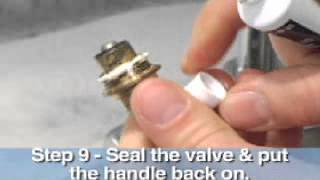
Apply plumber's putty along the threads to ensure a watertight seal when reassembling.
For a leak at the base of the stem, remove the entire assembly using protected channel lock pliers. Inspect the rubber o-ring and replace if worn. Clean inside the faucet with an abrasive pad to remove burrs.
Replace the faucet stem, tighten the fitting, turn on the water, and check for leaks. If no leaks, the repair is complete.
Fixing a leaky faucet is a manageable DIY project if you follow instructions carefully and take your time. The key steps involve turning off the water, using the right tools, and addressing either the handle or stem assembly as needed.
What should you do before starting any faucet repair project?
Turn off the water using shutoff valves usually located below the sink, and stop up the sink to avoid losing parts.
0:33
What tools are needed to fix a leaky faucet?
Pipe joint compound, taped flathead screwdriver, Phillips screwdriver, adjustable wrench, utility knife, taped channel lock pliers, and a mild abrasive pad.
0:14
How do you fix a leak around the handle of a compression faucet?
Pry off the top protective piece, remove trim and set screw, pop off the handle, tighten the exposed piece with a wrench. If still leaking, remove it completely, clean threads, replace o-ring if needed, apply plumber's putty, and reassemble.
0:46
What is the purpose of applying plumber's putty along the threads?
To create a watertight seal when reassembling the faucet piece.
1:46
How do you fix a leak at the base of the stem?
Remove the entire assembly using protected channel lock pliers, inspect and replace the rubber o-ring if worn, clean inside the faucet with an abrasive pad to remove burrs, then replace the stem and tighten the fitting.
2:01
Why should you tape the end of a flathead screwdriver and the teeth of channel lock pliers?
To avoid nicking or marring the finish on plumbing parts and fixtures.
0:15
Protect Work Area
Emphasizes a crucial preparatory step to prevent water damage and tool marks.
0:06Turn Off Water First
A fundamental safety step that prevents flooding and makes repair easier.
0:33Use Plumber's Putty for Seal
A simple but effective technique to ensure a watertight seal during reassembly.
1:46Inspect O-Ring and Clean Inside
Highlights the importance of checking for worn parts and removing burrs to prevent future leaks.
2:22[00:01] hi I'm in and today we're gonna fix a
[00:04] leaky faucet now the setup is about the
[00:06] same for every faucet you always want to
[00:08] protect your work area with some towels
[00:09] that's gonna keep excess water from
[00:11] getting everywhere and tools from
[00:12] damaging your countertop for this
[00:14] project you'll need some pipe joint
[00:15] compound a flathead screwdriver with the
[00:18] end taped up so you don't Nick any of
[00:19] the plumbing parts a regular Phillips
[00:21] head screwdriver an adjustable wrench a
[00:24] utility knife some channel lock pliers
[00:27] again with tape on the teeth so you
[00:29] don't Mar to finish on any of these
[00:30] fixtures and a mild abrasive pad now
[00:33] before you start any project with your
[00:34] faucet make sure you turn the water off
[00:36] these shutoff valves are usually located
[00:38] just below your sink also stop up the
[00:41] sink so you don't lose any parts down
[00:42] the drain again a lost part isn't gonna
[00:44] do any good today we're we working with
[00:46] a compression faucet now if you have
[00:49] some leaking happening around the handle
[00:50] the first thing you want to do is take
[00:53] utility knife and lightly pry off top
[00:56] protective piece now when you get it
[00:58] open a little bit pop off the trim piece
[01:01] at the top of the faucet that'll expose
[01:03] the set screw now you want to take a
[01:05] Phillips head screwdriver and take that
[01:07] set screw out and then pop off the
[01:11] handle now if it's a little tight you
[01:12] can take your screwdriver and kind of
[01:13] pry it up and get that off now I'm gonna
[01:16] take your crescent wrench and tighten
[01:17] down on this piece turn your water back
[01:20] on if it's still leaking you want to go
[01:22] ahead and actually take this off
[01:23] completely now a little bit of water all
[01:26] come up when you pop this piece off but
[01:28] don't worry about as long as the waters
[01:29] off no problem now take a look at the
[01:31] bottom of the piece if the threads look
[01:33] corroded or dirty take your scouring pad
[01:35] and just sort of get any of that residue
[01:38] off of there now if there's an o-ring or
[01:40] a gasket on the bottom that looks
[01:41] deteriorated to take the screw off and
[01:43] replace the gasket itself when
[01:44] everything looks good and checks out
[01:46] you're going to take a little bit of
[01:47] plumber's putty and just put it along
[01:49] the threads that's going to give us a
[01:50] watertight seal when we put the piece
[01:52] back in so put your handle back on open
[01:55] it up a little bit turn the water back
[01:56] on then close down your handle if
[01:59] there's no leakin you're golden now if
[02:01] your faucet is leaking from the base of
[02:02] the stem what you're going to need to do
[02:04] is remove this whole assembly you want
[02:06] to take your channel lock pliers that
[02:08] are protected so we don't mess up the
[02:09] finish on the faucet and loosen this up
[02:11] a little bit
[02:12] hand loosen and remove this fitting
[02:14] completely gently rock the piece back
[02:19] and forth a little bit of water will
[02:20] come up that's not a problem now you
[02:22] want to look at the rubber o-ring and
[02:23] make sure it's in good condition if it
[02:25] appears worn or torn replace it if it
[02:27] looks like it's in good shape go ahead
[02:28] and put it aside now you want to look
[02:30] into the actual assembly on the faucet
[02:32] run your finger inside now if you feel
[02:34] anything in there take a mild abrasive
[02:35] pad put it inside the faucet running
[02:37] around a little bit and I'll take care
[02:39] of any burrs that might have formed
[02:40] inside you're ready to replace your
[02:42] faucet stem gently work it back into the
[02:44] slot replace your fitting take your
[02:48] channel locks get it a final tightening
[02:50] once your fitting is tightened down go
[02:52] ahead and open up the water and then
[02:56] close it down the leaking is gone you're
[02:59] done so that's how you fix a leaky
[03:01] faucet as you can see it's not too
[03:02] difficult to project just make sure you
[03:04] read your instructions carefully take
[03:06] your time you should be fine
⚡ Saved you 0h 03m reading this? Transcribe any YouTube video for free — no signup needed.